

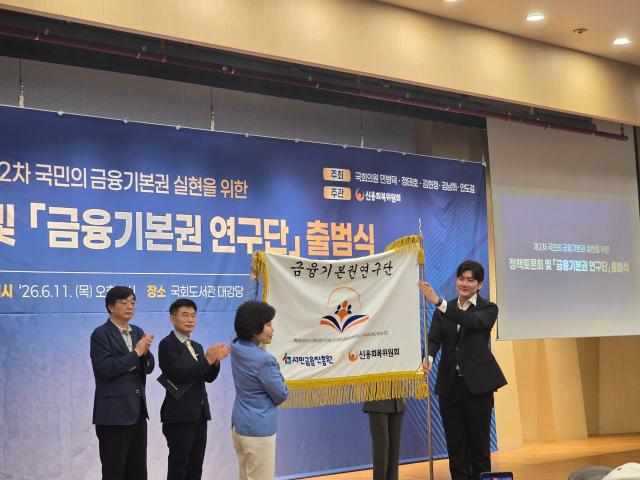
Discussions are intensifying around the idea of guaranteeing the opportunity for individuals in debt to rebuild their lives as a fundamental financial right. The plan aims to establish a legal framework that supports vulnerable financial groups not just through loan provision but through a step-by-step recovery support system that includes counseling, debt adjustment, insurance, loans, and savings.
On June 11, the Credit Recovery Commission held the "Second Policy Forum for Realizing the People's Financial Rights and Launching the Financial Rights Research Group" at the National Library of Korea.
Kim Eun-kyung, chair of the Credit Recovery Commission and the Korea Financial Services Agency, presented the proposal for the enactment of the National Basic Financial Security Act aimed at guaranteeing financial rights. She stated, "Financial rights are the essential infrastructure of society, allowing everyone to access finance without discrimination and to utilize it minimally for a dignified life. This should not remain in the realm of charity but be viewed as a universal right."
The concept of financial rights is divided into five categories: the right to access, the right to survive, the right to recover, the right to independence, and the right to asset formation. To realize these rights, four basic financial services are proposed: basic counseling and debt adjustment, basic insurance, basic loans, and basic savings.
The key principle is "diagnosis first, then prescription." Kim emphasized that just as a sick person receives a diagnosis and treatment at a hospital, financially vulnerable individuals should first assess their financial status and debt structure. She explained, "The first step in realizing financial rights is diagnosis. After counseling and debt adjustment, we will prescribe a structured approach to insurance, loans, and savings based on the results."
Basic insurance is designed to protect against minimal living risks such as health issues, while basic loans are intended to provide necessary funds for recovery after debt adjustment. Additionally, there are plans to offer asset formation opportunities through basic savings for diligent repayers.
Kim noted that many users of policy-based financial services are overwhelmed by living expenses and existing debt repayment burdens. She stressed the need for prior debt adjustment, stating, "It is not about borrowing more to live well; first, we need to get organized."
However, the legislative process is expected to face challenges regarding the target population, eligibility criteria, and funding sources. If financial rights are defined as legal rights, the scope of coverage for basic insurance, basic loans, and basic savings, as well as the funding structure, will need to be clarified.
Furthermore, Kim expressed hope that just as the National Basic Livelihood Security Act changed the welfare paradigm in 1999, the National Basic Financial Security Act will transform the financial paradigm in 2026.
* This article has been translated by AI.
Copyright ⓒ Aju Press All rights reserved.