

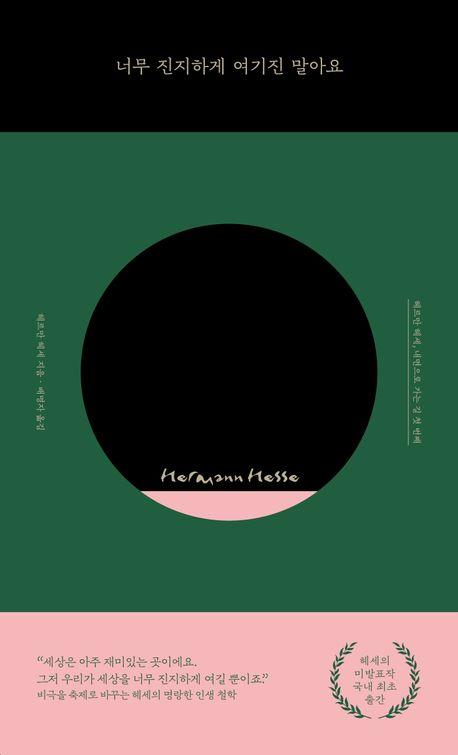
Don't Take It Too Seriously = Written by Hermann Hesse, translated by Bae Myung-ja, published by Pika.
This collection features previously unpublished works by Hermann Hesse, known for classics such as Demian, Under the Wheel, and Siddhartha. It compiles prose, poetry, and essays that have not been introduced in South Korea until now, showcasing another side of Hesse, often referred to as the 'symbol of solitude.'
R.J. Hume, a long-time friend of Hesse, described him as an 'old child and a boyish sage.' He noted that Hesse could be both fatherly and son-like at times. The book includes writings filled with wit, humor, and satire, revealing the vibrant human side of Hesse that was often overshadowed by his solitude.
As the first volume in the series The Path to Hermann Hesse's Inner Self, this book illustrates Hesse's ability to maintain his sense of humor even amidst the violence of two world wars.
In the included piece 'Meeting with the Author,' Hesse's cheerful acceptance of the gap between expectations and reality is evident. His love for simplicity and ease in life shines through. In 'Literary Everyday Life,' he endures the bleak realities of the war's end through various episodes, maintaining his characteristic humor. He captures human nature sharply yet compassionately through diverse characters, including the elderly in a relief facility and Casanova.
At the end of the book, 'Hesse as Seen by Others' contains anecdotes remembered by those around him. One scene depicts a young Hesse responding to his mother’s admonition not to throw stones, saying, 'But Mom, David was loved even after throwing stones?!' This moment reveals his playful and free spirit.
"I do not understand evolution at all. I cannot find any merit in youth over childhood, or in middle age over youth. If evolution is correct, then the old should be better than the middle-aged, and ultimately the 'perfect person' should be the one who has died, better than the living." (Page 317, letter to Eduard Engels, January 1908)
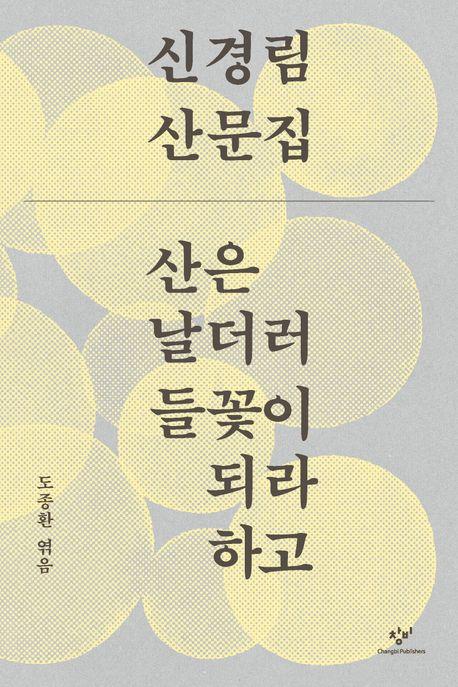
Shin Kyung-rim's Essay Collection - The Mountain Tells Me to Be a Wildflower = Edited by Do Jong-hwan, published by Changbi.
This posthumous essay collection commemorates the second anniversary of the late poet Shin Kyung-rim, known for his poetry collections Farm Labor, Poor Love Songs, and The Camel. The essays reflect the poet's experiences through the tumultuous events of modern Korean history, including liberation, the Korean War, the April 19 Revolution, military dictatorship, and the June Uprising.
The collection serves as a literary confession of the poet's pursuit of unity between poetry and life, showcasing his philosophy of embracing people from the lowest positions. Editor Do Jong-hwan writes, "The path that Shin Kyung-rim walked in anguish is the same path our literature has walked in anguish, forming the backbone of Korean literary history. It is a reflection on modern Korean poetry and an honest statement on what poetry should be."
The poet warns against literature that merely echoes slogans while ignoring reality. He asserts, "Poetry that does not involve self-reflection, no matter how righteous its words, fails to touch the reader's heart," sharing his poetic theory that strives for literary completeness while embracing the pains of history.
The collection also recounts the journey from his debut work Reed to Farm Labor after a decade of wandering. The poet confesses, "My poetry can only be a journey of the soul seeking something new," reflecting on his continuous process of self-renewal. He draws warm insights from nature and daily life, addressing various social issues such as education, the environment, and unification. Particularly, he emphasizes the need to approach the division between North and South Korea with humility and respect for others.
Despite revealing his own shortcomings and vulnerabilities, the poet's voice, which ultimately retains a gentle faith in humanity and the world, resonates deeply with today's readers.
"However, not many Koreans believe they are living happily. The gap between the rich and poor is widening, the ecology and environment are being destroyed, and the unification of our nation and state remains uncertain, with the threat of war still looming. My poetry cannot escape these issues. Therefore, I must confess my conflicts and struggles in harmonizing the task of bringing forth the beauty within many people's hearts into poetry." (Page 32)
* This article has been translated by AI.
Copyright ⓒ Aju Press All rights reserved.