

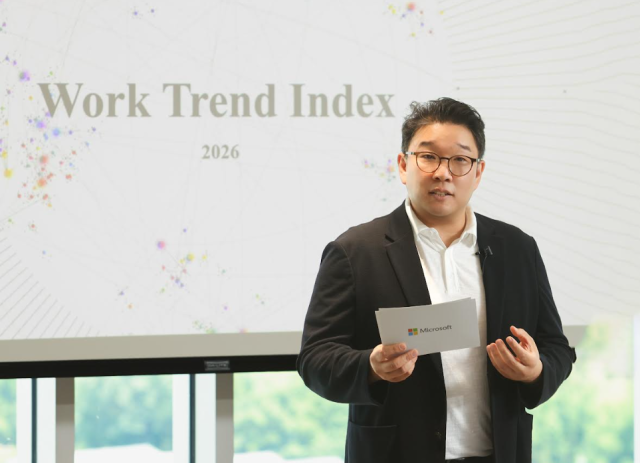
“The success of AI in the workplace is determined not by technology, but by employee judgment, leadership direction, and organizational learning systems.”
Jowon Woo, CEO of Microsoft Korea, made this statement during a press conference for the '2026 Work Trend Index Report' held at the Microsoft Korea office in Gwanghwamun, Seoul, on June 15. He explained that contrary to concerns that AI advancements would reduce human roles, the increasing execution of tasks by AI actually heightens the importance of uniquely human contributions.
Microsoft believes that to connect individual employees' strong willingness to utilize AI with organizational performance, changes in leadership roles and job redesign are necessary. Notably, while the willingness of employees in South Korea to embrace AI is higher than the global average, alignment in leadership, compensation structures, and the proportion of frontier experts are relatively low. Consequently, organizational readiness has been identified as a key challenge for achieving successful AI implementation.
Oh Seong-mi, Director of AI Workforce Go-To-Market at Microsoft Korea, stated, “This year’s Work Trend Index is the third report analyzing changes in AI work dynamics since the emergence of generative AI. Last year highlighted the need for hybrid organizations where humans and AI collaborate, while this year analyzes the changes that have occurred over the past year for individuals and organizations.”
The report introduces a new equation for workplace leadership: 'AI Execution × Human Judgment.' Oh emphasized, “The role of humans is shifting from task executors to conductors and supervisors who provide direction and validation. If human judgment is zero, performance will also be zero. Human judgment is the key variable that transforms AI execution into results.”
On an individual level, the utilization of AI has advanced. According to Microsoft, 58% of survey respondents reported that they are now able to perform tasks through AI that they could not do a year ago. Among frontier expert groups utilizing AI and agents in complex workflows, this figure rises to 80%. Additionally, 66% of respondents indicated that they are spending more time on high-value tasks since adopting AI.
Notably, the willingness of South Korean employees to utilize AI exceeds global averages. A significant 78% of domestic employees feel pressure, stating, 'If I do not adapt to AI, I may fall behind,' compared to a global response rate of 65%.
Oh noted, “This indicates a strong willingness to learn and apply AI quickly. The sense of urgency and desire for learning at the individual level could serve as a driving force for accelerating AI transformation in domestic companies.”
Microsoft identified organizational environment as the most significant factor influencing the effectiveness of AI adoption. While individual trust and utilization capabilities are important, organizational culture, managerial support, and talent policies are deemed even more critical. Oh stated, “An organizational culture that embraces AI as a strategic agenda, direct utilization and recognition by managers, and systems that reflect AI utilization capabilities in evaluations and career growth are key elements that determine success.”
In the South Korean market, the clarity of leadership commitment to AI direction (16%), recognition of compensation for AI-driven transformation (7%), and the proportion of frontier experts (12%) were all reported to be 6-10 percentage points lower than in global markets. To convert employees' willingness to utilize AI into actual work performance, alignment in leadership, compensation structures, strengthening the capabilities of middle managers, and nurturing frontier experts are essential, according to the report.
Microsoft also highlighted the cultivation of frontier experts who can implement and establish AI and AI agents in corporate organizations as a major task. Oh emphasized, “It is crucial for individuals to gain extensive experience using AI. Additionally, internal forums and reward programs that share best practices across the organization are necessary.”
* This article has been translated by AI.
Copyright ⓒ Aju Press All rights reserved.