
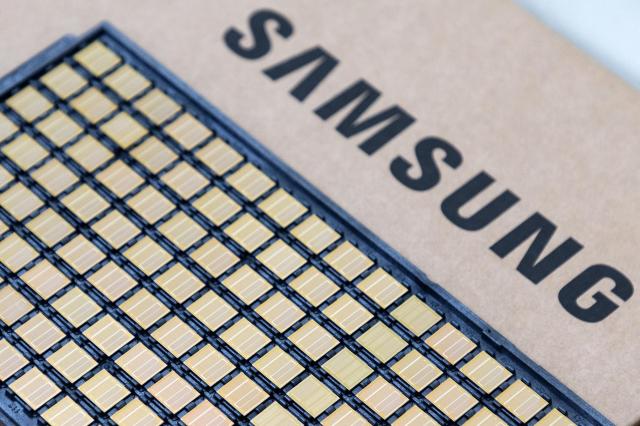
SEOUL, June 23 (AJP) - Samsung Electronics, vying to leapfrog in the high-bandwidth memory (HBM) race, has shipped out $1 billion worth of the sixth-generation HBM4 over the last four months since mass production, according to sources close to the matter.
The news come as the long-standing No.1 stock surrendered its place to SK hynix, the frontrunner in HBM essential to power AI accelerators of Nvidia and other major chip designers as well as hyperscale datacenters.
SK hynix on Monday commanded KOSPI's largest market cap, edging out Samsung Electronics from the top title for the first time in more than a quarter of a century.
The two chipmakers both shipped out HBM4 from February.
Samsung began mass shipments of HBM4 on Feb. 12 as it bolstered the next-generation HBM customer base to AMD, Nvidia, Google, and Broadcom. It previously said its supply capacity for the sixth-generation chips are fully booked for the year and is making long-term arrangements with some.
The rapid expansion into Application-Specific Integrated Circuit (ASIC) clients is seen as a key driver for this growth.
"Samsung is expected to see a sharp increase in its HBM shipments next year, driven by a diversified customer base centered on ASIC companies such as Broadcom, Google, Amazon, Microsoft, and Meta," said Kim Dong-won, an analyst at KB Securities.
Park Yu-ak, an analyst at Kiwoom Securities, echoed the positive outlook, noting that rising demand for customized ASIC chips will broaden Samsung's HBM profile. Park projected that Samsung’s HBM shipments in 2026 could surge by more than 200 percent year-on-year as global research firms forecast the HBM market to expand 58 percent to $54.6 billion next year.
Revenue for HBM4 series is expected to exceed $1.2 billion by the end of June and will likely bump up second-quarter bottom and top line. Samsung Electronics will release guidance for second-quarter earnings in early July.
According to latest FnGuide consensus, its second-quarter operating profit is estimated at 86.77 trillion won, sharpy higher than 57.2 trillion won in the first quarter and also higher than 62.46 trillion won estimated for SK hynix during the same period.
Samsung Electronics shares plunged 9.9 percent to close at 318,500 won on Tuesday.

Candice Kim
Candice Kim is a dedicated business and technology reporter specializing in the intersection of high-tech innovation and fast-paced consumer trends. Her core beats span the semiconductor, IT, cosmetics, and retail sectors, where she provides in-depth coverage of industry titans including Samsung Electronics, SK hynix, and LG Electronics, alongside leading consumer brands like Olive Young and Musinsa. Whether analyzing complex silicon supply chains or tracking the latest shifts in beauty and fashion retail, Candice is committed to delivering sharp, accurate reporting that keeps readers informed on the forces shaping today's most dynamic markets.
Copyright ⓒ Aju Press All rights reserved.
Related News
-
 SK Hynix Surpasses Samsung Electronics in Market Capitalization for First Time in 26 Years
- Credit spreads have widened on a weekly basis, and investor sentiment towards credit bonds has not yet clearly recovered. - In the short-term funding market, the issuance of commercial paper and short-term bonds by securities firms has increased, raising supply pressures, while demand is limited due to factors such as half-year-end repurchase responses and outflows from bond funds. - However, the purchasing of credit bonds by pension funds is absorbing some of the selling pressure from asset managers, which is a positive sign. While not sufficient to drive the market, it serves as a buffer in a bearish phase. - For investor sentiment towards credit bonds to improve, a reduction in the supply-demand imbalance in the issuance market is necessary. ◆Key Announcements After Market Close (June 22) ▷Finger Story announces a 3 billion won third-party allocation capital increase ▷Dongyang ENP decides to retire 6 billion won of its own shares ▷Jeongwon NCS decides to retire 1.4 billion won of its own shares ▷NXC acquires a 15% stake in Nexon through its European investment corporation ◆Fund Trends (as of June 19, excluding ETFs) ▷Domestic equity funds: -2.354 trillion won ▷Overseas equity funds: -116.6 billion won ◆Today's Key Schedule (June 23) ▷South Korea: Consumer Sentiment Index (June) ▷Germany: Manufacturing PMI, Services PMI (June) ▷Eurozone: Manufacturing PMI, Services PMI (June) ▷United States: Manufacturing PMI, Services PMI (June)* This article has been translated by AI.
-
 South Korean President Lee to Discuss Semiconductor Investments with Samsung's Lee Jae-yong
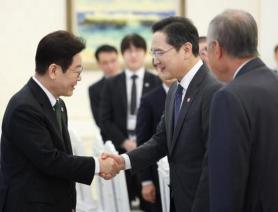
President Lee Jae-myung greets Samsung Electronics Chairman Lee Jae-yong during a corporate meeting on youth jobs and regional investment expansion at the Blue House on February 4. South Korean President Lee Jae-myung is set to leverage the booming semiconductor industry to promote balanced regional and generational development. According to reports from the political and business sectors on June 23, President Lee is expected to meet with Samsung Electronics Chairman Lee Jae-yong soon to discuss investment plans in key regions, including Honam. In addition to Chairman Lee, President Lee is reportedly reaching out to other major corporate leaders, including SK Group Chairman Chey Tae-won, to exchange views on fostering the artificial intelligence (AI) industry and promoting regional balanced development. A comprehensive blueprint for large-scale industrial investments centered on regional participation is anticipated to be announced in the near future. During a press conference marking his first anniversary in office on June 8, President Lee stated, "We will soon unveil a large-scale investment project aimed at a significant shift in growth strategy to the public." The Blue House is also focusing on intergenerational balanced growth. Chief of Staff Kang Hoon-sik emphasized during a senior aide meeting that the expected surplus from the semiconductor boom should be invested in projects for future generations. Kang proposed a broad discussion on fiscal reform tasks aimed at future generations, warning that if pressing issues are not addressed due to social controversies, the burden on future generations could become unmanageable. He stressed the need for both current and future generations to share the burden of national governance equitably and called for rational alternatives from the perspectives of national interest and future generations to secure investment resources. Kang also urged that opportunities for future generations to participate directly in the policy-making process should be adequately ensured. Additionally, he addressed recent incidents, including the death of a reserve soldier during training last month and a food poisoning outbreak at a reserve training center in Seocho-gu, stating, "How do you think young people perceive the state, government, and military?" He strongly criticized relevant departments for these issues. Kang remarked, "The places where young people go to dedicate their time and efforts for the nation and community should not be filled with distrust," and instructed the Office of the Minister of National Defense and related departments to thoroughly review not only food service and hygiene but also the entire reserve training system from the ground up. Furthermore, regarding the recent arrest of employers involved in the abuse and confinement of workers at a salt farm in Jeonnam, Kang expressed his "deep shame and sorrow" that labor exploitation and human rights violations, similar to those in the 2014 and 2021 incidents involving salt farm workers in Sinan County, have reoccurred in 2026. He called on the Ministry of Oceans and Fisheries, the Ministry of Employment and Labor, and the National Police Agency to investigate the employment conditions at salt farms nationwide to identify similar cases and develop effective measures to prevent recurrence.* This article has been translated by AI.
-
 Semiconductors Revive South Korea's Economy
South Korea's economy is regaining strength through exports. The Korea Customs Service reported that preliminary trade figures from June 1 to June 20, 2026, are not just monthly statistics; they signal a robust return of the South Korean economy to the global market after a prolonged period of stagnation and uncertainty. During this period, exports reached $62 billion, a 60.4% increase compared to the same period last year, while imports rose to $44.5 billion, up 23.2%, resulting in a trade surplus of $17.5 billion. Notably, semiconductor exports skyrocketed to $25.59 billion, marking a staggering 188.4% increase year-on-year and accounting for 41.2% of total exports. This clearly indicates that semiconductors are at the heart of South Korea's export recovery, driven by the AI memory supercycle. The significance of this export performance lies not only in the numbers. South Korea's economy has long fluctuated with the semiconductor market. When semiconductor sales decline, exports falter, which in turn affects the won, the stock market, and corporate earnings. However, the export figures from early to mid-June present a different narrative. As semiconductors rebound, overall exports surged, leading to a substantial trade surplus and increasing expectations for improved corporate performance, particularly for Samsung Electronics and SK Hynix. The lifeblood of the South Korean economy remains exports, with semiconductors once again serving as its heart. The trend in South Korea's exports during the first half of the year has already provided a preview of what’s to come. In May, exports reached a record high of $87.75 billion, a 53.2% increase from the previous year, with semiconductor exports soaring 169.4% to $37.16 billion. The trade surplus for that month was $26.95 billion. Reuters attributed this surge to the semiconductor boom resulting from increased AI investments, noting that the export growth rate is the highest since January 1984. Thus, the strong export performance from June 1 to June 20 should not be seen as a one-time spike. The record exports in May, the robust flow in early June, and the substantial surplus by June 20 should be viewed as part of a continuous trend. This reflects a structural change driven by investments in AI servers, high-bandwidth memory, DDR5, enterprise SSDs, and expanded data center investments. Unlike past semiconductor booms that heavily relied on smartphone and PC replacement demand, the current boom is propelled by significant industrial shifts in AI data centers, cloud infrastructure, competitive generative AI models, and the spread of physical AI. Experts view this export performance positively for these reasons. It’s not just about increased exports; the quality of the export growth is changing. If high-value semiconductors are leading the export increase, backed by investments in AI infrastructure and linked to data center expansions in the U.S., China, Southeast Asia, the Middle East, and Europe, it signifies more than just a cyclical economic recovery. The Bank of Korea has adjusted its growth forecast upward, reflecting this recovery in exports and the semiconductor market. Samsung Electronics and SK Hynix are clearly benefiting from this favorable environment. SK Hynix has secured a leading position in the HBM market, emerging as a key supplier of AI memory, while Samsung Electronics is positioned as a comprehensive semiconductor company, covering HBM, advanced DRAM, foundry, packaging, and system semiconductors. As long as U.S. companies like NVIDIA and other global tech giants continue to invest in AI servers, the prospects for improved performance among South Korean semiconductor firms will only grow. Importantly, it’s not just about increasing volume; it’s about improving prices and product mix. As the share of high-value memory increases, the growth in profits could outpace revenue growth. However, optimism alone is insufficient. For this export boom to solidify into a new growth cycle for the South Korean economy, several conditions must be met. First, the semiconductor export boom must continue into the third and fourth quarters. Second, other key industries such as automotive, shipbuilding, biotechnology, defense, batteries, and petrochemicals must also recover. Third, risks from U.S.-China tensions, tariff issues, Middle Eastern instability, and fluctuations in raw material prices must be managed. Fourth, the semiconductor boom should not only translate into corporate profits but also lead to domestic investment, job creation, research and development, and regional industrial innovation. Overall, the outlook for the first half of the year indicates that the South Korean economy has started off stronger than expected. In particular, exports and the trade surplus are bolstering economic sentiment. The fact that semiconductor exports account for over 40% of total exports presents both a strength and a risk. The strength is clear: as the world enters the AI era, the strategic value of South Korean semiconductors increases. However, the risks are also evident. An excessive reliance on specific products could mean that adjustments in semiconductor prices or a slowdown in global investment could quickly burden the entire South Korean economy. The outlook for the second half of the year is even more critical than the first half. If the first half was a signal of recovery, the second half will serve as a test to determine whether a structural growth phase is underway. Experts believe that AI server investments and high-value memory demand will likely continue to support South Korean exports in the second half. However, variables such as U.S. interest rate trends, dollar strength, the pace of China's economic recovery, Middle Eastern conditions, and U.S. tariff policies remain uncertain. Particularly, the strengthened industrial policies and protectionist trends following the U.S. presidential election present both opportunities and challenges for South Korean companies. South Korea must leverage U.S. AI investment demand while responding coolly to supply chain restructuring and tariff risks. Positive impacts are also expected for the won and capital markets. A large trade surplus contributes to the stability of the current account, which underpins the value of the won. Improved performance among export companies is favorable for the KOSPI. Indeed, the strong export performance in May and expectations for semiconductor results have been major drivers of the rise in the South Korean stock market. However, exchange rate stability does not come automatically. It is influenced by U.S. interest rates, dollar movements, foreign capital flows, and geopolitical risks. The better the export performance, the more robust the measures for foreign exchange soundness and financial market stability must be. This export performance has significant implications for North Jeolla Province, Saemangeum, and the physical AI strategy. The core of the AI era starts with semiconductors but does not end there. AI will ultimately transform the real world, impacting industries such as manufacturing, logistics, agriculture, healthcare, shipbuilding, automotive, robotics, and energy. This is what physical AI entails. For South Korea to become a true AI powerhouse, it must evolve beyond being a leading exporter of memory semiconductors to a national strategy that integrates manufacturing AX, robotics, smart factories, autonomous logistics, and energy infrastructure. The foreign currency and technological capabilities earned from semiconductors must be expanded into the physical AI industrial ecosystem. Therefore, the June export statistics are not merely economic news; they serve as a directional sign for where the South Korean economy should head. Semiconductors are once again sustaining South Korea. However, semiconductors alone are not enough. The connections must be made from semiconductors to AI, from AI to manufacturing, from manufacturing to regional innovation, and from regional innovation to national resurgence. Only when the strengths that Samsung Electronics and SK Hynix bring from the global market are extended to improve the industrial structure of the entire nation can the South Korean economy truly enter a new growth cycle. As the Dao De Jing states, “Knowing contentment avoids disgrace; knowing when to stop avoids danger.” We must not become complacent with the current export boom, but neither should we be fearful. The Doctrine of the Mean states, “Achieving harmony establishes the position of heaven and earth, and nurtures all things.” The same applies to the South Korean economy. We must not be intoxicated by the power of semiconductors, nor should we miss the opportunities presented by exports. Instead, we must deepen the roots of our industry with balance and moderation. June's exports were much stronger than expected, with semiconductors riding the wave of the AI memory supercycle. This export boom suggests that the South Korean economy is entering a new growth cycle. However, the real challenge begins now: will the semiconductor boom end as a temporary statistic, or will it lead to a second renaissance in South Korea's exports? The answer depends on corporate investments, government industrial policies, trust in financial markets, and the rational choices of the public. ※ This article was generated using generative AI and has been reviewed by an editor.* This article has been translated by AI.