

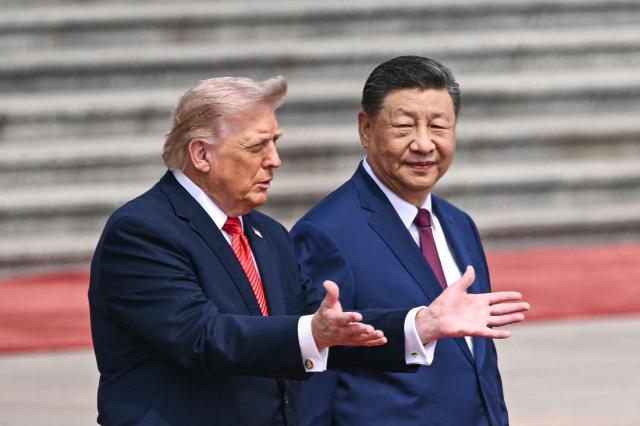
This scene is more than a diplomatic event; it signals a shift in the global order that has persisted for centuries since the Industrial Revolution. Once, the center of the world was London, followed by New York and Washington, which became the hubs of finance, military power, industry, and civilization. However, as we move toward the mid-21st century, the weight of the global economy and geopolitics is shifting back to Northeast Asia, the easternmost part of the Eurasian continent.
At the center of this shift is China. It is now the world's largest manufacturing nation and exporter, as well as one of the largest importers of crude oil. China's influence is rapidly expanding across electric vehicles, batteries, rare earths, solar energy, drones, and AI infrastructure. The reason world leaders are flocking to Beijing is simple: it has become impossible to address supply chain, energy, market, and investment issues without China.
A key moment in Beijing's diplomacy this May was Putin's visit shortly after Trump's trip. The fact that the leaders of the two major military powers, the U.S. and Russia, visited China in quick succession symbolically illustrates the current transformation of the international order.
Chinese President Xi Jinping is employing a complex diplomatic strategy, managing competition with the U.S. while maintaining close ties with Russia without becoming dependent. While engaging in a power struggle with the U.S. over tariffs, semiconductors, AI dominance, and Taiwan, he seeks to avoid a complete economic rupture. With Russia, he is expanding cooperation in energy, finance, and security to counter the U.S.-led order.
This is the emergence of what is termed the 'New Beijing System.'
The war in Ukraine has accelerated this trend. Russia, having lost significant access to European markets due to Western sanctions, is rapidly shifting toward dependency on China. Russian oil and gas are increasingly directed to China, and the proportion of transactions in yuan is rising sharply. Notably, the 'Power of Siberia' gas pipeline project is not just an energy initiative; it symbolizes the formation of a new economic axis between Russia and China within the Eurasian continent.
However, this shift also highlights Russia's structural weaknesses. President Putin maintains an image of a strong leader, but the prolonged war in Ukraine is rapidly depleting Russia's national power. Population decline, weakened industrial competitiveness, and international financial sanctions and technological blockades are gradually undermining the development of Russia's Far East. Regions like Vladivostok, Khabarovsk, and Sakhalin are becoming more economically integrated with Northeast Asia than with Europe.
In contrast, China's influence continues to expand. Chinese capital, logistics, consumer markets, and manufacturing supply chains are infiltrating various parts of the Russian Far East. Even nominally Russian territories are increasingly functioning as part of the Northeast Asian supply chain.
In essence, the Russian Far East is being absorbed into the periphery of the Northeast Asian economic zone, rather than remaining a 'paper tiger' under a weakened Russia.
The Middle East is experiencing a similar transformation. Oil-rich nations such as Iran, Saudi Arabia, and the UAE now view China as their largest customer. While the U.S. still exerts military influence over the Middle Eastern order, China is exercising new power through its vast purchasing capability. Particularly, amid tensions with the U.S., Iran is increasing its reliance on China for oil sales. Russia finds itself in a similar situation, as it must rely on China as a major consumer market due to dwindling options for selling oil and gas. This represents a significant change.
In the past, the U.S. controlled the global energy order through the dollar and aircraft carriers. Now, China is reshaping geopolitics through its purchasing power. As the world's largest manufacturing nation and consumer market, China has become a key player in the international order simply by its ability to purchase oil.
This is where the strategic value of South Korea and Japan resurfaces. They are the only countries in Northeast Asia capable of creating an economic and technological axis that can stand up to China. Japan still possesses world-class technology in materials, components, and equipment, along with financial competitiveness. South Korea boasts strengths in semiconductors, batteries, AI servers, shipbuilding, cultural industries, and advanced manufacturing.
If South Korea and Japan can strengthen strategic cooperation beyond historical conflicts, the situation could change. The U.S. strongly desires this, as it faces significant costs and burdens in countering China alone. If South Korea-Japan cooperation expands into supply chains, AI, aerospace, nuclear power, defense, and bio-industries, there is ample potential for a new balance of power to emerge in Northeast Asia.
The AI era presents new opportunities for South Korea and Japan. While China pushes forward with scale and speed, South Korea and Japan can respond with ultra-precision technology, AI semiconductors, advanced manufacturing, and robotics. In a structure where the three Northeast Asian countries compete yet cooperate, the core stage for global advanced industries is increasingly shifting to the Pacific Rim.
This is not a coincidence.
Before the Industrial Revolution, the center of the global economy was essentially Asia. China and India accounted for a significant portion of global GDP, and the Silk Road and maritime trade were centered in Asia. However, following the British Industrial Revolution, global hegemony shifted to Europe and the U.S.
Now, that direction is changing again.
China is the world's largest manufacturing nation. South Korea is the leading producer of semiconductor memory. Japan excels in precision manufacturing and robotics. Ultimately, the core of global industry, supply chains, AI, and semiconductors is converging back to the three Northeast Asian countries.
History does not flow in a straight line; it circulates like a circle. The global hegemony that shifted to the West after the Industrial Revolution is now returning to the East.
However, the reality is far from simple.
The U.S. remains the world's strongest military and financial power. China dominates manufacturing, supply chains, and consumer markets. Russia, though weakened, is still a military power with nuclear weapons and resources, while Europe maintains a vast technological and financial market despite stagnation.
In this context, South Korea can no longer survive solely through 'middle power diplomacy.'
South Korea must now recognize itself as a strategic nation with strengths in semiconductors, AI, batteries, shipbuilding, nuclear power, and cultural industries. At the same time, it should expand cooperation in supply chains, defense, energy, and cultural sectors with third strategic nations like India, Brazil, Saudi Arabia, the UAE, and Turkey.
India is poised to become the world's most populous country, Brazil is a powerhouse of resources and food, and Turkey serves as a geopolitical gateway connecting Europe, the Middle East, and Central Asia. Saudi Arabia and the UAE are driving new industrial transformations in AI, smart cities, hydrogen economies, and nuclear power.
The world is now moving beyond a simple U.S.-China bipolar system toward a multipolar structure, with Northeast Asia at its center. Seoul, Tokyo, and Beijing are likely to become key stages for the global economy, supply chains, and technological hegemony.
Beijing in May 2026 was indeed heated by this massive flow.
Now, the world is also focusing on another development: the potential visit of President Xi Jinping to North Korea. Following the war in Ukraine, the closeness between North Korea and Russia is rapidly advancing, with discussions of military cooperation, arms trading, and technological exchanges. However, China will not allow North Korea to become excessively close to Russia.
North Korea is not just a neighboring country to China; it is a strategic buffer zone adjacent to the U.S. alliance network and a key pillar of Chinese influence in the Northeast Asian order.
Therefore, Xi Jinping's potential visit to North Korea could carry significance beyond a mere friendly visit. It may signal that China intends to maintain its influence over the Korean Peninsula and could be a strategic move to reintegrate the North Korean issue into a China-centered order.
Ultimately, all scenes unfolding in Beijing converge on one question:
What kind of order will define the era of Asia in the 21st century? And in this monumental shift of civilization, what kind of nation will South Korea become?
* This article has been translated by AI.
Copyright ⓒ Aju Press All rights reserved.