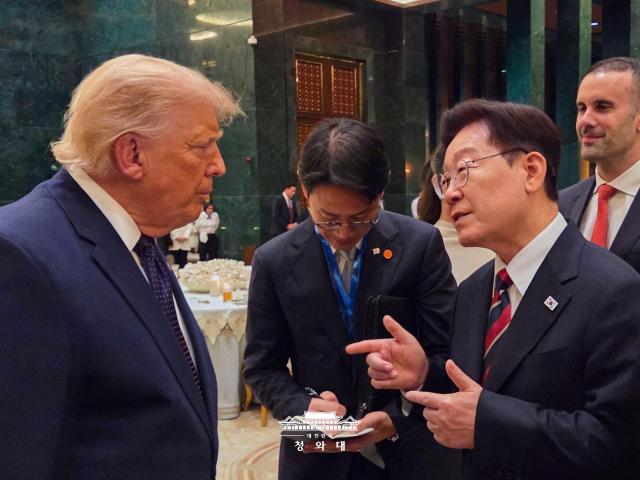
The issue featured prominently during a reception and dinner hosted by Turkish President Recep Tayyip Erdogan on Tuesday on the sidelines of the NATO summit in Ankara, where Lee and Trump held follow-up discussions on military shipbuilding just three weeks after the subject was raised during the Group of Seven summit in France.
According to South Korea's presidential office, Lee told Trump that Seoul would cooperate "as much as possible" with the U.S. request and introduced Korean shipbuilders with world-class manufacturing capabilities. The two leaders agreed to continue working-level discussions on specific forms of cooperation.
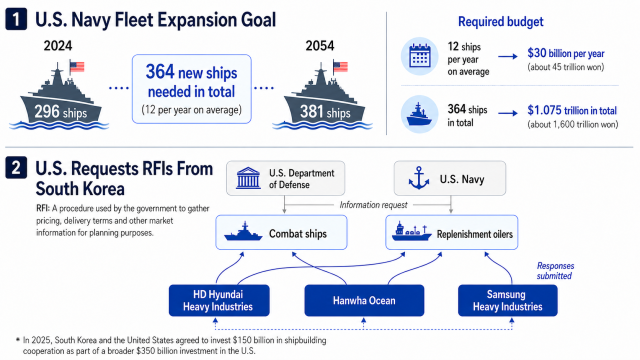
The renewed talks followed Trump's request during the G7 summit asking whether South Korea could rapidly build 10 U.S. warships, reflecting Washington's urgency in naval production bottlenecks and fleet capacity strains after its Gulf engagement.
According to industry sources, the U.S. Department of Defense and the Navy recently sent requests for information (RFIs) to major Korean shipbuilders seeking detailed data on their capabilities to design and build combat vessels and medium-sized replenishment oilers.
The 129-meter vessel incorporates significantly upgraded combat systems over the earlier Incheon- and Daegu-class frigates. HD Hyundai Heavy Industries designed and built the lead ship, Hanwha Ocean is constructing the fifth and sixth vessels, while SK Oceanplant is building the second through fourth ships.
A U.S. Defense Department inspection team reportedly visited SK Oceanplant's shipyard in Goseong in May, boarding a Chungnam-class frigate under construction and closely inspecting the vessel's interior, exterior and production process.
The American outreach comes on the heels of Hanwha Ocean's narrow defeat to Germany's TKMS in Canada's submarine competition, a setback that underscored the high barriers to cracking NATO-linked procurement despite Korea's technological competitiveness.
Although the United States is NATO's leading military power, procurement decisions rest primarily with Washington rather than a smaller ally balancing alliance politics and European industrial interests.
That gives the United States greater flexibility to prioritize industrial capability, production speed and cost efficiency over broader political considerations. Still,
legal hurdles remain formidable.
U.S. law effectively prohibits Navy vessels and major hull or superstructure components from being constructed overseas under the Byrnes-Tollefson Amendment unless specific exceptions are granted.
That means Korean shipbuilders cannot simply build combat ships in domestic yards and export them directly to the United States.
"Words alone will not make it happen," said Ryu Yeon-seung, head of the Defense and Security Research Institute, cautioning that Trump's remarks should not be interpreted as a guaranteed contract.
Still, Ryu said discussions between the two governments are already underway and could develop into commercially viable cooperation.
"Construction is more likely to take place in the United States," he said. "But that does not mean all the benefits would go to the United States."
Korean companies could supply high-value components, contribute ship designs and establish long-term maintenance businesses as vessels require replacement parts, upgrades and overhauls throughout their service lives, he said.
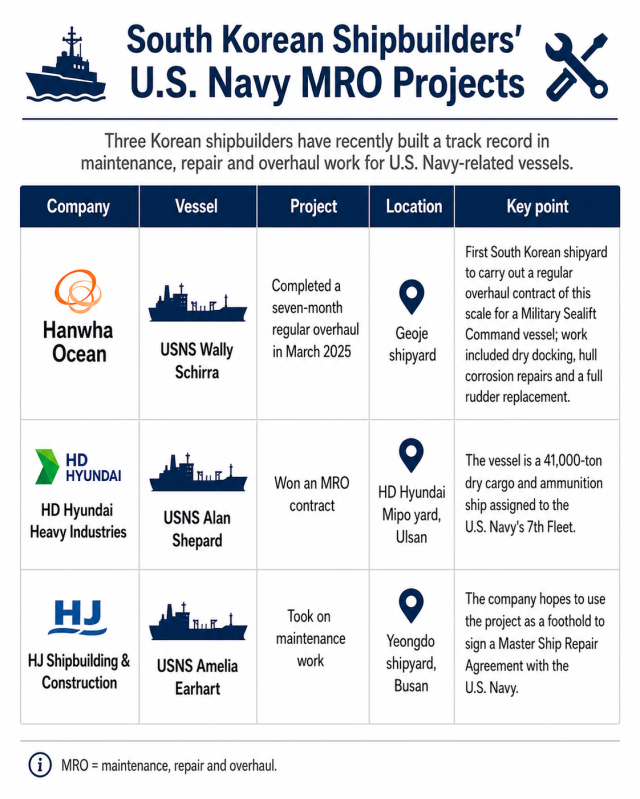
Hanwha Ocean completed a seven-month regular overhaul of the USNS Wally Schirra, a U.S. Navy Military Sealift Command dry cargo and ammunition ship, at its Geoje shipyard in March 2025. The U.S. Navy described the project as the first regular overhaul of that scale performed by a South Korean shipyard for one of its Military Sealift Command vessels. The work included dry docking, hull corrosion repairs and complete rudder replacement.
HD Hyundai Heavy Industries has since secured an MRO contract for the USNS Alan Shepard, a 41,000-ton dry cargo and ammunition ship assigned to the U.S. Seventh Fleet, with work carried out at HD Hyundai Mipo's Ulsan yard.
HJ Shipbuilding & Construction has also entered the market through maintenance work on the USNS Amelia Earhart at its Busan shipyard.
Those projects are increasingly viewed not as isolated repair contracts but as stepping stones toward deeper participation in the U.S. naval supply chain through component manufacturing, engineering support and, eventually, naval shipbuilding partnerships.
For Korean shipbuilders, Canada may have demonstrated how difficult it is to crack NATO procurement. The United States could prove whether Korea's biggest competitive advantage — building sophisticated warships faster than almost anyone else — can ultimately outweigh legal and political barriers.

Copyright ⓒ Aju Press All rights reserved.