

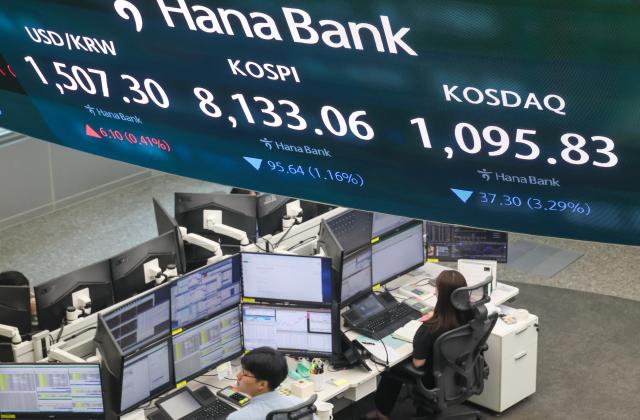
SEOUL, July 09 (AJP) — "I demand a refund," wailed a day trader on social media after SK hynix shares plunged from their near 3 million won peak in June.
Memes of disbelief, despair and fury quickly spread across Korean investing forums.
The complaint captured the contradiction of this year's Korean stock market. The benchmark KOSPI nearly doubled through June to become one of the world's best-performing equity markets, yet a large majority of retail investors are losing money. Trading data from a major domestic brokerage showed that an average 73.5 percent of investors in the 50 most-purchased Korean stocks remained underwater at the end of June, meaning they bought shares above current prices.
In half of those stocks, more than 80 percent of investors were sitting on losses. The average return of the 50 stocks still reached 20.5 percent, but that figure masked an exceptionally narrow rally. The five best-performing stocks gained an average of 198 percent, suggesting that a handful of AI beneficiaries generated most of the market's advance while the majority delivered mediocre or negative returns.
Nowhere was that concentration more evident than in semiconductors. According to Korea Exchange data, Samsung Electronics and SK hynix ranked as the two most-bought stocks by retail investors this year through July 8, attracting net purchases of roughly 51.9 trillion won and 48.3 trillion won, respectively.
As semiconductor shares kept climbing, latecomers increasingly piled into the market through single-stock leveraged ETFs in an attempt to catch up.
Many instead bought near the top.
Shinhan Securities data illustrate the paradox. Despite SK hynix rising roughly tenfold from last summer, half of them or 45.7 percent of its shareholders were still losing money as of Thursday afternoon because many entered only after the rally had become widely celebrated.
The average investor still showed a healthy 76.8 percent gain thanks to earlier buyers, but the headline return concealed the large number of recent entrants now sitting in the red.
Samsung Electronics investors fared somewhat better. Average returns stood at 72.2 percent, while about 63 percent of investors remained profitable.
Analysts said the pattern reflects a familiar retail tendency to chase momentum after prices have already risen sharply, leaving investors exposed when sentiment reverses.
Overseas bet proved smarter.
Among the 50 most-purchased foreign stocks, only 44.2 percent of investors were underwater on average during the first half, while average returns reached 44.7 percent — more than twice the comparable figure for Korean shares.
The difference reflected a broader AI rally in the United States, where gains spread across chipmakers, software companies, cloud providers and infrastructure firms. Korea's advance, by contrast, rested overwhelmingly on its two semiconductor champions.
That dependence made the market especially vulnerable once doubts emerged over whether the AI memory boom had peaked.
Foreign investors have since sold roughly 40 trillion won worth of KOSPI shares over 13 consecutive sessions, concentrating their selling on semiconductor heavyweights after several global investment banks questioned the durability of the memory-chip supercycle.
Retail investors who had amplified their exposure through leveraged ETFs found the reversal even more painful.
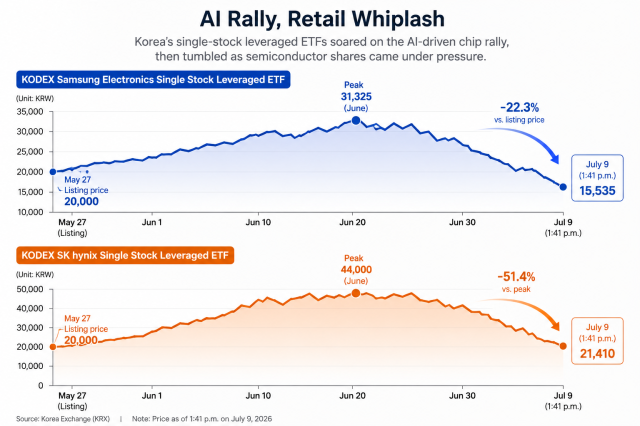
According to Korea Exchange data, the KODEX Samsung Electronics Single Stock Leveraged ETF surged from its listing price of 20,000 won on May 27 to an intraday high of 31,325 won before tumbling to 15,535 won on Thursday, about 22 percent below its debut price.
The KODEX SK hynix Single Stock Leveraged ETF followed a similar pattern. It climbed from 20,000 won to as high as 44,000 won before falling back to around 21,400 won, wiping out more than half of its peak value.
Because such products are designed to deliver multiples of daily returns rather than long-term performance, volatility itself steadily erodes returns, making them particularly punishing during sharp reversals.
Investor frustration has become increasingly visible online.
"It's only a matter of time before it converges to zero," one user wrote on the Naver Finance message board for the Samsung Electronics leveraged ETF.
Another posted: "Don't expect Samsung Electronics to rise if everyone's buying leveraged ETFs. Know what you're buying."

Copyright ⓒ Aju Press All rights reserved.
