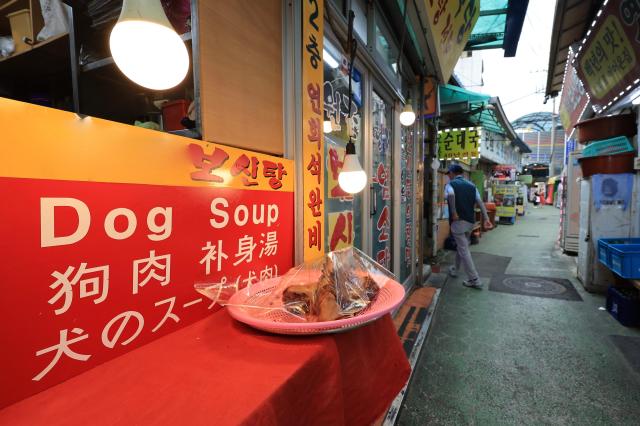
SEOUL, August 11 (AJP) - There are "dog days of summer" for English-speaking societies. Korea likewise has its own pun from ancient calendar for the season’s punishing heat — and this Friday, its final dog day will carry an unusually literal sense of ending.
Aug. 14 is Malbok, the last of the three traditional hottest days collectively known as Sambok, or Boknal. It will also be South Korea’s last Malbok before breeding, slaughtering and selling dogs for food becomes a crime.
Malbok comes after Ipchu, the traditional beginning of autumn, and falls on the first gyeong day after it. This year’s Malbok falls on Friday, Aug. 14.
The meaning of bok itself captures the seasonal struggle.
The Chinese character 伏 means to lie prostrate or submit and combines the characters for a person and a dog. In the old East Asian theory of the five elements, summer belongs to fire and autumn to metal. Boknal was understood as the point when the cool force of approaching autumn tried to rise but was beaten back by the lingering power of summer — autumn forced to crouch before the heat.
Three times it submits. Hence Sambok, the three bok days. For generations, Koreans answered that heat by eating heat.
The idea known as iyeol chiyeol — fighting heat with heat — filled restaurants on Boknal with steaming bowls of samgyetang, chicken soup made with a whole young bird stuffed with glutinous rice, ginseng, jujubes and garlic.
For many, particularly older Koreans, there was another restorative soup: bosintang, made with dog meat.
That part of Malbok is now disappearing. Under a special law enacted in February 2024, breeding or slaughtering dogs for food and distributing or selling dog meat will be prohibited from Feb. 7, 2027, after a three-year transition period.
Slaughtering dogs for food can carry up to three years in prison or a fine of 30 million won ($21,000), while breeding or distributing them for food can lead to up to two years in prison or a 20 million won fine. The law does not criminalize eating dog meat itself.
The industry is already vanishing.
Of the 1,537 dog farms registered with the government, 1,204, or about 78 percent, had closed by late December 2025, leaving just 333, according to the Ministry of Agriculture, Food and Rural Affairs.
It is a remarkable end for a practice documented on the Korean Peninsula for centuries.
Xu Jing, a Chinese envoy who visited the Goryeo kingdom in 1123, recorded Koreans eating dog meat and raising dogs much as they did cattle and pigs. For much of modern Korean history, dog meat remained associated less with everyday dining than with stamina food, particularly during the oppressive weeks of Sambok.
Its place in Korean society began changing rapidly in the late 20th century.
International criticism intensified ahead of the 1988 Seoul Olympics. At home, rising incomes, smaller families and the rapid growth of pet ownership gradually transformed the dog’s place in Korean life — from livestock or guard animal to companion and, increasingly, family member.
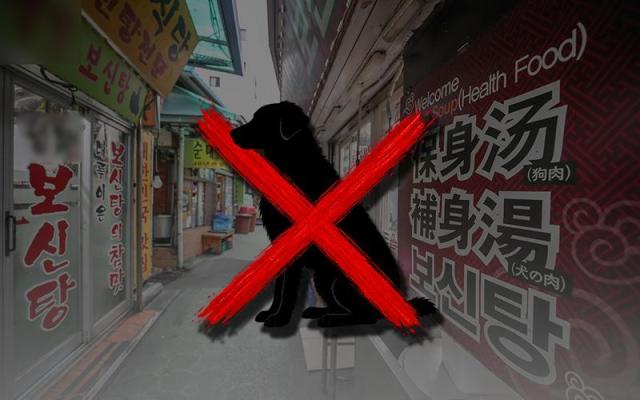
Today, pet cafes, hotels, restaurants and hospitals are commonplace. Koreans spend heavily on dog food, clothing, grooming and medical care.
What many older Koreans once regarded as summer health food has become unthinkable to much of a younger generation.
South Korea had an estimated 5.46 million pet dogs at the end of 2024, according to the KB Financial Group Research Institute. Some 11.96 million people lived with dogs, while the broader number of Koreans living with pets reached 15.46 million, or nearly three in every 10 people.
“I can’t imagine how we could be so brutal to these precious animals,” said Park Da-yeon, 45, who raises a 2-year-old brown poodle.
“Better late than never. I’m glad we are finally past the custom.”

Goat meat emerged as one possible alternative, prompting farmers to expand production, but oversupply and rapidly growing imports have since helped drive domestic live-goat prices down more than 60 percent from two years ago.
Across the border, however, the cultural clock is moving in the opposite direction.
North Korean state media this month again promoted dog-meat soup, known there as dangogi-guk, or “sweet meat soup,” among nutritious foods to help people cope with the summer heat. Pyongyang continues to celebrate the dish as traditional summer nourishment even as Seoul prepares to eliminate the industry altogether.
That divergence gives this year’s Malbok an ending larger than a change in menu.
The arrival of Malbok has always suggested that summer’s grip is finally beginning to loosen. The character 伏 evokes autumn’s cool energy lying defeated beneath the heat, waiting for its chance to rise.
This Friday, the heat may still win that ancient battle.
But for South Korea’s dog-meat tradition, there will be no next Malbok.
AJP Takeaways:
-
South Korea’s dog meat ban takes effect Feb. 7, 2027, making Aug. 14, 2026, the country’s final Malbok before breeding, slaughtering and selling dogs for food becomes illegal.
-
Dog meat consumption, once linked to Boknal and summer stamina food, is rapidly disappearing as pet ownership grows and 78 percent of registered dog farms had already closed by late 2025.
-
The shift marks a major cultural divide on the Korean Peninsula: South Korea is ending its centuries-old dog meat industry, while North Korea continues to promote dog-meat soup as a traditional summer food.
Copyright ⓒ Aju Press All rights reserved.