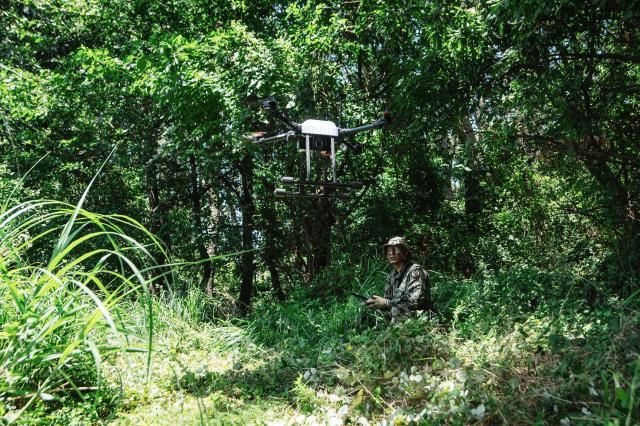
The United States has demonstrated the advantage of combining its AI software edge with military might. Japan, China and South Korea are now pursuing different strategies to ensure that critical military capabilities do not become dependent on technology controlled elsewhere.
That is turning military AI sovereignty into a new layer of national defense.
For East Asia’s manufacturing powers, the shift is particularly important. China, Japan and South Korea possess formidable manufacturing capabilities, increasingly enhanced by AI, giving them strategic leverage in an increasingly volatile geopolitical environment.
But as weapons become more dependent on software, manufacturing strength alone may no longer be enough.
The United States currently holds the strongest advantage in frontier AI.
Palantir Technologies' Maven Smart System, which brings together information from satellites, drones, radar and other sensors, supported thousands of U.S. strikes against Iran, according to Reuters.
In March, the Pentagon moved to designate Maven as a formal "program of record," effectively establishing it as a long-term military command-and-control capability rather than an experimental project.
The Pentagon has since gone further.
In May, it announced agreements with eight U.S. technology companies, including OpenAI, Google, Microsoft, Nvidia, SpaceX, Amazon Web Services, Oracle and Reflection, to deploy frontier AI capabilities directly on classified military networks.
The Pentagon said more than 1.3 million personnel had already used its GenAI.mil platform within five months, generating tens of millions of prompts and deploying hundreds of thousands of AI agents.
It is also deliberately using multiple providers, saying its architecture is designed to prevent vendor lock-in.
The issue is becoming increasingly important as commercial AI moves closer to military decision-making. Reliance on a single provider could leave critical military capabilities dependent on one company's technology, while the ability to switch between models gives governments greater control over the systems they deploy.
The commercial stakes are rising just as quickly.
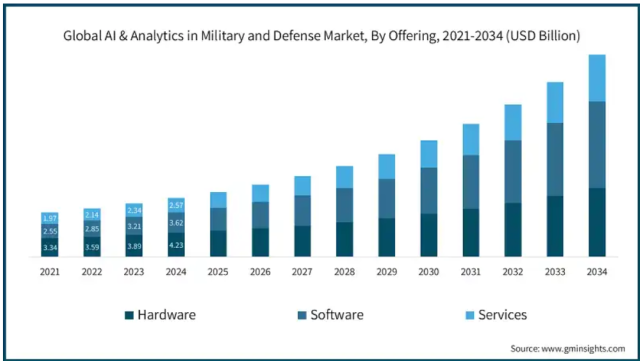
North America accounted for 37.7 percent of the market in 2024, while Asia-Pacific is expected to be the fastest-growing region through 2034, with annual growth of 15.1 percent.
The figures reflect how AI is spreading beyond intelligence analysis into command and control, autonomous weapons, cyber defense and logistics.
But while the United States is home to most of the world's leading frontier AI developers, its Asian allies and rivals are increasingly confronting a different question: how much of a country's military AI can safely depend on technology developed elsewhere?
Japan provided the latest answer this week.
Tokyo is considering using advanced U.S. AI models across multiple defense systems while entrusting its most sensitive command-and-control functions to a Japanese-developed system, according to Japanese media reports.
A leading candidate is Fugu, developed by Tokyo-based Sakana AI.
Unlike a conventional model, Fugu acts as an orchestrator capable of selecting and coordinating several specialized AI models depending on the task. Sakana describes the technology as a way to achieve frontier-level performance without becoming dependent on a single model provider.
The move follows a broader Japanese effort to test American military AI.
Japan has been considering Palantir's technology for Self-Defense Forces command-and-control operations, and Palantir's system was reportedly used during the U.S.-Japan Keen Edge command-post exercise earlier this year.
But Tokyo appears to be drawing a firm line around its most sensitive systems.
Although Sakana AI has previously used Chinese open-source models in developing Fugu, Chinese models are expected to be excluded from versions supplied for defense use.
Developers involved in the military project would also be limited to Japanese nationals, while data centers handling sensitive defense information would be located inside Japan.
The strategy effectively combines American AI capability with Japanese control.
Tokyo can use foreign models where they offer superior performance while retaining domestic authority over the system that decides which models are used and how their outputs enter military decision-making.

China is pursuing a different model — learning from foreign AI while attempting to move military applications onto its own systems.
A Reuters review published late last month found that researchers linked to the People's Liberation Army have used outputs from leading U.S. AI models, including those developed by OpenAI and Anthropic, to train smaller Chinese models through a process known as model distillation.
In one case, researchers linked to PLA Unit 96941, which is involved in intelligence and cyber operations, used OpenAI's GPT-3.5 to process software code and then used the results to train a domestic model capable of operating within Chinese networks.
Researchers at China's National University of Defense Technology have similarly used distillation to develop smaller image-processing models suitable for drones, allowing them to analyze imagery and assist navigation even when communications are disrupted.
Other research has examined lightweight AI for target recognition in maritime operations involving drones, surface vessels and unmanned underwater vehicles.
The approach illustrates Beijing's broader objective: extract useful capabilities from frontier foreign models while reducing dependence on them in actual military operations.
China has also accelerated military adoption of domestic systems, including models derived from DeepSeek, for battlefield decision support, autonomous systems and target recognition.
The commercial gap could narrow as well.
Global Market Insights projects China's military and defense AI and analytics market to reach $4.53 billion by 2034, with China expected to remain the largest market in the rapidly growing Asia-Pacific region.
South Korea: manufacturing strength, weaker AI layer
South Korea, meanwhile, is increasingly embracing the same language of technological sovereignty.
Its traditional strength lies in manufacturing.
The country's defense industry has built capabilities in aircraft, armored vehicles, missiles and other hardware, while its broader manufacturing and ICT infrastructure provide a strong base for physical AI.
But its military AI capabilities remain less developed.
In July, Naver, Naver Cloud and Korea Aerospace Industries agreed to jointly develop a defense-specific sovereign AI foundation model based on domestic technology.
The project is intended eventually to extend beyond language models into physical AI, including unmanned aircraft, AI pilots and future manned-unmanned combat systems.
Naver said the effort was designed to minimize security risks and reduce reliance on foreign technology in defense and national security.
It follows a separate agreement in May between the Defense Ministry and SK Telecom to develop and test a military-specific AI model based on Korea's government-backed sovereign AI foundation model project.
Seoul has also begun testing AI closer to actual military operations.
During the 2025 Freedom Shield exercise with the United States, the Defense Ministry tested its Defense Generative AI, or GeDAI, including services designed to answer questions about wartime mobilization and Marine Corps doctrine.
More recently, the military has turned to AI for unmanned warfare.
In June, the Defense Ministry announced plans to introduce about 60,000 drones by 2029, including around 11,000 this year, while moving to acquire AI-based drone swarms and loitering munitions.
Defense Minister Ahn Gyu-back also said military drones would use domestically produced components instead of Chinese parts because of security concerns.
Yet South Korea still faces a considerable gap with the United States.
A September 2025 report by Kim Ji-won, a researcher at the Korea Information Society Development Institute, cited an assessment that South Korea's defense AI technology was about 4.1 years behind leading countries such as the United States.
The report estimated that South Korea had about 2,664 defense AI specialists, equivalent to only 9 percent of the U.S. level, while limited access to classified military data was identified as another major obstacle to domestic AI development.
That weakness could become more significant as the defense AI market shifts increasingly toward software.
While hardware accounted for 40.6 percent of the global military AI and analytics market in 2024, software is forecast to be its fastest-growing segment, expanding at an annual rate of 15.7 percent, according to Global Market Insights.
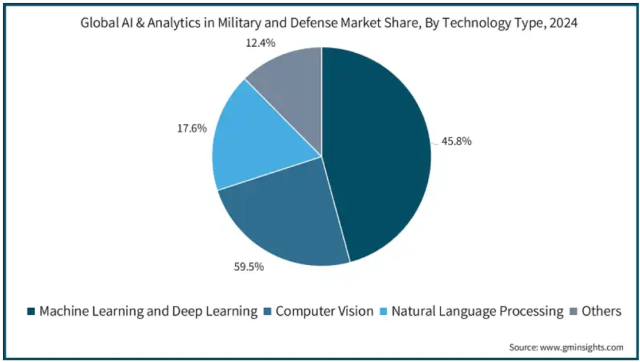
That presents a particular challenge for South Korea, whose defense industry has traditionally been stronger in manufacturing aircraft, armored vehicles, missiles and other hardware than in military software and algorithms.
The KISDI report identified manufacturing and ICT infrastructure as strengths but cited software capabilities, specialist manpower and military data access among the country's structural weaknesses.
Kim warned that Korea's existing strengths alone may not be enough as competition accelerates.
"If Korea fails to confront its internal weaknesses in technology and talent and the rapidly changing external environment, it also risks rapidly falling behind in global competition," Kim said.
The three Asian countries are approaching the same strategic problem in different ways.
As AI moves deeper into command and control, autonomous systems, intelligence and battlefield decision-making, control over the software and models behind those weapons is becoming increasingly important.
For the United States, access to the world's leading AI developers remains a major strategic advantage.
For its Asian allies and rivals, the challenge is how to benefit from frontier technology without allowing dependence on foreign AI to become a new military vulnerability.
As Kim put it, "Defense AI is no longer science fiction but a reality, and achieving a successful defense AI transformation is no longer an option but a necessity."
AJP Takeaways
△ The U.S. leads military AI integration, using systems such as Palantir’s Maven and deploying frontier AI directly on classified networks.
△ Japan is pursuing a hybrid model, using advanced U.S. AI while keeping sensitive command-and-control functions under domestic control.
△ China is using U.S. AI outputs to train domestic military models while expanding homegrown systems for drones, targeting and battlefield decisions.
△ South Korea is building sovereign defense AI but still faces gaps in software, manpower and military data access compared with the U.S.

Copyright ⓒ Aju Press All rights reserved.