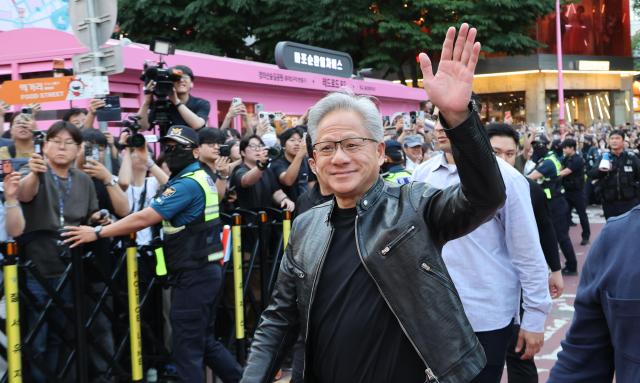
The company reported second-quarter revenue of $96.2 billion for its fiscal 2027, more than doubling from a year earlier, as data center revenue jumped 117 percent to $89 billion. Nvidia forecast revenue of $108 billion, plus or minus 2 percent, for the current quarter, while giving a preliminary forecast for revenue to grow about 70 percent in fiscal 2028.
Still, the rapid expansion of AI infrastructure is increasingly putting pressure on the memory supply chain.
"We are experiencing extreme pricing conditions in memory," Nvidia Chief Financial Officer Colette Kress said during an earnings call Wednesday. "The magnitude of the price increase has exceeded our prior expectations and are headed even higher into next year," she said.
The higher component costs are weighing on Nvidia's margins. The company expects its non-GAAP gross margin to fall from 75 percent in the second quarter to about 74 percent in the third quarter before bottoming at between 71 percent and 72 percent in the fourth quarter.
Nvidia expects margins to recover to between 72 percent and 73 percent in fiscal 2028 as product price increases take effect.
The comments offer a bullish signal for South Korea's Samsung Electronics and SK hynix, two of the world's largest memory chipmakers, as red-hot demand for high-bandwidth memory and other advanced memory products is expected to extend well through next year.
Gartner recently forecast global memory revenue at $837.3 billion this year, nearly four times last year's $220.1 billion, before climbing above $1 trillion to $1.08 trillion in 2027. Memory's share of worldwide semiconductor revenue is projected to rise to 54 percent this year from 27 percent in 2025.
In Seoul, shares of Samsung Electronics opened 2 percent and SK hynix 3.5 percent higher Thursday.
"Memory scarcity today is being driven in large part by the AI buildout itself," Kress said, adding that Nvidia has "long-standing deep relationships with all three major memory suppliers" and is working with them to secure additional capacity required for its product roadmap.
Nvidia did not identify the suppliers by name during the call. The world's three major DRAM suppliers are South Korea's SK hynix and Samsung Electronics and U.S.-based Micron Technology.
Chief Executive Jensen Huang also stressed that supply, rather than demand, is becoming a key constraint on Nvidia's growth.
Huang said demand for the company's computing systems is running well above the roughly 70 percent revenue growth Nvidia currently expects to deliver in fiscal 2028.
"Our demand is much higher than that," Huang said, adding that Nvidia would need help from its "entire supply chain" to increase capacity.
Nvidia expects supply to remain a bottleneck at least through the end of fiscal 2028.
The company also highlighted its expanding ties with South Korean companies during the earnings call.
Nvidia said Samsung Electronics is using its cuLitho computational lithography platform to achieve up to 20 times higher performance in computational lithography, a technology used to optimize complex semiconductor manufacturing processes.
The company also cited LG and Hyundai Motor Group as partners working with Nvidia to build and scale AI infrastructure in South Korea.
The strong outlook comes as Nvidia's next-generation Vera Rubin platform enters full production. Huang said AI has reached an inflection point where it is increasingly performing productive work and generating economic returns, fueling further demand for computing infrastructure.
As AI agents and more sophisticated reasoning models require increasingly large amounts of computing power, Nvidia expects the global race to build AI infrastructure to continue.
The company said supply constraints extend across its broader supply chain, including semiconductor manufacturing, memory, data center power and infrastructure, even as additional capacity comes online.
AJP Takeaways
Nvidia says extreme memory prices are squeezing margins, exposing a cost downside to the AI boom it helped create.
Samsung Electronics and SK hynix stand to benefit as scarce HBM and DRAM supplies strengthen memory pricing power.
Nvidia says demand is running ahead of supply, with bottlenecks expected to persist through fiscal 2028.

Copyright ⓒ Aju Press All rights reserved.