
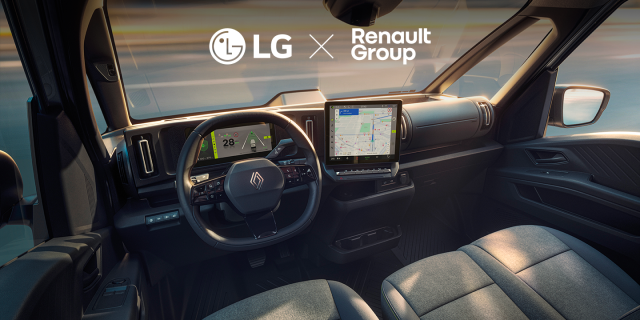
The system combines the vehicle's instrument cluster and infotainment functions under a unified interface, allowing driving information, navigation and media functions to be managed together. LG said the integrated architecture can also simplify components and reduce production costs.
Software-defined vehicles, or SDVs, rely on centralized computing and software rather than numerous electronic control units dedicated to individual functions, allowing features to be upgraded through over-the-air software updates.
LG has worked with Renault on automotive electronics for more than a decade, including the joint development of an Android-based infotainment system in 2021.
"We will continue to advance the core technologies and solutions needed for the mobility industry's transition to SDVs through close cooperation with Renault Group and other global automakers," said Eun Seok-hyun, president of LG's Vehicle Solution business.

Candice Kim
Candice Kim is a dedicated business and technology reporter specializing in the intersection of high-tech innovation and fast-paced consumer trends. Her core beats span the semiconductor, IT, cosmetics, and retail sectors, where she provides in-depth coverage of industry titans including Samsung Electronics, SK hynix, and LG Electronics, alongside leading consumer brands like Olive Young and Musinsa. Whether analyzing complex silicon supply chains or tracking the latest shifts in beauty and fashion retail, Candice is committed to delivering sharp, accurate reporting that keeps readers informed on the forces shaping today's most dynamic markets.
Copyright ⓒ Aju Press All rights reserved.
Related News
-
 LG Electronics Shares Rise Over 5% Following Major AIDC Cooling System Contract
LG Electronics shares rose more than 5% in early trading after the company secured a long-term supply contract for cooling systems for artificial intelligence data centers (AIDC) in North America, boosting investor sentiment.As of 9:52 a.m. on October 6, LG Electronics was trading at 227,500 won, up 5.56% (11,500 won) from the previous trading day, according to the Korea Exchange.The increase in stock price is attributed to the announcement of a significant order in the AIDC cooling business. The previous day, LG Electronics' U.S. subsidiary announced it had signed a long-term supply agreement (LTA) for chillers with Air Control Concepts, a major infrastructure platform provider in North America.Through this partnership, LG Electronics plans to gradually supply a range of cooling devices, including high-efficiency chillers for AIDC thermal management, with a total capacity of 5 gigawatts (GW). As the AI industry grows, the power consumption and heat generation of data centers are surging, increasing the importance of reliable cooling systems for stable operations.Air Control Concepts is a platform specialist responsible for the entire process of AIDC design and construction, public bidding, and aftercare (AM) across North America, including the U.S. and Canada. With major global data center operators as clients, LG Electronics is expected to accelerate its entry into the North American AIDC cooling market.Analysts believe this contract will highlight LG Electronics' growth potential in new business areas. They are particularly focused on the potential for AIDC cooling systems and robotics to become new growth drivers beyond the company's traditional home appliance business.Meritz Securities raised its target price for LG Electronics from 220,000 won to 250,000 won, reflecting the company's new business growth potential.Yang Seung-soo, a researcher at Meritz Securities, stated, "This year, LG Electronics' stock price is driven by expectations surrounding the AIDC cooling solutions and robotics as dual growth engines. In particular, the AI data center cooling business is expected to achieve an order backlog of about 3 trillion won this year, demonstrating tangible results."He also noted that the expansion of the cooling solutions product line increases the likelihood of additional orders. "In addition to air-cooled chillers, the certification of liquid cooling CDU products by major clients is broadening, significantly enhancing the potential for further orders," he explained.The robotics business is also presented as a future growth driver for the stock price. He mentioned, "In the robotics sector, approximately 200 Clod robots are being deployed at the Yangjae Data Factory for demonstration purposes, and they are expected to enter a full commercialization phase starting next year as they are gradually introduced to production bases in the Americas."* This article has been translated by AI.
-
KOSPI Opens Steady Above 7000, KOSDAQ Rises Over 1%
The KOSPI index opened slightly higher, remaining above the 7000 mark. Despite a surge in U.S. long-term Treasury yields, the New York stock market rose, driven by technology stocks focused on artificial intelligence (AI), while the KOSDAQ increased by more than 1%.According to the Korea Exchange, as of 9:05 a.m., the KOSPI was up 2.23 points (0.03%) at 7005.97, having reached a high of 7044.67 during the session.In the securities market, foreign investors sold a net 31.2 billion won, while institutions and individuals bought a net 2.9 billion won and 23.7 billion won, respectively.Among the top market capitalization stocks, the performance was mixed. Samsung Electronics fell 0.18% to 275,500 won, and SK Hynix dropped 1.41% to 1,815,000 won. Samsung Electronics preferred shares (-0.70%) and Samsung Biologics (-1.62%) also showed weakness.Conversely, Samsung Electro-Mechanics rose 3.67% to 1,639,000 won. Other gainers included Hyundai Motor (0.72%), KB Financial (0.42%), SK Square (0.34%), and LG Energy Solution (0.13%).At the same time, the KOSDAQ index was up 11.78 points (1.32%) at 905.07. In the KOSDAQ market, individuals purchased a net 20 billion won, while foreign and institutional investors sold a net 17.3 billion won and 1.4 billion won, respectively.The top stocks in the KOSDAQ generally showed strength. HLB surged 16.07%, while other gainers included Simtech (3.89%), Juseong Engineering (3.80%), Rino Industry (2.61%), Rainbow Robotics (1.89%), EcoPro BM (1.82%), and EcoPro (1.46%).Han Ji-young, a researcher at Kiwoom Securities, stated, "This week, the KOSPI is expected to be influenced by the U.S. employment results for September, changes in the U.S. stock market during the holiday period, the minutes from the September Federal Open Market Committee (FOMC) meeting, the direction of U.S. 10-year Treasury yields, and Samsung Electronics' preliminary third-quarter results." He projected the KOSPI's weekly range to be between 6800 and 7300.Han explained, "The weak U.S. employment figures for September have diminished the justification for further tightening by the Federal Reserve, but it is important to monitor that U.S. 10-year Treasury yields remain in the 5.2% to 5.3% range." He added, "This week, Samsung Electronics' preliminary third-quarter results will be the main event, and the key will be whether earnings estimates for the semiconductor sector will be revised upward and whether foreign investors will shift back to net buying in semiconductors."* This article has been translated by AI.
-
LG Tests Space Components on Nuri Rocket, Including Camera and Battery
LG is testing its camera, battery, and power control technologies in space, utilizing existing commercial technologies to verify reliability in orbit rather than developing new components from scratch. This marks the first time LG affiliates have jointly launched various components on a single satellite for space validation.On October 6, LG Science Park announced that it will equip the CubeSat aboard the fifth launch of the Nuri rocket, scheduled for October 7, with five components from LG Electronics, LG Energy Solution, and LG Innotek. The validation is being prepared in collaboration with the unmanned exploration research institute, a startup focused on lunar rover development.The components include a camera module from LG Innotek and a battery pack from LG Energy Solution. LG Electronics is supplying a power module, attitude control actuator, and satellite communication antenna. The camera module will capture images of the Korean Peninsula and transmit data back to Earth. The power module and attitude control actuator will manage the satellite's power and orientation, while the battery pack will provide power and collect status information.If the Nuri rocket launch and satellite separation proceed as planned, these components will undergo operational testing for about 60 days at an altitude of approximately 570 kilometers. A key verification target is whether the commercially available components can function normally in the actual space environment, which includes exposure to vacuum, extreme temperature changes, and radiation.This test will employ a Commercial Off-The-Shelf (COTS) approach, which involves adapting existing commercial components for space use. This method can reduce development time and costs compared to creating dedicated space components from the ground up. However, since ground-based components are not designed for space radiation and temperature variations, separate reliability verification is necessary before actual operation.LG aims to gather data on how each component performs in orbit and plans to use the results to enhance its technology. This represents an initial step in determining whether the technologies acquired from its existing electronics and battery businesses can be expanded into the space sector.Notably, LG Electronics, LG Innotek, and LG Energy Solution each possess expertise in power control, camera, and battery technologies. The satellite must generate and store power, control its orientation, and capture information to send back to Earth. For LG, the critical question is whether it can extend its core components from existing businesses into the space environment rather than building a separate space venture from scratch.LG plans to gradually expand the scope of its verification efforts. By 2028, it aims to launch its own CubeSat. While this test involves components mounted on a satellite developed by the unmanned exploration research institute, future plans include validating independent satellite mounting technology.LG is also broadening its collaborations in the space sector. LG Science Park discussed cooperation with the Korea Aerospace Administration on two occasions last year regarding the space industry. Additionally, LG Energy Solution has begun developing aerospace battery cells in partnership with South8 Technologies in the United States. As LG expands from supplying technology among its affiliates to joint validation efforts, it is solidifying its movement to explore the space industry as a new application market for its existing electronics and battery technologies.Jung Soo-hun, CEO of LG Science Park, stated, "This launch is the first step in confirming how LG's technology operates in the space environment. We will continue to validate the technologies we have accumulated on the ground and contribute to the domestic space industry ecosystem."* This article has been translated by AI.