
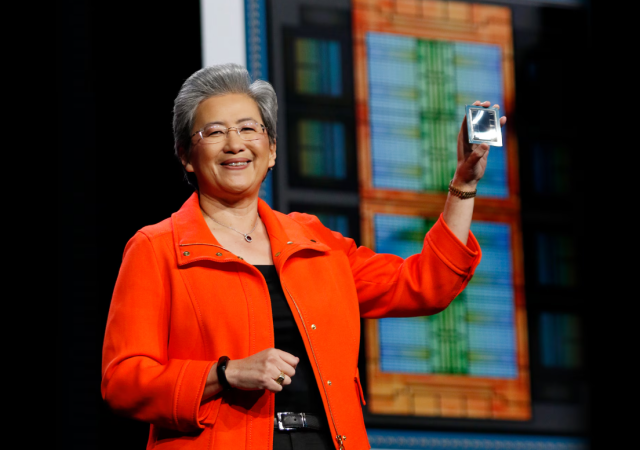
SEOUL, October 07 (AJP) - AMD will work with 14 South Korean AI chip and technology companies to build computing infrastructure combining its CPUs and GPUs with Korean-made AI processors, as the U.S. chipmaker expands its AI partnership with Korea.
The initiative follows an agreement signed between AMD and South Korea's Ministry of Science and ICT in July. The partners plan to test the heterogeneous computing infrastructure in Korea and develop it into a reference model that could be deployed in global markets, the ministry said Wednesday.
AMD also plans to establish an AI Center of Excellence in South Korea and hire several hundred AI researchers, AMD Chair and CEO Lisa Su said during a meeting with Vice Science Minister Ryu Je-myung in Seoul on Wednesday.
Su said AMD is also expanding AI computing capacity in Korea, including through its first cloud infrastructure project with Korean startup MangoBoost, and plans to broaden cooperation with local universities and startups. AMD recently signed a memorandum of understanding with Seoul National University's AI Institute.
The 14 companies include Rebellions, FuriosaAI, HyperAccel, DEEPX, Mobilint, MangoBoost, Panmnesia, Nota AI, FADU and Upstage, spanning AI processors, software, memory, networking, cloud services and AI models.
The companies will also explore participation in AMD's open-source ROCm software ecosystem and ways to connect their technologies with AMD's global AI network.

Candice Kim is a dedicated business and technology reporter specializing in the intersection of high-tech innovation and fast-paced consumer trends. Her core beats span the semiconductor, IT, cosmetics, and retail sectors, where she provides in-depth coverage of industry titans including Samsung Electronics, SK hynix, and LG Electronics, alongside leading consumer brands like Olive Young and Musinsa. Whether analyzing complex silicon supply chains or tracking the latest shifts in beauty and fashion retail, Candice is committed to delivering sharp, accurate reporting that keeps readers informed on the forces shaping today's most dynamic markets.
Copyright ⓒ Aju Press All rights reserved.
Related News
-
 Once the buyer, now the suitor: AMD's Lisa Su due back in Korea
AMD Chair and CEO Lisa Su visits Samsung Electronics during a trip to South Korea in March 2026/ Courtesy of Samsung Electronics SEOUL, October 06 (AJP) - For decades, the semiconductor industry’s pecking order was relatively straightforward: chip designers and system companies called the shots, while memory makers competed to supply them. The artificial intelligence boom is starting to turn that relationship on its head. AMD Chair and CEO Lisa Su is due in South Korea this week, seven months after her previous visit in March, as the U.S. chipmaker seeks the advanced memory and manufacturing partnerships needed to challenge Nvidia in AI computing. Su will attend AMD Gamer Day 2026 in Seoul on Wednesday alongside Jack Huynh, senior vice president and general manager of AMD’s Computing and Graphics Group. A media Q&A is scheduled for the same day, while meetings with Korean AI chip companies and government officials are expected during the trip. Behind the gaming event lies a much bigger semiconductor story. As AI accelerators become more powerful, access to high-bandwidth memory, or HBM, increasingly determines how quickly chip designers can turn their ambitions into products. Samsung Electronics and SK hynix together accounted for more than 80 percent of global HBM revenue in the second quarter, according to Counterpoint Research figures. That concentration gives the Korean suppliers considerable leverage over the companies competing to build the next generation of AI systems. “The relationship between the buyer and supplier has changed significantly,” said Kim Deok-kee, a professor of electronic engineering at Sejong University. “In the past, memory companies were largely in the weaker position,” Kim said. “Now memory has become so critical that you could almost say the memory companies have become the ones holding the upper hand.” For AMD, the stakes are particularly high. Its Instinct graphics processors are central to its effort to narrow Nvidia’s commanding lead in AI accelerators. But that requires more than designing faster chips. The processors need increasingly large amounts of advanced memory to deliver data to their computing cores at high speed. Securing HBM has consequently become a strategic priority. “The first priority is securing memory,” Kim said. “More than future technology itself, securing allocations of the highest-performance and most expensive HBM is likely the immediate priority.” There is an irony to AMD’s position: it helped pioneer the technology it now needs to secure. SK hynix announced the development of its first HBM product using through-silicon vias — vertical connections between stacked memory chips — in December 2013, following joint development with AMD. AMD brought first-generation HBM to its Fiji-based graphics products in 2015, well before the generative AI boom made the technology indispensable to advanced accelerators. What began as an architectural innovation has become a scarce component sought by the world’s leading AI chipmakers. Samsung is emerging as an especially important partner in AMD’s response. During Su’s March visit, she traveled to Samsung’s semiconductor complex in Pyeongtaek and signed a memorandum of understanding with Vice Chairman and CEO Jun Young-hyun to expand cooperation in AI memory and computing. Samsung Electronics Vice Chairman and CEO Jun Young-hyun (L) and AMD Chair and CEO Lisa Su pose after signing an MOU in March 2026 / Courtesy of Samsung Electronics The agreement covers primary HBM4 supply for AMD’s next-generation Instinct MI455X accelerator, alongside advanced DDR5 memory for sixth-generation EPYC server processors and systems built around AMD’s Helios rack-scale platform. It builds on Samsung’s existing role as AMD’s primary HBM3E partner for the MI350X and MI355X accelerators. The relationship could extend beyond memory. Samsung and AMD also agreed to discuss a potential foundry partnership under which Samsung would manufacture future AMD products. Such an arrangement could broaden their cooperation across memory, chip production and advanced packaging, although a manufacturing agreement has not been announced. For Su, those discussions draw on relationships that predate her AMD career. She spent more than a decade at IBM, holding senior positions in semiconductor technology development and manufacturing. “Su had experience working with Samsung Foundry around 2005 while she was at IBM, so she likely still knows people within Samsung’s foundry business,” said an industry source who worked with her at the time. Su became vice president of IBM’s Semiconductor Research and Development Center in 2005. By 2006, she was heading a joint development alliance involving IBM, Samsung, Chartered Semiconductor and Infineon that worked on advanced manufacturing processes. AMD Chair and CEO Lisa Su/ Courtesy of AMD “Su understands not only software and system architecture but semiconductor devices and manufacturing as well,” the source said. “She understands how foundries operate.” That background could become increasingly relevant as AMD explores cooperation extending from memory supply to manufacturing and packaging. Su’s return does not establish that another supply deal is imminent. It does, however, come as AMD’s competitive ambitions depend increasingly on technologies concentrated in South Korea. The country’s role in that strategy has evolved. AMD’s work with SK hynix helped establish HBM’s first generation; its expanding Samsung partnership now reaches into HBM4 and potentially contract chipmaking. For Korean memory makers, the change is significant. Their products are becoming a constraint around which even the most powerful chip designers must plan. Nvidia and AMD still wield enormous influence over the AI industry. But without sufficient advanced memory, neither can deliver its fastest processors at the scale customers demand. That gives Korean suppliers greater bargaining power — and Su a compelling reason to keep returning. “Securing memory comes first,” Kim said. “After that, there is the question of jointly developing the next technologies — memory, foundry and the overall architecture.” For AMD, both increasingly lead to South Korea.
-
 Solidigm Expands SSD Production Base in Taiwan Amid AI Server Boom
Solidigm, a subsidiary of SK Hynix, is expanding its solid-state drive (SSD) production base in Taiwan to better respond to the growing demand for AI data centers. This move aims to strengthen ties with Taiwan's robust market, which is home to numerous major tech server manufacturers. According to industry sources, Solidigm recently announced on its website that it will add a new original design manufacturer (ODM) production site for data center SSDs in Taiwan. The new facility is expected to maintain existing quality standards and begin shipping products to global clients starting in December. Without its own NAND manufacturing plant in Taiwan, Solidigm has relied on local partners such as Powertech Technology Inc. (PTI) and Pegatron for its contract manufacturing. This expansion is seen as a strategic move to maximize collaboration synergies within Taiwan's manufacturing ecosystem, which accounts for a significant portion of global AI server shipments. Currently, major Taiwanese server companies like Foxconn, Quanta, and Wistron play a crucial role in the supply chains of global tech giants such as NVIDIA and AMD. Since SSDs are integrated into these servers before reaching the final data centers, enhancing local supply infrastructure is essential. At the group level, SK Hynix is also continuously expanding its global SSD production capabilities. The company is working on the construction of a new M17 fab in Cheongju and expanding its second plant in Dalian, China. Solidigm's efforts to integrate into the local ecosystem are expected to position it favorably to meet the surging demand for enterprise SSDs.* This article has been translated by AI.
-
Lisa Su, AMD CEO, to Attend Gamer Day in Yongsan on October 7, Strengthening AI Memory Alliance with Samsung and SK
Lisa Su, Chair and CEO of AMD, is returning to South Korea for the first time in seven months since her visit in March. According to AMD, Su and Senior Vice President Jack Huynh will attend the 'Gamer Day' event at Dragon City in Yongsan, Seoul, on October 7 at 2 p.m. A media Q&A session with Su is scheduled to follow at 3:30 p.m. Industry experts expect Su's visit to further solidify AI memory collaboration with major domestic semiconductor companies, including Samsung Electronics and SK Hynix. Particularly noteworthy is Su's previous meeting with Samsung Electronics Chairman Lee Jae-Yong and Vice Chairman Jeon Young-Hyun during her March visit, raising speculation about a potential reunion this time. If the two companies meet, discussions are likely to focus on expanding the high-bandwidth memory (HBM) supply chain and exploring next-generation foundry collaboration. AMD is strengthening its partnership with SK Hynix to secure a leading position in the next-generation AI accelerator market. SK Hynix is currently working closely with AMD to supply HBM products for its next-generation AI accelerator lineup. As AMD aims to reduce its reliance on NVIDIA and expand its independent AI ecosystem, SK Hynix, with its unique HBM technology and mass production capabilities, is considered a key strategic partner. This visit is expected to enhance practical cooperation between the two companies regarding securing next-generation memory supplies and jointly developing next-generation standards.* This article has been translated by AI.