
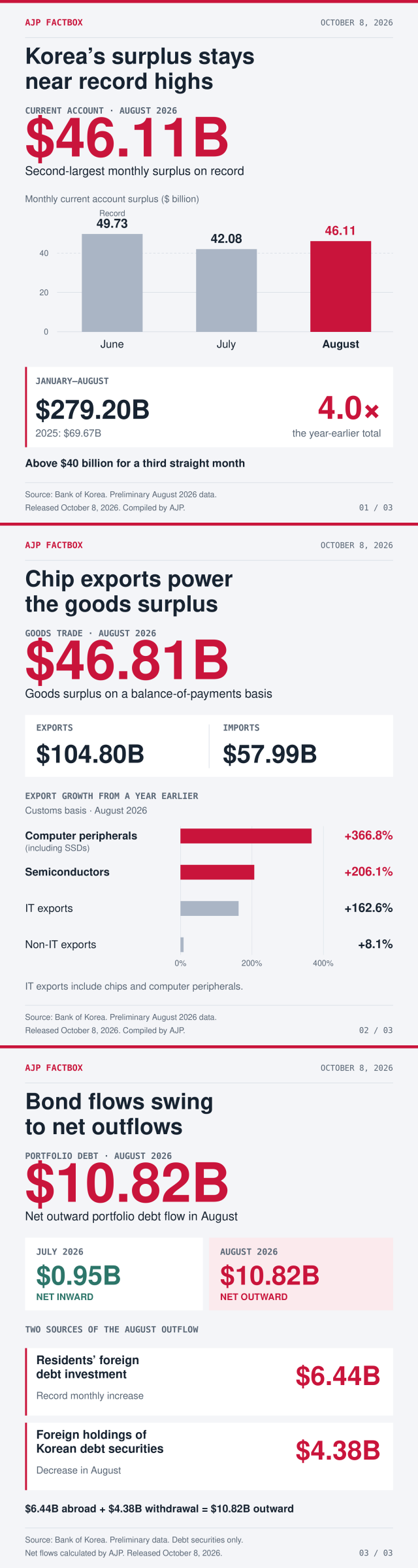
South Korea’s current account surplus reached $46.11 billion in August, its second-largest on record, as semiconductor exports surged, according to data released October 8 by the Bank of Korea (BOK). The January–August surplus totaled $279.20 billion, about four times the year-earlier figure.
Net portfolio debt flows swung from $950 million inward in July to $10.82 billion outward in August as residents increased foreign debt investment by a record $6.44 billion and foreigners reduced Korean debt holdings by $4.38 billion.

Kim Yeon-jae is a journalist at AJU Press (AJP's English platform),
covering macroeconomics, international finance, and geopolitics.
He closely tracks central bank monetary policies, global energy supply chains,
and the Korean defense industry.
Copyright ⓒ Aju Press All rights reserved.
Related News
-
 Korea's C/A second monthly high, quadrupled on year as of Aug
An export storage yard at Pyeongtaek Port in Pyeongtaek, Gyeonggi Province, is brightly lit on December 26, 2022. Aju Business Daily Yoo Dae-gil SEOUL, October 8 (AJP) —Unwaveringly robust chip demand fed the second-largest monthly current account surplus for South Korea in August, while Korean appetite for overseas debt was whetted by falling U.S. treasury and global bond prices, central bank data showed Thursday. The current account recorded a $46.11 billion surplus, widening from $42.08 billion in July and staying above $40 billion for a third straight month, according to the Bank of Korea (BOK). August's surplus was second only to the record $49.73 billion set in June. The cumulative surplus for the first eight months stretched to $279.20 billion, about four times the $69.67 billion recorded during the same period last year. Korean residents increased their holdings of foreign debt securities by a record $6.44 billion in August, more than five times July's $1.24 billion increase, while foreign investors reduced their holdings of Korean debt securities by $4.38 billion after adding $2.19 billion a month earlier. Combining the two sides, bond flows shifted to a net outward $10.82 billion in August from a net inward $950 million in July, marking a sharp reversal even as Korea continued to generate one of the largest current account surpluses in its history. The goods surplus widened to $46.81 billion from $40.43 billion in July, also the second-largest on record, as exports rose to $104.80 billion — staying above $100 billion for a third straight month — while imports fell to $57.99 billion. The export boom remained heavily concentrated in technology products. On a customs basis, semiconductor shipments surged 206.1 percent from a year earlier in August and exports of computer peripherals including solid-state drives jumped 366.8 percent, while overall IT exports rose 162.6 percent and non-IT shipments increased 8.1 percent. Imports also reflected continued investment in the semiconductor cycle, with capital-goods purchases rising 42.9 percent from a year earlier, including a 96.5 percent increase in semiconductor manufacturing equipment and a 70.6 percent rise in semiconductor imports. The services deficit narrowed to $1.68 billion from $1.97 billion in July as higher export freight rates lifted the transport surplus to $520 million from $60 million, more than offsetting a widening travel deficit that more than doubled to $770 million during the summer travel season. The primary-income surplus fell to $1.92 billion from $4.35 billion, largely because quarterly dividend payments reduced the dividend-income surplus to $1.18 billion, with such payments typically concentrated in February, May, August and November, according to the BOK. The sharper change came in the financial account, where Korean residents increased overseas portfolio assets by $16.60 billion in August, up from $13.57 billion in July and the second-largest monthly increase on record. Overseas equity investment remained high at $10.15 billion but eased from $12.33 billion, leaving the surge in foreign bond purchases as the main source of the monthly acceleration. The BOK attributed the record August increase in overseas debt-security investment to improved investment appeal in foreign bond markets at the time. Foreign portfolio investment in Korea simultaneously swung into reverse, falling by $4.85 billion after increasing by $8.17 billion in July. The BOK cited weaker arbitrage incentives as foreign investment in Korean debt securities declined, while foreign stock investment also turned negative after the temporary boost from SK hynix's American depositary receipt issuance faded. Despite the August reversal, foreign investment in Korean debt securities remained up $15.34 billion for the first eight months of the year, showing that the monthly outflow had yet to erase earlier inflows. As a result, net portfolio assets increased by $21.44 billion in August, nearly four times the $5.40 billion increase recorded in July. Comparable September balance-of-payments data have yet to be released, making it too early to determine whether August's shift in bond flows will persist. AJP Takeaways - Korea posted a $46.11 billion current account surplus in August, the second-largest on record and the third straight monthly surplus above $40 billion. - Bond flows swung from a net $950 million inward in July to a net $10.82 billion outward in August as residents' foreign bond purchases hit a record. - Residents' overseas portfolio investment rose to $16.60 billion, the second-largest monthly increase on record, while foreign portfolio investment in Korea turned negative.
-
 Can the Korean won stay resilient through year-end?
A USD/KRW exchange-rate board, Samsung Electronics' HBM4E chips and a U.S. stock-market display are shown in a composite image. AJP Yoo Na-hyun / Courtesy of Samsung Electronics / AI-generated image SEOUL, October 7 (AJP) — The South Korean won has held steady for more than a month after a volatile year despite heavy foreign stock selling, renewed Korean investment overseas and advance government payments tied to U.S. investment — offering relief to Koreans planning overseas trips or financing education abroad. The won closed Wednesday at 1,340.4 per dollar, up 0.9 percent from September and nearly 7 percent from the end of 2025. The pair has hovered around 1,340 since early September, weathering elevated U.S. Treasury yields, renewed dollar strength, oil prices above $100 a barrel and persistent foreign selling of Korean equities. Dealers broadly attribute that resilience to dollar sales by cash-rich exporters converting earnings accumulated during months of currency volatility as year-end settlements approach. “A sizable amount of exporter dollar selling is coming into the market, and that is capping the dollar-won's upside,” an FX official at a regional bank said. “We would need to check exactly which industries the flows are coming from.” Exporters sell dollars to obtain won for domestic expenses such as wages, taxes and supplier payments, adding foreign-currency supply to the local spot market. The potential pool of those dollars has expanded sharply alongside Korea’s record exports. Exports reached $120.94 billion in September and the trade surplus widened to a record $49.85 billion. Semiconductor shipments alone surged 262.8 percent from a year earlier to $60.30 billion, according to the Ministry of Trade, Industry and Resources. An FX official at a commercial bank said the dominance of chips in the export boom suggested that semiconductor companies accounted for a substantial share of the dollar sales. “Semiconductors are leading exports, so a substantial share of exporter dollar sales is bound to come from the chip sector,” the official said. “Those flows are clearly easing upward pressure on the dollar-won rate.” The official stopped short of linking individual transactions to specific semiconductor companies, reflecting dealers’ limited ability to trace the ultimate source of funds moving through the interbank market. Nor does a record trade surplus translate directly into an equivalent amount of dollars being sold in Seoul. Exporters can retain earnings in foreign-currency accounts, use them for overseas expenses and investments, hedge future payments or wait for a more favorable exchange rate before converting them into won. That distinction matters because Korea’s external surplus is only one side of the currency equation. The Bank of Korea said in an April study that a widening current-account surplus had coexisted with won depreciation for a prolonged period since the second quarter of 2023, as private overseas portfolio investment became increasingly important in the country’s external balance sheet. Overseas investment creates immediate demand for foreign currency, the central bank has also noted, even if the resulting assets generate income and strengthen Korea’s external position over time. Generated with ChatGPT Koreans’ exposure to U.S. equities remains substantial. Domestic investors held about $200.2 billion in U.S. stocks as of Oct. 5, according to Korea Securities Depository data, taking the value of their holdings above $200 billion for the first time in four months. The tension between cheaper dollars and continued overseas demand is also apparent among Koreans who regularly spend or invest abroad. Jeon Hyun-a, 52, sends living expenses to her eldest daughter, who is in her final year at a U.S. university. Her two younger children are also preparing for possible study in the United States. The earlier surge in the dollar-won rate into the 1,500s made those payments particularly painful, she said. The additional currency burden ate into gains she had made on U.S. and Korean AI-related stocks. “Since around mid-September, the burden of exchanging and sending money has eased a little,” Jeon said. But the stronger won has not diminished her interest in dollar assets. She has already bought some dollars and is considering increasing her holdings of dollar-denominated assets, including U.S.-listed exchange-traded funds such as QQQ, with potentially years of overseas education expenses ahead. Foreign tourists walk past a currency exchange booth displaying foreign exchange rates in Myeong-dong, Seoul, on August 24, 2026. AJP Yoo Na-hyun Kim Soo-hwan, 36, who works in motorsports and travels abroad frequently, said the earlier jump in the exchange rate sharply increased the cost of trips to the United States and Europe. The recent stabilization has made exchanging money less burdensome, although he remains wary of another abrupt rise in the dollar. “I don't think I would buy dollars outright right now,” Kim said. “But I would consider U.S. stocks, ETFs or other investments that give me dollar exposure.” Available data do not yet establish whether education remittances, travel-related currency purchases or other household dollar buying have increased since the won strengthened. Still, cheaper dollars give households with future overseas expenses an incentive to buy foreign currency or acquire dollar-denominated assets. For now, exporter dollar sales are helping meet demand arising from foreign equity outflows, overseas investment and other transactions. Record export earnings have enlarged the potential supply. Whether the exchange rate will stay stable for longer cannot be assured, but for families budgeting for tuition or travel, the respite is welcome — and an opportunity to prepare for the next bill. AJP Takeaways - The won closed at 1,340.4 per dollar Wednesday and has remained near the 1,340 level since early September despite persistent external headwinds. - Exporter dollar sales are helping cap the dollar-won's upside, with record semiconductor exports expanding the potential pool of foreign-currency supply. - Overseas investment remains a major source of dollar demand, suggesting the won's recent resilience does not necessarily point to a one-way appreciation through year-end.
-
 AJP Factbox: How big is South Korea's 2026 chip bonanza?
Graphics by Song Ji-yoon SEOUL, October 02 (AJP) -South Korea’s chip bonanza has compressed almost two years of exports into nine months. Semiconductor shipments reached $340.3 billion in January–September 2026, nearly twice the $173.4 billion exported during all of 2025, according to provisional government data. September alone brought in a record $60.3 billion—nearly three times January’s monthly total and up 262.8 percent from a year earlier. Chips generated 49.9 percent of Korea’s goods exports, almost matching every other product combined. Their export value was roughly 10 times that of cars and 4.7 times the country’s energy import bill. The international comparisons are equally striking. Korea’s September chip exports approached Japan’s entire August goods exports and exceeded those of India and Indonesia individually. They were also equivalent to nearly 30 percent of total U.S. goods exports and 15 percent of China’s. Those comparisons use August figures for the other economies, their latest available monthly data. Source: Ministry of Trade, Industry, and Resources. Edited by AJP and ChatGPT-assisted table Government data sources. Compiled and edited by AJP and ChatGPT Source: Government data. Compiled by AJP. Graphics via Claude