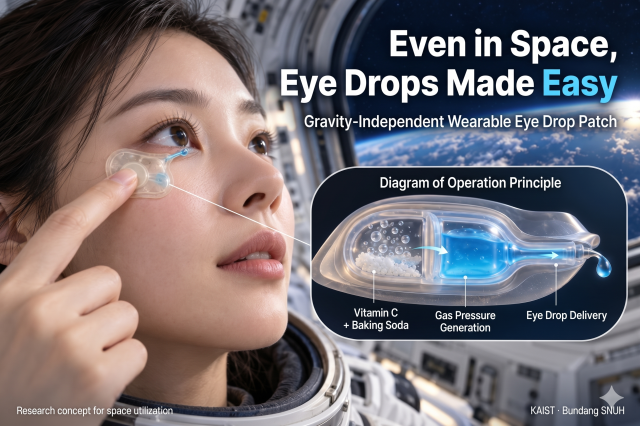
SEOUL, October 21 (AJP) - Putting in eye drops on Earth takes little more than tilting the head back, but in space a drop never falls into the eye. Researchers in South Korea have built a wearable patch that pushes medicine into the eye with gas from a reaction between vitamin C and baking soda, so the process no longer depends on gravity.
KAIST said Wednesday that a team led by Jeong Ki-hun, a professor in its Department of Bio and Brain Engineering, developed the patch with a team led by Professor Woo Se-joon at Seoul National University Bundang Hospital. The study was published online Oct. 7 in Sensors and Actuators B: Chemical, with doctoral student Jeon Jae-hun as first author.
On long missions, astronauts have to look after their own health without a doctor nearby, and eye care is part of that. In microgravity, body fluids shift toward the head, which can change the structure of the eye and affect vision, according to KAIST.
Standard eye drops offer little help in that setting because the liquid has to fall from the bottle into the eye.
The flexible patch attaches around the eye and holds two parts. One is a network of tiny channels that carry the eye drops, and the other is a small chamber where a chemical reaction builds pressure.
When the wearer presses a button on the patch, ascorbic acid, the chemical name for vitamin C, meets sodium bicarbonate, the main ingredient in baking soda, in the presence of water. The two react and release carbon dioxide, and the gas pressure pushes the drops along the channels and into the eye.
A filter between the reaction chamber and the drug reservoir lets gas pass but blocks liquid. That keeps the reacting chemicals out of the medicine while still transferring the pressure. Because the device needs no external pump and no electrical parts, KAIST said it could suit places where equipment is limited.
Controlling the reaction inside such a small device was the hardest part of the work, the team said. If carbon dioxide forms too quickly, the drug can shoot out too fast, and if the pressure is too low, the drops stay in the reservoir. The researchers tuned the reaction conditions, the size of the reservoir and the size and layout of the channels together to get a steady release.
In laboratory tests, the patch released drops consistently when the researchers turned it in different directions relative to gravity. They then tested it on volunteers wearing the device, using artificial tears mixed with a fluorescent dye. By tracking the glow in the volunteers' tears over time, they found that the patch delivered drops about as effectively as the usual method.
The patch has not been tested in space or in conditions that simulate microgravity, and the human trial used artificial tears rather than an actual medicine. KAIST said whether the patch works in a real space environment still needs to be confirmed.
Before it could become a medical device, the team said, it would also need checks on safety with repeated use, on how long drugs stay stable inside it and on whether it works with different types of eye drop formulas.
The researchers see uses on the ground as well. People with Parkinson's disease, whose hand tremors make it hard to aim a dropper, and older adults with limited movement could use the patch to give themselves eye drops.
"The flexible eye drop patch developed in this study is a wearable platform that can deliver drugs without separate, complex equipment," Jeong said. He added that he expected it could "expand into medical technology for various environments, including space medicine."
The team plans to test the patch with actual medicines and under conditions that simulate space, and to develop a version that can store drugs for long periods and be used repeatedly.
[Reference Information]
Journal/Source: Sensors and Actuators B: Chemical
Title: Wearable self-instillation microfluidic eyedrop patch for space medicine
Link/DOI: https://doi.org/10.1016/j.snb.2026.140885

Copyright ⓒ Aju Press All rights reserved.