SEOUL, November 5 (AJP) — South Korea's top financial authorities met Thursday to assess fallout from the U.S. midterm elections and possible changes in American policy, pledging coordinated monitoring as market volatility deepened.
Deputy Prime Minister and Minister of Finance and Economy Lee Hyung-il chaired a market monitoring meeting at the Export-Import Bank of Korea at 12:30 p.m., joined by Bank of Korea (BOK) Governor Shin Hyun-song, Financial Services Commission Chairman Lee Eok-won and Financial Supervisory Service Governor Lee Chan-jin.
Officials reviewed global financial-market reactions to the November 3 U.S. midterm elections and the potential impact of changes in American fiscal, trade and industrial policies, according to the Ministry of Finance and Economy.
The meeting took place amid a sharp selloff in South Korean equities, as concerns over tighter U.S. regulations on artificial intelligence data centers weighed on semiconductor stocks.
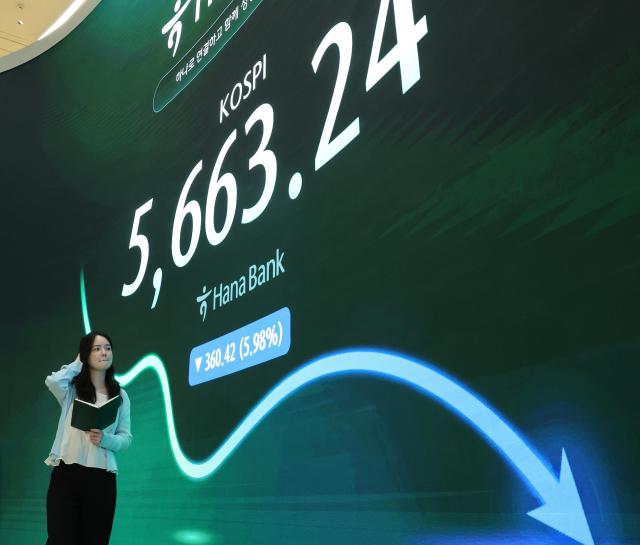
At around 2:50 p.m., the benchmark KOSPI had plunged 324.83 points, or 5.72 percent, to 5,358.97, while the tech-heavy KOSDAQ had lost 38.90 points, or 5.44 percent, to 676.05.
The Korea Exchange activated a sell-side sidecar on the KOSPI market at 10:16 a.m., temporarily suspending program sell orders for five minutes after KOSPI 200 futures fell more than 5 percent. A similar trading curb was subsequently triggered on the KOSDAQ market.
Samsung Electronics and SK hynix led the declines as investors reassessed the outlook for AI infrastructure investment following the U.S. election results.
The selloff followed a mixed reaction on Wall Street Wednesday. The Dow Jones Industrial Average surged 3.03 percent, while the S&P 500 and Nasdaq gained 1.58 percent and 1.44 percent, respectively. The Philadelphia Semiconductor Index, however, declined 3.13 percent.
South Korean government bond yields moved sharply lower, supported by reduced domestic bond issuance and a sharp decline in international oil prices.
In separate intraday quotations, the benchmark 10-year government bond yield fell 7.4 basis points to 3.894 percent, while the three-year yield declined 4.3 basis points to 3.671 percent.
The finance ministry cited the continuing impact of reduced government bond issuance and falling oil prices as factors behind the decline in domestic yields.
West Texas Intermediate crude plunged 8.3 percent to $88.12 a barrel Wednesday, while Brent crude dropped 8.7 percent to $94.62.
Officials said global financial markets had experienced significant swings during the U.S. election count, but volatility moderated as the results became clearer.
They agreed that the economic impact would depend on the direction, scope and pace of any changes to U.S. policy, particularly regulations affecting the AI industry and tariffs.
The authorities pledged to maintain joint market monitoring and assess developments in the Middle East, while coordinating a swift response if financial-market volatility intensifies.

Copyright ⓒ Aju Press All rights reserved.