
SEOUL, November 13 (AJP) - Nvidia is a darling of South Koreans invested in U.S. stocks and a customer helping memory chipmakers SK hynix and Samsung Electronics mint profits. Jensen Huang, its departing founder, enjoyed a celebrity status here.
Yet Seoul took his abrupt exit with relative calm. For now, Koreans are not ready to part with faith in AI.
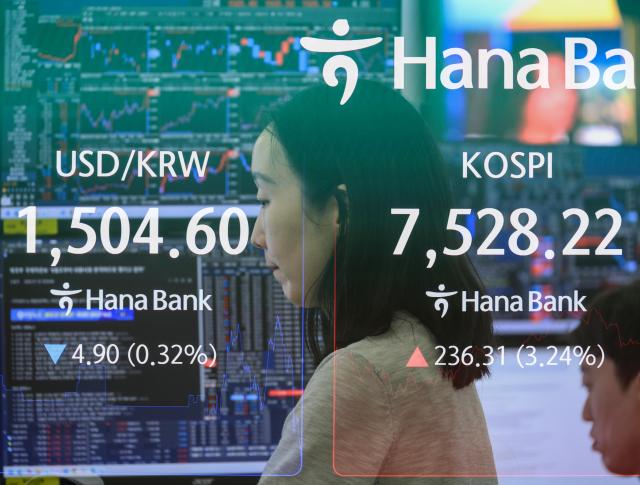
The main KOSPI ended Friday around 1 percent lower, reversing morning gains of more than 2 percent after foreign investors turned net sellers. The KOSDAQ finished 0.45 percent higher while the Korean won closed mostly flat at 1,337.70 per dollar.
For now, investors expect the $4 trillion company to remain in steady hands under interim leadership.
Nvidia finance chief Colette Kress, whom the board appointed interim CEO on Thursday, said in August that revenue for the fiscal year ending in early 2028 was expected to grow 70 percent. Although slower than the previous year, that would add around $287 billion in revenue at gross profit margins expected to exceed 70 percent.
The company does not expect supply of its AI chips to catch up with demand anytime soon.
“Although we will work to close the supply-demand gap, we expect supply to remain a bottleneck at least through the end of fiscal year ‘28,” Kress said.
Economists agree the AI phenomenon has yet to fizzle out.
“It's too early to call this a period of plateau,” said Yang Jun-sok, an economics professor at the Catholic University of Korea.
“We still don't have reliable figures for future revenue and profits. The industry is driven more by expectations than by predictable returns.”
Kim Dae-jong, a professor of business administration at Sejong University, sees the industry moving into a different phase.
“The AI boom hasn't peaked,” Kim said. “But we're moving from rapid expansion to a phase where efficiency and profitability are being put to the test.”
For Asian chipmakers that have benefited from the AI spending surge, that distinction could determine whether their shares recover from a steep selloff.
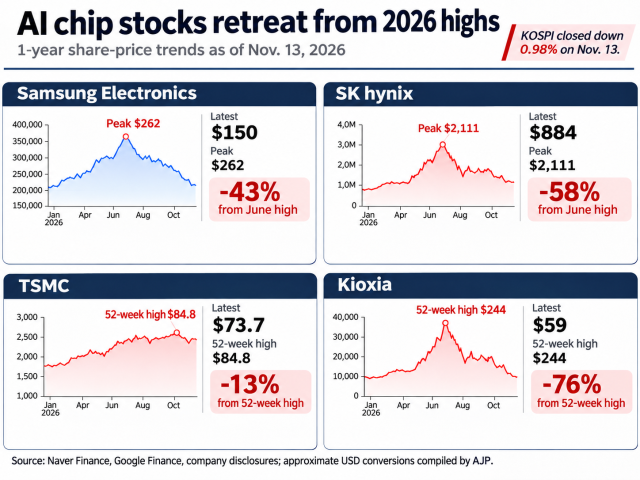
The four companies — Samsung Electronics, SK hynix, Taiwan’s TSMC and Japan’s Kioxia — have ridden the AI investment wave through different businesses, from advanced chipmaking and high-bandwidth memory to data storage.
Their shares have fallen sharply from this year’s highs, even as AI demand remains strong upon fears over over-enthusiasm and spending in AI buildout.
The reckoning sharpened after Huang's exit and the struggle to replace the outsized figure in the AI orbit.
Nvidia shares plunged more than 13 percent at the opening bell before recovering much of the loss to close Thursday 4.34 percent lower at $166.19. The stock has fallen roughly 31 percent from its October high, wiping out a substantial portion of the gains that had accompanied the AI investment boom.
Samsung Electronics ended Friday at 207,000 won, down 0.48 percent, and SK hynix at 1,222,000 won, down 2.55 percent. At Friday’s close, Samsung Electronics was about 43 percent below its June 18 peak of 362,500 won, while SK hynix was down roughly 58 percent from its June 22 high of 2,919,000 won.
The selloff also hit other Asian chipmakers, though the losses varied.
TSMC’s U.S.-listed shares closed Thursday at $405.49, about 17 percent below their 52-week high of $487.47, although they remained up roughly 34 percent this year. Japan’s Kioxia closed at 9,300 yen, down about 75 percent from its June peak.
Yang sees the retreat in Korean chip stocks as a correction of the excessive optimism that drove their rally earlier this year.
“The market was too optimistic about AI in the first half,” he said. “There was a bubble, and I think we're seeing something of a soft landing as it deflates.”
Kim also sees room for a reassessment of valuations, though he remains more optimistic about the industry’s long-term prospects.
“AI will remain a major growth industry shaping the global economy over the next decade,” Kim said. “But excessive expectations in the stock market can still be corrected.”
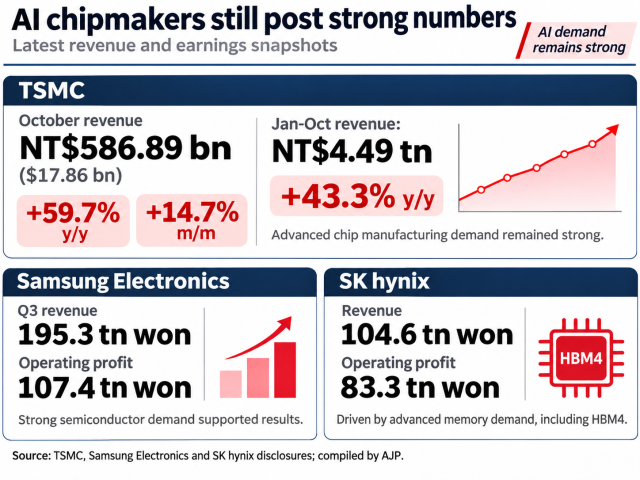
The stocks have stumbled. The earnings have not.
TSMC, the world’s largest contract chipmaker and a key manufacturer of Nvidia’s advanced processors, reported October revenue of NT$586.89 billion ($17.86 billion), up 59.7 percent from a year earlier and 14.7 percent from September. Revenue for the first 10 months rose 43.3 percent from a year earlier.
South Korea’s two chip giants have also delivered record earnings. Samsung Electronics reported third-quarter revenue of 195.3 trillion won and operating profit of 107.4 trillion won, while SK hynix posted revenue of 104.6 trillion won and operating profit of 83.3 trillion won, fueled by strong demand for advanced memory chips, including fourth-generation high-bandwidth memory (HBM4).
Still, strong AI demand alone does not guarantee sustained profit growth. Samsung Electronics and SK hynix compete in the HBM market, which supplies the fast memory used alongside AI processors. Their earnings will depend on chip prices, production capacity and their ability to secure customer orders.
Kioxia faces different challenges. The Japanese company specializes in NAND flash memory, used to store data in AI data centers rather than feed AI processors at high speed. Growing demand for storage could lift its earnings, but an oversupply of NAND chips could drive down prices and squeeze profits.
“All four companies stand to benefit from AI's long-term growth, but their share prices will increasingly diverge based on their technology, profitability and how much future growth is already priced in,” Kim said.
“Samsung has room to grow if it strengthens its HBM technology and recovers market share,” Kim said. “SK hynix is a major beneficiary of AI investment, but its stock may already reflect much of the expected earnings growth.”
Kim said Samsung also has an advantage in operating both memory and contract chipmaking businesses, giving it more ways to benefit from AI demand. SK hynix, despite its leading position in HBM, could face greater short-term share-price volatility if earnings fail to meet already elevated expectations.
For TSMC, Kim sees advanced chipmaking technology and a broad customer base as key advantages, although geopolitical risks and heavy capital spending remain concerns.
“Kioxia could benefit from growing demand for enterprise solid-state drives (SSDs) as AI data centers expand,” he said. “But it faces greater volatility from NAND oversupply and price swings.”
For the two Korean chipmakers, Kim said, much will depend on whether they can secure more HBM4 orders as competition intensifies.
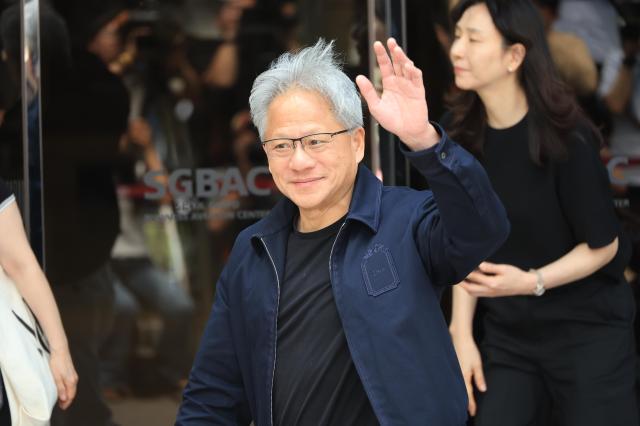
The outlook also depends on Nvidia, whose processors sit at the center of much of the AI infrastructure boom. Its leadership shake-up raises questions about whether the company can sustain innovation and keep customers’ investment plans on track.
“For the next few months, I don't expect a major difference because the GPUs have already been sold and investment plans are in place,” Yang said. “But if the company loses momentum without Huang, we could begin to see the effects in two or three months.”
Yang said Nvidia would need time to reorganize a decision-making structure centered on Huang. He estimated that the transition could take around six months, depending on how quickly the company appoints a successor and the new CEO’s experience.
Kim, however, believes Nvidia’s competitive edge extends well beyond its founder. He pointed to the company’s CUDA software platform, which helps developers use its processors for computing tasks.
“Nvidia's competitiveness does not depend on one person alone,” he said. “It has accumulated GPU design expertise, the CUDA software ecosystem, a global customer network and enormous research and development capabilities.”
Both economists see opportunities for Nvidia’s rivals, though Yang expects its technological and software lead to limit any immediate shift.

Kim sees growing competition as an opportunity for Korean memory suppliers.
“If Samsung and SK hynix reduce their dependence on a single company and diversify their customers across Nvidia, Advanced Micro Devices (AMD) and Google, they can create new growth opportunities in HBM and advanced memory,” he said.
Nvidia, for its part, has sought to reassure customers. Its board said Thursday that it expects existing commitments, operations and product development plans to continue without disruption.
Yang identified a separate, conditional risk: any evidence of leaked company secrets or management involvement in illegal chip shipments to China could expose Nvidia to criminal proceedings and regulatory penalties.
Huang’s departure adds to pressures already weighing on the AI boom. Rising borrowing costs, opposition to energy-intensive data centers and uncertainty over how technology companies will fund their expansion plans have raised doubts about whether AI spending can continue at its current pace.
Kim sees the industry shifting toward a greater focus on returns.
“The industry is moving from quantitative expansion to qualitative growth,” Kim said. “Companies that use AI to raise productivity and generate real profits will be valued more highly than those that simply build more data centers.”
He pointed to financing costs, electricity shortages, delays in expanding power grids and local opposition as constraints on further construction.
“AI companies are investing enormous sums, but the question is how quickly those investments can produce revenue and profits,” Kim said. “Growth will continue, but the days of expanding investment without regard to returns will become harder to sustain.”
For investors, the question is whether AI stocks can keep rising as growth slows. Strong earnings may not be enough if expectations are too high. Shares that have already fallen sharply, however, could recover if profits hold up.
AJP also asked ChatGPT and Anthropic’s Claude whether the AI chip boom was nearing a plateau.
Echoing Kim’s view that the boom has not peaked, ChatGPT suggested that demand for advanced processors and memory could keep growing even if data-center construction slows. Claude’s assessment was closer to Yang’s, suggesting that the selloff in chip stocks may reflect a correction in excessive expectations rather than weakening demand.
Attention now turns to Nvidia’s fiscal third-quarter results on November 17, due after U.S. markets close. Investors will be watching its earnings, sales outlook and plans for maintaining its technology roadmap under new leadership.
The AI boom may outlast Jensen Huang. But for chip stocks, the question is whether reality can finally catch up with the hype.

Ryu Yuna
Yuna Ryu covers finance, capital markets and Southeast Asian affairs.
She is drawn to the questions that numbers raise and the stories that data alone cannot answer.
Prior to journalism, she worked at Hyundai Motor Company and the Singapore Chamber of Commerce, focusing on business strategy and international affairs. She has also hosted diplomatic receptions and international conferences as an MC.
Ryu holds a master's degree in Media and Communication from Korea University, where her research focused on neuroscience-based studies of media effects.
Copyright ⓒ Aju Press All rights reserved.
Related News
-
 KOSPI falls as foreigners sell
South Korea's KOSPI fell 0.98 percent to 5,290.53 on Friday after touching an intraday high of 5,504.44, while Korea Electric Power Corp. plunged nearly 10 percent following disappointing third-quarter earnings. Foreign investors sold 550.5 billion won ($412.6 million), while retail investors bought 17.4 billion won and institutions followed with purchase of 2.1 billion won. Among the most actively traded stocks by volume, Samsung Electronics slipped 0.48 percent to 207,000 won, while Kumho Electric jumped 23.18 percent to 8,130 won and Kumho Engineering & Construction surged 29.90 percent to 11,210 won. Tags : KOSPI, Stocks, Samsung Electronics, Kumho Electric, Kumho Engineering and Construction,
-
KOSPI Falls 0.98% Amid Foreign Selling; KOSDAQ Closes Higher
코스피가 외국인의 매도세에 밀려 하락마감했다. 삼성전자와 SK하이닉스 등 반도체 대형주가 동반 하락하며 지수를 끌어내렸다. 반면 코스닥은 기관의 매수세에 힘입어 상승 마감했다.On November 13, the KOSPI index closed down 52.20 points, or 0.98%, at 5,290.53, marking its second consecutive day of decline following a 0.61% drop the previous day.Foreign investors led the decline in the KOSPI, selling a net 547.5 billion won ($460 million) in the stock market. Meanwhile, individual and institutional investors bought a net 17.4 billion won and 2.1 billion won, respectively, but their purchases were insufficient to absorb the foreign selling pressure.Among the top market capitalization stocks, semiconductor-related shares saw significant declines. Samsung Electronics fell 0.96%, while SK Hynix dropped 3.03%. Other notable declines included SK Square (-3.67%) and Samsung Electro-Mechanics (-3.50%). Additionally, Samsung Biologics (-2.62%) and LG Energy Solution (-1.52%) also experienced losses.In contrast, KB Financial Group rose 4.74%, with Hyundai Motor (1.13%), Samsung Electronics preferred shares (1.31%), and Samsung Life Insurance (0.80%) also closing higher.The KOSDAQ index finished up 3.13 points, or 0.45%, at 699.66, driven by institutional buying of 126.2 billion won. However, individual and foreign investors sold a net 56.3 billion won and 75.2 billion won, respectively.Among the top KOSDAQ stocks, Rainbow Robotics rose 5.21%, while EcoPro BM (1.00%), EcoPro (0.41%), and JUSUNG Engineering (0.29%) also gained. Conversely, IOTech (-2.72%), Samchundang Pharm (-1.76%), Rino Technology (-1.71%), and Alteogen (-0.68%) showed weakness.Market sentiment was shaken by uncertainties surrounding the AI semiconductor supply chain and expectations for government measures to stabilize the market. During a capital market policy meeting, various policies were discussed, including the stabilization fund, shareholder return enhancements, and restructuring of the KOSDAQ, but no immediate market intervention plans were announced.Lee Kyung-min, a researcher at Daishin Securities, noted, "Concerns have grown regarding the AI semiconductor supply chain following allegations that Alice Huang, the former partner of Jensen Huang, the former CEO of NVIDIA, is linked to Chinese intelligence agencies, along with suspicions that NVIDIA's Blackwell chips were supplied to China's DeepSeek."He added, "While the capital market policy meeting discussed the stabilization fund, shareholder return enhancements, KOSDAQ restructuring, and measures to increase long-term investment funds, there were no immediate plans for the activation of the stabilization fund or specific execution plans, which limited the ability to meet investors' expectations for short-term market stabilization measures."* This article has been translated by AI.
-
 AI bust? Korea presses on with chip republic despite Huang setback
Ground-breaking ceremony of Chungcheong Mega Project in Onyang on Nov. 12 2026. At the center President Lee Jae Myung to his right industry minister Kim Jung-kwan and to his right Samsung Electronics chair Lee Jae-yong. Courtesy of Cheong Wa Dae Editor’s note: South Korea has basked in the glow of Nvidia’s epic rise and now stands exposed to the fallout from the sudden departure of Jensen Huang, a central architect and driver of the AI boom. His exit comes as scrutiny of soaring AI spending and resistance to data center construction test the durability of a boom that has powered Korea’s semiconductor earnings and export surge. In this four-part series, AJP examines the ripple effects on chipmakers, the wider AI supply chain and the broader economy. SEOUL, November 13 (AJP) - President Lee Jae Myung and Samsung Electronics Chairman Lee Jae-yong turned the first shovels of earth on Thursday at a groundbreaking ceremony to scale up the company’s decades-old chip assembly and testing complex in Onyang into a cutting-edge high-bandwidth memory (HBM) packaging hub while Nvidia — a driving force behind South Korea’s ambitious chip republic project — was weighing the ouster of its founder and AI crusader Jensen Huang. "This site, once focused on assembling and testing conventional semiconductors, will be transformed into a cutting-edge HBM hub at the heart of AI chips," the president declared in Asan, South Chungcheong Province. The city is positioned to bridge a growing chip belt connecting the industry’s established bases in Gyeonggi Province with planned hubs in Honam, the southwestern region encompassing Gwangju. Samsung plans to invest 46 trillion won ($34 billion) in the Onyang campus over time, including 6 trillion won for facilities and 40 trillion won for advanced equipment. Its new production line is scheduled to begin operations in June 2028, about a year earlier than originally planned. The investment is part of a broader industrial buildout stretching from Samsung’s semiconductor complexes in Pyeongtaek and Yongin to its planned factories in Gwangju, alongside SK hynix’s expanding manufacturing network in Yongin and Cheongju. Together, the projects represent a multiyear bet that demand for AI computing power will remain strong enough to justify new fabrication plants and advanced packaging facilities well into the next decade. Huang’s abrupt departure adds uncertainty to that bet. Nvidia named Chief Financial Officer Colette Kress as interim CEO, and the transition has not been accompanied by any announced changes to Nvidia’s HBM procurement or capital spending plans. Nevertheless, it adds a new variable to an industry already questioning how long the extraordinary pace of AI infrastructure investment can last. For Samsung, the expansion involves coordinating the factories that manufacture chips with the facilities that turn them into finished products. HBM4 illustrates the division of labor. Samsung’s design combines sixth-generation 10-nanometer-class DRAM, known as 1c DRAM, which stores data, with a 4-nanometer logic base die that controls signal transmission. The components are made through separate memory and foundry processes. Packaging brings them together into a single product, stacking, connecting and testing the chips before they can be supplied to AI processor makers. More DRAM production in Pyeongtaek will therefore translate into more HBM shipments only if packaging facilities can handle the additional output. Expanding chip fabrication in the Seoul metropolitan region and advanced packaging in the Chungcheong region are complementary investments. President Lee Jae Myung shakes hands with Samsung Electronics chairman Lee Jae-yong at Onyang groundbreaking ceremony on Nov. 12, 2026. Courtesy of Cheong Wa Dae Samsung’s established manufacturing bases also have distinct roles. Giheung develops and validates next-generation processes before mass production. Samsung plans to invest 20 trillion won in its integrated research and development complex there by 2030. Hwaseong houses DRAM production lines and foundry operations using extreme ultraviolet (EUV) lithography, a technology for printing fine circuit patterns. Pyeongtaek handles mass production of memory and advanced foundry chips, with its fourth production line expanding capacity for the 1c DRAM used in HBM4. The Pyeongtaek and Onyang expansion schedules are closely aligned. Samsung has identified 2028 as the year its fifth line in Pyeongtaek’s second complex will begin operating as a key HBM production base. Onyang’s fifth line, which broke ground Thursday, is targeting June of the same year. The company stressed that the 46 trillion won commitment is a medium- to long-term investment in five HBM production lines at the Onyang campus, rather than the construction cost of a single building. The campus, which began operations in 1991, is shifting from conventional semiconductor assembly and testing toward the advanced stacking required for high-performance memory. Nearby Cheonan is also expanding and modernizing facilities to handle HBM. The importance of the Chungcheong region lies increasingly in the products it can complete, beyond its geographical position between existing and planned manufacturing hubs. Samsung’s next major fabrication expansion in the metropolitan region is in Yongin’s Cheoin district. Separate from its existing Giheung campus, the company plans to build six fabs in stages at the advanced system semiconductor national industrial complex, with the first production line targeting October 2029. Edited and compiled by AJP. Graphics AI Assisted The Honam investment looks further ahead. Samsung announced in June that it would invest 400 trillion won to build two new fabs in Gwangju. The planned facilities will manufacture circuits on silicon wafers, extending Samsung’s fabrication footprint from southern Gyeonggi into southwestern Korea. Advanced packaging operations in Chungcheong would help complete the expanding production network. SK hynix is also accelerating its expansion. In August, the company approved 54.3 trillion won in additional investment for two new fabrication facilities: 35.2 trillion won for its second Yongin plant, known as Y2, and 19.1 trillion won for M17 in Cheongju. The first cleanroom at Y2 is scheduled for June 2029, while M17 is targeting December 2028. The company is also developing its first Yongin facility, Y1, and expanding production capacity at its Cheongju manufacturing complex. The scale of those commitments reflects the increasingly high stakes of the global AI race. SK Group Chairman Chey Tae-won acknowledged the extraordinary sums required during a lecture at Seoul National University on Nov. 5. "The scale and very concept of money have changed completely," Chey said, recalling the announcement of a 2,100 trillion won investment initiative associated with the government’s regional megaprojects. "The whole world is in this game. We cannot keep up unless we make bets of this magnitude." His remarks capture the dilemma facing Korean chipmakers. Investing too cautiously risks falling behind in the next phase of AI development. Expanding too aggressively could leave them exposed if demand slows before new facilities reach full production. Chey also warned of heightened market volatility after a sharp selloff in semiconductor stocks following the U.S. midterm elections. "This roller-coaster market is bound to continue," he said. The warning comes as investors debate whether the memory industry’s extraordinary earnings growth is approaching a cyclical peak. Samsung and SK hynix are still enjoying strong demand for HBM and conventional memory. But their longer-term outlook remains sensitive to AI infrastructure spending, memory prices and the timing of new capacity. Edited and compiled by AJP. Graphics AI Assisted A slowdown or plateau in growth from 2027 would not necessarily end the boom. It could, however, change the conditions under which factories planned during the current heyday begin operating. Major facilities scheduled to come online from 2028 onward will add supply to a market whose growth trajectory remains uncertain. Decisions made while demand is racing ahead will be tested against the orders and prices available several years later. For both companies, maintaining profitability will increasingly depend on more than producing additional chips. Energy efficiency is emerging as a critical competitive factor as data center operators confront rising electricity costs, power-grid constraints and pressure to improve computing performance per watt. Advanced memory packaging, lower-power chips and improved thermal performance could help Korean suppliers strengthen their positions even if the pace of new data center construction moderates. Customer diversification could provide another avenue for growth. Nvidia remains a major force behind global HBM demand, but competing AI accelerator developers and cloud computing companies designing their own chips offer additional opportunities for memory suppliers. Korea’s chip republic is therefore pressing ahead with a construction timetable that extends far beyond Huang’s departure. The strategic challenge is whether its chipmakers can sustain demand and profitability when the factories now breaking ground begin delivering output. The investments underway in Onyang, Pyeongtaek, Yongin and Cheongju will be tested long after today’s semiconductor earnings records have been set.