

Candice Kim
Candice Kim is a dedicated business and technology reporter specializing in the intersection of high-tech innovation and fast-paced consumer trends. Her core beats span the semiconductor, IT, cosmetics, and retail sectors, where she provides in-depth coverage of industry titans including Samsung Electronics, SK hynix, and LG Electronics, alongside leading consumer brands like Olive Young and Musinsa. Whether analyzing complex silicon supply chains or tracking the latest shifts in beauty and fashion retail, Candice is committed to delivering sharp, accurate reporting that keeps readers informed on the forces shaping today's most dynamic markets.
Copyright ⓒ Aju Press All rights reserved.
Related News
-
 One in four young Seoul women say they don't want to marry
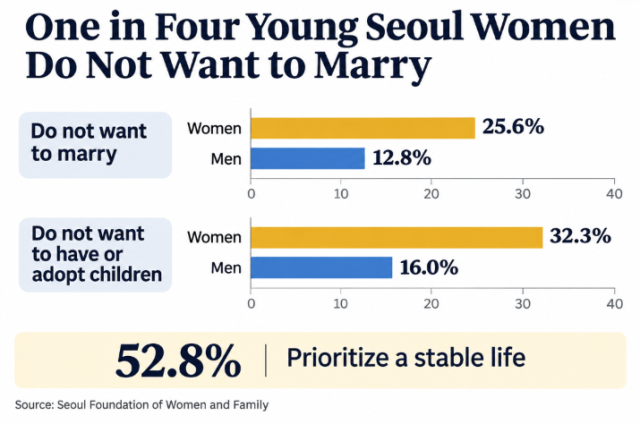
Graphics AI assisted SEOUL, November 15 (AJP) - One in four young women in Seoul say they have no desire to marry, twice the proportion of men, according to a survey released Sunday that also found a sharp gender gap in attitudes toward having children. According to a report released by the Seoul Foundation of Women and Family, 25.6 percent of unmarried women aged 19 to 34 said they did not want to marry, compared with 12.8 percent of men. The gap was similarly pronounced in attitudes toward parenthood. Some 32.3 percent of women said they did not want to have or adopt children, more than double the 16 percent of men who gave the same response. Among those opposed to marriage, 51.8 percent of women and 38.9 percent of men said they saw no need for it. Financial concerns were cited by 14.7 percent of women and 23.9 percent of men. The survey, conducted online from May 11 to 29, covered 2,647 Seoul residents aged 19 to 34. Questions on marriage were directed at 2,331 respondents without spouses. The findings also revealed differing perceptions of gender equality. The largest group, accounting for 40.3 percent, recognized both structural disadvantages faced by women and discrimination against men while emphasizing fairness. Another 29.9 percent expressed heightened sensitivity to gender discrimination, bringing the combined share of the two groups to 70.2 percent. Despite these differences, financial and personal stability remained a common priority. More than half of respondents, or 52.8 percent, identified a stable life as their most important value, followed by high income at 20.6 percent and work-life balance at 16.3 percent. Women were more likely to cite career interruptions and work-life balance as concerns, while men emphasized income and housing costs, according to follow-up interviews. The foundation said policymakers should consider differences in gender perceptions, economic circumstances and family plans when designing employment, housing and childcare support programs.
-
 Swiss children switch sides to challenge career stereotypes
Courtesy of National Future Day website ZURICH, November 12 (AJP) -Thousands of Swiss schoolchildren spent Thursday trying out jobs dominated by the other gender as Switzerland held its National Future Day for the 26th time. Boys helped out in care homes and therapy practices. Girls put on hard hats at building sites and tried their hands at joinery. More than 1,700 companies and public bodies participated in Nationaler Zukunftstag, Switzerland’s annual career exploration day for pupils in grades five to seven, Swiss public broadcaster Schweizer Radio und Fernsehen (SRF) reported. The day’s motto is “Seitenwechsel,” German for “switching sides.” Organizers say it is not an ordinary career taster day. The aim is to introduce children to a working world they might never picture themselves entering. At an occupational therapy practice in Regensdorf near Zurich, two boys aged 10 and 12 spent the day with therapist Fabian Debrassine. Men make up only about 10 percent of his profession. He told SRF that male therapists can be role models for boys who would otherwise never consider the field. In Effretikon, northeast of Zurich, three girls aged 10 to 12 tried their hand at a training center for the building trades. Women hold about one in 10 jobs in Swiss construction, up from just under 6 percent around 30 years ago, according to figures reported by SRF last year. Switzerland’s vocational system makes that early exposure particularly relevant. While university remains a major goal for teenagers in South Korea and Japan, most Swiss students enter vocational apprenticeships after completing compulsory schooling at around 15 or 16. The trade they choose can shape much of their working life. Future Day tries to reach them years before that decision, while their ideas about work are still forming. Those ideas take root early. Children begin forming views about which jobs suit them between the ages of 4 and 6, said Elena Makarova, an education researcher at the University of Basel. “The Swiss job and training market is strongly divided by gender,” Makarova told SRF. She cited a study showing that only about two in 100 Swiss men choose an occupation in which men are a clear minority. Among women, the figure is about six in 100. Pressure to conform to gender norms appears stronger for boys than for girls, she said. The event began in 2001 as “Daughters’ Day,” when girls accompanied their fathers to work to explore occupations dominated by men. Boys joined in subsequent years, and the event took its current name in 2010. Alongside those persistent divisions, children face a changing career landscape. SRF highlighted jobs that barely existed 20 years ago, from artificial intelligence (AI) product manager to civilian drone pilot and professional gamer. At the other end of the spectrum, cashiers and administrative assistants are among the occupations the World Economic Forum (WEF) expects to see the largest declines worldwide by 2030. Swiss children tried jobs usually done by the other gender on Switzerland’s national Future Day on Nov. 12, 2026. Graphics AI assisted Gaming illustrates how opportunities in emerging careers differ across countries. Switzerland’s first salaried esports team, Team Helix, paid each player 2,500 Swiss francs a month in 2018 — roughly $2,560 at that year’s average exchange rate. The team folded within a year after its sponsor withdrew. Full-time gaming careers remain far more accessible in South Korea, China or the United States, SRF said. Asia also faces persistent gender divisions. In the WEF’s Global Gender Gap Report released in September, East Asia and the Pacific ranked fourth among eight regions, behind Europe, North America and Latin America. South Asia ranked second to last. New occupations will not necessarily erase old patterns. Women account for fewer than one in five AI engineers worldwide, according to the WEF. Makarova said a single day could achieve little on its own. Lasting change requires sustained support, visible role models and career advice that does not steer children by gender. Whether either of the boys in Regensdorf becomes a therapist will not be known for years. Tags: Switzerland, Zukunftstag, Future Day, gender equality, apprenticeships, vocational training, careers, esports, Asia, South Korea, Japan, World Economic Forum, AI jobs
-
 Government Launches Investigation into GS Construction's Data Breach
The South Korean government has initiated an official investigation into a hacking incident involving GS Construction's apartment community facility reservation and management system. The company reportedly declined to cooperate with the government investigation, citing its own analysis as the reason, although GS Construction clarified that it only disagreed with the technical support aspect of the investigation.On November 11, the Ministry of Science and ICT announced its decision to investigate the breach of resident information at GS Construction, following the implementation of the revised Information and Communications Network Act last month. This marks the first instance of an official investigation being launched under the newly established legal committee for reviewing breach incidents.The incident occurred on the night of October 28. GS Construction detected unusual access attempts at 11:29 PM and subsequently blocked external access. Analysis of access logs revealed that the initial unauthorized access occurred around 10:15 PM on the same day. The affected system is the community facility reservation management system (formerly FMCS).Information that may have been compromised includes residents' names or nicknames, birth dates, mobile phone numbers, gender, email addresses, home addresses, membership numbers, residency types, passwords, administrator IDs, household head status, membership registration timestamps, last login IP addresses, and RF card numbers. GS Construction stated that the actual data leaked varies by customer and is currently investigating the extent of the breach for each individual.GS Construction reported the breach on October 29 but did not agree to the investigations by the Ministry of Science and ICT and the Korea Internet & Security Agency (KISA), citing its intention to conduct its own analysis. The committee determined that an official investigation was necessary due to the scale of the leak and the sensitivity of the information involved, and it is considering forming a joint public-private investigation team if the incident is deemed significant.Previously, government investigations into breach incidents required voluntary reporting or consent from companies. However, under the revised Information and Communications Network Act, which took effect on October 1, official investigations can now be conducted if there is clear evidence of a breach or if there are concerns about potential harm to the public.A GS Construction representative stated, "We did not refuse the government's and KISA's investigation; rather, we disagreed with the technical support for our own cause analysis and preventive measures. We will cooperate sincerely with the relevant investigations."* This article has been translated by AI.