

Candice Kim
Candice Kim is a dedicated business and technology reporter specializing in the intersection of high-tech innovation and fast-paced consumer trends. Her core beats span the semiconductor, IT, cosmetics, and retail sectors, where she provides in-depth coverage of industry titans including Samsung Electronics, SK hynix, and LG Electronics, alongside leading consumer brands like Olive Young and Musinsa. Whether analyzing complex silicon supply chains or tracking the latest shifts in beauty and fashion retail, Candice is committed to delivering sharp, accurate reporting that keeps readers informed on the forces shaping today's most dynamic markets.
Copyright ⓒ Aju Press All rights reserved.
Related News
-
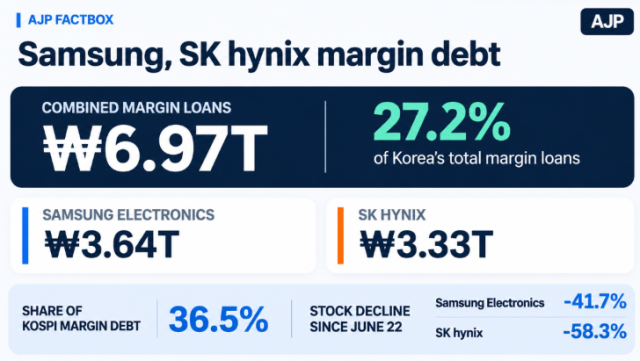
 Samsung, SK hynix draw 27% of Korea's margin debt
SEOUL, November 15 (AJP) - Samsung Electronics and SK hynix accounted for 27.2 percent of South Korea's outstanding margin loans as of Thursday, raising concerns that leveraged bets on the two chipmakers could amplify stock market volatility, according to data from FnGuide. Outstanding margin loans stood at 3.64 trillion won for Samsung and 3.33 trillion won for SK hynix, totaling nearly 7 trillion won. The two stocks accounted for 36.5 percent of margin debt on the benchmark KOSPI, while their share of the broader market's margin debt averaged just 6.7 percent last year. The concentration comes amid sharp swings in semiconductor stocks driven by concerns over AI investment returns. Samsung and SK hynix have fallen 41.7 percent and 58.3 percent, respectively, since June 22, raising the risk of further declines from forced selling. Tags: Samsung, Samsung Electronics, SK hynix, Korea, SCO, semiconductor, AI
-
 Samsung wins 19 CES 2027 innovation awards
Courtesy of Samsung Electronics SEOUL, November 15 (AJP) - Samsung Electronics has secured 19 CES 2027 Innovation Awards, including four top honors, with its foldable smartphones, displays and AI-related memory products among the winners. The Consumer Technology Association (CTA), which organizes the annual technology exhibition in Las Vegas, announced the winners on Nov. 9, ahead of CES 2027 in January. Samsung received 13 awards in video displays, three in semiconductors, two in mobile devices and one in home appliances. Its four Best of Innovation awards, up from three last year, went to two display products and two foldable smartphones. The Galaxy Z Fold8 and Galaxy Z Fold8 Ultra received the top honors in the mobile category. The Ultra model, Samsung's first foldable to carry the Ultra branding, features an 8-inch main display and a 5,000mAh battery. In semiconductors, the company won awards for three memory products: LPDDR5X SOCAMM2 and DDR5 RDIMM modules designed for AI servers, and UFS 5.0 storage for on-device AI applications. The Bespoke AI Combo all-in-one washer-dryer also received an award in the home appliance category. The winning products are scheduled to be showcased at Samsung's CES 2027 exhibition in Las Vegas in January.
-
Gwangju-Jeonnam Integrated City Advocates for Strategic Relocation of Public Institutions
The Gwangju-Jeonnam Integrated City is advocating for the prioritization of public institutions ahead of the second phase of their relocation. Academics have joined the call, emphasizing the need for the relocation of the National Agricultural Cooperative Federation, the National Federation of Fisheries Cooperatives, the headquarters of five power companies, and IBK Industrial Bank. Experts argue that the relocation of public institutions should not merely be a distribution among regions but should be approached as a strategic placement aimed at enhancing industrial competitiveness and achieving national balanced development. This perspective raises questions about how it may influence the government's selection and placement of relocating institutions. According to the Gwangju-Jeonnam Integrated City, the Korean Regional Development Association held its 2026 Fall Academic Conference on November 13 in Naju, focusing on the theme of 'Second Phase of Public Institution Relocation and Balanced Development Strategies for Integrated Metropolitan Areas.' The conference attracted over 200 participants, including academic experts, local government officials, and representatives from related organizations, who discussed strategies for attracting public institutions to the Gwangju-Jeonnam Integrated City and plans for regional balanced development. In his keynote speech, Go Kwang-wan, a special professor at Chosun University, emphasized the need for the government to reflect the special consideration for prioritizing the integrated city in the relocation of public institutions as outlined in the 'Special Law for the Establishment of Gwangju-Jeonnam Integrated City.' Professor Go proposed that the headquarters of the National Agricultural Cooperative Federation, the National Federation of Fisheries Cooperatives, and the five power companies should be located in the integrated city, citing the region's largest agricultural and fishery production base and abundant renewable energy resources. He also highlighted the necessity of prioritizing the relocation of IBK Industrial Bank, a specialized financial institution for small and medium-sized enterprises, to build an industrial ecosystem linked to the planned investment of 800 trillion won by Samsung Electronics and SK Hynix in semiconductor production facilities. Practical execution plans regarding securing office buildings and improving living conditions due to the relocation of public institutions were also presented. Yu Chang-ho, a senior researcher at the Regional Development Institute of Chonnam National University, suggested constructing a modular joint rental office building within the innovation city to accommodate 2,200 people for the swift relocation of smaller institutions. Kim Kyung-ae, CEO of K Research and Consulting, emphasized that based on surveys of relocating institution employees and local residents, there should be simultaneous efforts to enhance cultural and medical facilities and improve regional transportation networks to create a stable living environment. Im Hyung-baek, a professor at Sungkyul University, argued that the relocation of public institutions should be pursued in a manner that enhances regional industries and national productivity, rather than framing it as a conflict between the capital region and local areas. He introduced the 'Nash equilibrium' policy model, which seeks to find a reasonable balance while adjusting the interests of different regions. Additionally, discussions and presentations continued on topics such as addressing regional development disparities, strengthening the role of local governments, residential mobility and regional settlement, improving the quality of life in rural areas, and changes in regional vitality and living environments. Jeon Han-seong, head of the Financial Planning Division of Gwangju-Jeonnam Integrated City, stated, "The second phase of public institution relocation is a crucial opportunity to expand the region's future growth base and establish a new turning point for national balanced growth. We will concentrate all our efforts to ensure that the government's promise of preferential treatment for integrated regions is practically reflected in the relocation policy." Ki Jeong-hoon, president of the Korean Regional Development Association, remarked, "The launch of Gwangju-Jeonnam Integrated City holds significant meaning as it connects the region's industries, talents, universities, research institutions, and living areas into a single metropolitan development system beyond administrative boundaries." He further emphasized, "The second phase of public institution relocation and the reorganization of the metropolitan administrative system present an important policy opportunity to redesign the region's future." Meanwhile, Gwangju-Jeonnam Integrated City views the second phase of public institution relocation as a key task for enhancing the regional industrial structure and balanced development. It is responding to ensure that the preferential treatment outlined in the special law for integrated cities is reflected in the actual selection and placement of relocating institutions. The necessity for relocation of specific institutions, securing office buildings, and improving living conditions, as presented at this academic conference, is expected to become a major focus in the government's public institution relocation policy.* This article has been translated by AI.