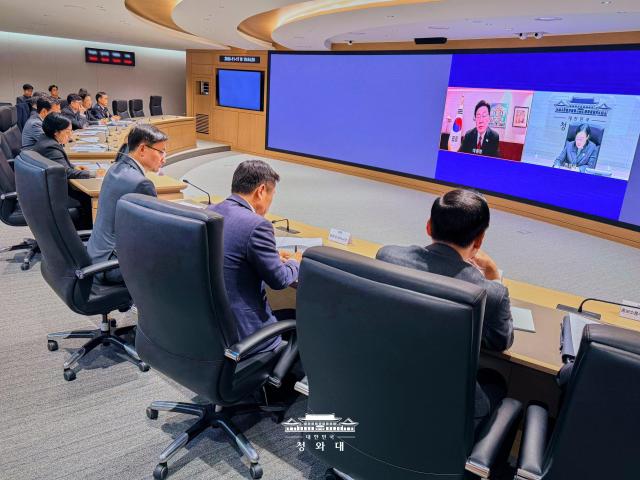
President Lee Jae Myung on Tuesday called for a zero-tolerance response during an emergency review of preparations for the College Scholastic Ability Test, known as the suneung, on Tuesday as he connected from from the Philippines where he is attending ASEAN summit.
The crackdown would extend beyond the examination hall. Lee ordered officials to investigate all cases in which photographs of exam papers are uploaded to artificial intelligence services during the test, drawing on information-sharing agreements with global technology companies.
“Recent cases of cheating using artificial intelligence and miniature high-tech devices have come as a major shock to society,” Lee said. “With concerns over the fairness of the exam running very high, thorough preparations and a firm response are essential.”
He described the suneung as a “ladder of opportunity” and a symbol of fairness in South Korean society. “As the saying goes, people can endure poverty but not unfairness,” he said. “The fairness and credibility of the suneung must never be shaken.”
Lee called cheating a serious crime that undermines fair competition and the trust society has built. He instructed officials to publicize the consequences, citing a 10-year loss of exam eligibility, the loss of school enrollment or student status, and criminal punishment.
He also stressed that digital records could expose misconduct after the exam. Photographing a test question and submitting it to an AI service leaves a trail that investigators can trace, he said.
“Make it clear that offenders will be caught and that we have the means to catch them,” Lee said, urging officials to explain that penalties would also be severe, according to a written briefing by chief presidential spokesperson Kang Yu-jung.
Lee checked the details of agreements with global technology companies with the science minister and his senior secretary for AI. He then ordered a comprehensive investigation of exam-paper images uploaded to AI services during testing hours.
He also called for legislation requiring major technology companies to provide relevant data for future national qualification examinations. To encourage reports of cheating involving advanced electronic devices, Lee asked officials to consider rewards of at least 100 million won ($75,000).
He ordered additional measures inside examination venues, including at least one unannounced emergency alert message on exam day, supplementing alerts already scheduled for announced times.
Lee asked the Education Ministry to explore supplying correction fluid, erasers and other permitted stationery directly to candidates to eliminate opportunities for misuse.
The president instructed officials to scrutinize public reactions to the safeguards announced by Prime Minister Han Seong-sook and immediately address any gaps. Because those who designed the measures might overlook weaknesses in their own plans, he said, a fresh perspective was essential.
Noting that the concerns had first surfaced in online communities, Lee urged officials to examine objections and reports of vulnerabilities posted on social media and discussion forums. He separately called for firm action against the spread of false information that fuels anxiety among candidates and parents.
Lee also asked officials to account for the heavier burden on exam supervisors and ensure that every stage of the operation — from transporting and securing question papers to safety inspections — worked properly.
“Prepare thoroughly, as though your own child were taking the exam, so that every candidate can concentrate solely on the test without other worries,” he said.
He urged officials to remain vigilant until the examination ended and ensure that the measures reached “every last classroom.”
Lee Jung-woo
I studied philosophy in college, and sociology and journalism in graduate school. I cover North Korea, South Korean politics, foreign affairs and films. I enjoy Nordic cinema, Indian cuisine and Japanese detective novels. I have a cat and like bright, acidic coffee.
Copyright ⓒ Aju Press All rights reserved.