
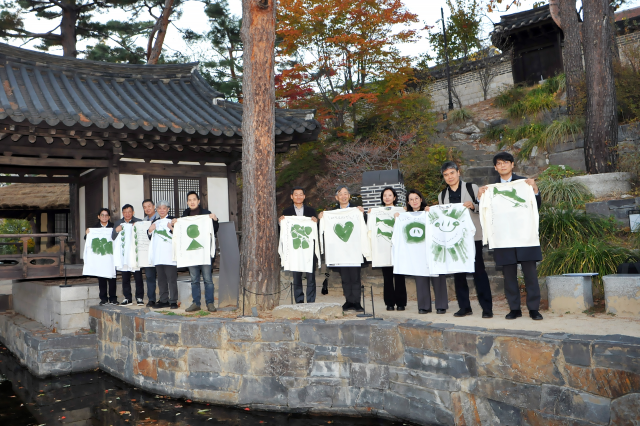
SEOUL, November 26 (AJP) - A barley patch planted in front of Kookmin University's main building in 2003 started a campus environmental movement. The Seoul university is now trying to carry that movement into its climate education.
The university's Climate Change Response Project Team held a seminar titled "Again, Green Campus" on Nov. 6 at Haeongheon, a hall in the university's Myungwon Museum. Professors who led the original movement joined current members of the team to review what it achieved and discuss how its practices can be passed on to today's students.
The barley plot covered about 33 square meters. The effort grew into a campus-wide program built on three values the university called Green Campus, Green Curriculum and Green Network. It led to green liberal arts courses, secondhand reuse markets and, in 2004, a declaration that made the campus car-free and pedestrian-centered.
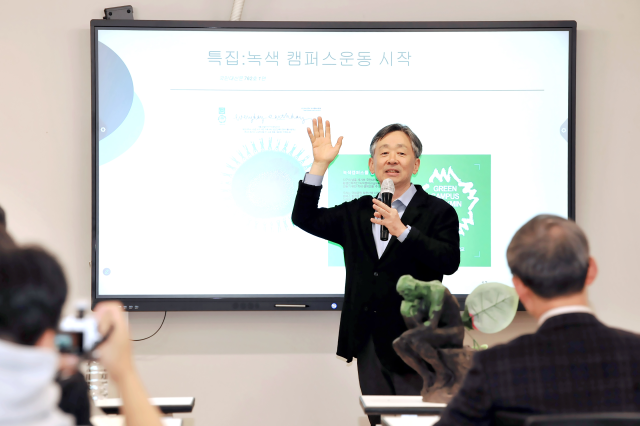
Lee Chang-hyun, a professor in the university's School of Media and Advertising, opened the presentations with a talk on the movement's origins and results. He said the movement had been an attempt to change the university's educational goals and the way its members lived, not just a campaign to protect the environment. He argued that the green campus should become a brand unique to Kookmin.
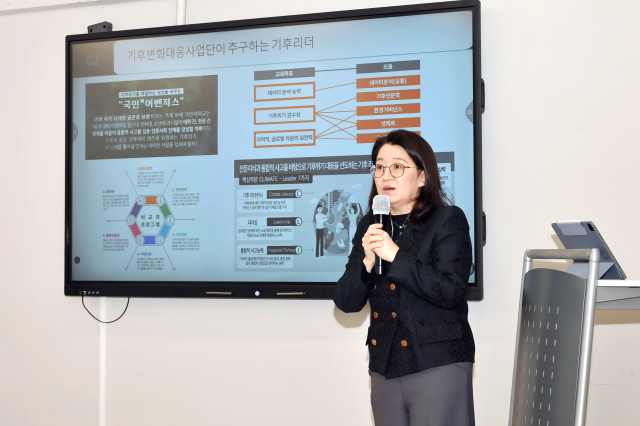
Jeong Ha-yoon, a research professor with the project team, explained how the movement's values carry on in current classes and student activities. She pointed to student environmental clubs Net Zero and D-Eco, which run a shared umbrella project and plogging outings, where participants pick up litter while jogging. She also described project-based learning courses in which students tackle environmental problems themselves, and partnerships with the Seoul YWCA and the Seongbuk District Office.
Two professors emeritus who took part in the 2003 movement, Cho Jung-bin and Jeon Yong-il, shared their experiences by video. Both stressed education that builds respect for life and ecological awareness, and both said environmental action should become a lasting part of the university's teaching and research rather than a series of one-off events.
Han Kyung-koo, former secretary-general of the Korean National Commission for UNESCO, attended in person. He said sustainability should be built into the entire curriculum to encourage students to take voluntary and creative environmental action.
Yoon Ho-seop, a professor emeritus of visual communication design, gave a live performance, painting designs on T-shirts. Yoon opened South Korea's first graduate program in green design at Kookmin in 2003. His message was that solving environmental problems takes a change in how people think and what they value, along with new rules and technology.
In a closing panel, Lee Ki-in, head of the university's Office of Facilities Management, joined Yeoun Myung-heum, a professor of industrial design, and Lee Won-deog, a professor in the Division of International Studies. They listed steps the university has already taken, including campus energy cuts, a resource-recycling space called Bugak Market and machines that collect plastic bottles for recycling.
The panel called for more eco-friendly design, more ecology education and more student-led environmental activities. Panelists also discussed tying the green campus to the university's long-term development plan and extending it to the surrounding community.
In 2023, the Ministry of Education chose Kookmin as the lead university for the environment track of its HUSS program, which trains humanities and social science students to work across disciplines. Kookmin runs the program with Duksung Women's University, the University of Ulsan, Inha University and Chosun University under the theme "Coexistence and Mutual Prosperity in the Era of the Climate Crisis."
Park Sae-jin
Experienced journalist and editor at AJU PRESS specializing in multilingual news. I cover international diplomacy, geolpolitics, and policy, consistently delivering highly accurate, compelling reporting for a worldwide audience.
Copyright ⓒ Aju Press All rights reserved.
Related News
-
 Ministry of Climate to Discuss Follow-Up Actions After COP31
The Ministry of Climate, Energy, and Environment will gather public opinions on follow-up actions after the conclusion of the 31st United Nations Climate Change Conference (COP31) and the implementation of domestic greenhouse gas reduction targets.The ministry will hold a 'Public Forum on the 31st United Nations Climate Change Conference' on the 26th at the Westin Chosun in Jung-gu, Seoul.Previously, COP31, held in Antalya, Turkey, from November 9 to 22, concluded without adopting a representative decision document outlining key directions for responding to the climate crisis. While some progress was made in individual agendas such as adaptation, just transition, and climate finance, no overarching decisions were reached. In addition to intergovernmental negotiations, international cooperation for practical climate actions, including electrification and industrial decarbonization, was also pursued.The forum will examine the achievements and limitations of the COP31 negotiations and discuss South Korea's implementation of the Paris Agreement and the tasks ahead for achieving greenhouse gas reduction targets. The forum will be conducted under two main topics: the results of COP31 and the implementation of the Paris Agreement, and the carbon budget and national reduction pathways.The first topic will explore the implications of the main discussions from COP31, including responses to exceeding the global average temperature rise of 1.5 degrees, the global electrification pledge, and cooperation on industrial decarbonization.It will also share the status of domestic policy implementation, including the Korean Green Transition (K-GX) and electrification. Achievements in international cooperation, such as decarbonization collaboration between South Korea and Australia and the 'RISE ASIA' initiative for Asian energy security promoted with the International Energy Agency (IEA), will be introduced. Additionally, cooperation strategies to expand climate action based on citizen participation, such as the Global Climate Citizen Forum, will be discussed.The second topic will examine the relationship between the carbon budget and national reduction pathways and discuss the direction for implementing national greenhouse gas reduction targets (NDC) based on scientific evidence.Meanwhile, the 32nd United Nations Climate Change Conference (COP32) will be held in Addis Ababa, Ethiopia, from November 8 to 19 next year.Oil Young, head of the Climate Energy Policy Office, stated, "It is important to gather the diverse experiences and wisdom of the public to address the tasks left by the 31st United Nations Climate Change Conference. I hope this discussion will be a place to find solutions for international climate cooperation and the implementation of our country's reduction targets together with the public."* This article has been translated by AI.
-
Lovebug Research Aims to Address Climate Change with 30 New Specialists
A project analyzing the impact of climate change on species' habitats and training specialists to respond to ecosystem changes has achieved its first results. Various research findings, from analyzing vulnerable areas for lovebug outbreaks to changes in the timing of swallow arrivals and predictions of amphibian habitats, have been presented as policy alternatives.The National Institute of Biological Resources, under the Ministry of Climate, Energy, and Environment, announced on the 19th that it will hold a final results presentation for the 'Biological Climate Research Specialist Training Project' on the 20th at the Incheon Saengsaengchaeum Exhibition Hall. Biological climate research is a field that studies the interactions between climate and living organisms, analyzing changes in habitats and ecological characteristics due to climate change.This year, the project, which started for the first time, selected 30 researchers from 121 applicants in March. The researchers receive monthly salaries, research activity funds, and expert consultations to conduct studies related to climate change and biodiversity policies.The top research achievement this year was awarded to Lee Joo-ho, a doctoral student at Korea University, for his study titled 'Analysis of Habitat Characteristics of the Red-legged Lovebug and Response Strategies for Vulnerable Urban Areas.' This researcher analyzed approximately 24,000 complaints related to lovebugs received in Seoul from 2022 to 2025 to identify areas vulnerable to outbreaks.The analysis revealed that the northwestern regions, including Eunpyeong, Seodaemun, and Mapo, as well as the southwestern regions, including Yangcheon, Guro, and Geumcheon, were identified as major vulnerable areas. Notably, the risk of outbreaks was higher in areas where green spaces and residential areas are adjacent, and there is a tendency for the outbreak range to expand to the east and south.The excellence award went to Myung Ra-yeon, a researcher at Ewha Womans University, who analyzed about 10,000 swallow observation records. Myung confirmed that in years with higher spring temperatures from 2000 to 2024, swallows tend to be observed earlier, based on data from the Global Biodiversity Information Facility (GBIF).However, it was also noted that the observation data is concentrated in urban areas, with reliable data secured in only 1.8% of the national grid. As a solution, a citizen science observation system involving schools and local communities was proposed.Additionally, research on microbial indicators to predict harmful algal blooms in advance and predictions of changes in amphibian habitats due to climate change were also recognized as outstanding achievements. In particular, Jeong Yeon-ji from Kyonggi University projected that under high-carbon scenarios, the habitat suitability for five domestic amphibian species could decrease by 36.5% to 52.7% by the 2070s.The National Institute of Biological Resources plans to compile these research results into a policy report and distribute it to the Ministry of Climate and its affiliated organizations. Yoon, the director of the National Institute of Biological Resources, stated, 'The climate crisis and the decline in biodiversity are significant challenges that will determine the future of generations and the sustainability of the nation,' and added, 'We will actively support the research results to lead to national environmental policies and on-site responses.'* This article has been translated by AI.
-
Minister Kim Seong-hwan Urges Climate Goal Implementation at COP31, Expands International Cooperation for Green Transition
Minister of Climate, Energy and Environment Kim Seong-hwan urged countries to implement their climate goals at the 31st United Nations Climate Change Conference of the Parties (COP31) and proposed ways to expand international cooperation for the Korean-style green transition (K-GX).The Ministry of Climate announced on November 17 that Minister Kim introduced the status of South Korea's climate policy and the direction of international cooperation during a national statement at the high-level meeting held in Antalya, Turkey.On the 10th anniversary of the Paris Agreement's enforcement, Minister Kim emphasized that commitments to reduce greenhouse gases must lead to actual policy changes and transformations in the industrial and energy sectors.South Korea announced its Nationally Determined Contribution (NDC) for greenhouse gas reduction by 2035 last year and has legislated a five-year reduction roadmap leading up to 2050 this year. In October, the Korean-style green transition strategy was also announced.The Constitutional Court ruled in August 2024 that "quantitative criteria for greenhouse gas reduction targets for 2031-2049 have not been established in law," declaring Article 8, Section 1 of the Carbon Neutrality Basic Act unconstitutional.Minister Kim also outlined plans to develop the Korean-style green transition into a global green transition. As examples of cooperation, he introduced decarbonization collaboration with Australia and the RISE ASIA initiative, which involves the International Energy Agency (IEA) and aims to enhance energy security in Asia.RISE ASIA is a collaborative initiative that comprehensively diagnoses energy and resource supply and demand and the stability of power systems, supporting Asian countries' capacities to respond to energy crises and build stable power systems.On this day, South Korea signed a memorandum of understanding (MOU) with Australia on decarbonization and issued a joint statement. The two countries agreed to strengthen cooperation in electrification, power grid expansion, clean energy supply chains, and industrial decarbonization.Minister Kim proposed an international cooperation system that involves youth and civil society in climate policy. He introduced cases where South Korea's climate litigation led to the Constitutional Court's decision and the legislation of a mid- to long-term reduction roadmap, and presented a 'Global Climate Dialogue' involving government, businesses, financial institutions, and civil society.On November 18, he is scheduled to attend a ministerial dialogue on energy transition hosted by the Netherlands, Tuvalu, and Ireland to discuss energy security and cost burden issues. He will also participate in the launch event for the RISE ASIA initiative with the IEA.Minister Kim stated, "To turn the promises of the Paris Agreement into tangible changes, the policy efforts of each government, along with international cooperation and civil society participation, are necessary. The Republic of Korea will contribute to the global green transition based on the Korean-style green transition and cooperate with the international community for new progress in climate multilateralism."* This article has been translated by AI.