

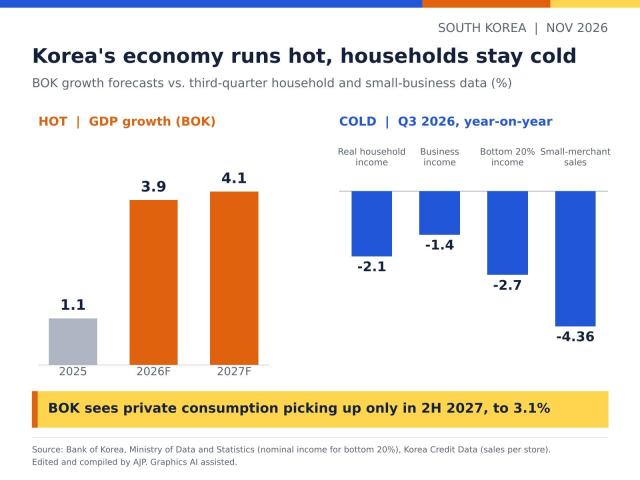
The Bank of Korea (BOK) raised its policy rate to 3.25 percent from 3.00 percent at its final policy meeting of the year, delivering its third hike alongside growth forecasts of 3.9 percent for 2026 and 4.1 percent for 2027. Next year's estimate was lifted sharply from 2.9 percent in August.
The unusually upbeat message from the typically cautious bank challenged expectations of slower growth and a winding-down of the tightening cycle.
Governor Shin Hyun-song's argument was simple: staggering semiconductor profits would spread through corporate taxes, performance bonuses, dividends and investment, putting the expansion on a broader footing.
"The 700 trillion won ($521.3 billion) in operating profit does not disappear into a black hole. It flows into corporate taxes and performance bonuses," he said, referring to the estimated operating income of Samsung Electronics and SK hynix for 2026.
The figure is equivalent to roughly a fifth of national income, he said, estimating nominal gross domestic product swell well above 3,000 trillion won this year from about 2,600 trillion won last year.
"There are substantial grounds for next year's 4.1 percent forecast."
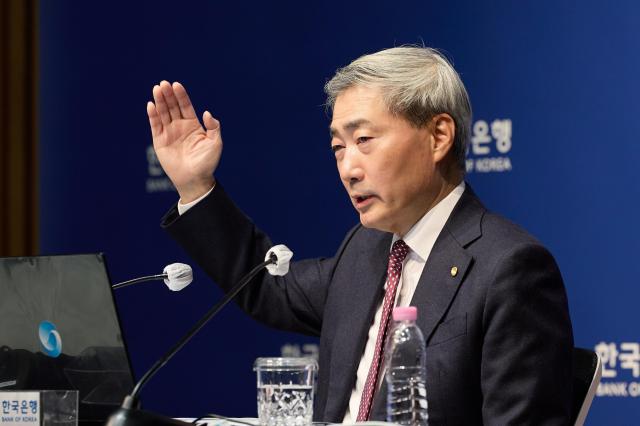
Shin said a BOK analysis due Dec. 15 shows cost pressures still dominate price gains, but demand is also clearly supporting inflation.
Asked why inflation forecasts rose only modestly despite the growth upgrade, Shin said: "It is because we assume monetary policy will be used appropriately."
That answer makes further tightening part of the bank's outlook. Inflation is expected to return to its 2 percent target only in 2028.
Board members' six-month rate projections had a median of 3.50 percent, with seven of the 21 dots at 3.75 percent and none below the newly raised policy rate.
Bond markets took the hint. The three-year Korean government bond yield rose 3.9 basis points to 3.622 percent, while the 10-year yield climbed 2.9 basis points to 3.790 percent.
The household scorecard told a different story.
Inflation-adjusted household income fell 2.1 percent from a year earlier in the third quarter, its first decline in 10 quarters and the steepest since the second quarter of 2023, according to data released Thursday by the Ministry of Data and Statistics.
Average monthly income rose just 0.8 percent in nominal terms to 5.48 million won, well below inflation of 2.9 percent.

Property income, including interest and dividends, dropped 11.1 percent, while transfer income fell 8.5 percent. Public transfers declined sharply from a year earlier, when nationwide consumption vouchers had boosted government support.
For mom-and-pop stores, the squeeze is already cutting into sales and margins.
Average sales per store fell 4.36 percent from a year earlier in the third quarter, the first decline in five quarters, according to small-business data provider Korea Credit Data. Average profit dropped 8.30 percent.
Overdue loans owed by individual business owners jumped 21.5 percent to 16.4 trillion won. The BOK said in September that the delinquency rate on self-employed loans stood at 1.99 percent at the end of June, above the long-term average of 1.60 percent.
The poorest households had the least cushion. Income among the bottom 20 percent fell 2.7 percent, making them the only income group to post a nominal decline. More than half — 56.6 percent — spent more than their disposable income.
The BOK's own forecasts acknowledge that stronger consumption will take time.
The bank cut this year's private consumption growth forecast to 1.8 percent from 2.1 percent, with Shin citing the stock market slump, which he said has tightened financial conditions.
Consumption growth is projected to slow to 1.1 percent in the second half of this year and reach only 1.6 percent in the first half of 2027 before accelerating to 3.1 percent in the second half. For next year as a whole, the bank expects consumption growth of 2.4 percent.
Much of the money is sitting in short-term markets, awaiting investment or dividend payments next year or the year after. Corporate taxes will reach households through next year's budget.
"It is only a matter of time."
But the channels carrying that money to households are uneven.
The BOK expects wage gains to be concentrated in IT-sector bonuses, with increases in non-IT industries such as construction remaining limited. Part of the dividend windfall will also flow to foreign shareholders.
Markets still need to see the projected growth materialize, Yoon Yeo-sam, a fixed-income analyst at Meritz Securities, told AJP.
Shin offered no detailed explanation of how tighter financial conditions from falling stocks and uncertainty over the chip industry would play out, Yoon said.
Shin argued that monetary policy must consider the economy as a whole.
"If you look at only one sector, you can misstep," he said.
That leaves vulnerable borrowers relying on fiscal support and debt restructuring, which Shin said are better suited than monetary policy to helping specific groups.
Their borrowing burden is already rising. Household interest payments increased 11 percent in the third quarter, and the average rate on new household loans topped 5 percent in October for the first time in nearly three years — before Thursday's hike.
Two of the seven board members, Hwang Kun-il and Lee Soo-hyung, voted to hold the rate at 3.00 percent. Details of the debate will be available in the minutes due in two weeks.
The dissents likely reflect concerns over growth concentrated in chips, the drag from falling stocks on consumption and uncertainty over the semiconductor outlook, Yoon said.
The BOK is setting rates for the economy it expects the chip windfall to create. Households are bearing the cost of tighter policy before that economy reaches them.

Kim Yeon-jae
Kim Yeon-jae is a journalist at AJU Press (AJP's English platform),
covering macroeconomics, international finance, and geopolitics.
He closely tracks central bank monetary policies, global energy supply chains,
and the Korean defense industry.
Copyright ⓒ Aju Press All rights reserved.
Related News
-
 BOK ups growth estimate 3.9% for 2026, 4.1% for 2027
The construction site of Samsung Electronics' P5 fab at its Pyeongtaek campus in Gyeonggi Province is seen on the afternoon of November 15, 2026. AJP Han Jun-gu *Updated with core inflation forecast, growth drivers and policy outlook SEOUL, November 26 (AJP) — The Bank of Korea (BOK) on Thursday raised its growth estimates to 3.9 percent for this year and 4.1 percent for 2027 as the chip boom proves to be stronger and longer-lasting than expected. When achieved, it would be the first back-to-back years of growth close to 4 percent or more since 2006~2007 before the global financial crisis, as 2010 and 2021 topped the level only as one-off rebounds from crisis-hit years. The revised outlook is bumped up from August projections of 3.3 percent for this year and 2.9 percent for 2027. Exports and investment are expected to keep growing at a high pace on the strong chip sector, while consumption is likely to gain momentum on better incomes and expanded fiscal spending, the central bank said. The central bank expects consumer inflation of 2.7 percent this year and 2.4 percent next year, compared with August projections of 2.7 percent and 2.3 percent. Core inflation, which excludes food and energy, is projected at 2.6 percent for both years, up from 2.5 percent, as cost pressures pass through and stronger growth adds to demand-side pressure. The upgrade points to restrictive policy into next year, as the BOK indicated further increases after raising base rate to 3.25 percent. For the downside, the BOK flagged uncertainty over how far the chip upturn expands and spills over to domestic demand and developments in the Middle East.
-
 UPDATE: BOK hikes to 3.25%, signals tight policy into 2027
Bank of Korea Gov. Shin Hyun-song strikes the gavel at the central bank's final Monetary Policy Board meeting of the year in Seoul on November 26, 2026. Courtesy of the Bank of Korea *Updated with board vote, dot plot and revised forecasts SEOUL, November 26 (AJP) — The Bank of Korea bumped up its base rate to 3.25 percent on Thursday - its third hike this year - while signaling restrictive policy into next year with surprisingly upbeat outlook for next year. The central bank raised its growth forecasts to 3.9 percent for this year and 4.1 percent for 2027, from 3.3 percent and 2.9 percent in August, and lifted its core inflation outlook to 2.6 percent for both years from 2.5 percent. "Domestic economic growth has further strengthened, inflation is projected to remain above the target level for a considerable time, and financial stability risks persist," the board said in a statement, adding it will decide on the timing of further increases. Five of the seven board members voted for the increase, while Hwang Kun-il and Lee Soo-hyung dissented in favor of holding the rate at 3.00 percent. Seven of the 21 dots in the board's six-month rate projections sat at 3.75 percent, the first time members penciled in that level, while eight sat at 3.50 percent and six at 3.25 percent. None of the dots sat below the new 3.25 percent rate, compared with five at 3.00 percent in August. The increase follows back-to-back hikes in July and August and a hold in October. Markets had priced in an extended pause at the year's final rate-setting meeting amid stagnant stock and housing markets and sagging consumer sentiment, despite strong exports and growth driven by overseas chip demand. The move narrows the gap with the upper end of the U.S. Federal Reserve's target range to 0.75 percentage point, a preemptive step ahead of an expected Fed increase in December. Bonds sharply rose on the hawkish tone. The three-year government bond yield spiked 5.2 basis points to 3.635 percent and the 10-year 5.5 basis points to 3.816 percent by midday Thursday.