

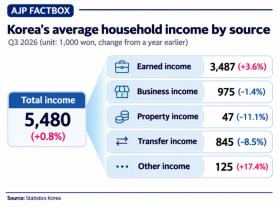
Inflation-adjusted household income fell 2.1 percent from a year earlier, its first decline in 10 quarters and the steepest since the second quarter of 2023, when it dropped 3.9 percent. Average monthly household income rose just 0.8 percent in nominal terms to 5.48 million won, well below inflation of 2.9 percent, according to the Ministry of Data and Statistics’ Household Income and Expenditure Survey.
Business income, which captures earnings from self-employment, fell 1.4 percent to a monthly average of 975,000 won per household. Its first contraction in 12 quarters came as higher operating costs and slower growth in self-employment weighed on earnings.
Property income, including interest and dividends, dropped 11.1 percent to 47,000 won. Transfer income, which includes government benefits and financial support from family members, declined 8.5 percent to 845,000 won.
The figures showed the strain on household finances despite the semiconductor boom underpinning the central bank’s optimism for upping economic growth estimates to 3.9 percent for this year and 4.1 percent for 2027 on Thursday.
Public transfers plunged 15.4 percent, largely reflecting the unusually high level of government support a year earlier, when consumption vouchers were distributed nationwide. Private transfers, including financial support exchanged among family members during Chuseok, Korea’s autumn harvest holiday, rose 20.4 percent.
Household outgoings meanwhile grew much faster than income.
Average monthly expenditure rose 5.1 percent to 4.20 million won. Non-consumption expenditure, including taxes, social insurance contributions and interest payments, jumped 11.0 percent to 1.17 million won, its largest increase in five years.
Interest payments rose 11.0 percent to a monthly average of 147,000 won, adding to the squeeze on household budgets.
Disposable income — the amount left after taxes and other non-consumption expenditure — fell 1.7 percent to 4.31 million won. The surplus remaining after consumption spending dropped 11.2 percent to 1.28 million won. Both recorded their steepest declines in 13 quarters.
Consumption expenditure rose 2.9 percent to 3.03 million won but remained flat after adjusting for inflation, meaning households spent more without consuming more.
The spending pattern showed households prioritizing essentials while cutting back on discretionary purchases.
In inflation-adjusted terms, spending on housing and utilities rose 3.0 percent, groceries and non-alcoholic beverages increased 2.8 percent and healthcare spending grew 2.3 percent.
By the same measure, clothing and footwear spending fell 7.2 percent, recreation and culture declined 4.0 percent and dining and accommodation dropped 2.0 percent.
The financial strain was particularly severe among lower-income households.
Average monthly income among the bottom 20 percent fell 2.7 percent to 1.28 million won. Their employment income dropped 9.2 percent as the share of households headed by salaried workers decreased.
By contrast, households in the top 20 percent saw monthly income rise 1.4 percent to 11.75 million won. Income growth among the three middle groups ranged from 0.3 percent to 1.7 percent.
Disposable income fell across all five income groups, with the poorest households suffering the largest decline.
For the bottom 20 percent, disposable income dropped 5.4 percent to 1.07 million won while consumption expenditure rose 1.6 percent to 1.41 million won. Their average monthly deficit widened 32.1 percent to 344,000 won.
Across all households, the proportion spending more than their disposable income climbed to 24.0 percent from 21.9 percent a year earlier, the highest third-quarter level in three years.
Among the lowest-income households, 56.6 percent ran a deficit, up 4.0 percentage points.
The income gap also widened. The ratio of equivalized disposable income between the top and bottom 20 percent rose to 5.39 from 5.07 a year earlier. The measure adjusts disposable income for household size, with a higher ratio indicating greater inequality.
Tags: South Korea, real household income, income inequality, household finances, inflation, cost of living, disposable income, low-income households, Ministry of Data and Statistics

Ryu Yuna
Yuna Ryu covers finance, capital markets and Southeast Asian affairs.
She is drawn to the questions that numbers raise and the stories that data alone cannot answer.
Prior to journalism, she worked at Hyundai Motor Company and the Singapore Chamber of Commerce, focusing on business strategy and international affairs. She has also hosted diplomatic receptions and international conferences as an MC.
Ryu holds a master's degree in Media and Communication from Korea University, where her research focused on neuroscience-based studies of media effects.
Copyright ⓒ Aju Press All rights reserved.
Related News
-
 AJP Factbox: Korea's household income under pressure in Q3
Compiled and edited by AJP. Graphics AI-assisted. Compiled and edited by AJP. Graphics AI-assisted.
-
 Couples Without Homes Push for Individual Income Deductions on Rent Loans
If this year's tax reform bill passes the National Assembly, couples without homes who live separately due to work will be able to receive income deductions for their individual rent loan repayments starting next year. Currently, only one spouse can claim the deduction.Kwon Dae-young, the first vice minister of the Ministry of Finance, held the second meeting of the 'Salary Defense Task Force' on the 26th in Seoul, where he reviewed these details with relevant ministries. The meeting discussed tasks assigned to each ministry that have been reviewed by four working groups focusing on existing support measures, taxation, finance, and fiscal policy since the first meeting on the 13th.According to the reform bill, couples will be able to receive a 40% income deduction on the principal and interest of their individual rent loans. The annual deduction limit will be 4 million won for the couple combined.For example, if a dual-income couple working in Seoul and Sejong each repays 5 million won annually on their rent loans, their total income deduction will increase from the current 2 million won to 4 million won. Assuming the additional deduction applies to the spouse with an income tax rate of 15%, the tax burden, including local income tax, would decrease by about 330,000 won. If a 24% tax rate is applied, the reduction would be approximately 530,000 won.If the reform bill is passed, tax benefits will also be established for relocation allowances provided by companies that move outside the capital region or establish or expand business sites in local areas. According to the reform bill, the tax-exempt limit will be 200,000 won per month in general non-capital areas and 500,000 won per month in preferential non-capital areas, applicable for three years from the date of relocation. The scope of preferential areas will be determined in the enforcement decree, considering discussions in the National Assembly.Vice Minister Kwon stated that new projects are also being explored to reduce the living cost burden for workers, including communication expenses. The government plans to review measures to reduce essential living costs and expand real disposable income, along with public suggestions discussed on that day. Kwon mentioned that by the 11th of next month, each ministry will supplement new tasks and coordinate with the Salary Defense Task Force in the presidential office to announce the measures.The government will accept public suggestions through the Ministry of Finance's website from the 27th to the 6th of next month. Relevant ministries will review the proposals based on policy effectiveness, equity, fiscal conditions, and feasibility, and those incorporated into the measures will be disclosed at the time of the announcement.Kwon emphasized, "The best ideas to protect workers' salaries are found in the field," and stated, "We will carefully review each citizen's suggestion to find tasks that break away from existing frameworks."* This article has been translated by AI.
-
Hanwha Life Launches 'LifeFit Pension' for Retirement Income Management
Hanwha Life has introduced an installment pension product that allows customers to manage their retirement pension assets while receiving the necessary pension payments.On November 24, Hanwha Life announced the launch of 'LifeFit Pension' aimed at customers enrolled in individual retirement pensions (IRP).Previously, customers had to sell all their managed products to convert to a pension product to start receiving payments. The LifeFit Pension is designed to allow customers to maintain their existing products while receiving only the amount they need as a pension.Customers aged 55 and older who are enrolled in Hanwha Life's IRP can utilize this product. It includes all types of products managed under the IRP, including guaranteed interest contracts (GIC).According to the Financial Supervisory Service, the total IRP reserves in South Korea reached 166.36 trillion won (KRW) as of the end of June this year, marking an increase of approximately 27% compared to the end of last year. The number of pension recipients is also rising as the second baby boomer generation (born between 1964 and 1974) begins to retire in earnest.Pension receipt methods are divided into fixed amount and fixed period types. The fixed amount type allows customers to receive the same amount each time, but the duration of payments varies based on investment performance. The fixed period type allows customers to receive pension payments for a set period, with the amount adjusted based on remaining reserves and the number of payments. Customers can switch between the two methods once a year.The annual payment amount is limited to one-fifth of the amount converted to the installment pension. The minimum payment period is five years, and the minimum payment amount is 10,000 won (KRW).It is also possible to convert from the installment pension to a lifetime pension. In the early stages of retirement, customers can manage their assets while receiving pension payments, and later secure lifelong income through a lifetime pension. However, once converted to a lifetime pension, customers cannot change to another payment method.Since November 2, Hanwha Life has waived management and asset management fees for performance-based individual IRP products. Fund fees and other product-related costs will still apply.A Hanwha Life representative stated, "How to accumulate retirement assets is as important as how to manage and distribute them. We will continue to expand pension solutions tailored to the life cycle of our customers, from accumulation to management and receipt."* This article has been translated by AI.