

Ryu Yuna
Yuna Ryu covers finance, capital markets and Southeast Asian affairs.
She is drawn to the questions that numbers raise and the stories that data alone cannot answer.
Prior to journalism, she worked at Hyundai Motor Company and the Singapore Chamber of Commerce, focusing on business strategy and international affairs. She has also hosted diplomatic receptions and international conferences as an MC.
Ryu holds a master's degree in Media and Communication from Korea University, where her research focused on neuroscience-based studies of media effects.
Copyright ⓒ Aju Press All rights reserved.
Related News
-
 KOSPI Recovers Above 4750 After Sharp Drop, Driven by Foreign and Institutional Buying
The KOSPI is rising over 1% thanks to simultaneous buying from foreign and institutional investors. Following a sharp drop the previous day, bargain hunting has emerged, and the recovery in investor sentiment is interpreted as a result of reduced losses in artificial intelligence (AI)-related stocks in the U.S. markets overnight.According to the Korea Exchange, as of 12:45 PM on November 26, the KOSPI index is trading at 4,759.26, up 61.75 points (1.31%) from the previous trading day.By investor type, foreign and institutional investors are leading the index's rise with net purchases of 59.2 billion won (KRW) and 418.3 billion won (KRW), respectively. In contrast, individual investors are net selling 723.2 billion won (KRW).Among the top market capitalization stocks, performance is mixed. Samsung Electronics (1.70%), SK Hynix (3.69%), Samsung Electronics Preferred (2.45%), SK Square (3.78%), and Samsung Electro-Mechanics (6.49%) are all rising. Conversely, LG Energy Solution (-1.62%), Samsung Biologics (-0.95%), Hyundai Motor (-3.15%), KB Financial (-1.22%), and Celltrion (-0.69%) are declining.At the same time, the KOSDAQ index is trading at 663.28, up 12.64 points (1.94%) from the previous trading day.In the KOSDAQ market, institutions are net buying 178.3 billion won (KRW). Individuals and foreigners are net selling 136.4 billion won (KRW) and 45.9 billion won (KRW), respectively.Among the top market capitalization stocks in the KOSDAQ, Alteogen (2.42%), Rainbow Robotics (4.31%), Juseong Engineering (5.73%), Simtec (3.53%), HLB (3.01%), Samchundang Pharmaceutical (7.97%), and Rino Industrial (3.83%) are performing well. EcoPro BM (-1.19%), EcoPro (-1.36%), and Roboteers (-0.35%) are showing weakness.Analysts in the securities industry suggest that the perception of excessive losses in AI-related stocks has led to a rebound in buying. In particular, news of CoreWeave, a U.S. AI cloud company, seeking new funding is expected to positively impact investor sentiment in the semiconductor sector.Financial authorities' measures to stabilize the stock market are also considered a key variable. The possibility of expanding the existing 10.8 trillion won (KRW) securities market stabilization fund is being discussed, and attention is focused on whether specific market stabilization measures will be presented at the capital market reform task force (TF) scheduled for today.Han Ji-young, a researcher at Kiwoom Securities, stated, "Despite recent credit instability in AI, the demand for investment in AI infrastructure remains intact," adding, "If loans are successfully secured next week, there is a possibility of further recovery in investor sentiment for domestic and foreign semiconductor stocks."He continued, "Resolving the uncertainty surrounding AI, which is the root cause of the market adjustment, is a separate issue, but policy responses such as the stabilization fund will contribute to restoring extremely depressed investor sentiment and preventing further declines."* This article has been translated by AI.
-
Third Quarter Real Income Declines for First Time in Ten Quarters, Income Gap Widens
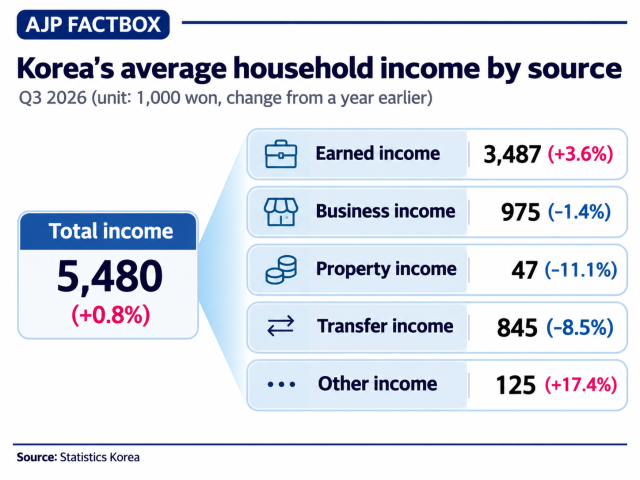
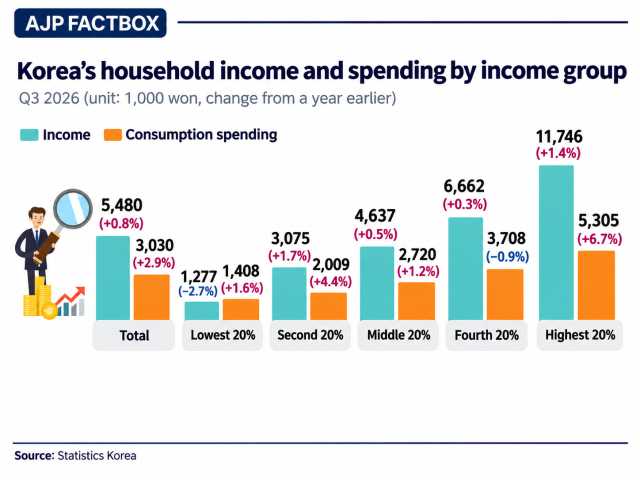
In the third quarter of this year, household income growth fell below the inflation rate, resulting in a decline in real income for the first time in ten quarters. The base effect from the distribution of consumer recovery coupons last year significantly impacted the figures, while the business income of self-employed individuals also turned negative. Notably, while low-income households saw a decrease in income, high-income households experienced an increase, leading to a widening income gap between classes.According to the '2026 Third Quarter Household Trend Survey Results' released by the National Data Agency on the 26th, the average monthly income per household in the third quarter of this year was 5.48 million won (KRW), a 0.8% increase compared to the same period last year. While nominal income has increased for 13 consecutive quarters, real income, adjusted for inflation, decreased by 2.1%. This marks the first decline since the first quarter of 2024 and the largest drop since the second quarter of 2023 (-3.9%).By source of income, labor income rose to 3.49 million won (KRW), an increase of 3.6%. This was influenced by an increase in the number of wage workers and higher wages due to holiday bonuses. In contrast, transfer income fell to 845,000 won (KRW), a decrease of 8.5%. Although private transfer income increased by 20.4% due to differences in the Chuseok holiday timing, public transfer income decreased by 15.4% due to the base effect from last year's consumer recovery coupons.Business income decreased by 975,000 won (KRW), down 1.4%. This decline was affected by a reduction in business days during the Chuseok holiday and a slowdown in the growth of self-employed individuals. The worsening business conditions for self-employed individuals, due to rising interest rates and costs, as well as a decrease in card spending in consumer-related sectors, were also cited as factors contributing to the decline in business income.The average monthly consumption expenditure per household was 3.03 million won (KRW), a 2.9% increase, but real consumption expenditure remained at the same level as the previous year. Transportation and logistics spending increased by 9.6% due to a rise in car purchases, while expenditures on housing, utilities, and fuel (4.9%) and food and non-alcoholic beverages (3.3%) also saw increases. Conversely, spending on clothing and footwear (-4.6%) and education (-2.4%) decreased.Household disposable income has decreased. Non-consumption expenditures, including inter-household transfer expenditures (30.0%), interest costs (11.0%), and current taxes (8.0%), increased by 11.0%, leading to a disposable income of 4.31 million won (KRW), a 1.7% decrease. The household surplus fell to 1.28 million won (KRW), down 11.2%, while the average propensity to consume rose to 70.4%, an increase of 3.2 percentage points from a year ago.The living conditions of low-income households have worsened further. The average monthly income of the lowest 20% of households, the first quintile, was 1.28 million won (KRW), a decrease of 2.7%. The proportion of wage-earning households has decreased, leading to a 9.2% drop in labor income, alongside a reduction in public transfer income. Disposable income fell by 5.4%, and the average propensity to consume rose to 132.3%, an increase of 9.2 percentage points. This indicates a deepening deficit structure where consumption expenditure exceeds disposable income.In contrast, the average monthly income of the highest 20% of households, the fifth quintile, increased by 1.4% to 11.75 million won (KRW). Although disposable income decreased by 0.7%, the average propensity to consume was 59.0%, relatively lower than that of low-income households.Income distribution indicators have also worsened. The quintile ratio based on equalized disposable income rose to 5.39 times, up from 5.07 times in the same period last year. A higher figure indicates a larger income gap between high-income and low-income households. However, it is important to consider the base effect from last year's government support payments that had improved income distribution indicators.A representative from the Data Agency stated, "The overall decline in real income is largely influenced by the base effect from last year's distribution of consumer recovery coupons," adding, "While labor income has increased in real terms, there appear to be some difficulties in terms of business income."* This article has been translated by AI.
-
KOSPI Plummets Over 6%, Falls Below 4,700; Samsung Electronics Market Cap Drops Below 1,000 Trillion Won
On November 24, the KOSPI, which had surged 6%, erased all its gains in just one day. Following the return of Jensen Huang, CEO of NVIDIA, uncertainties surrounding artificial intelligence (AI) investments resurfaced, leading to a drop of over 6% and a fall below the 4,700 mark. Foreign investors sold nearly 2 trillion won, causing Samsung Electronics' market capitalization to fall below 1,000 trillion won.According to the Korea Exchange on November 25, the KOSPI index closed at 4,697.51, down 308.52 points (6.16%) from the previous trading day. The day before, following the news of Jensen Huang's return as CEO of NVIDIA, the index had reclaimed the 5,000 mark, but lost those gains within a day. In the stock market, foreign and institutional investors net sold 1.9 trillion won and 700 million won, respectively, while individual investors net bought 1.42 trillion won.The total market capitalization of the domestic stock market also evaporated by over 259 trillion won in just one day. The KOSPI's market cap decreased from 4,104.82 trillion won the previous day to 3,853.54 trillion won, a drop of 251.28 trillion won. The KOSDAQ market cap also fell by approximately 8.1 trillion won to 373.28 trillion won.In the early trading session, a sell-side circuit breaker was triggered for five minutes due to a sharp drop in KOSPI 200 futures prices. This marked the fourth consecutive day of circuit breaker activation. So far this year, circuit breakers have been triggered 62 times in the KOSPI and 40 times in the KOSDAQ, totaling 102 instances. July saw the highest number of activations at 27, followed by June (15) and November (13).Most of the large-cap stocks declined. Samsung Electronics closed down 9.87% at 170,700 won, with its market cap decreasing by over 109 trillion won to 997.96 trillion won. SK Hynix also plummeted 11.05% to close at 1.03 million won.Other stocks with double-digit declines included Samsung Electro-Mechanics (-12.00%), SK Square (-11.19%), and Samsung Electronics Preferred Shares (-10.19%). In contrast, Samsung Biologics (5.66%) and Celltrion (3.83%) saw gains.The KOSDAQ index closed at 650.64, down 15.24 points (2.29%) from the previous trading day. Individual investors net sold 34.6 billion won, while foreign and institutional investors net bought 1.2 billion won and 26.9 billion won, respectively.Among the large-cap stocks, JUSUNG Engineering (-11.42%), SIMTECH (-6.51%), EcoPro (-5.01%), and EcoPro BM (-4.64%) experienced declines. Conversely, Alteogen (6.20%), Samchundang Pharmaceutical (5.05%), and HLB (1.99%) saw increases.Concerns over the profitability of AI investments resurfaced overnight in the New York stock market, leading to declines of 5.9% for NVIDIA and 11.0% for Micron Technology, which negatively impacted the domestic stock market.Lee Kyung-min, a researcher at Daishin Securities, analyzed, "As foreign investors have shifted to net selling, comments from President Donald Trump and uncertainties regarding tariffs are also contributing to the burden on the stock market."He added, "If the U.S. personal consumption expenditures (PCE) price index for October exceeds market expectations, concerns over tightening may increase, leading to greater volatility in the stock market."* This article has been translated by AI.