

Candice Kim
Candice Kim is a dedicated business and technology reporter specializing in the intersection of high-tech innovation and fast-paced consumer trends. Her core beats span the semiconductor, IT, cosmetics, and retail sectors, where she provides in-depth coverage of industry titans including Samsung Electronics, SK hynix, and LG Electronics, alongside leading consumer brands like Olive Young and Musinsa. Whether analyzing complex silicon supply chains or tracking the latest shifts in beauty and fashion retail, Candice is committed to delivering sharp, accurate reporting that keeps readers informed on the forces shaping today's most dynamic markets.
Copyright ⓒ Aju Press All rights reserved.
Related News
-
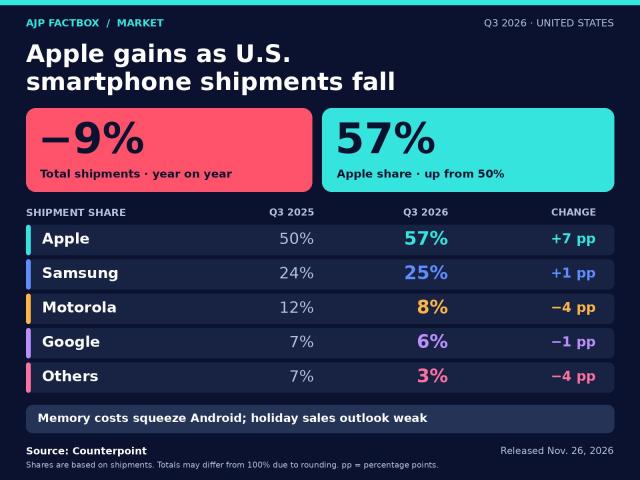
 Apple gains as U.S. smartphone shipments fall Q3
SEOUL, November 27 (AJP) - Apple’s share of U.S. smartphone shipments climbed to 57 percent in the third quarter from 50 percent a year earlier as the overall market shrank 9 percent, Counterpoint Research said Thursday. Apple was the only major manufacturer to avoid a shipment decline. Rising memory costs hit cheaper Android phones hardest. Samsung’s share edged up to 25 percent from 24 percent, supported by its premium Galaxy S and Z models and budget Galaxy A lineup. Motorola’s share fell to 8 percent from 12 percent. The squeeze is expected to persist through the holiday quarter as memory costs remain elevated and carriers become more selective with promotions. Smartphone sales through the three largest U.S. carriers fell 4 percent in the third quarter. “Consumers are timing their purchases around the best deals more than ever, if they buy at all,” Counterpoint analyst Maurice Klaehne said. Tags: Apple, Samsung, U.S. smartphones, memory prices, Motorola, Counterpoint Research
-
Internet Banks Set to Launch Apple Pay Ahead of Major Card Companies
Internet banks are poised to expand their services with Apple Pay ahead of major card companies, which have been more cautious. Kakao Bank and Toss Bank are preparing to integrate Apple Pay with their debit cards and aim to launch the service by the end of the year. While card companies are weighing the burden of additional fees, internet banks see this as an opportunity to attract iPhone users and increase account usage.According to financial industry sources, Kakao Bank and Toss Bank have completed the technical preparations for Apple Pay and are pushing for a service launch within the year. Kakao Bank is expected to start the service as early as this month. However, both banks have not officially confirmed their plans or launch dates.Currently, Hyundai Card is the only card company in South Korea offering Apple Pay services. Other companies, such as Shinhan Card and KB Kookmin Card, are in the process of reviewing terms but have yet to launch their services. If internet banks introduce Apple Pay first, consumers seeking to use the service will have more options beyond Hyundai Card.The primary reason card companies are hesitant to adopt Apple Pay is the cost. The fee for Apple Pay is reported to be around 0.15% of the transaction amount. With declining merchant fee rates and regulatory pressures on lending, card companies must carefully consider whether the potential increase in customers and transaction volumes justifies the additional costs. The actual burden may vary based on each company's contractual terms.The fee policy of Samsung Pay is another variable that card companies are monitoring. Currently, Samsung Pay does not impose separate transaction fees on card companies. However, there are speculations that Samsung Electronics may reconsider its fee policy if more companies join Apple Pay.When Apple Pay was introduced in South Korea in 2023, Samsung Electronics indicated it would not extend its agreement for free transaction fees, raising the possibility of future charges. Subsequently, in July of that year, Samsung decided to maintain the free fee structure.Given the large transaction volume of Samsung Pay, the decision on whether to implement fees could significantly impact card companies' costs. If we apply the 0.15% fee to Samsung Pay's projected transaction volume of 88 trillion won in 2024, it could amount to approximately 132 billion won annually. However, this is a hypothetical scenario based on applying the same rate to the total transaction volume, and no decision has been made regarding Samsung Pay's fee structure.For internet banks, the introduction of Apple Pay could enhance both debit card and account usage. Operating primarily through mobile apps, increasing payment convenience for iPhone users could attract new customers and encourage existing customers to use their debit cards more frequently. An increase in account usage could lead to securing primary customers and attracting deposits.Internet banks can also leverage this to capture a younger customer base. According to a survey by Gallup Korea in July, 19% of smartphone users in South Korea use iPhones, with the usage rate among those in their 20s exceeding 53%.However, internet banks are not free from fee burdens. Since their debit cards utilize the payment networks of partner card companies, how they share the costs associated with Apple Pay implementation will be crucial. It remains to be seen how actual customer acquisition and usage increases will offset these costs after the service launches.A financial industry official stated, “In payment services, who establishes a foothold in customers' daily lives first is crucial, making the initial market entry effect significant. If card companies continue to weigh various interests while internet banks expand their customer touchpoints, the competitive landscape for existing card companies may narrow in the future.”* This article has been translated by AI.
-
Domestic App Market Surpasses 10 Trillion Won Amid Google and Apple Growth, One Store Revenue Declines 12%
Last year, the domestic app market transaction volume exceeded 10 trillion won (KRW) for the first time since the start of the survey. While Google Play and the App Store saw transaction volumes increase by approximately 10% and 15%, respectively, One Store's revenue decreased by about 12%. Analysts suggest that to attract users who continue to use familiar app markets, differentiation in pricing or content is necessary.According to the '2025 App Market Status Survey' released on the 25th by the Korea Communications Commission (KCC) and the Korea Internet & Security Agency (KISA), the domestic app market transaction volume last year was 10.59 trillion won (KRW), a 9.4% increase from the previous year. This marks the first time it has surpassed 10 trillion won since the introduction of the survey in 2022.When examining by business entity, the Apple App Store's transaction volume increased by about 15%, the highest growth rate. Google Play saw an increase of about 10%, while Samsung's Galaxy Store grew by approximately 5%. Among the four surveyed entities, only One Store experienced a 12% decline in transaction volume.The revenue share among domestic and foreign app markets also showed significant differences. Google Play accounted for 65.3%, and the Apple App Store for 26.5%, together making up 91.8%. In contrast, the domestic app markets, One Store and Galaxy Store, accounted for 5.1% and 3.1%, respectively.The most frequently used app markets were Google Play (66.6%) and the App Store (30%). The main reasons users chose their preferred app markets were 'ease of use (62.8%)' and 'already installed (47.9%)'.Experts pointed to the 'network effect' as a reason why users and developers are gravitating toward Google and Apple. Users continue to use familiar app markets, while developers promote their apps primarily through the widely used Google Play and App Store links.Kim Yong-hee, a professor at Sun Moon University, stated, "For One Store to enhance its competitiveness, it needs to offer the same content at a lower price or secure games or apps that cannot be found on the two major app markets."He added, "From a policy perspective, reducing the burden of payment commissions imposed by Google and Apple, which are widely used by users and developers, and addressing consumer complaints is a practical situation." In the survey, developers identified major issues with in-app payments as 'price increases and customer attrition due to commission burdens (35.5%)' and 'excessive commissions (32.9%)'.The KCC explained that it is difficult to conclude that unfair practices by foreign app markets have affected the revenue gap with One Store based solely on this survey. Lee Sun-hee, head of the KCC's Telecommunications Market Research Division, stated, "It is difficult to determine whether unfair practices by foreign app markets have widened the revenue gap with One Store based on this survey alone, as differences in operational methods and provided content among businesses may also have had an impact."Meanwhile, the KCC decided to issue corrective orders to Google and Apple on October 28 for forcing specific payment methods and delaying app reviews unfairly, imposing a total fine of 63.71 billion won (KRW). The decision was sent to both companies on the 23rd. They must submit a compliance plan within one month from the date of receiving the corrective order and complete improvements within three months. The KCC plans to review the results of their compliance to determine if further adjustments are necessary.* This article has been translated by AI.