
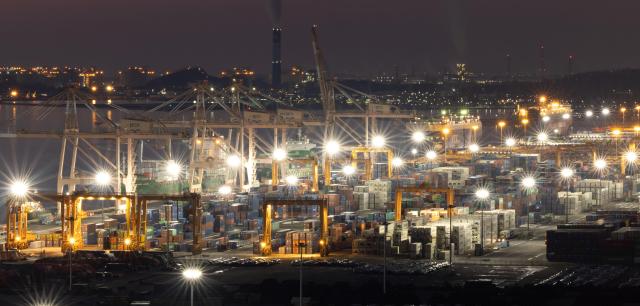
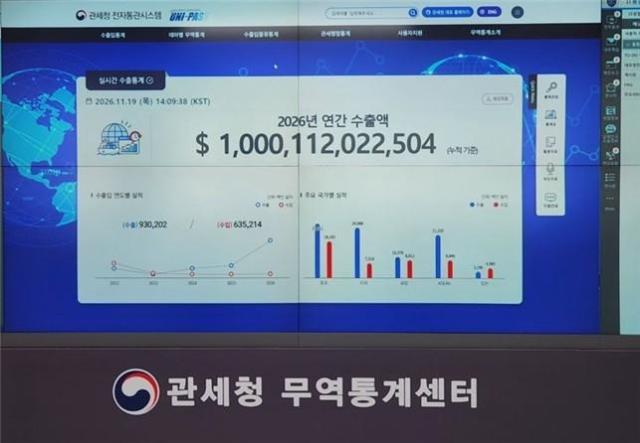
Cumulative goods exports reached $1 trillion at 2:09 p.m. Thursday, according to preliminary data from the Ministry of Trade, Industry and Resources and Korea Customs Service.
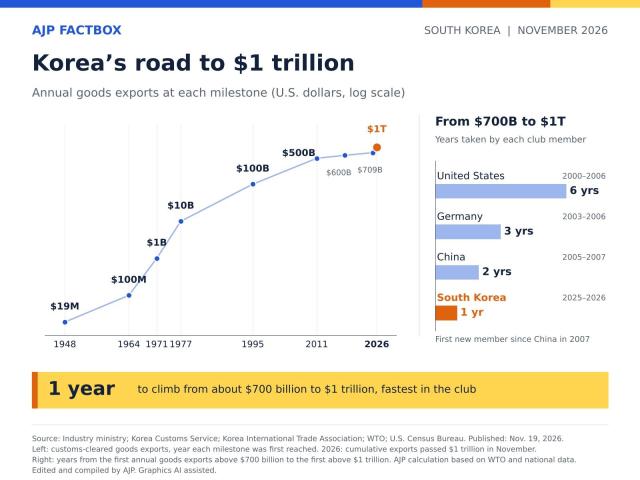
Korea became the club’s fourth member and its first new entrant in 19 years, after the United States and Germany crossed the threshold in 2006 and China in 2007. Other major exporters, including Japan, Britain and France, have yet to reach it.
The speed of Korea’s final ascent sets it apart.
Its exports stood at $709.3 billion last year, a record it surpassed by September 5 this year.
The other members needed several years between first exceeding $700 billion in annual goods exports and reaching $1 trillion: six for the United States, three for Germany and two for China, according to AJP calculations based on World Trade Organization and national data.
Korea did it in one.
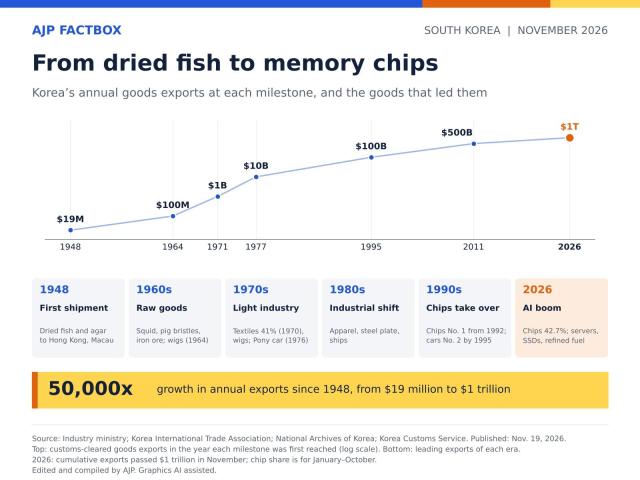
Korea's first shipment as a modern state, in 1948, carried dried fish and agar to Hong Kong and Macau.
By the early 1960s, with much of the country still in ruins after the 1950-53 Korean War, per capita income stood at about $80, on par with Ghana.
The country sold whatever it could abroad, from squid and pig bristles to iron ore, before a state-led export drive pushed it into labor-intensive manufacturing such as textiles and wigs made from human hair.
Korea’s exports began at $19 million in 1948, before crossing $100 million in 1964, $10 billion in 1977 and $100 billion in 1995. It took another 16 years to pass $500 billion in 2011, and 15 more to reach $1 trillion.
The day exports first passed $100 million, November 30, 1964, is still marked in Korea as Trade Day.
Heavy industry took over in the 1970s, as steel, ships and machinery grew to 40 to 50 percent of exports and Hyundai Motor shipped its first six Pony cars to Ecuador in 1976.
Semiconductors first became the top export in 1992, and chips and cars have ranked first and second since 1995.
“Reaching $1 trillion in exports is not an achievement that happened overnight,” Industry Minister Kim Jung-kwan said during a visit to Incheon New Port on November 17. He credited businesses that opened overseas markets, workers on production lines and logistics staff who carried Korean products around the world.
President Lee Jae Myung paid tribute to earlier generations of workers in a post on X shortly after the milestone was reached.
“Some gave their youth in sewing factories where they could hardly straighten their backs, some in shoe factories reeking of glue, and others at shipyard welding sites amid flying sparks,” Lee wrote.
“The $1 trillion in exports is the fruit of challenges across generations and the efforts of all our people,” he said.
Korea’s first-half exports of $496.1 billion ranked fifth behind China, the United States, Germany and the Netherlands, according to WTO and national data compiled by the Korea Trade-Investment Promotion Agency. The gap with the fourth-placed Netherlands, a European re-export hub, was $35.4 billion, leaving Korea within reach of another step up the rankings.
By the end of August, Korea’s lead over Japan had widened to $176.2 billion.
Korea is not alone in benefiting from the AI boom. Taiwan’s exports rose 47.7 percent to $758.3 billion in January through October, supported by strong shipments of information technology products and electronic components.
China's semiconductor exports also more than doubled in January through October.
Japan has also benefited from demand for semiconductor manufacturing equipment and equipment for power facilities, according to the Bank of Japan.
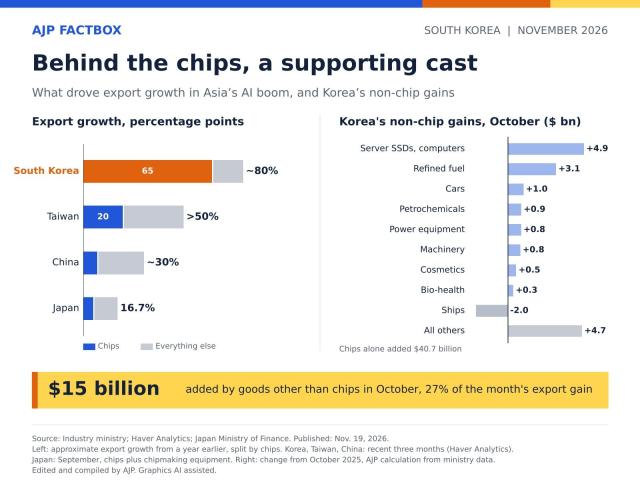
But chips have done far more of the lifting in Korea, accounting for about 65 percentage points of roughly 80 percent export growth in recent months, compared with close to 20 points in Taiwan and about 7 points in China, according to Haver Analytics.
Korea’s particularly sharp acceleration reflects its exposure to memory — both the advanced chips used alongside AI processors and the broader memory and storage needed to run data centers.
Samsung Electronics and SK hynix supply high-bandwidth memory, or HBM, as well as server DRAM and NAND flash storage. That gives Korea several channels through which AI investment feeds into exports.
In their third-quarter earnings reports, both companies described rising demand across their data-center product ranges. Samsung said strong server demand had pushed up memory prices across applications amid capacity constraints. SK hynix reported expanding sales of server DDR5 memory, HBM4 and enterprise solid-state drives.
Still chips alone could not carry Korea to $1 trillion.
Goods other than semiconductors added about $15 billion to exports in October from a year earlier, roughly a quarter of the month's gain, according to AJP calculations based on ministry data.
Much of that came from the same AI build-out. Computer exports jumped nearly sixfold to $5.85 billion in October, led by solid-state drives for servers, while shipments of electrical equipment such as transformers and cables for data centers rose 74 percent to a monthly record of $1.99 billion.
Consumer brands riding the global popularity of Korean culture also set records, with cosmetics exports reaching $12.57 billion in January through October, already above last year's annual total.
Shipbuilders and defense firms, whose order books have grown amid wars in Europe and the Middle East, add less to this year's total than their headlines suggest, because their sales are counted as vessels and weapons are delivered over several years.
Ship exports rose 3.7 percent to $27.9 billion through October 25, while defense export deals reached $15.4 billion last year, according to the Defense Acquisition Program Administration.
Not every industry joined the rally. Car exports slipped 1.7 percent to $58.6 billion in January through October as U.S. tariffs and overseas production weighed on shipments.
Together, those developments help explain the scale of Korea’s windfall: stronger demand, a shift toward higher-value products and rising prices have reinforced one another.
They also explain why the composition of this year’s gains is unusually narrow.
Semiconductor exports surged 196.9 percent to $413.4 billion from January 1 to November 10, accounting for 42.9 percent of total exports. Chips alone generated about three-quarters of the increase in exports over the period, according to AJP calculations based on customs figures.
The calculation puts the increase in chip exports at roughly $274.2 billion, against an overall export gain of about $368.8 billion.
By September, semiconductors accounted for roughly half of monthly shipments. Their share remained close to that level in October and the first 10 days of November.
October petroleum product exports jumped 80 percent in value even as shipment volumes fell 7.5 percent, benefiting from entrenched geopolitical conflict.
The non-chip strength matters when assessing how durable the trillion-dollar milestone will be.
The Korea Development Institute (KDI) forecast on November 18 that real exports of goods and services would grow 10.3 percent this year. Customs-cleared goods exports, measured in current dollars, were up 62 percent through November 10. The measures cover different periods and categories, so the gap cannot be treated as a direct measure of price increases. It nevertheless cautions against reading the surge in export earnings as an equivalent expansion in physical shipments.
A closer, like-for-like gauge comes from the Bank of Korea's trade indices, which track the same customs-cleared goods. Export volumes rose 43.9 percent in October from a year earlier, while export values jumped 107.6 percent, implying that average export prices rose roughly 44 percent, according to AJP calculations.
The gap was widest for computers, electronics and optical equipment, the category that includes chips, where volumes rose 51.2 percent but values climbed 214.8 percent.
KDI expects real export growth to slow to 8.1 percent next year, although its outlook still envisages goods exports on a balance-of-payments basis rising to about $1.44 trillion from $1.23 trillion. Those dollar forecasts use a different accounting basis from the customs figures behind the $1 trillion milestone.
Kim Young-joo, head of the Bank of Korea’s macroeconomic forecasting department, said at the Korea Institute of Finance’s 2027 outlook seminar on November 10 that chip prices were unlikely to keep rising at their current pace even if AI investment continued.
Slower price increases would not necessarily reverse Korea’s export gains. Expanding production and stronger demand could sustain growth. But they would make another leap of this magnitude harder to repeat.
Lee pledged to strengthen key industries, nurture artificial intelligence and biotechnology as future growth engines and help K-beauty and K-food brands expand overseas, while sharing the gains between large and small companies and between the capital region and the provinces.
Whether Korea consolidates its place in the $1 trillion club will depend on how long memory prices hold, how much additional demand its chipmakers can meet and how far cars, power equipment and consumer goods can carry the rest of the export basket.

Kim Yeon-jae
Kim Yeon-jae is a journalist at AJU Press (AJP's English platform),
covering macroeconomics, international finance, and geopolitics.
He closely tracks central bank monetary policies, global energy supply chains,
and the Korean defense industry.
Copyright ⓒ Aju Press All rights reserved.
Related News
-
 Korea $36B away from $1 trillion in 2026 exports
Container boxes ready for shipments at Pyeongtaek port. AJP Yoo Dae-gil SEOUL, November 11 (AJP) -South Korea eyes achieving $1 trillion export year this month as it keeps up chip-fueled record-setting streak in the first 10 days of November, preliminary customs data showed Wednesday. Exports reached fresh high of $33.46 billion in the first 10 days of the month, up 111.9 percent from a year earlier, according to preliminary Korea Customs Service data. Imports rose 45.0 percent to $24.71 billion during the 10-day period, leaving a trade surplus of $8.75 billion compared with a $1.24 billion deficit a year earlier. Cumulative exports reached $963.7 billion, up 62.0 percent and $36.3 billion short of joining the exclusive $1 trillion export club that includes just three other countries - the United States, China, and Japan. Tags: South Korea exports, Korea exports November 2026, Korea $1 trillion exports, Korean semiconductor exports, chip exports, Korea Customs Service, South Korea trade surplus, Korean economy, Korea trade data
-
 Korea's trillion-dollar export boom carries an AI risk
In this combination photo, SK hynix's M14 clean room in Icheon, Gyeonggi Province, is seen on the left, while LS ELECTRIC's UL-certified power distribution solution for data centers is shown on the right. Courtesy of SK hynix and LS ELECTRIC. SEOUL, November 02 (AJP) - South Korea is enjoying an export renaissance, approaching a $1 trillion annual milestone reached by only three other countries — China, the United States and Germany. Shipments have strengthened across categories from chips to cosmetics despite geopolitical tensions and an increasingly hostile trade environment. Still, semiconductors, computers and electrical equipment account for 56 percent of outbound shipments, leaving the economy that much exposed to the global AI investment cycle. With domestic consumption recovering more slowly, the question is how long companies and governments can sustain the spending driving Korea’s windfall. October trade data released on Sunday further underscored the staggering strength of chip demand turbocharging South Korea’s exports. Exports increased in 18 of the 20 major product categories, while shipments excluding semiconductors rose 34 percent from a year earlier. Even that strong double-digit growth paled against the chip industry’s performance. Semiconductor exports surged 259.4 percent to $56.44 billion, accounting for about 49 percent of total shipments. Chips generated roughly 73 percent of the $55.8 billion year-on-year increase in overall exports. Total exports jumped 93.7 percent to $115.28 billion, bringing shipments in the first 10 months to $930 billion. That leaves Korea just $70 billion short of the trillion-dollar threshold, which the government expects to cross in November. Some of the fastest-growing categories outside semiconductors were also tied to AI investment. Computer exports surged 496.6 percent to $5.85 billion on demand for servers and enterprise solid-state drives. Electrical equipment exports climbed 74.0 percent to a record $1.99 billion as data-center construction supported demand for transformers, wires and cables. Edited and compiled by AJP, Graphics AI assisted The gains are spreading across more products, but several remain exposed to the same investment cycle. “Growth is still concentrated in semiconductors, but the range of export improvement is gradually widening,” KB Securities analyst Ryu Jin-yi wrote in an Oct. 2 report, describing the trend preceding the latest figures. Ryu noted that exports excluding both semiconductors and computers were improving, with stronger performances in steel, electrical equipment, nonferrous metals and general machinery. Much of that improvement, however, was also supported by AI-related demand, including investment in data centers and power grids, she said. There were gains beyond that investment chain. Cosmetics, biohealth and agricultural and fisheries products all set October export records, with shipments rising 57.5 percent, 30.2 percent and 11.6 percent, respectively. The Bank of Korea (BOK) had already identified a broader recovery in September. In its Oct. 22 monetary policy briefing, the central bank said non-IT export growth had accelerated alongside continued triple-digit gains in IT products. It described consumption as recovering gradually, although stock-market losses and automobile strikes had temporarily interrupted that progress. Korea’s exposure to the technology cycle nevertheless remains substantial. At an Oct. 15 briefing on its Regional Economic Outlook for Asia and the Pacific, the International Monetary Fund (IMF) said Korea had benefited disproportionately from the AI boom through its semiconductor industry, particularly memory and logic chips. The IMF also warned that the boom’s sustainability depended on AI generating revenue and delivering expected productivity gains. Concerns over profitability, financing and valuations could bring a sharp reassessment of the sector’s prospects. Some of October’s export gains also reflected higher prices rather than greater shipment volumes. Petroleum product exports jumped 80.0 percent in value and petrochemical exports rose 27.5 percent, supported by elevated oil prices. Their shipment volumes fell 7.5 percent and 6.8 percent, respectively. Meanwhile, October’s manufacturing survey offered an early indication that demand momentum was easing. The S&P Global South Korea Manufacturing Purchasing Managers’ Index fell to 51.3 from 53.9 in September. Manufacturing remained above the 50 threshold separating expansion from contraction for an 11th consecutive month, but growth in new export orders slowed sharply to a marginal pace. “The positive demand momentum seen across South Korean manufacturing in the third quarter began to falter” as the fourth quarter started, said Usamah Bhatti, economist at S&P Global Market Intelligence, in the report. The survey measures changes from the previous month, while the export figures compare shipment values with a year earlier. Slower order growth can therefore coexist with record export receipts. Korea’s trillion-dollar milestone is drawing close. The harder test will be sustaining growth when the pace of AI spending eventually eases.