

Journalist
Kim Dong-young김동영
davekim0807@ajupress.com
ReporterSamsung Biologics, CJ CheilJedang, LG Chem, Celltrion, Naver, Krafton, Nexon, Hyundai Mobis etc. & energy, game, food, bio, petrochemical, AI
Kim Dong-young is a bilingual journalist at AJU Press (AJP), covering Korean tech, energy, and bio/pharma.
He reports from the field at events like CES and APEC, runs AJP's YouTube channels,
and is pursuing a master's at Sogang's MOT program. "I try everything in this AI era that can improve yet preserve the facts. Journalism still serves as my core."
He reports from the field at events like CES and APEC, runs AJP's YouTube channels,
and is pursuing a master's at Sogang's MOT program. "I try everything in this AI era that can improve yet preserve the facts. Journalism still serves as my core."
Latest by Kim Dong-young
-
 Daegu named first hub for South Korea's AI drug-discovery drive SEOUL, August 12 (AJP) - South Korea has designated the southeastern city of Daegu as the first innovation hub for artificial intelligence-driven drug discovery under "K-Moonshot," the government's flagship program to embed AI across national science and technology research. The Ministry of Science and ICT said on Wednesday it had held a launch ceremony in Daegu for a pilot project to build an "AIxBio" research base focused on synthetic new drugs, drawing together universities, companies, hospitals and research institutes in an open innovation ecosystem. At the heart of the Daegu project is a so-called "Lab-in-the-Loop" system, in which AI models, autonomous experiments, validation and data feedback continuously reinforce one another. The ministry said the design aims to let laboratories and algorithms advance in tandem, offering a new paradigm for how medicines are found. The pilot will be run by a Daegu consortium comprising Kyungpook National University, its affiliated hospital, and the Daegu-Gyeongbuk Medical Innovation Foundation, working with firms such as HLB Life Science to verify AI-proposed compounds in partly automated labs. "The competitiveness of future drug development hinges on how effectively we connect and apply AI technology and data within real experimental environments," said Oh Dae-hyun, the ministry's director general for future strategic technology policy, adding that next year the government would build on the pilot's results to expand into other areas of AI-bio. AJP Takeaways • Daegu becomes the first regional hub in the K-Moonshot program's AI drug-discovery mission, hosting a "Lab-in-the-Loop" system that links AI prediction, autonomous experiments and validation in a continuous cycle. • The pilot is led by a consortium of Kyungpook National University, its hospital, and the K-MEDI hub foundation, partnering with firms including HLB Life Science to test AI-proposed compounds in partly automated labs. • The ministry framed the effort as a bid to close the gap with the United States and Britain, which have already built dedicated AI-bio bases, and said next year it would extend the model into other AI-bio fields. 2026-08-12 14:47:14
-
 Samsung SDI to buy out GM's Indiana battery plant SEOUL, August 11 (AJP) - Samsung SDI announced Tuesday it will buy out General Motors' entire 49.99 percent stake in their U.S. battery joint venture, SynergyCells, giving the South Korean cell maker its first wholly owned battery plant in North America. The two companies also signed a joint development agreement to co-develop next-generation prismatic batteries for electric vehicles, drawing on Samsung SDI's high energy density and fast-charging technologies. The resulting cells are expected to power GM's future EV models. SynergyCells was established in 2024 in New Carlisle, Indiana, on the back of a combined investment of about $3.5 billion. The plant, still under construction, is designed for an annual capacity of 27 gigawatt-hours. Financial terms of the stake transfer were not disclosed. Samsung SDI plans to install energy storage system battery lines at the same site, a hedge against sluggish EV demand and a bid to capture the rapidly expanding North American ESS market. "This decision reflects changes in the market while continuing our strategic partnership with GM," said a Samsung SDI official. "At this plant we will sustain our joint efforts for the coming EV era, and at the same time respond aggressively to ESS demand in the United States." The handover extends GM's retreat from battery ventures. The Detroit automaker earlier sold its stake in a Michigan plant to LG Energy Solution, and its Ultium Cells joint venture in Tennessee has shifted toward stationary storage cells, according to Bloomberg, which first reported the Indiana sale. AJP Takeaways • Samsung SDI said on Aug. 11, 2026, that it will acquire General Motors Co.'s entire 49.99 percent stake in SynergyCells, their electric-vehicle battery joint venture in New Carlisle, Indiana, giving the South Korean company its first wholly owned battery plant in North America. • Samsung SDI and General Motors signed a joint development agreement the same day to co-develop next-generation prismatic batteries, which are expected to be fitted in General Motors' future electric vehicle models. • Samsung SDI will add energy storage system battery lines at the Indiana plant, which was launched in 2024 on a combined investment of about $3.5 billion and is designed for an annual capacity of 27 gigawatt-hours. 2026-08-11 15:02:33
-
 Unitree heads to market as China dominates humanoid robotics' first act SEOUL, August 11 (AJP) - In humanoid robotics’ first commercial act, there is one dominant player: China, whose manufacturers accounted for more than 97 percent of global shipments in the first half of 2026. South Korea, despite betting heavily on physical AI, remains largely a robotics powerhouse inside its own factory gates. Korea has 1,220 industrial robots per 10,000 manufacturing workers, the highest density in the world, according to the International Federation of Robotics. But that strength remains concentrated in conventional factory automation, while the country does not target mass production of humanoids until 2029. China is already putting its humanoid champions into the capital market. Unitree Robotics opened subscriptions Monday for a $904 million Shanghai IPO that would make it China’s first mainland-listed humanoid robot maker and the next marquee Chinese technology listing after memory-chip maker CXMT’s $8.6 billion STAR Market IPO last month. Retail demand for Unitree was more than 8,000 times the shares available, underscoring the investor frenzy surrounding China’s physical-AI push. Unitree is selling 40.45 million new shares, or 10 percent of its enlarged capital, at 150.8 yuan each to raise about 6.1 billion yuan ($904 million). The price implies a market value of about 61 billion yuan, or roughly $9 billion, and a valuation of about 219 times 2025 earnings. “Entering the capital market is a new starting point for Unitree,” founder and Chief Executive Wang Xingxing said during the IPO roadshow, pledging to deepen work on core technologies for general-purpose embodied intelligence. The listing comes as China converts an early hardware advantage into shipment scale. Global humanoid shipments reached about 19,100 units in the first half, up 272 percent from 5,100 a year earlier, according to research firm Smart Analytics Global. Shanghai-based AgiBot led with about 8,400 units, or 44 percent of the market, while Unitree shipped about 5,900, taking 31 percent. Chinese companies together supplied more than 97 percent of the global total. More significantly, over 70 percent of shipments went to industrial and commercial applications, up from about half a year earlier — evidence that at least part of the market is beginning to move beyond demonstrations and research laboratories. Capital is following the machines. Financing in China’s embodied-intelligence sector reached 93.5 billion yuan across 322 deals in the first half, according to IT Juzi data, while Beijing has elevated humanoid robots and embodied intelligence in its 2026 to 2030 technology strategy. DeepSeek added another link between China’s AI and robotics ecosystems by investing 140.8 million yuan in Unitree’s IPO for a 2.31 percent stake through the strategic placement. The two companies also agreed to cooperate on AI models for humanoid robots. South Korea’s diagnosis of its own position is blunt. The Korea Institute of Machinery & Materials said in an April policy report that 2026 marks a commercial tipping point for humanoids and identified two major Korean weaknesses: a shortage of homegrown AI foundation models and a fragile supply chain for humanoid-specific components such as actuators and reducers. Neither gap is closing overnight. Korea’s government-backed sovereign AI competition is now down to LG AI Research, SK Telecom, Upstage and Motif Technologies, with one of the four due to be eliminated in the current second-stage evaluation. Naver Cloud was disqualified earlier for failing the project’s originality requirement, while NC AI failed to advance on its evaluation score. What Korea has built at greater scale is the infrastructure to run AI. Private groups have outlined about 550 trillion won of investment to build 8.4 gigawatts of AI data-center capacity by 2029. The National AI Computing Center broke ground in Haenam, South Jeolla Province, on Aug. 3 with a project cost of about 2.5 trillion won and plans for computing capacity equivalent to roughly 15,000 advanced GPUs by 2028. President Lee Jae Myung has also put AI at the center of industrial policy, with 10.1 trillion won allocated to AI-related spending in the 2026 budget. But Korea’s humanoid timetable stretches further out. The government’s manufacturing-AI strategy calls for an industrial humanoid foundation model by 2028 and annual production of at least 1,000 humanoid robots beginning in 2029. The broader K-Humanoid Alliance is bringing government, robot makers, component suppliers and AI companies together around that goal. The United States has formidable names but, so far, little comparable shipment volume. Tesla has been preparing its Fremont factory for Optimus production, but mass output has yet to materialize. Figure AI’s Figure 03 has begun work at BMW’s Spartanburg plant on logistics tasks after an earlier Figure 02 deployment, putting the robots into real factory operations but still far short of Chinese shipment volumes. Boston Dynamics, owned by Hyundai Motor Group, unveiled the production version of its electric Atlas at CES 2026. Hyundai plans to deploy Atlas at its Georgia manufacturing operations from 2028 and aims to build manufacturing capacity for 30,000 robots a year by then — potentially giving Korea its most substantial route into humanoid scale, albeit through a U.S.-based subsidiary. Washington, meanwhile, has erected a new regulatory barrier around the U.S. market on national-security grounds. The Federal Communications Commission on July 28 added foreign-produced “advanced robotic devices,” including humanoids and quadrupeds, to its Covered List after an interagency national-security determination. New covered models generally cannot receive the FCC equipment authorization required for import, marketing or sale in the United States unless they receive conditional approval from the Department of War. Previously authorized models are exempt. That rule offers Seoul no automatic shelter. The FCC measure turns on where a robot is produced, not whether it is Chinese. New humanoids produced in South Korea, Japan or any other foreign country therefore face the same authorization barrier unless granted conditional approval. Unitree, meanwhile, has told investors that its existing humanoid and quadruped models already hold U.S. approvals, leaving the current lineup saleable while future models face uncertainty. U.S. sales accounted for 13.3 percent of Unitree’s revenue last year. For now, Korea has a timetable and formidable manufacturing infrastructure. China has something more immediate: a market, shipment scale and now a pipeline of robot makers heading into public markets. Unitree’s IPO makes the gap unusually visible. China is already financing the companies producing the first wave of humanoids at scale, while Korea is still building the models, components and production system it hopes will be ready for the next one. AJP Takeaways • Unitree’s $904 million IPO is poised to create China’s first mainland-listed humanoid robot maker, with its retail offering more than 8,000 times oversubscribed. • Chinese manufacturers supplied more than 97 percent of the roughly 19,100 humanoids shipped globally in the first half of 2026, led by AgiBot at 44 percent and Unitree at 31 percent. • South Korea has the world’s highest industrial-robot density but remains years from humanoid scale, targeting a robot AI foundation model in 2028 and production of at least 1,000 humanoids annually from 2029. 2026-08-11 14:44:25
-
 CJ CheilJedang's Q2 operating profit slides on costs, weak home market SEOUL, August 11 (AJP) - CJ CheilJedang, South Korea's largest food and bioscience group, announced that its second-quarter operating profit fell sharply as sluggish domestic demand and oil-driven increases in packaging and raw material costs squeezed margins. According to regulatory filings released Tuesday, consolidated revenue edged up 1.7 percent from a year earlier to 7.36 trillion won (about $5.19 billion) in the April-June quarter, while operating profit dropped 27.1 percent to 257.6 billion won. Excluding logistics affiliate CJ Logistics, revenue climbed 10.2 percent to 4.20 trillion won and operating profit fell 18.4 percent to 161.9 billion won, the company said. The food division posted revenue of 2.84 trillion won, up 5.8 percent, but operating profit slid 21.3 percent to 70.9 billion won. Overseas food sales rose 10.1 percent to 1.51 trillion won, led by the company's global strategic products, chiefly frozen dumplings and Hetbahn instant rice. Growth was broad-based abroad, with sales up 10 percent in the Americas, 19 percent in Europe, 21 percent in the Asia-Pacific region and 5 percent in China. At home, revenue inched up 1.4 percent to 1.34 trillion won as new health-and-wellness products cushioned a weak won and softer selling prices. The bioscience arm lifted revenue 20.8 percent to 1.35 trillion won on stronger sales of lysine and specialty amino acids such as arginine and isoleucine, though operating profit fell 15.9 percent to 91.0 billion won amid fiercer competition in high-margin tryptophan. Foreign-exchange and derivative valuation losses pushed the unit-level business to a quarterly net loss of 23.9 billion won. "We will speed up the expansion of K-food into new global territory with global strategic products such as dumplings and Hetbahn, and focus on improving profitability through wider bioscience sales and cuts in manufacturing and fixed costs," said a CJ CheilJedang spokesperson. Shares of CJ CheilJedang traded at 192,900 won per stock at 10:51 a.m., 6.13 percent lower than the day before. AJP Takeaways • CJ CheilJedang reported on Aug. 11, 2026 that consolidated second-quarter revenue rose 1.7 percent from a year earlier to 7.36 trillion won while operating profit fell 27.1 percent to 257.6 billion won, as weak domestic demand and higher packaging and raw material costs squeezed margins. • Overseas food revenue rose 10.1 percent to 1.51 trillion won in the second quarter of 2026, with sales up 19 percent in Europe and 21 percent in the Asia-Pacific region, while bioscience revenue climbed 20.8 percent to 1.35 trillion won. • CJ CheilJedang said it will use a business restructuring taking effect in the third quarter of 2026 to expand global strategic products such as dumplings and Hetbahn instant rice and to cut manufacturing and fixed costs. 2026-08-11 10:55:55
-
 NHN Q2 operating profit surges 164% on payment, tech growth SEOUL, August 11 (AJP) - South Korean internet firm NHN announced that its second-quarter operating profit jumped 164 percent from a year earlier, powered by robust demand across its payment, cloud and gaming businesses. According to regulatory filings released Tuesday, operating profit reached 57.9 billion won ($40.9 million) on a consolidated basis, while revenue climbed 25.3 percent to 757.9 billion won. Net profit rose 159 percent to 29.1 billion won. Payments, NHN's largest segment through its Payco and KCP units, generated 394 billion won, up 27.3 percent on the year, as KCP handled about 17 trillion won in transactions and captured a 30 percent share of the domestic payment-gateway market. Technology revenue, including AI cloud services, surged 52.9 percent to 159.8 billion won, lifted by an 85 percent jump at NHN Cloud after supply of Nvidia DGX B200 graphics processors from its Seoul-area data center began contributing to sales. Gaming revenue grew 21.5 percent to 139.6 billion won, buoyed by eased regulations on web-board games and offline tournaments, though total operating costs rose 20.1 percent to 700 billion won on higher fees and performance-based bonuses. "This was the first quarter in which those gains showed up as profit," Chief Executive Chung U-jin said, adding NHN would carry the momentum into the second half as it aggressively expands AI infrastructure and pursues a new stablecoin payments venture. Shares of NHN traded at 47,450 won per stock on 10:20 a.m., 13.65 percent higher than the day before. AJP Takeaways • NHN's second-quarter operating profit surged 164 percent year-on-year to 57.9 billion won, with revenue up 25.3 percent to 757.9 billion won, as its payment, cloud and gaming units all posted double-digit growth. • Payments remained the core engine, with the Payco and KCP units bringing in 394 billion won and KCP securing a 30 percent share of the domestic payment-gateway market on about 17 trillion won in transactions. • Technology revenue jumped 52.9 percent, led by an 85 percent surge at NHN Cloud tied to Nvidia DGX B200 GPU supply, signaling the company's growing bet on AI infrastructure alongside a planned stablecoin payments venture. 2026-08-11 10:25:37
-
 World-OKTA opens AI startup course ahead of Shenzhen finals SEOUL, August 10 (AJP) - The World Federation of Overseas Korean Traders Associations, known as World-OKTA, is recruiting participants for a four-day online course on agentic AI, the classroom stage of a startup competition that culminates in Shenzhen this autumn. The training runs from Aug. 18 to Aug. 21 on Zoom, Korea time, with applications closing Aug. 14. Eight modules trace a venture from idea discovery and customer research through problem-solution fit, business modeling, market analysis, venture capital, AI tools such as ChatGPT, AI-driven marketing and the building of AI-native firms. Those who finish all eight receive a certificate. The faculty includes Rick Rasmussen, an industry fellow at the University of California, Berkeley's Sutardja Center for Entrepreneurship and Technology, Stanford University professor Michael Lepech and Thomas Toy, a general partner at Startup Capital Ventures. "I hope this training will let aspiring founders and startup professionals apply AI technology to the actual process of building a company, and sharpen business models aimed at global markets," said Sun Park, chairman of World-OKTA's Global Startup Committee. The competition itself is open to companies joining the 2026 Korea Business Expo Shenzhen, moving from September preliminaries and online semifinals to an Oct. 9 final at the Shenzhen Convention and Exhibition Center. 2026-08-10 17:23:14
-
 Korean gaming industry's love-hate affair with AI SEOUL, August 10 (AJP) - South Korean gamers are famously hard to please, putting almost anything new through a punishing stress test. Few newcomers have received a colder welcome than artificial intelligence — loathed when players can see it, yet increasingly indispensable to the people making the games. Korean game developer Shift Up posted a music video for one of its own titles on July 31. Within days, fans had a word for it: slop. The clip for "Wanna Be in Love," from the soundtrack of Stellar Blade: Blood Rain, leaned on AI-generated footage of protagonist Evie and even included a fabricated behind-the-scenes sequence. YouTube labeled it altered or synthetic content. Shift Up said it had reconstructed existing game assets with AI used as a supporting tool and hoped the video would help fans reconnect with the character. The comment section was not persuaded. The episode exposed a divide now running through South Korea's game industry. Artificial intelligence has become deeply embedded in how games are made — and deeply unwelcome the moment players notice it. Generative AI was used by 70 percent of Korean game companies in the fourth quarter of last year, the highest rate of any content sector and more than double the overall average of 32.1 percent, according to the Korea Creative Content Agency. That was up from 41.7 percent in the first half of 2025. With industry surveys inevitably trailing adoption, actual usage is likely higher by now. "Programming, planning, art, running the company — using AI across all of it is where the industry is," said Yeom Seong-ho, a professor of game graphic design at Tongmyong University. "When it cuts a development cycle from a week to a day, there is no way not to use it." The technology appears to work best where nobody is watching. Krafton has operated an AI-powered anti-cheat system for more than a year across a service with more than 20 million users, the head of its AI for Game research unit said at a Seoul policy seminar on July 14. Its "co-playable character" Ella, built on an on-device model using Nvidia's ACE toolkit, entered beta testing on PUBG's Sanhok map on June 17, speaking Korean, Chinese and English. Streamers spent the next fortnight bombarding her with absurd questions. That was arguably part of the point: every exchange provided more interaction data. Yet the people building games are considerably less relaxed about where all this leads. A survey of 1,078 unionized workers at Nexon, NC and Netmarble found 77.3 percent anxious about the effect of AI on their jobs, even as 80.3 percent said the technology made them more productive. "A user's day is still 24 hours," Nexon Korea co-chief executive Kang Dae-hyun told developers in June, arguing that attention rather than technology remains the industry's ultimate constraint. The trouble begins when the seams show. Pearl Abyss apologized on March 22 after players on Reddit and Bluesky spotted melted faces and anatomically impossible horses in decorative paintings inside Crimson Desert, two days after its launch. The studio said experimental generative-AI tools had been used on some two-dimensional props early in development and that the assets were supposed to have been replaced. It acknowledged that this did not excuse the failure to disclose their use. That is the line the industry keeps tripping over. "AI output still reaches only about 90 percent of human quality," Jung Nae-hun, a professor at the Tech University of Korea, said earlier this year, noting that the remaining gap tends to appear exactly where players are looking. "Design is still the problem," Yeom said. "In genres where character visuals carry the game, like Genshin Impact, demand is constant, but players simply do not like knowing AI was involved." "A lot of them still want a human artist. Using AI on anything that shows on the surface is a stretch." Shift Up chief executive Kim Hyung-tae has argued that Chinese studios can deploy 1,000 to 2,000 people on a single title and that "AI capabilities will determine industry competitiveness." His fans offered a different verdict: competitiveness is not the same thing as watchability. Developers counter that AI is often judged by its most conspicuous failures rather than the less visible work it already performs well. A Varco business team leader at NC AI told the July seminar that internal resistance had faded as the tools spread and that time saved through AI "is spent making things better, not making more." Player irritation, however, is becoming harder to dismiss as mere noise. About 31 percent of nearly 4,000 core Steam users surveyed between June 25 and July 2 viewed AI use negatively, while 8 percent said they would refuse to buy a game if its use of AI were disclosed. That stigma now sits on top of a legal requirement. South Korea's Framework Act on the Development of Artificial Intelligence, in force since January, requires disclosure of AI-generated content, while Valve has revised Steam's rules to exempt behind-the-scenes development tools and focus disclosure requirements on material players can see, hear or interact with. Roughly one in five new Steam releases now carries an AI disclosure. Exactly how Korean law should apply to games — where images, dialogue, code and player interaction can be generated or combined in real time — remains unsettled. The Ministry of Culture, Sports and Tourism is drafting separate legislation for the content industry to clarify the rules. "The issue is no longer the tool itself," said Im Chung-jae, a professor of game software at Keimyung University, arguing that responsibility increasingly lies with the people who design the systems and write the commands. None of the resistance has stopped the industry from moving faster. OpenAI is set to hold its first Codex-based game development event anywhere in the world in Seoul on Aug. 31, backed by Com2uS, with 40 teams building games on the Hive backend. The next phase of AI in games may be far less visible than synthetic artwork or dialogue. An AI system capable of fully understanding a game's mechanics could eventually handle customer service, interpret player complaints and relay useful feedback directly to developers, Yeom said — effectively becoming a game master. That may prove the industry's safest place for AI: everywhere inside the machine, and nowhere players can see it. AJP Takeaway • What happened: Shift Up's AI-generated music video for "Wanna Be in Love," released July 31, 2026 and promoting Stellar Blade: Blood Rain, was widely criticized by fans as "AI slop," the latest South Korean game industry backlash over visible AI content after Pearl Abyss apologized on March 22, 2026 for undisclosed AI artwork in Crimson Desert. • Why it matters: South Korean studios have made generative AI standard in development while players continue to reject it in anything they can see, leaving publishers to use the technology extensively but quietly. • By the numbers: Generative AI was used by 70 percent of South Korean game companies in the fourth quarter of 2025, against a 32.1 percent average across all content sectors, according to the Korea Creative Content Agency, up from 41.7 percent in the first half of 2025. • The bigger picture: Disclosure has become a commercial risk as well as a legal duty. South Korea's Framework Act on Artificial Intelligence has required disclosure of AI-generated content since January 2026, Valve narrowed Steam's disclosure rules to cover only AI content players see or hear rather than development tools, and the Ministry of Culture, Sports and Tourism is drafting a separate bill to define how the rules apply to games. 2026-08-10 15:44:40
-
 Krafton turns PUBG danger zone into summer escape SEOUL, August 10 (AJP) - Krafton will open a summer-themed pop-up event called "Blue Zone" at its PUBG-branded space PUBG Seongsu in Seoul starting Tuesday. The event reimagines the in-game "blue zone" — a shrinking boundary that threatens players in the battle royale title Battlegrounds — as a refuge from the summer heat. The venue will host a collaborative exhibition featuring international artists from The Jaunt project and Busan-based Union Gallery, including Travis Weller and Stevie Shao. The artists will paint live murals on site, with finished works on display at the Survivor Hall on the first floor through Aug. 16. Krafton will also open a free cooling shelter with shaded tents and an ice-chilling zone, offering visitors complimentary drinking water. Creator-led programming will run alongside the exhibits, including a running event dubbed the "Frying Pan Run" on Aug. 15 followed by an after-party combining sauna sessions with cold-water plunges, as well as DJ and dance performances. A related "PUBG Seongsu Summer School" class series will continue through Aug. 31. "This 'Blue Zone' reinterprets a symbol of tension and threat from the game into a summer refuge in the middle of the city," a PUBG Seongsu official said, adding that the company hopes both Battlegrounds fans and local residents will enjoy the exhibition, music and lifestyle content together. 2026-08-10 15:26:08
-
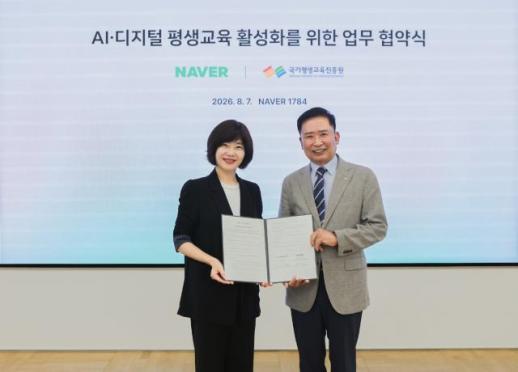 Naver, education institute team up on AI textbooks for seniors SEOUL, August 10 (AJP) - Naver announced Monday it has signed a memorandum of understanding with the National Institute for Lifelong Education (NILE) to jointly develop AI and digital literacy content tailored to senior citizens, as part of a broader push to narrow South Korea's digital divide. The agreement revealed Monday was signed on Aug. 7 at Naver's headquarters in Bundang, the company said. It aims to strengthen everyday AI and digital competency among seniors and other digitally underserved groups amid the wider shift toward AI. Under the partnership, the two organizations plan to co-develop and distribute lifelong education content on AI and digital tools. A key component will be a digital literacy textbook built on Naver's Whale browser, designed to walk users through practical services such as Naver Shopping and Whale's core functions. "By linking Naver's technology with the education field in the era of generative AI, we can innovatively bridge the digital literacy gap in daily life," said Kim Wol-yong, president of NILE. Naver said the collaboration would also feed into its commercial ambitions. Lee Yoon-sook, who heads Naver's shopping business division, said the company would keep upgrading its services for the "AI commerce era" while backing the educational push "so that AI-based services, including Naver Shopping, can become easy and convenient tools for anyone." 2026-08-10 11:05:19
-
 Korea's data-breach wave hits creator media, 3Pro TV latest target SEOUL, August 10 (AJP) -South Korea’s widening data-security problem has spread from banks, telecom operators and major online platforms to creator-led media, with the operator of popular financial channel 3PRO TV disclosing that roughly 460,000 pieces of personal information were exposed through its mobile application. E-Broadcasting Co., which operates 3PRO TV, said it detected signs in early August that an outside actor had gained unauthorized access to other users’ personal information and immediately began an investigation. The investigation confirmed that an external actor had illegally accessed the 3PRO TV application and maliciously viewed user information, the company said in a notice posted on its website. The company currently estimates the scale of the exposed data at about 460,000 records. It individually notified members for whom it had contact information and issued the public notice for users it could not reach directly. Subscribers to 3PRO TV’s YouTube channel were not affected, the company stressed. The breach involved users of 3PRO TV’s own application rather than subscriber information held by YouTube. The incident adds an influential digital-media operator to the growing range of South Korean businesses facing data-security failures, highlighting how companies that began as content providers increasingly face the same cybersecurity risks as financial institutions and major online platforms once they build their own membership, payment and customer-data systems. The information exposed differed by user and included names, profile information, mobile phone numbers, email addresses, addresses, bank account information, service-generated records, device information, credit-card information and service-use histories. More sensitive information was exposed for a relatively small portion of the affected data. The company said 2,972 bank-account records were exposed, including bank names, account numbers and account-holder names. Information involving 317 credit cards and two addresses was also affected. The credit-card information consisted of card company names and partially masked card numbers. E-Broadcasting said eight of the 16 digits of the affected card numbers remained masked and that passwords and CVC security codes were not exposed. The company said the disclosed card information by itself could not be used for unauthorized payments or other direct misuse. Resident registration numbers and other unique identification or sensitive information were not affected because the company does not collect such data, according to E-Broadcasting. The breach underscores how South Korea’s data-security problem is extending beyond industries traditionally associated with large repositories of personal information. Banks and other financial companies have long been prime targets because of the financial and identity information they hold, while telecom companies and large e-commerce and internet platforms have faced heightened scrutiny as their customer databases have grown. Digital-media businesses are increasingly entering the same territory. A media outlet that once primarily distributed videos through an external platform can accumulate substantial amounts of personal and financial information after launching its own applications, subscriptions, memberships, payments and other direct-to-consumer services That transition has transformed companies such as 3PRO TV from content producers into custodians of customer data as well. 3PRO TV began as an economics podcast in 2018 before launching its first YouTube live broadcast in January 2019. It has since grown into one of South Korea’s most prominent online financial-media brands, offering lengthy daily programming covering the U.S. and Korean stock markets, macroeconomic trends, companies and investment issues. The channel built much of its following by departing from the short, standardized commentary typical of conventional financial television and giving economists, fund managers and market specialists more time to explain the background behind financial and economic developments. It has since expanded beyond YouTube through its own application and other digital services, turning a creator-driven channel into a broader financial-content platform. E-Broadcasting said it blocked the suspected attacker’s access route and IP address immediately after identifying the incident and strengthened additional security settings. The company has also commissioned an external cybersecurity firm to inspect its systems and reported the breach to the Personal Information Protection Commission and the Korea Internet & Security Agency, or KISA. The combination of names, phone numbers, email addresses and, in some cases, banking information could potentially be used to make phishing messages or impersonation attempts appear more convincing even where the leaked information is insufficient to directly access financial accounts. E-Broadcasting urged members to be particularly cautious of calls or text messages impersonating 3PRO TV and advised them not to open links or attachments contained in suspicious messages, emails or other communications. The company said it is preparing customer-support and damage-relief measures and will announce details by Aug. 31 at the latest. AJP Takeaways South Korea’s data-breach problem has reached creator-led media, with about 460,000 personal-information records exposed through the 3PRO TV app. Financial data were included in the breach, with 2,972 bank-account records and information involving 317 partially masked credit cards exposed. 3PRO TV’s YouTube subscribers were not affected. The breach occurred through E-Broadcasting’s proprietary app, underscoring the cybersecurity responsibilities facing media companies as they expand into memberships, payments and digital platforms. 2026-08-10 08:43:15