

Journalist

Kim Dong-young김동영
davekim0807@ajupress.com
ReporterSamsung Biologics, CJ CheilJedang, LG Chem, Celltrion, Naver, Krafton, Nexon, Hyundai Mobis etc. & energy, game, food, bio, petrochemical, AI
Kim Dong-young is a bilingual journalist at AJU Press (AJP), covering Korean tech, energy, and bio/pharma.
He reports from the field at events like CES and APEC, runs AJP's YouTube channels,
and is pursuing a master's at Sogang's MOT program. "I try everything in this AI era that can improve yet preserve the facts. Journalism still serves as my core."
He reports from the field at events like CES and APEC, runs AJP's YouTube channels,
and is pursuing a master's at Sogang's MOT program. "I try everything in this AI era that can improve yet preserve the facts. Journalism still serves as my core."
Latest by Kim Dong-young
-
 Gartner sees one in five firms pulling back on AI by 2028 as costs mount SEOUL, August 16 (AJP) - South Korean companies racing to embed artificial intelligence across their operations face a mounting threat that has little to do with the technology itself: the bill. By 2028, about one in five organizations worldwide will scale back or abandon AI in parts of their operations and return to conventional software development, unable to rein in runaway costs, according to research from Gartner. The retreat is expected to concentrate in areas where the return fails to justify the spend. The reversal marks a sharp turn from the early land-grab era, when leading developers dangled free or heavily discounted access to win market share. As the large language model market consolidates around a handful of dominant suppliers, flat monthly subscriptions are giving way to pay-as-you-go pricing, handing pricing power to vendors and leaving customers unable to forecast their final tab. The strain is already visible at the world's largest firms. Microsoft in May halted Claude Code licenses for thousands of internal staff and shifted them to its own GitHub Copilot, while Uber Technologies burned through its entire 2026 AI budget in about four months after urging some 5,000 engineers to lean on AI coding tools, later capping monthly spending at about $1,500 per person. A McKinsey survey of 75 companies in May found that 93 percent had blown past their AI budgets. Agentic AI, which chains together multiple reasoning steps, drives the steepest overruns. Such systems can consume up to 30 times more tokens than a standard chatbot on the same task, and a failed output that forces the model to reprocess everything from scratch can push consumption as high as 50 times, with most of the cost accruing not in the first attempt but in the grind of revisions. Gartner has urged firms to adopt "AI FinOps," a discipline for tracking spending and performance in real time, and warns that the divide between companies that master cost control and those that cannot could widen across entire industries. AJP Takeaways • Gartner forecasts that by 2028 about one in five organizations worldwide will scale back or abandon AI in parts of their operations and revert to conventional software development because of uncontrolled costs. • Uber Technologies exhausted its entire 2026 AI budget in about four months in 2026 and capped engineer spending at about $1,500 a month, while Microsoft dropped Claude Code for its own GitHub Copilot in May 2026 to contain expenses. • A McKinsey & Company survey of 75 companies conducted in May 2026 found that 93 percent of respondents had exceeded their AI budgets, underscoring how token-based pricing is reshaping enterprise AI economics. 2026-08-16 09:39:13
 -
 Ottogi second-quarter net profit falls 2.7% as margins tighten SEOUL, August 14 (AJP) - Ottogi, one of South Korea's largest food manufacturers, announced that its second-quarter net profit fell 2.7 percent from a year earlier, as rising costs squeezed margins even though sales climbed on the back of instant noodles and stronger overseas demand. According to regulatory filings released Friday, net profit for the April to June period came to 33.2 billion won ($23.4 million). Revenue rose 4.6 percent to 943.8 billion won and operating profit edged up 0.3 percent to 45.3 billion won, but the operating margin slipped 0.2 percentage point to 4.8 percent. Overseas sales jumped 15.1 percent to 110.6 billion won, lifting their share of the total to 11.7 percent. "Domestic sales grew, led by our instant rice and cup noodle lines, and exports also increased," said an Ottogi spokesperson, pointing to the drivers behind the quarter's top-line gains. For the first half, operating profit rose 2.0 percent to 104.6 billion won as revenue climbed 4.2 percent to 1.9 trillion won and net profit gained 1.3 percent to 68.3 billion won. Overseas sales for the six months grew 12.3 percent to 220.5 billion won, while the operating margin eased 0.1 percentage point to 5.5 percent. Shares of Ottogi closed at 337,000 won per stock, up 3.22 percent from the day before. AJP Takeaways • Ottogi's second-quarter net profit fell 2.7% despite a 4.6% rise in sales, showing that cost pressure — not weak demand — is the drag on earnings. • Overseas sales jumped 15.1% in the quarter and now account for 11.7% of the total, signaling that exports, not the saturated domestic market, are driving growth. • The operating margin slipped to 4.8%, a sign that Korean food makers may face tougher pricing and cost decisions in the second half. 2026-08-14 15:55:56
 -
 Korea's game groups press for production and e-sports tax breaks SEOUL, August 14 (AJP) - South Korea's game industry associations urged the government to extend tax relief to game production costs and e-sports tournaments, arguing that the country's most lucrative cultural export remains shut out of incentives its rivals take for granted. Five bodies, including the Korea Game Developers Association, the Korea Association of Game Industry and the Korea e-Sports Association, said in a joint statement on Friday that games account for about 60 percent of the country's content exports yet are excluded from the production-cost tax credit available to film, broadcast, over-the-top and webtoon producers. The groups said existing research and integrated investment credits fail to capture the outlays unique to game-making, such as planning, scenario writing, graphics and localization. Britain, France and Canada, they noted, run production rebate schemes of 25 percent to 30 percent or more. "A tax credit applied after the fact, to companies that actually host tournaments and spend the money, is an indispensable system," the associations said, warning that discretionary grants alone would not spur private investment. Citing a Korea Creative Content Agency study, they said a production-cost credit could generate about 2.26 trillion won ($1.59 billion) in output and roughly 15,000 jobs over five years. The associations also called for extending an expiring e-sports credit, now covering 10 percent of operating costs for tournaments held outside the capital region, urging that it be widened nationwide and raised to 20 percent before its scheduled expiry at the end of 2026. AJP Takeaways • The government's 2026 tax reform proposal moves the existing e-sports credit toward a spending-based grant system, a shift the industry opposes as narrower and less predictable than an automatic credit. • The push reflects a persistent gap: webtoons won a production credit effective 2026, but games and music remain excluded, despite repeated legislative attempts from both major parties. • The Ministry of Economy and Finance has resisted, arguing the film-oriented credit targets sectors with strong nation-branding and tourism spillovers — a rationale the game groups directly contest with their export-share figure. 2026-08-14 15:02:02
 -
 Nexon Q2 profit slips even as MapleStory powers record first half SEOUL, August 13 (AJP) - Nexon revealed that its second-quarter operating profit fell 17 percent from a year earlier, a decline that underscored tough comparisons for the Tokyo-listed South Korean game maker even as booming demand for its MapleStory franchise drove record first-half sales. Quarterly revenue edged up 2 percent to 121.1 billion yen ($759 million), while operating income slipped to 31.3 billion yen from 37.7 billion yen a year earlier. Net income jumped 77 percent to 29.6 billion yen. The half-year picture was stronger. First-half revenue climbed 17 percent to 273.3 billion yen and net income more than doubled, rising 102 percent to ¥86.9 billion — both records for the company, which reports on a consolidated basis through its Japanese parent. The firm attributed its flagship RPG MapleStory for much of the heavy lifting. Revenue across the franchise surged 63 percent year on year to a quarterly high, lifted by summer updates to the 22-year-old PC original in Korea and the West and by the overseas rollout of mobile spin-off MapleStory: Idle RPG. The sandbox platform MapleStory Worlds saw sales jump 123 percent, buoyed by strong reception in Korea and Taiwan. ARC Raiders, the extraction shooter from Nexon's Swedish studio Embark, marked cumulative sales passing 16.3 million units nine months after its October debut. Overseas and PC-console revenue rose 44 percent and 27 percent respectively in the first half, both half-year records. "We posted solid results in the second quarter on the strong momentum of the MapleStory franchise and the steady contribution from ARC Raiders," said Chief Executive Lee Jung-hun, adding that Nexon would broaden its lineup in the second half with new titles including a mobile version of Dave the Diver and the Japan launch of Mabinogi Mobile. AJP Takeaways • Nexon's second-quarter operating profit fell 17 percent year-on-year to 31.3 billion yen (294.3 billion won), as the 2 percent revenue gain to 121.1 billion yen was outpaced by tougher comparisons, even though all three headline figures beat the company's guidance. • On a first-half basis, revenue rose 17 percent to 273.3 billion yen and net profit more than doubled, up 102 percent to 86.9 billion yen — both company records — with the MapleStory franchise surging 63 percent in the quarter and ARC Raiders passing 16.3 million cumulative units. • Nexon is banking on a second-half pipeline to sustain momentum, including the global rollout of Dave the Diver's mobile version in September and the Japan launch of Mabinogi Mobile in the fourth quarter, as growth stays concentrated in its two flagship IPs. 2026-08-13 16:24:23
 -
 HMM's Q2 profit jumps 52% as early peak season lifts freight rates SEOUL, August 13 (AJP) - South Korea's HMM, the country's largest container carrier, announced that second-quarter operating profit surged about 52 percent from a year earlier, as an early peak season and firmer freight rates powered a sharp recovery despite costlier fuel. According to regulatory filings released Thursday, operating profit jumped about 52 percent to 354.1 billion won ($248.7 million) and revenue surged about 30 percent to 3.40 trillion won, as peak-season demand arrived early from late May. Meanwhile, the Shanghai Containerized Freight Index averaged 1,957 points in the first half, about 15% above a year earlier. As for the first half of 2026, operating profit through June came to 623.2 billion won, down from 847.1 billion won a year earlier, while revenue climbed about 12 percent to 6.12 trillion won as higher freight rates cushioned the blow, the Busan-based company said. "Even amid uncertain market conditions, we have built a resilient earnings structure capable of generating consistent results," HMM said, crediting fuel-cost optimization after the outbreak of the Middle East conflict and a hub-and-spoke strategy that squeezed more efficiency from its fleet. The carrier struck a cautious note on the second half, warning that U.S. tariffs, congestion at the Panama Canal and major ports, and the lingering Middle East war would keep supply-chain risks elevated. It poured about 10 trillion won into ships and infrastructure over the 15 months to mid-2026, and last month lifted its 2030 investment blueprint to about 29 trillion won. That bet reflects a strategic pivot rather than mere expansion, HMM said, as it seeks to lock in relatively cheap vessels now to maximize future returns and cement its ascent toward the ranks of the world's top-tier carriers. Shares of HMM closed 21,050 won per stock, 1.41 percent lower than the day before. AJP Takeaways • HMM's second-quarter 2026 operating profit rose about 52% year-on-year to 354.1 billion won, driven by an early peak season and a first-half Shanghai Containerized Freight Index averaging 1,957 points, about 15% higher than a year earlier. • HMM reported first-half 2026 operating profit of 623.2 billion won on August 13, 2026, down about 26% from a year earlier, as a Middle East war raised fuel and voyage costs despite a 12% rise in revenue to 6.12 trillion won. • HMM in July 2026 raised its mid-to-long-term investment plan through 2030 to about 29 trillion won (about $19.8 billion), targeting a combined container and bulk fleet of 276 vessels under a hub-and-spoke strategy. 2026-08-13 15:56:16
 -
 Korea revives startup contest with doubled scale after data leak SEOUL, August 13 (AJP) - South Korea's Ministry of SMEs and Startups unveiled plans to relaunch its flagship "Startup for All" competition at twice the scale, pressing ahead with an ambitious idea-driven audition just weeks after a personal data breach forced the program's indefinite suspension. The ministry said Thursday it would recruit 10,000 participants for the second round — double the 5,000 chosen in the inaugural edition — under a plan announced jointly with related agencies at a national entrepreneurship strategy meeting. The competition invites ordinary citizens to compete on the strength of an idea alone, without the polished business plans or lengthy resumes that conventional government contests demand. Selected challengers receive early-stage mentoring, incubation and a shot at nationwide auditions. Of the 10,000 slots, 8,000 will be allocated to general and technology categories and 2,000 to a local track. At least 80 percent of those chosen must be prospective founders yet to launch a business, while 70 percent will come from outside the greater Seoul area in a bid to spread entrepreneurship across the regions. The revival comes after a bruising episode that shook public trust in the program. On June 18, the ministry disclosed that the personal information of all 5,000 first-round finalists — including names, email addresses and summaries of their startup ideas — had been exposed. An internal investigation found the data had been harvested not by an outside hacker but by an AI solutions company taking part as a support-service vendor, which allegedly used abnormal API requests and web-crawling techniques to scrape email addresses hidden from public view before sending promotional messages. Han Seong-sook, then the SMEs minister who designed the platform and has since become Korea's second female prime minister, issued a public apology on June 22, saying she had failed to protect the trust of citizens who took up the challenge of starting a business. Applications for the second round open on Aug. 20, with successful candidates to be announced in early October, the ministry said. Of the 10,000 challengers, 2,200 will advance to regional auditions and 400 to a national contest. To guard against a repeat, the ministry said it would tighten platform security and personal-data controls, submit the system to a National Intelligence Service security review and a privacy-impact assessment by the Personal Information Protection Commission, and narrow its roster of AI solution vendors to about 50 firms, down from the 283 companies that supplied solutions in the first round. The ministry also moved to knit the contest into a wider ecosystem, establishing startup "clubs" in the Seoul, Daejeon, Busan and Gwangju regions where veteran founders, investors and support agencies gather with challengers, and issuing "challenge certificates" that grant preferential treatment in state financing and research funding. "In the second Startup for All, we will open the door of challenge to more citizens and actively support re-challenge and startups across diverse fields, while building a foundation for entrepreneurs to grow together within the startup ecosystem even after their challenge," First Vice Minister Roh Yong-seok said. AJP Takeaways • South Korea's SMEs ministry is doubling its "Startup for All" contest to 10,000 participants, pressing ahead just weeks after a June data breach exposed all 5,000 first-round finalists' personal information and forced the program's indefinite suspension. • The relaunch pairs expansion with damage control: the vendor pool blamed for the leak is being cut from 283 firms to about 50, and the platform will face a National Intelligence Service security review and a privacy-impact assessment. • The breach toppled to the top of the ministry — then-minister Han Seong-sook, who designed the platform, apologized publicly before becoming Korea's second female prime minister — underscoring the political stakes riding on the program's recovery. 2026-08-13 10:31:59
 -
 Naver invests in wave-powered ocean data center startup Panthalassa SEOUL, August 13 (AJP) - Naver announced it has invested in Panthalassa, a U.S. startup building floating, wave-powered artificial intelligence data centers, deepening its push to lock down next-generation infrastructure as the global scramble for computing power intensifies. The deal revealed Thursday extends a rapid buildout by Naver, which has been racing to secure AI capacity through a string of high-profile partnerships. In July, the company, Nvidia and Brookfield Asset Management agreed to expand Naver's AI factory at its GAK Sejong hyperscale data center to 200 megawatts by 2028 under a $10 billion financing plan, one of the largest sovereign AI infrastructure commitments outside the United States. Founded in Oregon in 2016, Panthalassa is developing buoyant data centers that draw power directly from ocean waves, sidestepping the fuel and land costs that weigh on conventional facilities. Its nodes generate electricity, run AI computations and cool their servers with cold seawater, all offshore and untethered to the grid. The systems transmit results to shore through low-Earth-orbit satellite networks such as Starlink, which offer low latency well suited to AI inference and skirt the geographic limits of undersea cabling. The design lets the platforms perform AI workloads at sea without dedicated transmission lines. Panthalassa has tested earlier platforms dubbed Ocean-1 and Ocean-2, and plans to deploy its Ocean-3 pilot series this year, targeting commercial operation in 2027. "Naver is expanding into AI data centers and rapidly securing differentiated infrastructure through global partnerships," Naver CEO Choi Soo-yeon said. "We will invest preemptively in next-generation technologies such as wave-based renewable AI data centers to strengthen our competitiveness in the global AI infrastructure market." AJP Takeaways • Naver said on Aug. 13, 2026, that it has invested in Panthalassa, an Oregon-based startup founded in 2016 that builds floating, wave-powered AI data centers cooled by seawater and linked to shore via low-Earth-orbit satellites such as Starlink. • The deal builds on Naver's aggressive AI infrastructure push, including a July 2026 agreement with NVIDIA and Brookfield Asset Management to expand its AI factory at the GAK Sejong data center to 200 megawatts by 2028 under a $10 billion financing plan. • Panthalassa, backed by investors including Peter Thiel, raised $140 million in May 2026 and plans to deploy its Ocean-3 pilot series this year, targeting commercial operation in 2027. 2026-08-13 09:33:03
 -
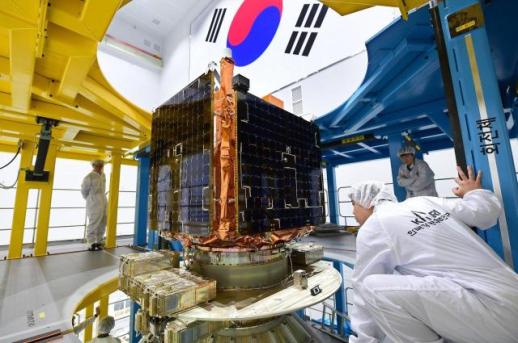 Kairospace verifies satellite de-orbit device in space SEOUL, August 13 (AJP) - A South Korean startup announced it had successfully demonstrated a device designed to pull defunct satellites out of orbit faster, a modest but concrete step in the global effort to curb the growing hazard of space debris. Kairospace said Thursday that its in-house de-orbit system, dubbed DORB, had proven its performance aboard a CubeSat launched into space by South Korea's homegrown Nuri rocket, in what the company described as a full validation under real orbital conditions. The system is built to stop retired or malfunctioning satellites from lingering in low orbit for years and becoming space junk. It works by expanding a satellite's surface area to increase atmospheric drag, hastening the craft's natural descent. Stowed, it folds into a sliver measuring 0.25 units — one unit being a 10-centimeter cube — from metal-coated polymer film pleated origami-style, then unfurls into a broad structure once triggered. Kairospace fitted DORB to KSAT3U, a 3U CubeSat carried aloft on Nuri's third flight in May 2023. The satellite was tasked both with observing weather through polarized imaging of the Earth's surface and with demonstrating that it could dispose of itself to help thin the orbital clutter. After about a year of normal operation, the company deployed the device and found the satellite's rate of orbital descent had more than doubled. Other CubeSats launched alongside it now sit about 80 to 150 kilometers higher, a gap Kairospace said makes the effect plainly visible. The firm said that even the public can watch the shift themselves through the satellite's NORAD tracking number, 56746. KSAT3U remains fully operational even after the device unfurled, and in May it captured and transmitted footage of the Busan New Port area. "Space debris is a critical challenge that the entire global space industry must solve together," said Shin Gyung-woo, Kairospace's chief executive, adding that the company would channel the result into European trials and global commercialization to build "a product that can compete in world markets." AJP Takeaways • A domestically built CubeSat, launched on the Nuri rocket, has become a rare in-orbit proof point for South Korean space-debris mitigation technology, an area where global regulation is tightening but few players have flight-verified hardware. • The measured result — a doubling of descent speed, publicly trackable via NORAD ID 56746 — gives Kairospace a credible export pitch as it moves to European trials with Gyeongnam Technopark backing. • Worth watching: the company's own project page describes a hydrogen-inflated balloon rather than the folded-film mechanism in this release. Reconciling that discrepancy, and confirming the projected reduction in total de-orbit time, would strengthen any follow-up. 2026-08-13 08:14:05
 -
 Naver confirms KEF membership, plays down labor-tension angle SEOUL, August 12 (AJP) - Naver, South Korea's largest internet company, has become the first domestic IT firm to join the Korea Enterprises Federation, the country's main employers' body. A Naver spokesperson said Wednesday that the membership, secured late last year, should be read chiefly through the lens of industrial convergence rather than labor relations. "This is a period when AI is accelerating connections across industries, and it should be seen as an effort to closely integrate with a variety of companies," the spokesperson said. The KEF is a management-side organization that specializes in advising member firms on labor and personnel matters. Experts say Naver's decision to join stands out because IT companies, long reliant on autonomous corporate cultures, had historically shown little interest in the federation's labor-management expertise. The spokesperson confirmed the KEF enrollment but said the company was not aware of any link between the membership and the kind of forceful union activity seen recently at rival Kakao. Industry accounts had tied the move to the amended trade union law known as the Yellow Envelope Act, which took effect in March and sharply broadens the liability of parent firms for subcontracted workers. Naver sits atop a sprawling structure of subsidiaries and lower-tier affiliates, a web that the revised law brings into closer regulatory focus. The company's union chapter, affiliated with the Korean Confederation of Trade Unions, has for years pressed headquarters to bargain directly over pay and welfare for workers at affiliated firms, and it plans to hold a ceremony on Aug. 20 declaring integrated bargaining across Naver group companies. AJP Takeaways • Naver has become the first South Korean IT company to join the Korea Enterprises Federation, the country's main management-side employers' body, confirming a membership secured late last year. • The company played down suggestions that the move was a defensive response to union pressure, with a spokesperson framing it instead as an effort to integrate with other firms as AI accelerates cross-industry convergence. • The membership comes as labor tensions build across Korea's tech sector, following Kakao's first-ever strike in June and ahead of a Naver union ceremony on Aug. 20 declaring integrated bargaining across group companies. 2026-08-12 17:27:21
 -
 KT Q2 profit falls 36% on tough property-gain base, AI revenue climbs SEOUL, August 12 (AJP) - KT reported a 36.1 percent year-on-year drop in second-quarter operating profit, as the absence of a large one-off property gain that lifted last year's earnings to a record weighed on the bottom line. According to regulatory filings released Wednesday, the telecommunications carrier posted consolidated operating profit of 648.3 billion won ($457 million) for the April to June quarter, down from 1.01 trillion won a year earlier. Revenue fell 10.1 percent to 6.68 trillion won. Net profit slid 34.5 percent from a year earlier, dragged down partly by a 54 billion won fine imposed last month by the Personal Information Protection Commission. Revenue from its AX, or AI transformation, business jumped 22.3 percent, buoyed by rising demand from financial firms and growth at cloud unit KT Cloud, even as legacy wireless and fixed-line revenue slipped. "We will secure new growth engines based on AX while faithfully carrying out our corporate value-enhancement plan, rewarding shareholders and investors with sustained results," Chief Executive Park Yoon-young said. Shares of KT closed at 52,700 won, 0.19 percent lower than the day before. AJP Takeaways • KT's Q2 operating profit fell 36.1 percent year-on-year to 648.3 billion won ($457 million), mainly because last year's quarter was inflated by a one-off property-development gain that produced record earnings. • Against the first quarter of this year, operating profit rose 34.3 percent, and revenue from the carrier's AX (AI transformation) business jumped 22.3 percent, signaling momentum in its pivot toward AI and cloud. • KT set a 2028 target of doubling AX revenue from 2025 levels and a 9-10 percent return on equity, backed by about 1 trillion won in cumulative share buybacks and cancellations. 2026-08-12 16:56:17