

Journalist
Kim Yeon-jae김연재
duswogmlwo77@ajupress.com
ReporterBank of Korea & Market, Macroeconomics
Kim Yeon-jae is a journalist at AJU Press (AJP's English platform),
covering macroeconomics, international finance, and geopolitics.
He closely tracks central bank monetary policies, global energy supply chains,
and the Korean defense industry. "Peering into the risks behind the euphoria."
covering macroeconomics, international finance, and geopolitics.
He closely tracks central bank monetary policies, global energy supply chains,
and the Korean defense industry. "Peering into the risks behind the euphoria."
Latest by Kim Yeon-jae
-
 AI chip boom begins to warm South Korea's broader domestic front SEOUL, July 31 (AJP) - Red-hot chip demand, which earned South Korea's two chipmakers 150 trillion won ($108 billion) in combined second-quarter operating profit — equivalent to about 6 percent of the country's entire 2025 nominal GDP — is beginning to warm the broader domestic front, with the AI boom spilling from exports into factories, construction sites and household spending. The latest government data suggest the country's semiconductor-driven expansion is no longer confined to export earnings. It is increasingly feeding capital investment, machinery orders and consumer activity as chipmakers embark on one of the world's largest manufacturing buildouts. Industrial production rose 6.4 percent from May in June, reversing a 2.9 percent decline the previous month, according to the Ministry of Data and Statistics Friday. Manufacturing output climbed 6.8 percent from May, led by automobiles and semiconductors. Semiconductor production rose 4.5 percent as output of DRAM and NAND flash memory chips increased, while automobile production jumped 15.4 percent, pointing to a broadening industrial recovery. The strongest spillover appeared in corporate investment. Facility investment rose 5.8 percent from May and 21.7 percent from a year earlier as semiconductor companies accelerated capacity expansion to meet resilient global AI demand. Machinery investment increased 6.9 percent on the month and 22.2 percent from a year earlier, with semiconductor manufacturing equipment accounting for much of the annual gain. Domestic machinery orders, excluding ships, surged 52.1 percent from a year earlier in June, accelerating from a 24.0 percent increase in May. Private-sector orders climbed 56.5 percent, while manufacturing companies boosted orders 79.3 percent, underscoring the strength of the semiconductor investment cycle. Domestic machinery shipments also rose 13.5 percent from a year earlier, reinforcing signs that equipment demand within South Korea continued to strengthen. The investment wave is backed by unprecedented long-term spending plans from the country's two memory giants. Samsung Electronics has outlined 2,450 trillion won ($1.6 trillion) in domestic investment through 2040, including 2,100 trillion won across its Pyeongtaek and Yongin semiconductor clusters, 400 trillion won for fabs in Gwangju and 56 trillion won for high-bandwidth memory facilities in Cheonan and Onyang. SK hynix has announced a separate 1,100 trillion won investment framework, allocating 600 trillion won to Yongin, 100 trillion won to Cheongju and 400 trillion won to southwestern South Korea. Together, Samsung plans six new fabrication plants and SK hynix four, with completion schedules brought forward to 2033 from the original 2045 roadmap. SK hynix's first new fab could begin operations as early as next year. Each advanced fab is estimated to cost roughly $30 billion. The buildout is also reshaping South Korea's supply chain. Imports of manufactured goods rose 14.7 percent from a year earlier in the second quarter, while domestically produced manufactured supply fell 1.2 percent, lifting the import share of manufactured goods by 3.4 percentage points to 32.1 percent. The increase reflects growing imports of advanced semiconductor equipment and specialized components needed for AI-related capacity expansion. Broader indicators also pointed to improving domestic demand. Retail sales rose 2.7 percent from May, the strongest gain in five months, driven by higher purchases of passenger vehicles, communications devices and computers. Services output increased 0.7 percent, while construction completed rose 4.1 percent from the previous month. The recovery, however, remains uneven. Construction orders fell 28.1 percent from a year earlier in June, while construction completed remained 4.0 percent below year-earlier levels despite the monthly rebound. 2026-07-31 11:35:00
 -
 Korea's June factory output hits 6-year high, chip lifts domestic front SEOUL, July 31 (AJP) - South Korea's factory output soared to a six-year high in June as robust automobile demand complemented chip activity, lifting the broader domestic economy. Mining and manufacturing output climbed 5.8 percent from May and 6.4 percent from a year earlier, the strongest monthly performance since June 2020, according to data released Friday by the Ministry of Data and Statistics. The rebound followed a revised 2.9 percent decline in May. Automobile production surged 15.4 percent from the previous month and 12.6 percent from a year earlier, returning to double-digit annual growth after contracting for two consecutive months. Semiconductor production rose 4.5 percent from May and 2.2 percent from a year earlier. While the monthly gain accelerated from May's 1.5 percent increase, annual growth remained far below April's 13.3 percent pace, suggesting chip output is stabilizing after an exceptionally strong run. Reflecting the broader recovery, overall industrial production excluding agriculture, forestry and fisheries increased 2.3 percent from the previous month and 4.2 percent from a year earlier. Domestic demand also showed signs of strengthening. Retail sales rose 2.7 percent from May, marking the strongest increase in five months as household spending improved despite persistent inflation. Facility investment climbed 5.8 percent from the previous month, the fastest increase in four months, and jumped 21.7 percent from a year earlier as semiconductor makers continued expanding production capacity. Construction completed, a gauge of current building activity, also increased 4.1 percent from May. Despite the strong June rebound, manufacturing output grew about 2.0 percent in the April-June quarter from the previous three months, easing from 2.7 percent growth in the first quarter, indicating that industrial momentum moderated on a quarterly basis even as June capped the period on a strong note. Retail sales increased to a five-month high of 2.7 percent amid income increase despite inflationary pressure. Facility investment rose to a four-month high of 5.8 percent and jumped 21.7 percent on year amid active chip expansion. Construction completed gained 4.1 percent from the previous month. The manufacturing output April-June period slowed to on-quarter 2-percent growth, slowing from 2.7 percent in the previous three-month period. 2026-07-31 08:46:18
 -
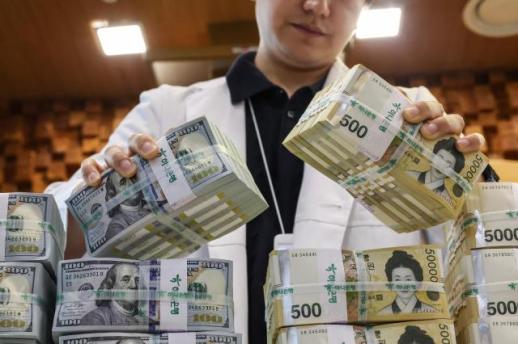 Won hits strongest level in about 5 months after Fed sends mixed signals SEOUL, July 30 (AJP) - The South Korean won strengthened to its highest level in about five months on Thursday, while government bond yields rose as currency and fixed-income markets drew contrasting signals from the Federal Reserve's latest policy decision. The won closed daytime trading at 1,437.4 per dollar, strengthening by 9.3 won from the previous session's close of 1,446.7. The currency traded between 1,435.9 and 1,447.7 during the session before returning below the 1,440 mark, finishing at its strongest closing level since Feb. 26. The Fed kept its benchmark rate unchanged at 3.50 to 3.75 percent, but three policymakers voted for a quarter-point increase, marking an unusually sharp split within the rate-setting committee. Currency traders, however, viewed Chair Kevin Warsh's remarks at a press conference as less hawkish than expected and scaled back bets on a September rate hike, while dollar inflows from SK hynix's American depositary receipt (ADR) issuance and month-end exporter selling provided additional support for the South Korean currency. In the bond market, the three-year Korea Treasury Bond yield rose 3.1 basis points to 3.831 percent, while the 10-year yield climbed 5.4 basis points to 4.311 percent. The gap between the two maturities widened to 48.0 basis points from 45.7 basis points, producing a bear-steepening move in which long-term borrowing costs rose faster than shorter-term rates. The rise reflected a sell-off in global sovereign debt after the Fed meeting, with the U.S. 10-year Treasury yield approaching 4.7 percent and the 30-year yield breaking above 5.2 percent to its highest level in 19 years, suggesting investors are demanding greater compensation for persistent inflation, heavy government borrowing and the risk that interest rates remain elevated for longer. 2026-07-30 17:43:00
 -
 BOK puts policy, markets veterans in key posts SEOUL, July 30 (AJP) - The Bank of Korea moved monetary policy and financial market specialists into key advisory and operational posts on Thursday, underscoring a push to strengthen policy coordination and its capacity to respond to market volatility. The central bank appointed or reassigned 11 department and regional branch heads and promoted 56 employees, including nine to Grade 1 and 15 to Grade 2. Lee Hwa-yeon, previously head of the Policy Coordination Team at the Monetary Policy Department, was named advisor to the governor, placing an official with experience in monetary policy, financial stability and the Monetary Policy Board Secretariat directly alongside the bank’s leadership. The BOK said Lee had extensive experience in monetary policy formulation and implementation as well as in analyzing financial market developments. Choi Young-joo was appointed director general of the Financial Markets Department after serving as head of the Office of Sustainable Growth, while outgoing markets chief Choi Yong-hoon moved to become director general of the Strategy & Coordination Department. Choi Young-joo spent much of her career in the Financial Markets and Monetary Policy departments and has participated in a range of market stabilization measures, according to the bank. Choi Yong-hoon’s experience spans the Financial Markets Department, the Reserve Management Group, parliamentary liaison and the Monetary Policy Board Secretariat, positioning him to coordinate internal strategy, external relations and major institutional projects. The moves effectively place a market specialist in charge of market operations and analysis while shifting an official with broader organizational and external-relations experience to the bank’s central planning arm. Lee Ah-rang, the outgoing advisor to the governor, was appointed head of the Office of Sustainable Growth, where she will oversee work related to green finance, climate change and coordination with domestic and overseas institutions. Baek Kyung-hoon, formerly head of the Audit Planning Team, was named head of the Office of Property, while Chae Hee-kwon moved from the bank’s Daejeon, Sejong and Chungnam branch to become director general of the Currency Department. Lee Hwa-yeon, Lee Ah-rang and Baek were all appointed to department-level leadership positions while remaining Grade 2 officials, reflecting the bank’s stated emphasis on performance and expertise rather than seniority alone. The promotion list also favored officials involved in the central bank’s core forecasting, financial stability, market operations and foreign-exchange functions. Kim Min-sik, who led revisions to the bank’s economic outlook reports and forecasting framework, was among nine officials promoted to Grade 1. Lim Kwang-kyu, director general of the Financial Stability Department, was promoted while retaining his current post after overseeing assessments of household debt, property-market risks and broader vulnerabilities in the financial system. Lee Dae-geon was promoted after helping develop the BOK’s climate-risk models and joint climate stress-testing framework for the financial sector. Nam Sun-woo was recognized for work on expanding foreign-exchange swaps with the National Pension Service, establishing local-currency transaction arrangements and supporting foreign-exchange market stability. Choi Wan-ho, previously compliance officer at the Reserve Management Group, was promoted for his role in overseas reserve management and the expansion of investment strategies. Women and externally recruited specialists each accounted for three, or 12.5 percent, of promotions to Grade 2 or above, compared with one, or 3.3 percent, in the first-half reshuffle. The appointments do not change the composition of the Monetary Policy Board and are therefore better viewed as an effort to sharpen policy execution and coordination than as a direct signal on the future path of interest rates. 2026-07-30 15:04:52
 -
 Fed holds rates despite three hike dissents, dovish signal: BOK SEOUL, July 30 (AJP) - The Federal Reserve held interest rates steady against three calls for a quarter-point increase, but markets nevertheless interpreted the decision as broadly dovish as Chair Kevin Warsh offered no clear trigger or timetable for further tightening, according to reports from the Bank of Korea’s overseas offices. The assessments were contained in the BOK Washington office’s review of the July Federal Open Market Committee meeting and the New York office’s report on financial-market reactions and views from major investment banks. The FOMC voted 9-3 to maintain the federal funds target range at 3.50 percent to 3.75 percent, with Dallas Fed President Lorie Logan, Cleveland Fed President Beth Hammack and Minneapolis Fed President Neel Kashkari favoring a 25-basis-point increase. The policy statement was virtually unchanged apart from a technical revision on the Fed’s policy of maintaining ample reserves, while the central bank said economic activity was expanding at a solid pace and inflation remained above its 2 percent target. Warsh rejected perceptions that more than five years of above-target inflation had led the Fed to tolerate a higher unofficial target, stressing that there was no softer alternative to its 2 percent goal. He said another rate increase could form part of the response if inflation remained elevated, but did not identify a specific threshold or timetable for further action. The BOK’s Washington office assessed that the principal disagreement within the FOMC concerned the timing of additional tightening and said policymakers were likely to continue discussing when another increase might become necessary. Warsh also defended the Fed’s reduced reliance on forward guidance, arguing that markets should form their own judgments from economic data rather than depend heavily on signals from policymakers. Market participants cited by the BOK’s New York office nevertheless viewed the meeting as broadly dovish because rates were held, the statement contained no substantive policy shift and Warsh did not provide a clear framework for responding to persistent inflation. Major investment banks cited in the report said the lack of a clearly identifiable reaction function, combined with reduced Fed communication, could increase uncertainty over the U.S. rate path and raise the term premium embedded in longer-dated Treasury yields. Treasury yields initially trimmed their gains, equities rose and the dollar weakened after the press conference, before those moves reversed as doubts over the Fed’s inflation-fighting credibility pushed longer-term yields higher and stocks lower. The 10-year break-even inflation rate rose 7 basis points and the two-year Treasury yield fell 1 basis point, while federal funds futures reduced the number of quarter-point increases priced in by September from one to 0.6 and by December from 1.7 to 1.3. The policy debate comes as strong U.S. productivity and corporate investment continue to support growth, with AI-related equipment and software spending rising at a pace approaching 20 percent from a year earlier even as the boom complicates the Fed’s assessment of whether higher chip prices signal broader inflation. 2026-07-30 13:46:07
 -
 BOK steps up vigilance on Fed uncertainty and Gulf risks SEOUL, July 30 (AJP) -South Korea's central bank said Thursday it would step up monitoring of domestic financial markets, citing mounting uncertainty over U.S. monetary policy and Middle East tensions layered on top of existing investor unease about a possible slowdown in artificial intelligence investment. The Bank of Korea (BOK) convened an emergency market review meeting at 8 a.m. local time, chaired by Deputy Governor Park Jong-woo, to evaluate global market developments following the U.S. Federal Reserve's latest policy decision and their potential spillover into Korea's financial and foreign-exchange markets. The BOK is South Korea's central bank, responsible for setting monetary policy and safeguarding financial stability. "Uncertainty related to the Federal Reserve's monetary policy and the situation in the Middle East has increased at a time when concerns over a slowdown in AI investment have already weakened sentiment in domestic financial markets," Park said. The central bank said it would track how domestic and external risks evolve and assess their effects on Korea's economy and financial markets with what Park called "heightened vigilance." The BOK's meeting followed the Fed's widely expected decision to hold its benchmark federal funds rate steady at a range of 3.50 percent to 3.75 percent. Three regional Fed presidents — Dallas Fed's Lorie Logan, Cleveland Fed's Beth Hammack and Minneapolis Fed's Neel Kashkari — dissented, favoring a quarter-point rate increase instead. Fed Chair Kevin Warsh reaffirmed the central bank's commitment to restoring price stability but gave no concrete signal on the timing or direction of the Fed's next move. Markets read the outcome as adding to uncertainty over the Fed's policy path and the inflation outlook, the BOK said, a reaction that drove a sharp rise in longer-term U.S. Treasury yields. The Korean central bank warned that the combination of U.S. monetary-policy uncertainty, Middle East tensions and worries over the AI investment cycle could continue to weigh on domestic stocks, bond yields and the won — South Korea's currency. As of 10:30 a.m., the won was trading at 1,442.7 per dollar, up 4.0 won, or 0.28 percent, from the previous session's close of 1,446.7. Earlier in the session, the won touched an intraday high of around 1,435 per dollar — its strongest level since Feb. 27, when it reached 1,430.5. The three-year government bond yield edged down 0.1 basis points from the previous close to 3.799 percent, while the 10-year yield rose 2.2 basis points to 4.279 percent. 2026-07-30 10:43:06
 -
 Korea's factory sentiment hits 4-year high on AI chip, shipbuilding boom SEOUL, July 30 (AJP) - South Korea's manufacturing confidence climbed to its highest level in more than four years in July as a wave of AI-related semiconductor investment, data-center construction and strong shipbuilding and defense orders boosted factory activity, Bank of Korea data showed Thursday. The manufacturing Composite Business Sentiment Index (CBSI) rose 2.0 points from June to 103.2, its highest reading since June 2022 and the third straight month above the long-term benchmark of 100. Unlike April's improvement, which was largely driven by easing inventory burdens, July's gain reflected stronger underlying demand. New orders contributed 0.8 point to the increase, followed by business conditions (0.7 point), production (0.6 point) and funding conditions (0.4 point), while inventories remained a slight drag. The data suggest manufacturers are benefiting from expanding production rather than simply clearing excess stock. Demand was particularly strong across industries tied to the AI supply chain. Other machinery and equipment makers reported a six-point improvement in business conditions and a 10-point jump in new orders as demand from the shipbuilding, defense and semiconductor industries accelerated. Medical and precision equipment manufacturers posted a nine-point increase in production and a 14-point surge in new orders, supported by overseas data-center construction and semiconductor manufacturing equipment demand. Fabricated metal producers also reported improving business conditions as orders from shipyards and industrial plants strengthened while raw-material costs eased. The broader improvement was reflected across key activity indicators. The sales BSI rose five points to 96, production gained three points to 93 and new orders increased four points to 92. Domestic sales posted the largest increase, climbing eight points to 93, while export sentiment improved two points to 98. The recovery also broadened beyond Korea's largest exporters. Business sentiment among exporters rose 1.1 points to 107.5, matching its highest level since June 2022, while manufacturers focused on the domestic market reached 100.0 for the first time in more than two years. Small and medium-sized manufacturers gained 1.9 points to 97.6, their strongest reading since July 2023, compared with a 0.8-point increase among large companies to 105.3. Manufacturers also reported easing cost pressures. The raw-material purchase price index fell 11 points to 129, while the profitability index rose six points to 79. The share of manufacturers identifying higher raw-material costs as their biggest challenge declined 5.9 percentage points to 21.8 percent. However, concern over economic uncertainty increased 2.5 points to 20.6 percent, suggesting geopolitical and global trade risks continue to cloud the outlook. Confidence outside manufacturing remained subdued. The all-industry CBSI edged up 0.8 point to 98.5, still below the historical average, as nonmanufacturing sentiment slipped 0.2 point to 95.2 after a sharp decline in June. Transportation and storage companies cited weaker maritime cargo volumes and higher operating costs, while engineering firms reported softer project orders. Wholesale and retail businesses also faced mounting merchandise costs as elevated shipping rates squeezed margins. Looking ahead, manufacturers grew more optimistic about August. Their outlook index rose 2.3 points to 100.5, the highest since September 2022, with export-oriented manufacturers reaching 105.0 and large companies climbing to 103.2, both their strongest readings in about four years. The broader Economic Sentiment Index, which combines business and consumer confidence, rose 1.1 points to 97.9 as improving corporate financing conditions and stronger household income expectations offset lingering weakness in services. The Bank of Korea surveyed 3,193 companies, including 1,783 manufacturers and 1,410 nonmanufacturers, between July 14 and 22. 2026-07-30 07:51:15
 -
 Fed, BOJ policy paths may be behind foreign exodus from Korean equities SEOUL, July 29 (AJP) - Foreign investors have sold nearly 20 trillion won ($14.5 billion) worth of South Korean equities this month, including about 10 trillion won this week, extending first-half outflows of roughly 170 trillion won as global investors reposition portfolios ahead of diverging monetary paths in the United States and Japan rather than simply locking in profits after Seoul's year-long rally. The sustained selling suggests global liquidity conditions—not domestic valuations alone—are increasingly dictating capital flows into Korean assets. The Federal Reserve and the Bank of Japan will deliver back-to-back policy decisions over the next two days, placing the world's two reserve-currency central banks at the center of global markets. While both are widely expected to leave interest rates unchanged, investors are focused on whether Fed Chair Kevin Warsh and BOJ Governor Kazuo Ueda signal further tightening, a shift that could reshape capital flows across equities, bonds and currencies. The Fed will announce its decision at 3 a.m. Thursday Korea time, followed by Warsh's press conference 30 minutes later, while the BOJ concludes its two-day policy meeting on Friday with updated economic forecasts. Markets overwhelmingly expect both central banks to stand pat. The debate instead centers on how firmly each prepares investors for the next move. Interest-rate futures assign roughly a 30 percent probability of a quarter-point Fed increase this week while placing higher odds on a move by September. Recent U.S. economic data have offered mixed signals. Consumer prices rose 3.5 percent from a year earlier in June, while core inflation slowed to 2.6 percent. The Fed's preferred core personal consumption expenditures price index remained elevated at 3.4 percent in May ahead of fresh PCE and second-quarter GDP data due later Thursday. The labor market has softened without a sharp deterioration. Payrolls increased by 57,000 in June, unemployment held at 4.2 percent and the economy expanded at an annualized rate of 2.1 percent in the first quarter. Fed policymakers also remain divided. Nine of 18 officials project another rate increase by year-end, eight expect no further change and one foresees a cut, although the median projection still implies roughly one additional quarter-point increase. With no updated Summary of Economic Projections or dot plot scheduled for this meeting, markets will rely largely on Warsh's assessment of inflation risks and the likelihood of tightening later this year. The BOJ is likewise expected to leave its overnight policy rate unchanged after raising it to 1.0 percent in June, the highest level in more than three decades. Unlike the Fed, however, economists see broader consensus for additional tightening. A Reuters poll found 75 of 87 economists expect the policy rate to reach 1.25 percent by year-end. Japan's core consumer inflation rose 1.6 percent in June but remained below the BOJ's 2 percent target for a fifth consecutive month. At the same time, the weak yen and higher import costs have kept concerns over renewed price pressures alive, while real household consumption fell 0.4 percent in May, underscoring the fragile state of domestic demand. Ueda has repeatedly said the BOJ will continue raising rates if underlying inflation moves sustainably toward 2 percent. Because the central bank will publish updated growth and inflation forecasts alongside Friday's decision, investors will scrutinize any upward revisions or stronger emphasis on upside inflation risks that could reinforce expectations for another increase in October or December. The changing policy outlook is particularly significant because Japan has long served as one of the world's cheapest sources of funding capital. For more than a decade of near-zero or negative interest rates, global investors borrowed yen at minimal cost and deployed the proceeds into higher-yielding assets overseas, ranging from U.S. Treasuries and corporate bonds to emerging-market equities. South Korea, with its deep capital market, liquid government bonds and globally competitive export companies, became one of the destinations for such capital. As the BOJ gradually raises interest rates while signaling further policy normalization, the economics of those trades are beginning to change. Higher Japanese borrowing costs reduce the return on leveraged overseas investments and encourage investors to trim exposure and repay yen borrowings. The persistent foreign selling in Seoul is consistent with such a gradual reallocation of capital, although the exact share of Korean investments financed through yen borrowing cannot be quantified. The scale of the outflows nevertheless suggests South Korea has become one of the markets most exposed to the global repricing of liquidity as Japanese monetary policy slowly exits its ultra-loose era. For global investors, however, the more immediate question is whether this week's policy guidance changes expectations for the dollar and the yen. The U.S. dollar has strengthened ahead of the meetings, with the dollar index hovering near a one-month high around 101, while the yen remains close to a four-decade low at roughly 163 per dollar despite the BOJ's tightening cycle. That distinguishes today's market from last August's turmoil. A yen carry trade becomes unstable when the Japanese currency appreciates rapidly. Investors who borrowed in yen face rising repayment costs, forcing them to unwind leveraged positions by selling overseas assets and buying back the Japanese currency. Such feedback loops can accelerate declines across global equity markets. Those dynamics amplified the turmoil in August 2024, when a sharp yen rally coincided with a 12.4 percent plunge in Japan's Nikkei 225 and an 8.8 percent drop in South Korea's Kospi. Conditions are different today. Although the BOJ has begun tightening monetary policy, the yen remains historically weak despite higher Japanese interest rates. That suggests investors are reducing overseas exposure more gradually than during last year's abrupt deleveraging, when rapid yen appreciation became the catalyst for a broad carry-trade unwind. Investors will therefore watch whether the Fed or BOJ triggers a sharper move in the dollar-yen exchange rate after their policy decisions. A sustained strengthening of the yen accompanied by simultaneous declines in Japanese, U.S. and emerging-market equities would point to a broader withdrawal of leveraged global capital. South Korea has already emerged as one of the clearest expressions of that global portfolio adjustment. Foreign investors have withdrawn nearly 190 trillion won from Korean equities this year despite resilient corporate earnings and the country's central role in the global AI semiconductor supply chain, underscoring how global monetary conditions are outweighing domestic fundamentals in determining cross-border capital allocation. The won strengthened 13.7 won from the previous session to close at 1,448.8 per dollar at the 3:30 p.m. reference rate, as dollar selling related to SK hynix's American depositary receipt proceeds helped offset heavy foreign equity outflows and uncertainty ahead of the Fed meeting. Government bonds also benefited from a flight toward safer assets. The three-year Treasury yield fell 4.3 basis points to 3.788 percent, while the 10-year yield declined 3.8 basis points to 4.258 percent as the equity sell-off boosted demand for bonds and the firmer won eased some concern over imported inflation. For South Korea, the policy decisions themselves matter less than what they imply for the future cost of global capital. A more hawkish Federal Reserve would reinforce the dollar's yield advantage, while a more confident BOJ would further erode the economics of financing overseas investments with cheap yen. Together, those forces could prolong foreign outflows from Korean equities even without another bout of market panic. The more immediate risk lies not in this week's expected policy holds but in the trajectory of the yen. If Japanese tightening eventually triggers sustained appreciation of the currency, the gradual portfolio adjustments now unfolding across Asian markets could evolve into a broader unwinding of carry trades. Until then, Seoul's persistent foreign selling appears more consistent with an orderly reallocation of global liquidity than with the disorderly deleveraging that rattled markets in August 2024. 2026-07-29 16:52:19
 -
 BOK chief argues rate-hike bias best to contain inflation SEOUL, July 29 (AJP) -Bank of Korea Governor Shin Hyun-song on Wednesday said maintaining a rate-hike bias was the most appropriate way to contain inflation, while stressing that the timing and pace of any further tightening would depend on incoming data and economic conditions. Shin made the remarks at a National Assembly Finance, Economy, Planning and Budget Committee meeting after Democratic Party lawmaker Yoon Hu-deok asked whether the central bank planned to raise rates once or twice more this year. He said the scale and timing of further action would depend on incoming data and economic conditions, offering no estimate of the terminal rate. The BOK raised its benchmark rate by 25 basis points to 2.75 percent on July 16 and said in its parliamentary report that it needed to maintain a tightening stance while monitoring inflation, growth and financial-stability risks. Shin said the central bank was placing greater emphasis on core inflation, which is less directly affected by movements in international oil prices than headline inflation. He said solid economic activity and improving income conditions were adding demand-side pressure, making the recovery in domestic demand an increasingly important driver of inflation. Headline inflation rose from 2.0 percent in January and February to 3.2 percent in June, while inflation excluding food and energy climbed to 2.5 percent. The BOK’s inflation diffusion index, which measures how broadly price increases are spreading, has approached its highest level since 2010 excluding the pandemic period. The central bank said accumulated import costs, exchange-rate effects and stronger domestic demand were likely to keep inflation above its 2 percent target for a considerable period. The BOK also said this year’s economic growth was likely to significantly exceed its May projection of 2.6 percent as global investment in artificial intelligence continued to support semiconductor exports and capital spending. South Korea’s economy expanded 3.8 percent from a year earlier in the first half, with second-quarter gross domestic product growing 0.6 percent from the previous quarter and 3.7 percent year on year. The central bank cautioned, however, that the benefits of the semiconductor boom remained concentrated in a limited number of industries and income groups, constraining its spillover into the broader economy. Rising home prices in the Seoul metropolitan area and increased borrowing for property and equity investment were also cited as financial-stability risks supporting continued tightening. Seoul apartment prices recently rose 0.27 percent in a week, equivalent to an annualized rate of 15.1 percent, while financial-sector household lending increased by between 8 trillion won and 9 trillion won in both May and June. The BOK also warned that equity demand had become concentrated in a small number of AI-related industries, with foreign selling and increased leverage amplifying market volatility. The central bank’s assessment broadly pointed in the same direction as those of other economic authorities, although their emphasis differed on inflation and household debt. Deputy Prime Minister and Finance Minister Koo Yoon-cheol said the government would seek to keep second-half inflation below 3 percent through measures aimed at easing energy and food costs and curbing market manipulation. The positions were not directly contradictory, but the finance ministry placed greater weight on supply measures and near-term headline inflation, while the BOK focused on persistent core-price pressure driven partly by domestic demand. Financial Services Commission Chairman Lee Eog-weon said household debt had fallen to 85.3 percent of GDP in the first quarter from 98.7 percent in 2021 and that slower mortgage growth following the June 27 measures had reduced its influence on the property market. The BOK, by contrast, highlighted the recent monthly increase in lending, rising metropolitan-area housing prices and the expansion of unsecured borrowing used for equity investment, suggesting greater concern about newly accumulating leverage. At 2:30 p.m., the won was trading at 1,444 per dollar, up 18.5 won from the previous session’s daytime close of 1,462.5. The KOSPI was down 7.25 percent at around 5,589 at the same time after a sell-side program-trading sidecar and a market-wide circuit breaker were triggered. Circuit breakers were activated in both the KOSPI and KOSDAQ markets for a second consecutive session for the first time since the systems were introduced. 2026-07-29 15:48:03
 -
 Financial regulators to probe leveraged ETFs amid market volatility, policy chief says SEOUL, July 29 (AJP) - Financial authorities will thoroughly review factors behind heightened stock-market volatility, presidential policy chief Kim Yong-beom said on Tuesday during a press briefing in São Paulo, Brazil, while accompanying President Lee Jae Myung on a state visit. Kim said the Financial Services Commission (FSC) and the Financial Supervisory Service (FSS) would examine why volatility in South Korean equities tends to be unusually high, while rejecting claims that single-stock leveraged exchange-traded funds (ETFs) introduced by the government this year were solely responsible for the recent market turbulence. He admitted that those ETFs could intensify market swings but argued it would be inappropriate to blame them entirely for the recent volatility. He then attributed the initial sell-off partly to global uncertainty over whether heavy investment in artificial intelligence would generate sufficient returns and whether semiconductor demand could remain resilient. Kim also cited the Shanghai debut of China's ChangXin Memory Technologies earlier this week and advances in Chinese lithography technology as factors fueling concerns over the long-term competitiveness of Samsung Electronics and SK hynix. The KOSPI closed 10.84 percent lower at 6,023.66 on Tuesday, its steepest daily fall since March 4, while SK hynix tumbled 14.7 percent and Samsung dropped 14.4 percent. The two chipmakers accounted for more than half of the benchmark's value, amplifying the impact of the global semiconductor sell-off on the broader Asian market. Kim's attempt to downplay their market impact still faces scrutiny over the government's hasty introduction of such high-risk ETFs and subsequent measures to restrict investment in them. The market value of some 16 single-stock leveraged and inverse ETFs surged from 4.4 trillion won when they became available on May 27 to 11.9 trillion won by July 15, about seven weeks later, according to the FSC. Their trading volume reached 8.29 trillion won as of Tuesday, accounting for 34.2 percent of total ETF turnover. Amid overheated trading, the FSC and FSS came up with measures on July 16, suspending new listings and advertisements. They also decided to raise the minimum cash deposit required for new or additional purchases of domestic and overseas single-stock leveraged ETFs and exchange-traded notes from 10 million won to 30 million won, starting from July 31. The FSC has also asked asset managers to spread rebalancing trades throughout the session rather than concentrating them near the close, reflecting concerns that mechanical trading around the closing price could further amplify market volatility. 2026-07-29 11:07:54