

Journalist
Lee Jung-woo이정우
cannes2030@ajupress.com
ReporterMinistry of Unification & North Korea, Politics, Foreign Affairs
I studied philosophy in college, and sociology and journalism in graduate school. I cover North Korea, South Korean politics, foreign affairs and films. I enjoy Nordic cinema, Indian cuisine and Japanese detective novels. I have a cat and like bright, acidic coffee.
"Were it left to me to decide whether we should have a government without newspapers, or newspapers without a government, I should not hesitate a moment to prefer the latter."
"Were it left to me to decide whether we should have a government without newspapers, or newspapers without a government, I should not hesitate a moment to prefer the latter."
Latest by Lee Jung-woo
-
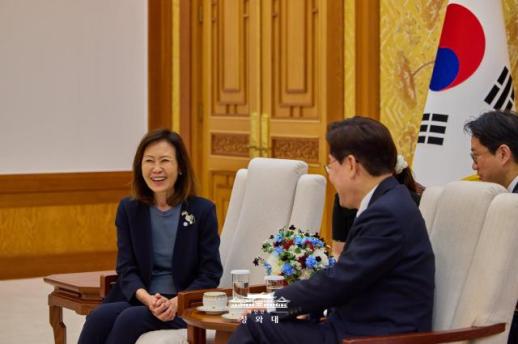 Lee accepts credentials of US Ambassador Steel and others SEOUL, August 12 (AJP) - President Lee Jae Myung welcomed U.S. Ambassador to South Korea Michelle Steel on Wednesday in their first meeting since the Korean American and former congresswoman took up her post in Seoul. Lee greeted Steel at Cheong Wa Dae during a ceremony in which he received credentials from newly appointed ambassadors of four countries. After accepting Steel's credentials, Lee said, "Welcome," before posing with her for a commemorative photo. He then offered the same greeting to her husband, attorney Shawn Steel, who accompanied her to the ceremony, and posed for another photo. A credentials presentation ceremony is a formal diplomatic event in which a newly appointed ambassador presents a letter of credence issued by the head of state of the ambassador's home country to the head of state of the host country. Lee also received credentials from Portuguese Ambassador Vanda Maria Dias Stelzer Sequeira, United Arab Emirates Ambassador Jamal Abdullah Al Suwaidi and Irish Ambassador Sean Hoy. Steel, born in Seoul in 1955, spent part of her youth in Japan before moving to the United States with her family in 1975. She later built a political career in California, serving on the California State Board of Equalization from 2007 to 2015 and the Orange County Board of Supervisors from 2015 to 2021. A Republican, Steel served two terms in the U.S. House of Representatives from 2021 to 2025, representing California's 48th and later 45th congressional districts. She was among the first Korean American women elected to Congress. President Donald Trump nominated her as ambassador to South Korea in April, and the Senate confirmed her on June 17. Steel is the second Korean American to serve as U.S. ambassador to South Korea, after Sung Kim, and the first Korean American woman to hold the post. Steel arrived in South Korea on July 30 and has since begun a series of diplomatic and public engagements. Before Wednesday's meeting with Lee, she met National Security Adviser Wi Sung-lac on Aug. 4 to discuss key issues concerning the South Korea-U.S. alliance. AJP Takeaways: President Lee Jae Myung met U.S. Ambassador Michelle Steel at Cheong Wa Dae on Wednesday, their first meeting since she began her post in Seoul. Michelle Steel is the first Korean American woman to serve as U.S. ambassador to South Korea and the second Korean American to hold the position, after Sung Kim. Steel, a former Republican U.S. congresswoman from California, arrived in South Korea on July 30 and has begun diplomatic engagements focused on the South Korea-U.S. alliance. 2026-08-12 14:35:17
-
 Korea, Tajikistan industry officials meet ahead of C5 summit SEOUL, August 11 (AJP) - Ahead of the first Korea-Central Asia Summit in September, South Korea and Tajikistan on Tuesday discussed expanding economic cooperation in critical minerals, supply chains and new technologies. South Korean Vice Minister of Trade, Industry and Resources Moon Shin-hak met Isojon Qurbonzoda, Tajikistan's first deputy minister of industry and new technologies, in Seoul to discuss projects that could produce tangible economic outcomes at the upcoming summit. The two sides discussed creating a regular C5+Korea Industry Ministers' Meeting, bringing together South Korea and the five Central Asian countries — Kazakhstan, Kyrgyzstan, Tajikistan, Turkmenistan and Uzbekistan. They also discussed a memorandum of understanding on bilateral cooperation in industry and new technologies and ways to expand exchanges among companies through a Korea-Central Asia Business Summit. The first Korea-Central Asia Summit is scheduled to be held in South Korea on Sept. 16-17, according to the Foreign Ministry. Seoul has been preparing for the inaugural gathering through a series of senior officials' meetings and established a 17-member private advisory committee covering seven fields. The summit is expected to serve as a platform for South Korea to deepen ties with the five Central Asian states, an increasingly important region for energy, critical minerals, infrastructure and supply-chain cooperation. Critical minerals were a major focus of Tuesday's meeting. Tajikistan has deposits of gold, silver and antimony, while South Korea is seeking to diversify supplies of minerals needed for its advanced manufacturing industries. The two countries will hold their first Korea-Tajikistan Minerals Forum in Seoul on Wednesday, bringing together government officials, institutions and companies to discuss mineral policies, joint exploration, investment, financing and supply-chain development. Moon said the forum could connect Tajikistan's resource potential with South Korea's mineral exploration and development technologies and its demand for raw materials. The government hopes the talks will lead to specific projects that can be presented when leaders meet in September. Economic ties between the two countries remain relatively small but have expanded sharply in recent years. Bilateral trade reached US$354 million in 2025, according to Korea International Trade Association data cited by the Foreign Ministry. "With their abundant resources and growth potential, Tajikistan and other Central Asian countries are important partners for Korea," Moon said, adding that Seoul would work to turn the discussions into concrete cooperation in industry, supply chains and critical minerals at the September summit. AJP Takeaways: - South Korea and Tajikistan are expanding cooperation in critical minerals, supply chains and advanced technologies ahead of the first Korea-Central Asia Summit in Seoul on Sept. 16-17. - Critical minerals will be a key focus, with the first Korea-Tajikistan Minerals Forum set for Wednesday to explore joint projects in mineral exploration, investment, financing and supply-chain development. - Seoul is seeking concrete economic outcomes from the September summit, including a possible C5+Korea Industry Ministers' Meeting and stronger business ties with resource-rich Central Asian countries. 2026-08-11 17:57:31
-
 Korea, Uzbekistan put AI minerals atop business agenda for C5 summit SEOUL, August 11 (AJP) - Artificial intelligence, from the critical minerals needed to build its infrastructure to the data centers and digital technologies that power it, is emerging as the centerpiece of the business agenda for Uzbek President Shavkat Mirziyoyev's visit to South Korea next month. Mirziyoyev is expected to bring a roughly 200-strong business delegation to Seoul during his first state visit to South Korea in nearly five years, coinciding with the inaugural Korea-Central Asia Summit on Sept. 16-17. The groundwork was laid in Seoul on Tuesday, when senior Uzbek officials and executives from major Korean companies met to identify projects that could be advanced during the summit. “Uzbekistan aims to join the ranks of upper-middle-income countries by 2030 and attract more foreign investment by improving its investment environment,” Deputy Prime Minister Jamshid Khodjaev said at a Korea-Uzbekistan business roundtable at Lotte Hotel Seoul. “We hope Korean companies will take part in Uzbekistan’s development.” Khodjaev identified infrastructure, critical minerals, automobiles and digital development as priority areas for bilateral cooperation, placing AI and the infrastructure supporting it high on the agenda. “Uzbekistan has established plans for AI and digital development,” he said, adding that Tashkent was seeking Korean participation in data centers, green technologies and renewable energy projects. The push reflects Uzbekistan's effort to pair its natural resources and growing domestic market with Korean capital and technology as it seeks to move up the industrial value chain. The high-level roundtable brought together officials from both governments and representatives from Hyundai Motor Group, Korea Electric Power Corp., GS E&C, LX International, SK Nexilis and Lotte Hotels & Resorts. The Uzbek Embassy said the meeting was organized as part of preparations for Mirziyoyev's visit and aimed at generating concrete projects before the leaders meet. Khodjaev also proposed expanding cooperation in healthcare, including hospital construction and pharmaceutical industry clusters. South Korean Trade Minister Yeo Han-koo said the talks could provide a foundation for broader economic diplomacy with Central Asia. “Uzbekistan is a key cooperation partner for Korea, and we are producing tangible results together,” Yeo said. “I hope today’s discussions will deepen our understanding of bilateral trade, investment, supply chains and economic cooperation and serve as a meaningful foundation for the successful Korea-Central Asia summit.” Moon Ji-sung, deputy minister for international economic affairs at South Korea's Finance Ministry, said the two economies could complement each other. “If Uzbekistan’s abundant potential is combined with Korea’s technology and financial capabilities, the economies of both countries can make a new leap forward,” Moon said. Officials and companies discussed prospective projects spanning industry, energy, critical minerals, AI, healthcare and logistics, with the aim of turning some of them into concrete investment and cooperation deals before the September summit. The Sept. 16-17 gathering will be South Korea's first summit with all five Central Asian countries — Kazakhstan, Kyrgyzstan, Tajikistan, Turkmenistan and Uzbekistan — collectively known as the C5. AJP Takeaways: South Korea and Uzbekistan are putting AI, critical minerals and data centers at the center of their economic agenda ahead of the inaugural Korea-Central Asia Summit in Seoul on Sept. 16-17. Uzbek President Shavkat Mirziyoyev is expected to bring about 200 business leaders to South Korea, as the two countries seek concrete deals in infrastructure, renewable energy, digital technology, healthcare and supply chains. Uzbekistan wants Korean technology, capital and investment to support its industrial transformation, while Seoul sees the partnership as a gateway to deeper economic cooperation with the five Central Asian countries, or C5. 2026-08-11 17:41:41
-
 Dog days of summer end, so does Korea's dog meat tradition SEOUL, August 11 (AJP) - There are "dog days of summer" for English-speaking societies. Korea likewise has its own pun from ancient calendar for the season’s punishing heat — and this Friday, its final dog day will carry an unusually literal sense of ending. Aug. 14 is Malbok, the last of the three traditional hottest days collectively known as Sambok, or Boknal. It will also be South Korea’s last Malbok before breeding, slaughtering and selling dogs for food becomes a crime. Malbok comes after Ipchu, the traditional beginning of autumn, and falls on the first gyeong day after it. This year’s Malbok falls on Friday, Aug. 14. The meaning of bok itself captures the seasonal struggle. The Chinese character 伏 means to lie prostrate or submit and combines the characters for a person and a dog. In the old East Asian theory of the five elements, summer belongs to fire and autumn to metal. Boknal was understood as the point when the cool force of approaching autumn tried to rise but was beaten back by the lingering power of summer — autumn forced to crouch before the heat. Three times it submits. Hence Sambok, the three bok days. For generations, Koreans answered that heat by eating heat. The idea known as iyeol chiyeol — fighting heat with heat — filled restaurants on Boknal with steaming bowls of samgyetang, chicken soup made with a whole young bird stuffed with glutinous rice, ginseng, jujubes and garlic. For many, particularly older Koreans, there was another restorative soup: bosintang, made with dog meat. That part of Malbok is now disappearing. Under a special law enacted in February 2024, breeding or slaughtering dogs for food and distributing or selling dog meat will be prohibited from Feb. 7, 2027, after a three-year transition period. Slaughtering dogs for food can carry up to three years in prison or a fine of 30 million won ($21,000), while breeding or distributing them for food can lead to up to two years in prison or a 20 million won fine. The law does not criminalize eating dog meat itself. The industry is already vanishing. Of the 1,537 dog farms registered with the government, 1,204, or about 78 percent, had closed by late December 2025, leaving just 333, according to the Ministry of Agriculture, Food and Rural Affairs. It is a remarkable end for a practice documented on the Korean Peninsula for centuries. Xu Jing, a Chinese envoy who visited the Goryeo kingdom in 1123, recorded Koreans eating dog meat and raising dogs much as they did cattle and pigs. For much of modern Korean history, dog meat remained associated less with everyday dining than with stamina food, particularly during the oppressive weeks of Sambok. Its place in Korean society began changing rapidly in the late 20th century. International criticism intensified ahead of the 1988 Seoul Olympics. At home, rising incomes, smaller families and the rapid growth of pet ownership gradually transformed the dog’s place in Korean life — from livestock or guard animal to companion and, increasingly, family member. Today, pet cafes, hotels, restaurants and hospitals are commonplace. Koreans spend heavily on dog food, clothing, grooming and medical care. What many older Koreans once regarded as summer health food has become unthinkable to much of a younger generation. South Korea had an estimated 5.46 million pet dogs at the end of 2024, according to the KB Financial Group Research Institute. Some 11.96 million people lived with dogs, while the broader number of Koreans living with pets reached 15.46 million, or nearly three in every 10 people. “I can’t imagine how we could be so brutal to these precious animals,” said Park Da-yeon, 45, who raises a 2-year-old brown poodle. “Better late than never. I’m glad we are finally past the custom.” The retreat of dog meat has even reshaped Korea’s market for traditional stamina foods. Goat meat emerged as one possible alternative, prompting farmers to expand production, but oversupply and rapidly growing imports have since helped drive domestic live-goat prices down more than 60 percent from two years ago. Across the border, however, the cultural clock is moving in the opposite direction. North Korean state media this month again promoted dog-meat soup, known there as dangogi-guk, or “sweet meat soup,” among nutritious foods to help people cope with the summer heat. Pyongyang continues to celebrate the dish as traditional summer nourishment even as Seoul prepares to eliminate the industry altogether. That divergence gives this year’s Malbok an ending larger than a change in menu. The arrival of Malbok has always suggested that summer’s grip is finally beginning to loosen. The character 伏 evokes autumn’s cool energy lying defeated beneath the heat, waiting for its chance to rise. This Friday, the heat may still win that ancient battle. But for South Korea’s dog-meat tradition, there will be no next Malbok. AJP Takeaways: South Korea’s dog meat ban takes effect Feb. 7, 2027, making Aug. 14, 2026, the country’s final Malbok before breeding, slaughtering and selling dogs for food becomes illegal. Dog meat consumption, once linked to Boknal and summer stamina food, is rapidly disappearing as pet ownership grows and 78 percent of registered dog farms had already closed by late 2025. The shift marks a major cultural divide on the Korean Peninsula: South Korea is ending its centuries-old dog meat industry, while North Korea continues to promote dog-meat soup as a traditional summer food. 2026-08-11 14:07:31
-
 Zelenskyy repeatedly warns of expanded N. Korean role in Russia's war SEOUL, August 11 (AJP) - North Korea's expanding role in Russia's war against Ukraine should raise security concerns in South Korea as Pyongyang gains battlefield experience and improves its weapons through cooperation with Moscow, Ukraine's top military commander has repeatedly warned. Ukrainian President Volodymyr Zelenskyy said Monday that Russia was preparing to station additional North Korean troops on its territory and had received more ballistic missiles from Pyongyang. Over the weekend, he said a decision had been made to deploy between 30,000 and 50,000 North Korean troops to Russia, though he did not disclose the source of the figure or give a timeline. Zelenskyy warned that North Korea's participation in the war poses risks extending far beyond Ukraine because its soldiers and weapons are being tested and improved under real combat conditions. "The greater the danger will later be for Japan, the Republic of Korea, the Philippines, and other countries in the region," Zelenskyy said in an address Sunday. He has also called on South Korea and Japan to provide Ukraine with greater air defense support, arguing that helping Ukraine counter North Korean weapons could prevent Pyongyang from using the conflict to strengthen its military capabilities. For South Korea, a key concern is the battlefield experience North Korean troops could bring back to the Korean Peninsula. North Korean forces fighting alongside Russia have gained exposure to drone warfare and other modern combat operations, potentially allowing Pyongyang to refine tactics for future conflicts. The changing threat is already being reflected in military preparations in South Korea. The South Korean and U.S. militaries will conduct their annual Ulchi Freedom Shield exercise from Aug. 17 to 27, with training covering threats including drones, GPS disruption and cyberattacks. U.S. military officials said North Korean troops returning from the Ukraine war have gained combat experience that must be taken into account in defending the peninsula. North Korea has also supplied Russia with artillery ammunition, ballistic missiles and other weapons. Analysts have warned that Pyongyang could receive economic assistance and Russian military technology in return, potentially accelerating improvements to weapons that directly threaten South Korea. North Korea previously deployed an estimated 14,000 to 15,000 troops to Russia, with its forces participating in fighting in the Kursk region. Pyongyang and Moscow publicly acknowledged the deployment in 2025. 2026-08-11 13:30:29
-
 Police raid state authorities in Jeju Air crash probe SEOUL, August 11 (AJP) - South Korean police investigating the 2024 Jeju Air disaster raided the transport ministry and other aviation authorities Tuesday as part of a widening probe into possible negligence linked to the crash that killed 179 people. A special investigation team began executing search warrants at the Ministry of Land, Infrastructure and Transport, Korea Airports Corp. and the Busan Regional Office of Aviation at around 9 a.m., according to police. Investigators said the searches were aimed at securing additional evidence related to suspected professional negligence resulting in death and injury. The latest raids come as police examine the roles of government agencies and airport authorities in the disaster, including the construction and oversight of a concrete embankment at Muan International Airport that the aircraft struck after overrunning the runway. The special investigation team previously raided the transport ministry in March and again in June. Korea Airports Corp., which operates Muan International Airport, has now been searched twice since the special investigation team was launched. Police are also investigating allegations that the transport ministry sought to downplay or conceal problems surrounding the concrete structure after initially maintaining that it did not violate regulations. Jeju Air Flight 7C2216, a Boeing 737-800 flying from Bangkok, crashed at Muan International Airport in southwestern South Korea on Dec. 29, 2024. The aircraft made an emergency belly landing without its landing gear deployed, overran the runway and slammed into a concrete embankment supporting a localizer, a navigation system that helps guide aircraft during landing. Of the 181 people aboard, 179 were killed. Two flight attendants seated near the rear of the aircraft survived. It was the deadliest aviation disaster on South Korean soil. A preliminary investigation found evidence of bird strikes in both engines. The aircraft's flight data recorder and cockpit voice recorder stopped recording about four minutes before the crash, complicating efforts to reconstruct the final moments of the flight. Scrutiny has increasingly focused on the concrete embankment at the end of the runway and whether it unnecessarily increased the severity of the accident. In March, South Korea's Board of Audit and Inspection found that the 2.4-meter-high embankment had been built in part to reduce earthwork costs without adequate review of relevant safety requirements. International aviation standards generally require structures supporting equipment such as localizers in runway safety areas to be designed to break away upon impact. The official investigation has also faced criticism from victims' families over its pace and independence. South Korea subsequently moved the Aviation and Railway Accident Investigation Board from under the transport ministry to the prime minister's office, with revised legislation taking effect on Feb. 28 to strengthen the body's independence. The investigation was effectively restarted this summer under a newly constituted accident investigation board, more than a year and a half after the disaster, as authorities continue to examine the bird strike, the aircraft and crew response, airport safety facilities and possible regulatory failures. 2026-08-11 10:22:13
-
 Extreme heat adds to Korea's inflationary pressure SEOUL, August 10 (AJP) - South Korea’s prolonged heat wave is pushing up food prices, as extreme temperatures disrupt fresh food output and add volatile press pressure on top of energy costs. While the worst of last week’s near-40 C heat has eased, heat wave alerts remained in effect across most of the country Monday, with daytime highs forecast at 27 to 34 C and tropical nights continuing in many areas. Temperatures topped 40 C in some parts of the country as recently as Friday, including areas of Gyeonggi Province and South Gyeongsang Province, underscoring the severity of this summer’s prolonged heat. The heat is now increasingly being reflected in grocery prices, a phenomenon often described as “heatflation.” According to price data from the Korea Agro-Fisheries & Food Trade Corp., or aT, the wholesale price of a 50-count box of cucumbers stood at 16,200 won ($11.4) as of Thursday, up 87.1 percent from a month earlier. The price of 4 kilograms of spinach jumped 86.5 percent to 37,300 won over the same period. Wholesale prices for Korean broccoli rose 69.6 percent, zucchini climbed 69.1 percent and red chili peppers gained 58.8 percent over the month. Persistent high temperatures have slowed crop growth while also reducing the amount of time farmers can work outdoors, contributing to lower shipments. The impact is also spreading to fisheries. The average auction price of farmed flounder at Seoul’s Noryangjin Fisheries Wholesale Market reached 22,300 won per kilogram between July 27 and Aug. 1, up 13.2 percent from a year earlier. More than 21,000 flounder reportedly died at fish farms on Jeju Island in late July as water temperatures rose to 27 to 28 C, above the species’ optimal range of roughly 18 to 25 C. Egg prices are also adding pressure to household food bills. The average price of a 30-egg carton reached 9,496 won in the second quarter, up 15.8 percent from a year earlier, although the increase also reflects factors such as supply disruptions caused by avian influenza rather than the heat alone. The Bank of Korea has warned that climate-driven temperature increases can have broader inflationary consequences. Its analysis found that a 1 C rise in the monthly average temperature could raise the agricultural product inflation rate by as much as 0.44 percentage point and overall consumer inflation by up to 0.07 percentage point. The heat is expected to remain a concern. The Korea Meteorological Administration said temperatures through mid-August would remain above seasonal norms, with apparent temperatures reaching at least 33 C across most of the country and exceeding 35 C in some inland areas. 2026-08-10 17:46:14
-
 North Korea's Kimsuky builds local AI for cyberattacks SEOUL, August 10 (AJP) - North Korean hacking group Kimsuky has apparently built its own local large language model environment as it expands its use of artificial intelligence from creating phishing lures to extracting information and automating cyberattacks, a South Korean cybersecurity firm said Monday. Genians said its analysis found signs that the group had deployed local AI tools including Ollama, GPT4All and Msty, as well as retrieval-augmented generation, or RAG, technology. Such systems could allow hackers to analyze stolen documents and automate parts of cyber operations without sending sensitive data to external AI services. The group was also found to be using what appeared to be AI-generated financial and cryptocurrency documents as spear-phishing lures. The malicious files were designed to resemble legitimate business documents and potentially expose cryptocurrency wallet information, Gmail account data and other personal information, according to Genians. Kimsuky is a North Korean cyberespionage group subordinate to the Reconnaissance General Bureau, the country's main foreign intelligence agency. Active since at least 2012, it has mainly used spear-phishing campaigns to target government officials, researchers, think tanks, academics and journalists in South Korea and other countries. The U.S. Treasury sanctioned Kimsuky in November 2023, saying its intelligence-gathering operations support North Korea's strategic and nuclear ambitions. 2026-08-10 17:39:17
-
 Rival parties vie to woo younger voters SEOUL, August 10 (AJP) - Support for the ruling Democratic Party (DP) showed a sharp generational split among young voters, plunging among those in their 20s while gaining ground among voters in their 30s, according to a survey by pollster Realmeter released on Monday. The survey showed the main opposition People Power Party (PPP) leading the DP 53.8 percent to 22.7 percent among voters aged 18 to 29, while the DP led the PPP 38.4 percent to 33.3 percent among those in their 30s, highlighting the widening divide among younger voters. The two rival parties are stepping up efforts to court voters in their 20s and 30s as shifting voting patterns and a growing share of politically unaffiliated young people turn the demographic into an increasingly important electoral battleground. The competition has become particularly visible ahead of the DP's Aug. 17 national convention, where the three candidates for party leadership - Chung-rae, Kim Min-seok and Song young-gil — have each unveiled proposals to expand political representation for younger generations. Jung has proposed appointing a young rank-and-file party member to the Supreme Council. He has also pledged to place two candidates representing people in their 20s and 30s — one man and one woman — in the party's proportional representation list for the 2028 parliamentary elections. Kim has proposed creating a permanent body directly under the party leader to focus on issues affecting people in their late teens through their 30s. The body would bring together lawmakers serving on parliamentary committees dealing with youth-related issues. He has also called for regular consultations between the government and the ruling party on youth policy and pledged to reserve one appointed Supreme Council seat for a young member. Song, meanwhile, has pledged to allocate both of the party leader's appointed Supreme Council seats to young members. He has also proposed developing former U.S. military land in Yongsan, central Seoul, to provide 50,000 homes for young people, newlyweds and those without homes, while offering airfare and overseas living expenses to 100,000 young people struggling to find jobs. The intensified focus comes after recent elections showed signs of weakening support for the DP among younger voters. In the 2025 presidential election, an exit poll conducted by South Korea's three major terrestrial broadcasters showed then-presidential candidate Lee Jae Myung receiving 41.3 percent among voters in their 20s. Conservative candidates Kim Moon-soo of the PPP and Lee Jun-seok of the Reform Party received 30.9 percent and 24.3 percent, respectively, giving the two candidates a combined 55.2 percent in the age group. Among voters in their 30s, Lee Jae Myung received 47.6 percent, compared with 32.7 percent for Kim and 17.7 percent for Lee Jun-seok. The PPP is also seeking to expand its appeal among younger voters. PPP leader Jang Dong-hyeok proposed in a parliamentary speech in February lowering the voting age from 18 to 16, arguing that younger citizens should be given greater opportunities to participate in politics. He called for discussions in the National Assembly on applying the lower voting age beginning with the June 3 local elections. The party has also sought to highlight issues it says are particularly important to younger voters including housing and concerns over fairness in the electoral process. It has criticized the current Lee administration's changes to real estate taxation, arguing that they could increase burdens on younger people and renters and make it more difficult for them to move up the housing ladder. Recent opinion polls underline the challenge facing both parties. Another poll by the National Barometer Survey released last week found a substantial generational divide over the government's housing policy. According to the poll, only 15 percent of respondents in their 20s and 17 percent of those in their 30s viewed the government's real estate policy positively, compared with 48 percent among both respondents in their 40s and 50s. Views of the Lee administration's overall direction showed a similar gap, with younger respondents considerably less positive than people in their 40s and 50s. The shift, however, does not necessarily translate into firm support for the conservative opposition. Korea Gallup figures cited for the fourth week of July showed the DP supported by 20 percent of respondents in their 20s and the PPP by 15 percent. The largest group — 58 percent — said they did not support any political party. The unaffiliated share among voters in their 20s had stood at 33 percent in a January survey. Among people in their 30s, support stood at 29 percent for the DP and 26 percent for the PPP. Korea Gallup has cautioned that weekly results broken down by age or region are based on smaller samples than its nationwide figures and should therefore not be interpreted as precise week-to-week trends. Its mid-July survey, for example, put overall support at 40 percent for the DP and 26 percent for the PPP, with 28 percent of respondents nationwide identifying with no party. The figures suggest that voters in their 20s and 30s remain a fluid constituency rather than a reliable support base for either major party, raising the stakes as both sides begin looking toward the 2028 parliamentary elections. "I don't think the difficulties young people face can be solved with just one or two policies. We need good jobs, stable and affordable housing, and a supportive environment for raising children, including parental leave," Rep. Kim Yoon of the DP said. "We also need to strengthen young people's political and policy representation so they can participate more actively in politics and policymaking and have a greater voice in the decision-making process," Kim added. 2026-08-10 14:00:02
-
 A tale of two Koreas: one learns war, the other stumbles at the border SEOUL, August 07 (AJP) - North Korea is gaining first-hand experience in drones, artillery and ballistic missiles on the battlefields of Ukraine while South Korea's front-line forces are confronting failures in something more basic: loaded weapons, reporting and command. The contrast is sharpening as Pyongyang expands military cooperation with Russia and continues developing its nuclear and missile arsenal, while Seoul investigates why some troops guarding the world's most heavily fortified border stood watch without ammunition loaded into their weapons and how a U.S. military drone taking part in a joint exercise was nearly mistaken for a hostile aircraft. The stakes rose again Thursday when North Korea fired a short-range ballistic missile from the Wonsan area toward the East Sea, its 10th ballistic missile launch this year, according to South Korea's Joint Chiefs of Staff. But North Korea is no longer learning only through weapons tests at home. Its involvement in Russia's war against Ukraine has expanded from supplying artillery shells and missiles to sending troops and, more recently, a missile unit. Ukrainian military intelligence said this week that about 90 North Korean personnel had begun deploying to Russia's western Voronezh region and could eventually operate as many as 120 ballistic missiles and six launchers. Ukrainian President Volodymyr Zelenskiy has also said Russia may be preparing to receive another 30,000 North Korean troops. The size of any additional deployment has not been independently confirmed. North Korean troops have already gained combat experience in and around Russia's Kursk region, exposing them to a battlefield shaped by drones, electronic warfare, artillery and rapidly changing Western and Russian tactics. For Pyongyang, that amounts to an opportunity few militaries receive: testing soldiers, weapons and tactics against an experienced opponent in an actual war. Rep. Jin Seong-joon, a ruling Democratic Party lawmaker who chairs the National Assembly's National Defense Committee, said Seoul should treat the change seriously. "North Korea is strengthening its alliances with Russia and China while learning and training for modern warfare through its deployment to the war in Ukraine," Jin told AJP. South Korea must revise its operational plans and training for the changing battlefield, he said, while ensuring that basic border security does not suffer in the process. "There must never be complacency or negligence in the existing border security posture," Jin said. Rep. Hwang Myung-sun, another Democratic Party member of the committee, called North Korea's battlefield exposure a "qualitative transformation." "This is not simply an expansion of conventional military strength but a qualitative leap in its ability to conduct modern warfare," Hwang said. The concern is not that North Korea will simply copy Russian tactics. Its troops are also observing Ukrainian forces employing drones, Western weapons and new methods of combining reconnaissance, targeting and artillery. Any Russian transfer of military technology would add another layer to what Pyongyang can bring home. South Korea, meanwhile, is examining a series of lapses along its western front. The Army's 1st Corps changed instructions earlier this year so that ammunition was kept outside K6 heavy machine guns and K4 automatic grenade launchers used at general outposts and guard posts near the Demilitarized Zone. Inspections subsequently found some troops standing guard without ammunition loaded into K2 rifles and other individual weapons, although ammunition was carried separately. The military has since ordered front-line units to comply with ammunition-loading requirements. Defense Minister Ahn Gyu-back relieved 1st Corps commander Lt. Gen. Han Ki-sung of his duties on Aug. 3 as investigations continued. Hwang said the case went beyond one commander. "It is a structural problem," he said. "Defects that accumulated in the field command system under the name of customary practice have now surfaced." A separate episode raised questions about communication between South Korean and U.S. forces. During a Korea Marine Exercise Program drill on July 30, a U.S. Marine Corps fixed-wing reconnaissance drone flew near Story Range in Paju, about 3.7 kilometers south of the Military Demarcation Line. South Korean forces identified it as an unknown aircraft and prepared for a possible shootdown. The U.S. side had notified a South Korean 1st Corps working-level officer of the flight by text message the previous day, according to a JCS inspection. The message never moved up the command chain. Investigators also found that formal airspace and flight approval procedures had not been properly completed. Rep. Kim Dai Sik of the conservative People Power Party said the ammunition and drone cases exposed failures both inside the Korean military and in combined operations. "Internally, the command and reporting system failed, while externally, procedures for South Korea-U.S. coordination failed," Kim said. "The problem was not that the South Korea-U.S. alliance is weak. It arose because a strong alliance was operated loosely." Rep. Koh Dong-jin, another PPP lawmaker, said the underlying weakness was a military culture in which procedures established at headquarters were not always followed in the field and critical information failed to reach commanders. For Seoul, those failures are emerging just as it pours more money into the technologies transforming warfare elsewhere. South Korea's 2026 defense budget totals 65.86 trillion won ($46.5 billion), including nearly 20 trillion won for defense capability improvement. The military is also moving to acquire more than 20,000 low-cost combat drones and train some 500,000 personnel in drone operations as it tries to absorb lessons from Ukraine and other recent conflicts. Koh said Seoul should focus investment not on matching North Korea weapon for weapon but on capabilities that can neutralize Pyongyang's asymmetric strengths, including nuclear weapons, missiles, drones and special operations forces. Artificial intelligence, advanced semiconductors and unmanned systems should take a larger role, he said, while South Korea and the United States repeatedly train for nuclear contingencies and the integration of Korean conventional forces with U.S. strategic assets. Rep. Cheon Ha-ram of the Reform Party also said the Ukraine war was giving North Korea access to the "cutting edge of modern warfare," particularly drone operations. But he argued that no amount of advanced equipment could compensate for weakened fundamentals at the front. "The 1st Corps' unloaded-weapon guard posture shows a situation in which the objectives of front-line units have become distorted into 'avoiding accidents' and 'not provoking North Korea,'" Cheon said. Lawmakers differed over why the failures occurred and how Seoul should approach Pyongyang. They agreed more readily on the danger. North Korea is returning from Russia with experience that cannot be acquired on a training ground. Its troops are learning how drones, missiles, artillery and electronic warfare work when an enemy shoots back. South Korea is also trying to learn from Ukraine, investing in drones, artificial intelligence and manned-unmanned warfare. But its recent problems carry a simpler lesson. Modern warfare may depend increasingly on algorithms, drones and precision weapons. Front-line defense still depends on weapons being ready, orders being followed and the right information reaching the right commander in time. 2026-08-07 17:56:03