

Journalist
Lee Jung-woo이정우
cannes2030@ajupress.com
ReporterMinistry of Unification & North Korea, Politics, Foreign Affairs
I studied philosophy in college, and sociology and journalism in graduate school. I cover North Korea, South Korean politics, foreign affairs and films. I enjoy Nordic cinema, Indian cuisine and Japanese detective novels. I have a cat and like bright, acidic coffee.
"Were it left to me to decide whether we should have a government without newspapers, or newspapers without a government, I should not hesitate a moment to prefer the latter."
"Were it left to me to decide whether we should have a government without newspapers, or newspapers without a government, I should not hesitate a moment to prefer the latter."
Latest by Lee Jung-woo
-
 Seoul deepens ties with Tajikistan, Kyrgyzstan SEOUL, September 16 (AJP) - South Korean President Lee Jae Myung held back-to-back summits with the leaders of Tajikistan and Kyrgyzstan on Wednesday, expanding cooperation in critical minerals, infrastructure and trade as Seoul hosted its first-ever summit with the five Central Asian nations. Lee first met Tajik President Emomali Rahmon at Cheong Wa Dae, where the two countries agreed to establish a “comprehensive partnership” for the first time since establishing diplomatic relations in 1992. The leaders agreed to broaden ties beyond development assistance into trade and investment, rail and transport infrastructure, critical minerals, artificial intelligence, digital transformation and climate issues. The two sides identified Tajikistan’s mineral resources, including antimony, as a promising area for cooperation with South Korea’s exploration and development technology. They also agreed to establish a “Korea Desk” to support Korean companies operating in Tajikistan and signed a total of 17 agreements and memorandums of understanding covering areas ranging from railways and customs to digital technology and public administration. Relations between Seoul and Dushanbe have expanded gradually since diplomatic ties were established in April 1992. South Korea upgraded its diplomatic mission in Tajikistan to a full embassy in 2021, while Tajikistan opened its embassy in Seoul in 2015. Bilateral trade reached about $354 million in 2025, overwhelmingly consisting of South Korean exports such as vehicles, auto parts and construction machinery, according to South Korea’s Foreign Ministry. Lee later met Kyrgyz President Sadyr Zhaparov, agreeing to deepen the comprehensive partnership the two countries established during Zhaparov’s visit to Seoul in December 2024. The leaders discussed cooperation in trade and investment, critical minerals, urban development and infrastructure, food security, public administration, disaster response, AI, climate and education. The two governments agreed to open a Korea Trade-Investment Promotion Agency, or KOTRA, office in Bishkek and establish a Korea Desk within Kyrgyzstan’s National Investment Agency to help companies from both countries. They also agreed to pursue mutual recognition of halal certification to help South Korean food and beauty companies expand into Kyrgyzstan and the broader Central Asian market. A total of 18 agreements and MOUs were signed during the summit. South Korea and Kyrgyzstan established diplomatic relations in January 1992 and have built cooperation particularly in development assistance, public administration, health care and environmental policy. Direct flights between the two countries began in 2023, helping expand travel, education and other people-to-people exchanges. The bilateral meetings came as Lee and the presidents of Uzbekistan, Kazakhstan, Turkmenistan, Tajikistan and Kyrgyzstan gathered in Seoul on Wednesday for the inaugural Korea-Central Asia Summit, the first multilateral leaders’ meeting South Korea has held with the five countries. Opening the summit, Lee said South Korea and Central Asia should build on more than three decades of cooperation to prepare together for the next 30 years, citing supply chains, energy, markets and technology as increasingly intertwined economic and security issues. The summit is intended to elevate a cooperation framework that began with the Korea-Central Asia Cooperation Forum in 2007 from the ministerial to the leaders’ level. Seoul has also sought to set out a longer-term regional partnership through a planned Seoul Declaration, with critical minerals, energy, infrastructure, digital technology and people-to-people exchanges among the main areas of cooperation. AJP Takeaways - South Korea and Tajikistan established a comprehensive partnership, expanding cooperation in critical minerals, infrastructure, digital technology and trade. - President Lee Jae Myung and Kyrgyz President Sadyr Zhaparov agreed to deepen their countries’ comprehensive partnership, including through new business-support mechanisms and cooperation on halal certification. - The bilateral summits came as South Korea hosted the inaugural Korea-Central Asia Summit in Seoul, bringing together the leaders of all five Central Asian nations. 2026-09-16 15:22:33
 -
 Korea targets Q1 rollout of abortion pill SEOUL, September 16 (AJP) -South Korea will allow abortion pills to be prescribed as early as the first quarter of next year, seven years after the Constitutional Court ruled the country's abortion ban incompatible with the Constitution. The medication would be approved for use within 63 days, or nine weeks, of pregnancy under a plan unveiled Wednesday by the Ministry of Gender Equality and Family, the Ministry of Health and Welfare and the Ministry of Food and Drug Safety. The drug is currently undergoing regulatory review, with authorities targeting distribution in the first quarter of 2027. Doctors would directly prescribe and dispense the medication at medical institutions during the first two years after its introduction. Authorities would then consider expanding access after reviewing side effects and other safety data. Whether the drug will be covered by national health insurance has yet to be decided. The move comes after years of delay following the Constitutional Court's 2019 decision, which left South Korea with a prolonged legislative gap over abortion. The government said bringing medication abortion into the formal medical system could help curb the black-market trade in abortion pills and reduce health risks from unverified drugs. “It is already used in more than 100 countries around the world, and I believe its safety has been established over roughly 30 years,” said Democratic Party (DP) Rep. Seo Young-seok, a pharmacist-turned-lawmaker and member of the National Assembly's Health and Welfare Committee. “I think this was an issue that kept being postponed because of the lack of social consensus," said Seo, a sponsor of related legislation. Another sponsor, DP Rep. Kim Yoon, a physician and fellow member of the committee, said, “I think it would be appropriate to first introduce the drug and then pursue the necessary legal revisions together in the National Assembly." AJP Takeaways - South Korea plans to introduce abortion medication, including mifepristone, as early as the first quarter of 2027. - DP lawmakers Seo Young-seok and Kim Yoon told AJP the drug’s safety is well established and urged swift introduction alongside legal revisions. - The government plans to initially limit prescription and dispensing to medical institutions while monitoring safety and access. 2026-09-16 13:15:47
 -
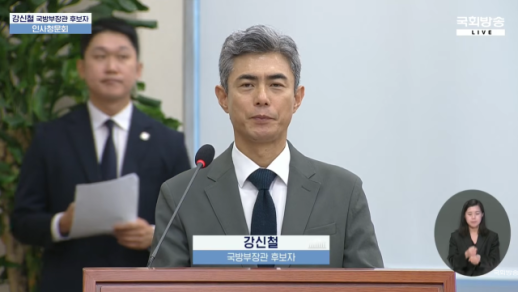 Korea's defense min nominee faces confirmation test on Hormuz SEOUL, September 16 (AJP) - Defense Minister nominee Kang Shin-chul faces grilling from lawmakers Wednesday over contentious issues ranging from the proposed merger of South Korea's military academies to U.S. calls for Seoul to contribute to security in the Strait of Hormuz. Even before facing lawmakers, Kang set out firm positions on several key issues, backing the Lee Jae Myung administration's push to integrate the Army, Navy and Air Force academies. “I believe integrated education is necessary,” Kang, a retired four-star Army general and Korea Military Academy graduate, said in written responses submitted ahead of the hearing. The government has proposed establishing a four-year Armed Forces Academy at the military complex in Daejeon. Kang said there are areas of military education that the three services should conduct together, while pledging to hear views from cadets, applicants, parents and others before details are finalized. The hearing comes as Seoul weighs how to respond to U.S. calls for contributions to security in the Strait of Hormuz. A government assessment team recently returned from the United Arab Emirates after examining operating conditions, military facilities and logistical support near the strategic waterway. The government has said no deployment decision has been made, while the National Security Council is expected to review possible options Thursday. Kang has so far taken a cautious stance, saying the issue should be approached from the perspective of protecting South Korean citizens and safeguarding national interests. Possible contributions under consideration have included P-8A maritime patrol aircraft, explosive ordnance disposal personnel and unmanned mine-detection and removal systems. Another focus will be the transfer of wartime operational control, or OPCON, from the U.S.-led Combined Forces Command to South Korea. Kang has said he agrees with the assessment that South Korea could defend itself even if OPCON were transferred immediately, while stressing that mutual trust in the alliance must be maintained. He has pledged to pursue the transfer in a way that strengthens the South Korea-U.S. alliance and their combined defense posture. Lawmakers are also expected to question Kang over property-related allegations involving him and his family. Opposition lawmakers have alleged that Kang registered his address at a house in Seoul's Cheonwang-dong while serving at a military unit in Gangwon Province and later qualified for a special apartment allocation available to residents displaced by redevelopment. Kang subsequently acquired an apartment in Seoul's Seocho District through the program. He has denied wrongdoing, saying the Cheonwang-dong property was a family home he legally received from his parents and that his military postings led to differences between his actual residence and registered address. Separate questions surround Kang's son, who bought a 700 million won ($512,000) commercial property in Bundang's Yangji Village in June. The property was initially omitted from Kang's disclosure submitted for the confirmation process. Kang's side said the omission was an error and later submitted corrected documents. His son financed the purchase largely through loans from relatives, while Kang has said neither he nor his wife was involved in selecting or financing the property. AJP Takeaways - South Korean Defense Minister nominee Kang Shin-chul faced scrutiny over a potential Strait of Hormuz deployment, wartime operational control and military academy reform. - Opposition lawmakers also raised property allegations involving special housing allocation and a 700 million won commercial property purchased by Kang's son. - Lawmakers from both ruling and opposition parties urged Kang to address the security and ethics controversies while maintaining close communication with the National Assembly. 2026-09-16 11:42:44
 -
 Cho flies to Washington, Seoul holds NSC meeting SEOUL, September 16 (AJP) - South Korean Foreign Minister Cho Hyun will travel to Washington from Thursday through Saturday for talks with U.S. Secretary of State Marco Rubio, while Seoul convenes a National Security Council meeting to review options in response to U.S. demands for a contribution to security in the Strait of Hormuz. The NSC review could give Cho a clearer position to take into his meeting with Rubio on Friday. The Foreign Ministry said Wednesday the two ministers would discuss bilateral relations, Korean Peninsula issues and a broad range of regional and global affairs. The Hormuz issue is expected to loom large over the talks. Seoul has been weighing military and nonmilitary options after Washington repeatedly called on South Korea to help secure freedom of navigation through the strategic waterway. A government assessment team returned from the United Arab Emirates last week after inspecting military facilities, ports, security conditions and logistical arrangements near the strait. The government has stressed that the mission was not conducted on the premise of a military deployment and that no final decision has been made. Options under consideration include noncombat assets such as P-8A maritime patrol aircraft and explosive ordnance disposal personnel, as well as technical assistance, according to government discussions reported this week. The government is expected to review the assessment at a National Security Council meeting Thursday as it works toward a more concrete position on South Korea's possible contribution. Economic negotiations are also entering a critical stage. South Korea pledged $350 billion in U.S. investments under its trade agreement with Washington, comprising $200 billion for strategic industries and $150 billion for shipbuilding. Industry minister Kim Jung-kwan was in Washington last week to discuss the composition and scale of individual projects. Projects under discussion include a natural gas project in Texas, nuclear power plants and an Alaska gas pipeline. Washington has sought commitments that could exceed the $200 billion earmarked for strategic industries, while Seoul has been trying to keep the projects within that ceiling. Cho and Rubio discussed both agendas during an Aug. 24 phone call. The two ministers agreed to seek progress on tariffs and investment, shipbuilding and security cooperation, while Cho expressed South Korea's willingness to make a practical contribution to restoring freedom of navigation in the Strait of Hormuz, according to the Foreign Ministry. They also agreed to maintain close coordination on North Korea and efforts to resume dialogue on the Korean Peninsula. AJP Takeaways - Foreign Minister Cho Hyun heads to Washington as Seoul reviews options for contributing to security in the Strait of Hormuz. - Thursday’s NSC meeting could shape South Korea’s position before Cho meets U.S. Secretary of State Marco Rubio on Friday. - The talks will also cover South Korea’s $350 billion U.S. investment pledge, shipbuilding cooperation and coordination on North Korea. 2026-09-16 10:44:39
 -
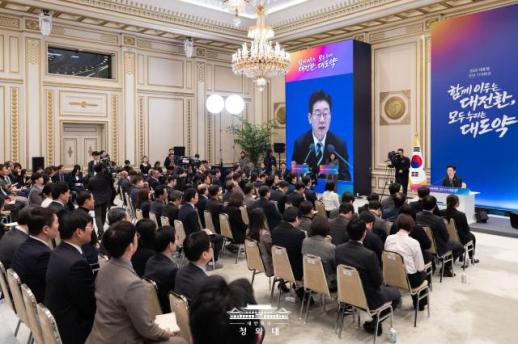 Lee to face controversies at Friday press conference SEOUL, September 15 (AJP) - President Lee Jae Myung will hold an agenda-free press conference Friday, with questions expected over whether he would seek a second term under any constitutional revision. The press conference will begin at 10 a.m. at Cheong Wa Dae's Yeongbingwan, or state guest house, presidential communications chief Sung Ki-hong said Tuesday. The event, Lee's seventh press conference since taking office, is expected to last about 90 minutes and will be attended by around 150 domestic and foreign journalists. It will consist of Lee's opening remarks, a question-and-answer session and closing remarks. Questions will be divided broadly into politics and foreign affairs, and policy and the economy, although reporters will be free to raise other major issues. “This press conference will be an occasion to convey the president's firm commitment to reform, his governing principle of putting people's livelihoods first and a message of stronger national unity,” Sung said. Lee will also “make clear and explain to the public his position and direction on major pending issues,” Sung added. Cheong Wa Dae plans to arrange seating to reduce the distance between Lee and reporters and will also introduce real-time comments from members of the public during the event. The conference comes as Lee faces his weakest public approval numbers since taking office. A Realmeter survey released Monday put Lee's approval rating at 33.8 percent, down 3.6 percentage points from the previous week and marking a ninth consecutive weekly decline. His disapproval rating rose 3.8 percentage points to 63.3 percent. Realmeter cited uncertainty over housing policy and controversy surrounding Lee's recent Cabinet reshuffle among factors weighing on his support. The poll also showed a particularly sharp drop among voters in their 20s and liberal voters. The conference is also expected to draw questions over a continuing controversy surrounding constitutional revision and presidential reelection. Lee said on Aug. 14 that he had consistently supported changing South Korea's current single five-year presidential term to a four-year system allowing a president to serve a second term, saying such a system would make possible greater political accountability through a midterm public assessment. The proposal prompted the opposition People Power Party to demand that Lee explicitly promise not to seek another term. During a meeting with South Korean residents in Paris on Sept. 9, Lee appeared to respond to the controversy, saying, “My term is clearly limited under the Constitution.” Cheong Wa Dae later said the comment meant reelection by Lee was not possible, but opposition politicians have continued to press him to state unequivocally that he would not seek another term. Rep. Son Myung Soo of the ruling Democratic Party welcomed the opportunity for Lee to address the public directly. “I think it is a meaningful occasion for the president to communicate directly with the public,” Son said. AJP Takeaways - President Lee Jae Myung will hold a press conference Friday as his approval rating falls to a new low. - Lee is expected to face questions over Cabinet nominations, housing policy and controversy surrounding presidential reelection. - The event will be Lee’s seventh press conference since taking office, with about 150 domestic and foreign journalists attending. 2026-09-15 17:17:59
 -
 Ulsan to host global horticulture meeting in 2028 SEOUL, September 15 (AJP) - Ulsan, South Korea’s leading industrial city, will host the 2028 Spring Meeting of the International Association of Horticultural Producers (AIPH), bringing global horticulture leaders to the city as it prepares for a major international garden expo. The southeastern city said Tuesday that the decision was finalized during the AIPH Annual Congress being held in Bari, Italy. Ulsan plans to hold the spring meeting in April 2028 in conjunction with the opening of the 2028 Ulsan International Garden Expo. The garden expo is scheduled to run from April 22 to Oct. 22, 2028, with venues including the Taehwagang National Garden and former landfill areas in Samsan and Yeocheon. The AIPH has officially listed the event on its calendar of approved international horticultural exhibitions. Organizers said the spring meeting will provide an opportunity to showcase Ulsan’s efforts to transform itself from a heavily industrialized city into a greener and more sustainable urban center. The city’s expo delegation also presented its preparations and venue development plans at an AIPH conference in Bari this week. Ulsan, a coastal city in southeastern South Korea with a population of about 1.12 million, has long been regarded as the country’s industrial capital. It is home to major automobile, shipbuilding, refining and petrochemical operations, including facilities operated by Hyundai Motor, HD Hyundai Heavy Industries, SK and S-Oil. In recent years, the city has sought to broaden that identity through environmental restoration projects, including the rehabilitation of the Taehwa River and the development of the Taehwagang National Garden. The 2028 expo is expected to become a centerpiece of that transition. Plans include converting former urban landfill sites into public gardens, a project the city says will demonstrate how industrial land can be repurposed as green urban space. AJP Takeaways - Ulsan will host the 2028 AIPH Spring Meeting alongside the Ulsan International Garden Expo. - The southeastern city is South Korea’s industrial hub, home to major automobile, shipbuilding, refining and petrochemical operations. - Ulsan is using the 2028 expo to highlight its transformation from an industrial center into a greener, more sustainable city. 2026-09-15 16:22:58
 -
 Building the Future on a 3,000-Year Legacy: Uzbekistan's 'Third Renaissance' The Islamic Civilization Center in Tashkent, Uzbekistan's capital, is impressive in scale. Covering an area equivalent to 14 soccer fields, it encapsulates 3,000 years of Uzbekistan's history. The three-story building, which cost approximately $161.8 million, has a total floor area exceeding 42,000 square meters, with a central dome soaring 65 meters high. However, this massive structure aims to showcase more than just the past. The exhibition begins with ancient civilizations predating Islam, progresses through the Islamic Golden Age in Central Asia and the Timurid dynasty, and culminates in modern Uzbekistan following its independence. The final space invites visitors to explore 'New Uzbekistan — the Foundation of the Third Renaissance.' After reflecting on 3,000 years of history, visitors arrive at a vision for the future. President Shavkat Mirziyoyev's national vision of 'New Uzbekistan' intersects with this point in history. Once a land that produced world-renowned mathematicians, astronomers, physicians, and scholars, it aims to reignite education, science, and technological innovation to usher in a new era. The Islamic Civilization Center embodies this vision in a physical form. From the Quran to Science: A Chronicle of Civilization At the center's heart lies the ancient 'Uthman Quran.' Surrounding it are manuscripts, archaeological artifacts, and cultural heritage that illustrate centuries of Islamic scholarship. During what the Uzbek government calls the 'First Renaissance' from the 9th to 12th centuries, scholars emerged who transformed the course of global knowledge in Central Asia. Al-Khwarizmi laid the foundations for mathematics, while Al-Biruni made significant contributions to astronomy and natural sciences. Ibn Sina had a profound impact on medicine and philosophy. The 'Second Renaissance' is linked to the Timurid dynasty. In the 15th century, the ruler and astronomer Ulugh Beg established an observatory in Samarkand, leading precise astronomical observations. The center does not treat these figures merely as religious icons. It connects mathematics, medicine, astronomy, philosophy, and religious studies into a unified intellectual history. The Mirziyoyev administration takes this a step further by proposing a 'Third Renaissance.' Just as global scholarship flourished in the past, today's youth are encouraged to achieve intellectual breakthroughs in universities, research institutions, artificial intelligence, and advanced technology. The center serves as both a museum displaying history and a national declaration of Uzbekistan's future aspirations. 35th Anniversary of Independence: President Reiterates 'Civilization' This message was clearly articulated during the 35th anniversary celebrations of Uzbekistan's independence. On August 28, just four days before Independence Day, around 6,000 people gathered at a large outdoor amphitheater in 'New Tashkent.' After discussing economic development, education, and national identity, President Mirziyoyev turned the conversation to Uzbekistan's Islamic heritage. “We have built unique scientific and educational institutions such as the Islamic Civilization Center and the Imam Bukhari and Burkhaniddin Margilanani memorial complexes,” he stated. As he finished speaking, the audience erupted in applause. This moment encapsulated the significance of Islamic civilization in President Mirziyoyev's vision for 'New Uzbekistan.' The government seeks to revive not just religion but also the era when Islamic civilization led advancements in science, scholarship, enlightenment, and cultural development, linking it to the current national development strategy. Kirill Abramov, a professor at the University of Texas, explained that since the dissolution of the Soviet Union, Islam in Central Asia has played a multifaceted role encompassing “religious revival, cultural restoration, and national identity formation.” In Uzbekistan, this cultural revival is intertwined with the nation's future vision. Independence Restores History In his Independence Day speech, President Mirziyoyev did not merely describe Uzbekistan's independence as a political sovereignty that began in 1991. He emphasized that the nation's roots extend back over 3,000 years, mentioning figures such as Al-Khwarizmi, Ahmad al-Farghani, Al-Biruni, Ibn Sina, Ulugh Beg, and Alisher Navoi. “Independence has restored our honor and dignity, our sacred religion, our mother tongue, and our long-forgotten national values,” he said. This is why the Islamic Civilization Center holds a nationally significant position. The story conveyed through the center is straightforward. This land once hosted a brilliant civilization, and through independence, that history has been reclaimed. Now, it is time to transform that legacy into an asset for future development. Since its official opening on March 17, the center's visitor flow follows this same narrative. Guests starting from ancient Uzbekistan move through the Islamic Golden Age and the Timurid dynasty to modern independent Uzbekistan. However, the exhibition's endpoint is not the past. At the end lies 'New Uzbekistan' and the Third Renaissance. President Mirziyoyev has defined this center as one of the foundations of the Third Renaissance, emphasizing that it must also serve as a scientific, secular, and modern institution. Immediately after mentioning the Islamic Civilization Center and the reconstructed Imam Bukhari memorial complex in his Independence Day speech, he transitioned to discussions about youth, education, and the national development plan for the next decade. He characterized the next ten years as a period of 'national leap,' proposing that the first of seven national programs the government will pursue is to make knowledge and capabilities the core assets of the nation. This connects the past's civilization with the future's talent into a single narrative. Restoration of History from Tashkent to Samarkand These national projects are not limited to Tashkent. The Imam Bukhari memorial complex near Samarkand is another symbolic space that President Mirziyoyev directly mentioned in his Independence Day speech alongside the Islamic Civilization Center. Born near Bukhara in the 9th century, Imam Bukhari compiled the 'Sahih al-Bukhari,' one of the most authoritative collections of hadith for Sunni Muslims, documenting the sayings and actions of the Prophet Muhammad. Uzbekistan has extensively reconstructed his burial site. The 45-hectare complex includes a large mausoleum, a mosque accommodating 10,000 people, four 75-meter-high minarets, a museum, and research and educational facilities. Since the reconstruction, the daily visitor capacity has increased from about 12,000 to over 65,000. The government has also invested 570 billion som, approximately $65 million, in developing surrounding hotels and commercial services. Plans include four-star and three-star hotels, as well as family guesthouses. According to the government, over 1 million domestic and international visitors had visited the complex by early May. The Islamic Civilization Center in Tashkent also welcomed around 500,000 visitors within two and a half months of its opening by June 1. The commonality between these two projects is clear. They are not merely restoring Islamic cultural heritage as pilgrimage sites or tourist attractions but are reconstituting them as national assets that encompass research, education, international exchange, and the tourism industry. Enlightenment Against Ignorance The image of Islam that Uzbekistan seeks to present to the international community aligns with this vision. The government emphasizes knowledge, tolerance, scholarship, and peace as core principles. This is encapsulated in the phrase 'Enlightenment Against Ignorance.' Shovosil Ziyodov, director of the Imam Bukhari International Scientific Research Center, stated in an interview, “Our people have always lived by Islamic philosophy as a guide in their daily happiness, sorrow, and trials of fate. We are creating a new narrative that describes Islam as a religion of science, creativity, and tolerance.” He explained that preserving and inheriting Uzbekistan's Islamic heritage serves as “a powerful public diplomacy tool and a part of soft power.” This vision was first presented by President Mirziyoyev in 2017 when he announced plans for the Islamic Civilization Center at the United Nations. He emphasized that ignorance and intolerance can create an environment for the growth of extremism, and that education and the humanistic traditions of Islam must be leveraged to counter this. The Islam represented by the center is one of goodness and peace, knowledge, and enlightenment, not violence or radicalism. Center of Islamic Civilization, Not an Islamic State Uzbekistan is now actively utilizing this historical asset in its diplomacy. It is expanding international cooperation in manuscript digitization, historical research, and cultural heritage preservation, while also opening an office for the Islamic World Educational, Scientific and Cultural Organization (ICESCO) in Tashkent. President Mirziyoyev has instructed officials to promote the Islamic Civilization Center to 55 countries and to organize events at the UN offices in New York and Geneva, as well as at UNESCO headquarters in Paris, to introduce scholars from Uzbekistan such as Imam Bukhari, Imam Maturidi, and Imam Tirmidhi. Since its opening, the center has also become a venue for international forums involving scholars, journalists, and cultural figures from around the world. Uzbekistan's desired image in the international community is distinct from that of a simple 'Islamic state.' It identifies itself as a 'center of Islamic civilization' that has produced scholars and manuscripts, as well as advancements in astronomy, medicine, mathematics, and philosophy. This identity provides a historical and cultural resonance with Islamic countries while also establishing a foundation for collaboration with secular international organizations like UNESCO in the fields of science and culture. Importantly, this movement is distinct from any attempts to religiously transform Uzbekistan's national system. The Uzbek constitution defines the state as a 'sovereign democratic, legal, social, and secular state.' Article 75 explicitly states the separation of religious organizations and the state. The religious policy concept adopted in 2025 also reaffirmed freedom of conscience and the secular nature of the state. Thus, the rise of the Islamic Civilization Center as a national symbol does not signify the Islamization of the state but rather a recontextualization of Islamic civilization within the narrative of the secular state of Uzbekistan. It aims to restore historical and cultural memories that faded during the Soviet era and to transform the identity reclaimed after independence into an asset for national development. At the end of 3,000 years of history beneath the grand dome in Tashkent lies the 'Third Renaissance.' What Uzbekistan seeks to convey through the Islamic Civilization Center is not merely nostalgia for a glorious past but a forward-looking declaration to reclaim a history that once led the world in scholarship and civilization, and to leap forward once again through education, science, and innovation. In this sense, the Islamic Civilization Center is not just a museum preserving the past but a starting point for moving toward a 'New Uzbekistan.'* This article has been translated by AI. 2026-09-15 16:04:20
 -
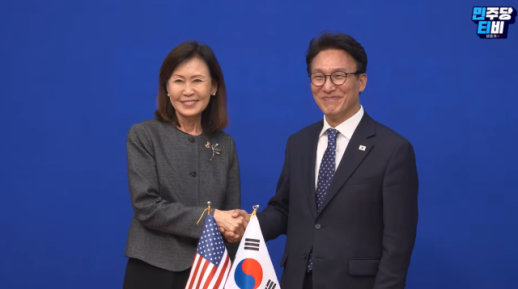 Korea's ruling party chief touts stronger US alliance in meeting with envoy SEOUL, September 15 (AJP) - Stronger self-defense capabilities do not conflict with a deeper alliance with the United States, ruling Democratic Party (DP) leader Kim Min-seok told U.S. Ambassador Michelle Steel on Tuesday. “The United States has been a reliable neighbor throughout South Korea's modernization, democratization and industrialization,” Kim told the U.S. envoy during their first meeting at the National Assembly since her arrival in late July. “I believe that the process of South Korea building its own capabilities does not contradict the deepening of its alliance with the United States.” Kim also expressed hope for progress in relations between Washington and Pyongyang, saying improved U.S.-North Korea ties could contribute to peace and progress on the Korean Peninsula. Steel said South Korea has emerged as a major player on the global stage and voiced hope for cooperation with Kim and the DP to strengthen the alliance and expand Seoul's international role. Kim's remarks came about a week after he told the National Assembly that South Korea could no longer rely solely on the United States and should strengthen its independent diplomatic and security capabilities as the regional security environment changes. Steel, a Korean-born former two-term U.S. congresswoman from California, arrived in South Korea on July 30 to take up her post. She was confirmed by the U.S. Senate in June and is the second Korean American to serve as Washington's ambassador to Seoul. AJP Takeaways - DP leader Kim Min-seok says stronger South Korean self-defense capabilities can coexist with a deeper U.S. alliance. - Kim tells U.S. Ambassador Michelle Steel that improved U.S.-North Korea ties could support peace on the Korean Peninsula. - Steel says South Korea has become a major global player and calls for closer cooperation to strengthen the alliance. 2026-09-15 15:45:34
 -
 Korea, Turkmenistan broaden economic partnership at summit SEOUL, September 15 (AJP) - South Korean President Lee Jae Myung and Turkmen President Serdar Berdimuhamedow agreed Tuesday to expand cooperation in investment, infrastructure, shipbuilding and public security as the two countries signed 13 agreements and memorandums of understanding. Lee met Berdimuhamedow, who is on a state visit to South Korea, at Cheong Wa Dae in Seoul ahead of the inaugural Korea-Central Asia Summit. The agreements cover investment protection, chemical and plant industries, construction, transportation and logistics, water resources, railways and efforts to combat transnational crime. Among them was an investment promotion and protection agreement concluded after 16 years of negotiations. The pact establishes protections for investors, including fair and equitable treatment, provisions on investor-state dispute settlement and guarantees concerning the transfer of investment-related funds. The two leaders also agreed to broaden cooperation beyond the energy and plant sectors into railway modernization, shipbuilding, smart cities, water management, forestry, artificial intelligence and science and technology. Lee asked Berdimuhamedow to support the participation of Korean companies in Turkmenistan's railway modernization projects. Lee thanked Turkmenistan for helping South Korean nationals and their families evacuate from Iran through its territory amid heightened tensions in the Middle East. In March, more than 30 South Koreans crossed by land into Turkmenistan, with Ashgabat providing special immigration arrangements for them. South Korea and Turkmenistan established diplomatic relations on Feb. 7, 1992, and formed what Seoul describes as a "mutually beneficial partnership" in 2008. Economic ties have focused heavily on Turkmenistan's vast natural gas resources and South Korea's engineering and industrial capabilities. Korean companies have participated in major Turkmen energy projects, including the Kiyanly gas chemical complex, built by a consortium involving Hyundai Engineering and LG International. During a 2024 summit, the two countries also signed a Trade and Investment Promotion Framework, while Hyundai Engineering reached agreements related to the Galkynysh gas field and the Kiyanly plant. More recently, the two governments have sought to extend cooperation into transportation infrastructure and shipbuilding. Turkmen officials said in May that Korean companies were already making significant contributions to the country's gas chemical industry, transport infrastructure and shipbuilding projects. Berd Berdimuhamedow's visit comes as Seoul hosts the first Korea-Central Asia Summit, bringing together the leaders of Kazakhstan, Kyrgyzstan, Tajikistan, Turkmenistan and Uzbekistan on Sept. 16-17. AJP Takeaways - South Korea and Turkmenistan agreed to broaden economic cooperation at a summit in Seoul, with 13 agreements and memorandums covering investment, infrastructure, logistics and public security. - The two countries finalized a long-negotiated investment protection agreement, providing a stronger legal framework for companies operating in each other's markets. - Seoul and Ashgabat are seeking to expand ties beyond energy and plant construction into railways, shipbuilding, smart cities, water management, AI and other emerging sectors. 2026-09-15 14:57:33
 -
 One in nine Koreans in 50s never married SEOUL, September 15 (AJP) - More than one in 10 people in South Korea in their 50s have never married, with the number more than tripling over the past decade as marriage becomes increasingly less universal among middle-aged adults. Data from the Ministry of Data and Statistics showed that 934,000 people in their 50s, or 10.9 percent of the age group’s 8.54 million population, had never married as of August. A decade earlier, the figure stood at 281,000, or 3.4 percent. Among people in their 40s, the never-married rate has also risen to 20 percent, about 1.8 times the level recorded 10 years ago. The divide was particularly pronounced by gender. About 15 percent of men in their 50s had never married, compared with 6.9 percent of women. Education was also associated with sharply different patterns. Among men in their 50s, the never-married rate was 19.7 percent for those with a junior-college education or less, falling to 9 percent among four-year university graduates and 5.9 percent among those with graduate-level education. For women, the pattern ran in the opposite direction: the rate rose from 5.6 percent among those with a junior-college education or less to 8.9 percent among university graduates and 13.5 percent among those with graduate degrees. The shift is not unique to Korea. In Japan, 2020 census-based data showed that 28.3 percent of men and 17.8 percent of women were never married at around age 50, up from 20.1 percent and 10.6 percent, respectively, in 2010. In the United States, 15.6 percent of people aged 45 to 54 had never married in 2023, according to the U.S. Census Bureau’s American Community Survey. The figures are not directly comparable because the countries use different age groups and statistical methods, but they point to a broader trend toward delayed or forgone marriage across advanced economies. 2026-09-15 14:13:35