

Journalist
Park Sae-jin박세진
swatchsjp@ajupress.com
Assistant EditorForeign embassies in Seoul & Geopolitics, Diplomacy, Policy
Experienced journalist and editor at AJU PRESS specializing in multilingual news. I cover international diplomacy, geolpolitics, and policy, consistently delivering highly accurate, compelling reporting for a worldwide audience.
"Reporting the facts. Shaping the narrative. Every second counts."
Latest by Park Sae-jin
-
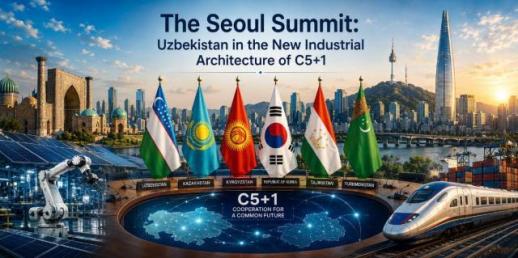 Five Central Asian states join Korea in new industry ministers' forum SEOUL, August 26 (AJP) - A standing consultative body of industry ministers will anchor the economic agenda when South Korea hosts the leaders of five Central Asian countries in Seoul next month, giving a relationship built largely on separate bilateral deals its first permanent multilateral working channel. The first Korea-Central Asia Summit, set for Sept. 16 and 17, puts industrial modernization, infrastructure, critical minerals and energy, workforce training and private-sector participation at the center of the agenda. The C5+Korea Industry Ministers' Meeting is designed to keep sectoral talks running between leaders' meetings, identify joint initiatives and maintain a list of priority projects that links each area to specific partners and sources of financing. In materials setting out Tashkent's approach to the summit, the Embassy of Uzbekistan in Seoul said Uzbekistan enters the new regional format with elements of the industrial agenda already operating inside its bilateral relationship with South Korea. The two countries have held what both governments describe as a special strategic partnership since 2019, a designation that places South Korea in Uzbekistan's highest tier of diplomatic relationships. Cumulative South Korean direct investment in the Uzbek economy has passed $8 billion, according to the embassy. Bilateral trade approached $1 billion in the first half of 2026, up 11.5 percent from the same period a year earlier. Behind those figures sits a network of joint institutions rather than a trade balance. Uzbekistan hosts Korean-linked centers in textiles, rare metals and alloys, agricultural machinery and e-government, and cooperation has extended into chemical technologies and construction. Their function is to move engineering methods, technical knowledge and production experience across, not finished goods. Critical minerals are where the summit agenda and Uzbekistan's own industrial plans overlap most directly. The metals and rare earth elements that go into batteries, semiconductors and defense equipment, and the processing steps that turn raw ore into usable input are the part most countries cannot do alone. Uzbekistan already runs the Uzbek-Korean Scientific and Technological Center for Rare Metals and Alloys, which works on materials science, processing technologies, research and specialist training with the aim of moving those results into industrial production. More sophisticated industry raises the demands placed on everything around it. Within the summit agenda, infrastructure covers energy, industrial complexes, transport and logistics, and urban systems, and it extends across the full life of a project, from planning and construction through modernization and operation. For an investor, that means an industrial site can be assessed together with the power, engineering and logistics needed to run it. Financing for projects on that scale already exists in part. The cooperation program between Uzbekistan and the Economic Development Cooperation Fund, South Korea's concessional lending arm for developing countries, has been set at $2 billion for 2024 through 2027. A new portfolio of initiatives is under preparation, and the two sides are examining financing without state guarantees and through public-private partnerships, arrangements that shift more of the risk onto commercial participants and open the door to private capital. Where the agenda ultimately settles is at the level of individual companies, which turn sectoral priorities into investment decisions and products. That places private firms, financial institutions and research organizations at the center of the industrial cooperation the ministers' forum is meant to steer. The workforce is the constraint that grows alongside the rest. The Korea International Cooperation Agency has helped establish four vocational education centers in Uzbekistan, in Tashkent, Fergana, Shakhrisabz and Samarkand. A fifth is under construction in Urgench. 2026-08-26 15:45:59
 -
 S. Korea's denuclearization goal remains unchanged: MOFA SEOUL, August 25 (AJP) - The stated goal of peace on the Korean Peninsula means the denuclearization of North Korea, South Korea's foreign ministry said Tuesday. The ministry was restating a position left out of its own account of a phone call between the two allies' top diplomats the night before. That account said Foreign Minister Cho Hyun and U.S. Secretary of State Marco Rubio agreed to keep up close communication on peace on the peninsula and a resolution of the North Korean nuclear issue, while maintaining a firm combined defense posture. The word denuclearization did not appear. The State Department released two sentences under spokesperson Tommy Pigott, saying only that Rubio had discussed a range of issues related to the alliance. Denuclearization was discussed, Ministry of Foreign Affairs Spokesperson Park Doo-soon said Tuesday. Both governments continue to hold to the two goals set out in the joint fact sheet issued Nov. 14 after President Lee Jae-myung and President Donald Trump met in Gyeongju, it said. That document commits the two sides to the complete denuclearization of North Korea and to peace and stability on the peninsula, and pledges cooperation on implementing the 2018 Singapore statement signed by Trump and North Korean leader Kim Jong Un. Pressed on what peace on the peninsula refers to, the ministry said the term can be rendered as the denuclearization of North Korea. The distinction carries weight. Denuclearization means Pyongyang giving up the weapons it has built. Peace on the peninsula, left undefined, is compatible with an arrangement that leaves them in place. Cho and Rubio spoke late Monday evening Seoul time, their first call in five months. Rubio serves as both secretary of state and White House national security adviser. He briefed Cho on Iran and U.S. efforts in the Middle East. Cho raised South Korea's willingness to help restore free passage through the Strait of Hormuz, which Iran has largely closed to traffic. The two also agreed to seek gains on tariffs, an investment agreement, shipbuilding and security cooperation. Scrutiny of the ministry's wording follows several weeks of signals from Washington that have unsettled Seoul. Trump posted a photograph of his 2019 meeting with Kim at Panmunjom to his social media account on Aug. 15. He said the next day that he has a very good relationship with Kim, and disclosed that he had ordered a substantial reduction in combined military exercises. Cho and Defense Minister Ahn Gyu-back both said afterward that they had not been told in advance. The ministry said the government hopes North Korea responds to steps taken by Seoul and Washington and that talks between the United States and North Korea resume. It described South Korea as a peacemaker and a party to peace on the peninsula rather than an observer of it. The ministry did not say which side requested Monday's call, saying both had wanted it. It also declined to comment on the brevity of the U.S. readout, saying the text reflects the American side's own position. China's language has moved in the opposite direction. When Trump met Chinese President Xi Jinping in Beijing on May 14 and 15, the White House fact sheet issued two days later said the two leaders reaffirmed a shared goal to denuclearize North Korea. Chinese foreign ministry spokesperson Guo Jiakun, addressing that line the following day, did not use the word. He said instead that China's position on the peninsula has remained consistent. Beijing has left the term out of a series of documents in recent years, including its most recent arms control white paper. The South Korean ministry cited that same summit as evidence that the goal still holds, noting North Korean denuclearization was confirmed there as a joint objective. It said it continues to press China toward what it called a constructive role. Chinese Foreign Minister Wang Yi visited Seoul last week and described the two Koreas as two states coexisting peacefully. The ministry said it would refrain from offering its own interpretation and is watching how Beijing uses the phrase. It did not say whether it had asked for a correction. The phrasing drew notice because North Korea declared at the end of 2023 that the South is a separate and hostile state, abandoning reunification as a goal. The ministry declined to confirm details of Trump's public remarks about North Korea's nuclear arsenal, including references to the number of weapons it holds. Park Doo-soon, the ministry spokesperson, rejected the argument that South Korea's pragmatic diplomacy has failed as Russia deepens military ties with Pyongyang, China drops the denuclearization language and Washington softens its own. "I do not agree with that judgment," he said, pointing to continuing contacts with all three governments. Speculation about a Trump meeting with Kim has centered on November, when the leaders of the Asia-Pacific Economic Cooperation forum gather in Shenzhen on Nov. 18 and 19. 2026-08-25 15:17:55
 -
 Researchers develop embryo-like stem cell heart model SEOUL, August 25 (AJP) - By easing off the chemical signals normally used to force stem cells into heart tissue, researchers at Sookmyung Women's University and Sungkyunkwan University have grown a model that lengthens and bends on its own, reproducing a stage of human heart development that has been almost impossible to observe. Congenital heart disease is the most common birth defect in the world, occurring in about nine of every 1,000 live births since the mid-1990s, or roughly 1.35 million newborns a year, according to a systematic review published in the Journal of the American College of Cardiology. A later update covering 260 studies put Asia's rate highest among world regions, at about 9.3 per 1,000. Most of those defects begin in the first weeks after conception, when the heart is a straight tube that has to stretch, curve and sort itself into an ordered sequence of future chambers. That window is effectively closed to observation. Human embryos at that stage are inaccessible, and animal hearts diverge enough from human ones to limit what mouse studies can settle. Laboratory heart models have grown more sophisticated over the past five years, but most of them stay round. Researchers typically drive stem cells toward cardiac fate with strong external chemical signals, an approach that reliably produces beating heart tissue and just as reliably produces it as a sphere. Shape does not emerge, and neither does the ordering that depends on shape. Bae Gyu-un, a professor at Sookmyung's College of Pharmacy, and Kang Jong-sun, a professor in the Department of Molecular Cell Biology at Sungkyunkwan University School of Medicine, went the other way. Their permissive culture strategy weakens the external signals and leaves the cells to arrange themselves. Grown from human induced pluripotent stem cells, adult cells reprogrammed back to an embryonic-like state, the resulting structures elongated and curved without being pushed into shape. The team named them elongating heart organoids. Cells inside them settled along a venous-to-arterial axis in the order a developing heart follows, with sinus venosus-like cells at one end, then atrial cells, then ventricular cells. The sinus venosus is the inflow region of the embryonic heart and the site where the sinoatrial node, the heart's natural pacemaker, later forms. The organoids also beat in sequence rather than all at once. Contractions started at the venous end and traveled toward the ventricular end, accompanied by a matching wave of calcium ions, the signal that triggers each contraction in heart muscle. To work out what drove the lengthening, the team sequenced individual cells and ran trajectory analysis, a computational method that infers how cell populations relate to one another. That analysis pointed to dividing splanchnic mesoderm cells at the venous end, an early tissue layer that supplies cardiac cells in the embryo, feeding new cells into the structure as it grew. The inference comes from gene expression patterns. No one tracked individual cells making the journey. The disease result came from deleting TBX5, a gene mutated in Holt-Oram syndrome and linked to septal and conduction defects in patients. Organoids missing it failed to elongate or bend, and contracted irregularly. Bae claimed priority for the result. "This study is the first to reproduce the three-dimensional form and axis organization of the early heart outside the body by inducing the self-organizing capacity of stem cells," he said, adding that it should "raise the competitiveness of organoid-based drug development platforms and help establish the mechanisms behind congenital heart disease." Other groups have built human heart models with patterned regions. Heart-forming organoids reported in Nature Biotechnology in 2021, multi-chamber cardioids in Cell in 2023, and a patterned primitive heart organoid in Nature Communications the same year each reproduce parts of early cardiac structure, and the Nature Communications model elongates and contorts as it grows. Reviews of the field describe most human systems as reaching heart tube formation without elongation. Whether the Sookmyung model is first in the narrower sense Bae describes cannot be checked against the university's summary alone. Several things remain unshown. The organoids correspond to the earliest weeks of development and do not form chambers, septa, valves, coronary vessels, or the nerve tissue that regulates heartbeat. The university released no measurements, no culture duration, no count of organoids grown, and no success rate, leaving open how consistently the structures form. The TBX5 experiment establishes that removing the gene disrupts the model, not that the same sequence causes disease in patients. No drug has been tested in the system. The work was carried out with researchers at AniMusCure Inc., a Suwon-based biotechnology company founded in April 2020. Bae and Kang are its co-chief executives. The company, whose existing pipeline covers sarcopenia and Duchenne muscular dystrophy rather than cardiac disease, plans to use the technology for congenital heart disease modeling, cardiac toxicity testing and screening cardiovascular drug candidates, the university said in announcing the work Aug. 20. (Reference Information) Journal/Source: Developmental Cell (IF 9.2, JCR top 3.95%) 2026-08-25 14:19:47
 -
 Kazakhstan marks 35 years since closing of nuclear site SEOUL, August 25 (AJP) - The Soviet Union detonated its first atomic bomb on the Kazakh steppe on Aug. 29, 1949. Kazakhstan shut the place down 42 years later, to the day. Saturday marks 35 years since the closure of the Semipalatinsk Test Site. The anniversary is also the International Day against Nuclear Tests, a United Nations observance that exists because Kazakhstan asked for it. The site absorbed 456 nuclear explosions over four decades, 340 of them underground and 116 in the open air. Eight countries have conducted 2,056 nuclear tests since 1945. More than a fifth of them happened here, on 18,000 square kilometers of steppe, an area about the size of Wales. Soviet planners called the land uninhabited when they selected it in 1947. It was not. Villages stood within tens of kilometers of the detonation points, and prison camp labor built the first facilities. Kazakh experts estimate about 1.5 million people were exposed to radioactive fallout over the life of the site. Health studies conducted since the closure identify roughly 200,000 residents whose health was directly affected, with elevated rates of several cancers and of thyroid disease. The two figures do not contradict each other. One counts exposure across a vast area over 40 years. The other counts demonstrated harm in the populations nearest the blasts. Neither number existed at the time. Soviet authorities concealed the effects for decades, and the scale of the damage emerged only after the site closed. Glasnost and a protest movement broke the silence. The Kazakh poet Olzhas Suleimenov founded Nevada-Semipalatinsk in February 1989, naming it for his own country's test site and the American one. It pulled tens of thousands into the streets and became one of the first mass anti-nuclear movements in Soviet history. The last explosion at the site came on Oct. 19, 1989. Former Kazakh President Nursultan Nazarbayev signed the closure decree on Aug. 29, 1991, four months before the Soviet Union dissolved. Kazakhstan then gave up the world's fourth-largest nuclear arsenal, inherited rather than built, and joined the Treaty on the Non-Proliferation of Nuclear Weapons. What followed turned that history into a diplomatic position. Kazakhstan ratified the Comprehensive Nuclear-Test-Ban Treaty in May 2002. It hosted the signing of the treaty creating a nuclear-weapon-free zone across Central Asia at Semipalatinsk on Sept. 8, 2006, in the 15th anniversary year of the closure. The General Assembly adopted resolution 64/35 unanimously in December 2009, establishing the International Day against Nuclear Tests and fixing it to Aug. 29. The ground took longer. Fissile material sat in the tunnels and boreholes of the Degelen mountain complex, effectively unguarded after the Soviet collapse and ranked among the most serious nuclear security risks of the period. Kazakh, Russian and American scientists spent 17 years securing it, sealing tunnels and pouring specialized concrete to bind waste plutonium. The work cost about $150 million, ran largely in secret and finished in October 2012. Parts of the site have since reopened to mining, farming and tourism. The old testing infrastructure now does the opposite job. Kazakhstan hosts five facilities in the International Monitoring System, the global sensor network that verifies compliance with the test ban treaty. They include a primary seismic array at Makanchi and an auxiliary station at Kurchatov, about 120 kilometers from the city of Semey. Those sensors watch for the tests that still happen. When North Korea conducted its third nuclear test in February 2013, the Makanchi array was among the stations that recorded it and sent data to the treaty organization's international data center in Vienna. Kazakhstan also hosted the organization's large-scale on-site inspection exercise in 2008. Seoul is party to the same treaty. Pyongyang has never signed it. North Korea has tested six times. Its detonation of Sept. 3, 2017 remains the most recent nuclear test conducted anywhere in the world. 2026-08-25 10:50:40
 -
 KAIST develops technique to detect fast charging damage SEOUL, August 24 (AJP) - Fast charging can damage an electric vehicle battery in ways that standard capacity measurements do not reveal, researchers at the Korea Advanced Institute of Science and Technology said Monday, after building a three-dimensional virtual replica of the interior of a commercial lithium-ion cell. In a graphite electrode 50 micrometers thick, slightly less than the width of a human hair, shifting the adhesive that binds the electrode together from an even spread to a concentration on one side altered total charging capacity by less than four percent. Lithium metal accumulating near one edge of that same electrode increased by more than 10 percent. Charging capacity is the figure a battery test reports. The degradation the simulation identified was concentrated in a region that figure did not describe. Lee Kang-taek's group in the mechanical engineering department at the Korea Advanced Institute of Science and Technology (KAIST) carried out the study with Cho Eun-ae's group in materials science and engineering. A lithium-ion battery stores charge by moving lithium ions into the graphite particles that form its negative electrode. A polymer binder holds those particles in place. Pores, the empty channels running between them, carry the ions to the graphite. During rapid charging, some ions fail to enter the graphite and settle on its surface as metallic lithium, a process known as lithium plating. The deposited lithium no longer carries charge, and repeated plating lowers both performance and battery life. A protective film called the solid electrolyte interphase also forms on the graphite surface during charging. The film is necessary, but an excessively thick or uneven one degrades performance. Graphite particles swell as they absorb lithium, generating mechanical stress inside the electrode. These processes occur simultaneously within a very small volume, which has made them difficult to isolate by experiment. Earlier computer models generally worked from average properties across the whole electrode and could not account for variation by position. The researchers reconstructed the internal structure of a commercial graphite electrode in three dimensions, reproducing the graphite particles, the binder and the pores. They varied electrode thickness, pore volume and binder position, then simulated rapid charging while recording where lithium accumulated, where the protective film formed unevenly and where stress concentrated. Binder concentrated on one side of the electrode reduced the pore space available for ion movement. Lithium plating near the current collector, the metal foil that carries current out of the cell, rose more than 10 percent above the level measured in an electrode with binder distributed evenly. Even distribution produced smoother ion movement and a more uniform protective film. The effect grew with electrode thickness. At 83 micrometers, the capacity difference attributable to binder position widened to about 18 percent. KAIST said the result means electrodes built thicker to hold more energy require control over where materials sit inside them, not only over how much material is used. Pore volume affected mechanical stress in the same way. Sufficient pore space absorbed the expansion of the graphite particles and dispersed the resulting force. Where pore space was insufficient, stress concentrated at particular points. Binder gradients of this kind form during electrode manufacturing and drying rather than being introduced by design. The numbers are computed, not measured. The team validated its model against a real electrode and against test data, but the percentages come out of the simulation. No batteries were cycled to failure, so nothing here shows a battery lasting longer. The work covers the graphite negative electrode alone, not the positive electrode and not a full cell. It names binder and pore distribution as design variables without showing how to control them on a production line. KAIST said the approach allows a range of electrode structures to be examined in simulation before any of them are manufactured. "If the binder and the empty space inside the electrode are placed appropriately, it should help in designing batteries that store a large amount of energy while charging quickly and lasting a long time," Lee said. Kang Ye-jin, a doctoral candidate in mechanical engineering at KAIST, was first author on the paper, which was published in the journal InfoMat and selected as the back cover article on July 7. 2026-08-24 17:33:41
 -
 Kookmin students win forest management AI contest SEOUL, August 24 (AJP) - A team of students from Kookmin University has won the top prize at South Korea's inaugural forest artificial intelligence contest by developing a tool that helps private landowners predict 30 years of revenue and carbon absorption. The web service, named MOFOM, addresses a longstanding challenge in South Korean forestry by democratizing access to fragmented government data. By simply entering a land parcel number, forest owners can instantly view economic and environmental projections across different management scenarios, turning dense academic models into a practical financial tool. The students took the grand prize in the service creation category at the first Forest Science AI Use Contest, hosted by the National Institute of Forest Science. The competition drew 259 participants from 41 universities and 33 institutions to find technological solutions for regional and national forest management. MOFOM integrates satellite imagery with government datasets, including national forest resource surveys, carbon absorption standards, and mountain weather records, to estimate timber volume and carbon content. It then generates six distinct management scenarios, ranging from immediate logging to long-term thinning and cultivation, calculating expected profits and carbon offset values for each path. To ensure accuracy and reduce the risk of artificial intelligence hallucinations, the system relies on hard-coded calculations for its numerical data. The embedded language model is restricted strictly to explaining the finalized numbers, a feature that earned the team high marks for technical completeness and practical viability during live demonstrations. Led by graduate student Choi Hee-do alongside undergraduates Na Jung-woo, Ha Su-beom, and Kim Min-seok, the team validated their model using actual land data and carbon offset project records from Boeun-gun, North Chungcheong Province. The students handled the entire development process, from satellite image analysis and economic calculations to web service deployment. "It took a lot of time to connect forest data scattered across various institutions into a single service, but it is meaningful that we were evaluated for implementing it in a form that can actually be used," Choi said. "I want to expand the model verified in Boeun nationwide and develop it into a service that forest owners can actually use." 2026-08-24 16:31:36
 -
 Kazakhstan builds interfaith forum into institution over 2 decades SEOUL, August 24 (AJP) - An idea that surfaced in Astana days after the September 11 attacks has grown into a standing international institution, with a permanent secretariat, its own awards, a 10-year strategy and a place on the United Nations record. The Congress of Leaders of World and Traditional Religions has met eight times since 2003, always in the Kazakh capital, and is scheduled to convene again in 2028. The proposal took shape during Pope John Paul II's visit to Kazakhstan from Sept. 22 to 25, 2001, 11 days after the attacks on the United States. Kazakhstan suggested seating the leaders of the world's major faiths at one table at a moment when much of the world was bracing for a religious rupture. The first Congress opened two years later, on Sept. 23, 2003, with 17 delegations from 13 countries. Participants condemned extremism and terrorism as having nothing to do with the substance of religion, and agreed to meet every three years. The scale has widened steadily since. The eighth Congress, held Sept. 17 and 18, 2025, drew more than 100 delegations from around 60 countries, spanning Islam, Christianity, Judaism, Buddhism, Hinduism, Taoism, Zoroastrianism and Shinto. The high-water mark came in 2022, when Pope Francis traveled to Astana for the seventh Congress and appeared alongside Sheikh Ahmed el-Tayeb, the Grand Imam of Al-Azhar, Patriarch Theophilos III of Jerusalem and the chief rabbis of Israel. Patriarch Kirill of Moscow, who had been expected, did not attend. Each Congress has left something behind. The first created a permanent Secretariat, the second adopted a set of Principles of Interreligious Dialogue that the forum treats as its founding code, and later meetings added a Council of Religious Leaders, two awards for contributions to interfaith dialogue and, in 2019, a dedicated center that now operates as the International Center for Interfaith and Interreligious Dialogue. The Secretariat meets every year between congresses in the Palace of Peace and Reconciliation, a pyramid on Tauelsizdik Avenue built for the purpose. Its working agency reports more than 30 memorandums with outside bodies, among them UNESCO, Al-Azhar Al-Sharif, the Holy See's Dicastery for Interreligious Dialogue and the Moscow Patriarchate. A development concept commissioned in 2022 and running to 2033 commits the forum to problems well beyond theology, including poverty, inequality, environmental crisis and the protection of religious sites. It also states that Congress bodies may take part in mediation for the peaceful settlement of disputes, an unusual ambition for a dialogue platform. Congress declarations are filed with the UN Secretary-General for registration as official General Assembly documents. The 2022 declaration was transmitted by Kazakhstan's permanent representative and entered the UN record that September. The 2025 Congress went further. Organizers said the forum hosted an official United Nations event on its own platform for the first time, a special session on safeguarding religious sites convened under the UN Alliance of Civilizations and tied to a plan of action developed under Miguel Ángel Moratinos. President Kassym-Jomart Tokayev chaired the plenary, and Pope Leo XIV sent a message. Muslim World League Secretary-General Mohammed bin Abdulkarim Al-Issa attended as guest of honor, using his address to raise the situation in Gaza. The meeting produced the Astana Peace Declaration 2025, a document of 34 points adopted, as the forum's rules provide, by a majority of delegates rather than by consensus. It instructs the Secretariat to prepare a paper on faith and climate change, calls for international norms on artificial intelligence grounded in human rights, and urges the prevention of any use of nuclear weapons. It also endorses Tokayev's call for a new global movement for peace and describes Kazakhstan as a global center for interfaith dialogue. What the Congress can point to is durability. Two decades on, an institution that began as a Kazakh proposal draws the leaders of most of the world's major faiths to the same room every three years. Delegates closed the 2025 session by agreeing to return. The ninth Congress is set for Astana in 2028. 2026-08-24 10:00:44
 -
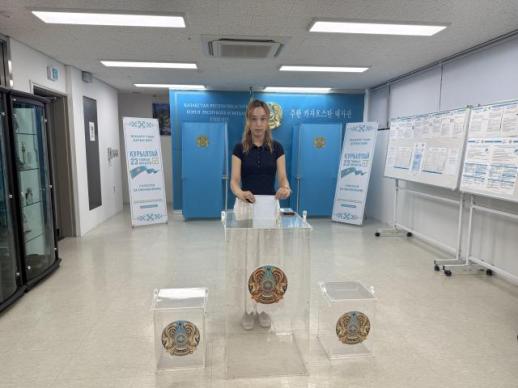 Kazakhs in Seoul vote in first Kurultai election SEOUL, August 23 (AJP) - The first voter reached the Kazakh embassy in Seoul at 7 a.m. Sunday, hours before most of the roughly 300 Kazakh nationals eligible to cast ballots in South Korea would make their way to the compound to help choose their country's new parliament. She was Azhar Karimzhanova, 23, a student at Korea University, according to Rakhymzhan Altynbay, an official at the embassy. By 1:30 p.m., Altynbay said, about 70 people had voted. That is roughly a quarter of the eligible electorate in the country, and they kept arriving through the morning. Some brought children. Some came with family. A few stopped to greet one another at the gate before going in. The Seoul station is one of 79 the Central Election Commission opened at Kazakh diplomatic missions in 61 countries. Voters abroad receive the same ballot as those at home, and there is no postal or online option. At stake are all 145 seats of the Kurultai, the single chamber that replaced the Senate and the Mazhilis when a new constitution took effect July 1. Seven parties are running 545 candidates in one nationwide district. Self-nomination is not allowed. Ulanbek Aueskhan came on his day off with his five-year-old son. He has lived in South Korea for more than 10 years, took his bachelor's degree through his doctorate here, and works as a researcher at Samsung Electronics. He said he brought the boy deliberately. "I wanted to show him," Aueskhan said. "Our country does this. He should see it while he is young, and experience it directly." Voting from abroad, he said, was a way of staying useful to a country he no longer lives in. "We are outside the country, but there is still a contribution to make," he said. "Even from Korea, we can support Kazakhstan." Asked what the new chamber would change, he pointed to the merger itself. "Until now there were the Senate and the Mazhilis," he said. "Now they are combining, so decisions can be made faster." Alisher Saduakas, 28, arrived with him. They are colleagues, both researchers at Samsung Electronics, and Saduakas lives in Suwon. He has been in South Korea for 10 years and had never voted in his life. "I had no plans to vote," he said. "Ulanbek said we should come and do it together. This is the first time, and it feels good." What changed, he said, was that he can now follow what is happening at home. "There was no Kurultai before, and things were complicated," Saduakas said. "Now I can see how it works on social media, what is moving in Kazakhstan. So I thought I could support it too." Kazakhstan's ambassador to South Korea, Asset Issenali, who presented his credentials on July 22, was at the embassy as voters came through. He said the country was in the middle of political and economic transformation, and that the new chamber would let it pass legislation to make economic reform more effective. "This will be a stepping stone," Issenali said. Polls close in Kazakhstan on Sunday evening. The commission has accredited 781 foreign and international observers, among them 39 long-term and 208 short-term monitors sent by the Organization for Security and Co-operation in Europe through its Office for Democratic Institutions and Human Rights. Aueskhan's son waited beside him while he marked his ballot. "From a young age, here, you have to show them," his father said. 2026-08-23 16:22:04
 -
 Kazakhstan President Urges Voter Participation Ahead of First Kurultai Election Kazakhstan President Kassym-Jomart Tokayev called on citizens to participate in the upcoming Kurultai election during a national address on August 21, the last day of the official campaign period. Tokayev described the election as a truly historic event and a starting point for reforms under the new constitution that took effect on July 1. "With the enactment of the people's constitution, this election will mark the beginning of new reforms," he said, adding that it would open a new chapter in the history of modern Kazakhstan. The term 'people's constitution' is how Tokayev refers to the new constitution. On August 23, all 145 seats in the Kurultai will be contested. The new constitution, which passed a national referendum on March 15, established a unicameral parliament by abolishing the Senate and the Mazhilis. According to the Central Election Commission, the approval rate for the new constitution was 87.15%, with a voter turnout of 73.12%. Seven political parties have nominated a total of 545 candidates. The entire country serves as a single electoral district, and only parties that receive more than 5% of valid votes will gain seats. Independent candidates are not allowed. There are 12,605,788 registered voters. Tokayev noted that he informed each party of the election schedule in advance to allow for adequate preparation. He praised the campaign as substantive, open, competitive, and mature, reflecting a common perception among the public. Political parties have presented their platforms through voter meetings, media promotions, nationwide television debates, and social media discussions, providing voters with opportunities to compare their proposals. The Adilet party, listed first on the ballot, has nominated 186 candidates, more than double that of any other party. Registered on June 1, this party absorbed the Amanat party following a decision at its party congress that same month. Amanat was the largest party in the Mazhilis, securing 53.9% of the vote in the 2023 general election. In his address, Tokayev did not mention any specific parties or candidates but noted a shift in social agendas. He welcomed the emergence of new figures and ideas, particularly from youth, professional organizations, and entrepreneurs. He characterized this as a sign of political renewal and a result of his reforms aimed at enhancing political culture and broadening public participation in governance. He stated, "The new legislative body should serve as a common platform for constructive views and aspirations," asserting that the Kurultai would accelerate the pace of national modernization. He also referenced unprecedented geopolitical tensions and growing global challenges, emphasizing that Kazakhstan must steadfastly pursue its strategy toward becoming a true developed nation, acknowledging that significant challenges remain before achieving this goal. He added that both domestic and international observers would monitor the election process, with activities planned at polling stations on election day. The Central Election Commission has approved 781 foreign and international observers as of August 17, including 39 long-term and 208 short-term observers sent by the Organization for Security and Co-operation in Europe (OSCE) through its Office for Democratic Institutions and Human Rights. The campaign period ended at midnight on August 21, with August 22 designated as a day of reflection. The publication of opinion polls and predictive surveys has been prohibited since August 18. Tokayev emphasized that participating in the vote is the highest expression of the people's will, noting that millions around the world are still fighting for their right to vote. He concluded his address by quoting a Kazakh proverb, "Keliship pishken ton kelte bolmas," which means that the decision made together is the wisest.* This article has been translated by AI. 2026-08-22 19:52:00
 -
 President Tokayev urges Kazakhs to vote in first Kurultai election SEOUL, August 22 (AJP) - With one day to go before Kazakhstan chooses a new single-chamber parliament, President Kassym-Jomart Tokayev called on citizens to turn out, casting Sunday's vote as the start of a fresh cycle of reform under a constitution that took effect seven weeks ago. Tokayev issued the appeal in an address to the nation published Aug. 21 (local time), the final day on which campaigning was permitted. He called the election a truly historic event. Voters choose all 145 seats of the Kurultai, the chamber that replaced the Mazhilis and the Senate when the new constitution came into force on July 1. Seven parties are fielding 545 candidates in a single nationwide district. Seats go only to parties that clear five percent of valid votes. Self-nomination is not allowed. The Central Election Commission has registered 12,605,788 voters. The constitution was approved in a referendum on March 15, with the Central Election Commission (CEC) reporting support at 87.15 percent on turnout of 73.12 percent. Tokayev calls it the People's Constitution, and in the address he tied Sunday's vote directly to it. "With the entry into force of the People's Constitution, these elections will become the starting point of new reforms," he said, adding that they would open a new chapter in the country's modern history. He said he had announced the election well in advance so that every party could prepare. The campaign that followed was substantive, open, competitive and civilized, he said, and called that the general view among citizens. Parties set out their programs at voter meetings, in the media, in nationwide televised debates and in arguments on social media, he said, giving people a chance to weigh competing visions of the country's future. Adilet, which holds first place on the ballot, is running 186 candidates, more than double any rival list. The party was registered June 1 and absorbed Amanat, which took 53.9 percent in 2023 and held the largest bloc in the Mazhilis, after congresses of both parties approved the merger that month. Tokayev named no party and endorsed no candidate. He instead pointed to what he called a shift in the public conversation, with new faces and new arguments emerging. He said he was particularly pleased that young people, professional associations and entrepreneurs had joined the debate, describing it as a sign of political renewal and crediting his own program of raising political culture and widening public participation in government. "The new legislative body must become a common platform for constructive views and aspirations," he said, adding that the Kurultai would set a high tempo for the country's modernization. He placed that task against what he called unprecedented geopolitical tension and mounting global challenges. Kazakhstan had to hold to its strategy of becoming a genuinely developed state, he said, and faced difficult work to join the front rank of nations. Domestic and international observers followed the campaign and will be present at polling stations on Sunday, he said. The CEC had accredited 781 foreign and international observers as of Aug. 17. They include 39 long-term and 208 short-term monitors sent by the Organization for Security and Co-operation in Europe through its Office for Democratic Institutions and Human Rights. The address ran on the last day campaigning was allowed. Aug. 22 is set aside as a day of electoral silence, and publication of opinion polls and forecasts has been barred since Aug. 18. Tokayev closed by calling participation the highest expression of the popular will, and noted that millions of people around the world are still fighting for the right to vote. He ended on a Kazakh proverb, "Kelisip pishken ton kelte bolmas," which he glossed as meaning that a decision taken together is the wisest. 2026-08-22 19:45:06