

Journalist
Park Sae-jin박세진
swatchsjp@ajupress.com
Assistant EditorForeign embassies in Seoul & Geopolitics, Diplomacy, Policy
Experienced journalist and editor at AJU PRESS specializing in multilingual news. I cover international diplomacy, geolpolitics, and policy, consistently delivering highly accurate, compelling reporting for a worldwide audience.
"Reporting the facts. Shaping the narrative. Every second counts."
Latest by Park Sae-jin
-
 KAIST solves oxygen problem blocking 3D memory for AI chips SEOUL, August 20 (AJP) - In a bid to stabilize memory stacked directly on top of artificial intelligence chips, a joint research team led by the Korea Advanced Institute of Science and Technology said Thursday it had developed an insulating film that steers oxygen atoms toward the parts of a vertical memory transistor that need them and away from the parts they damage, allowing the devices to achieve higher current flow and longer data retention. The device held its electrical characteristics after more than 10 million switching cycles, with the voltage at which the transistor switches on drifting by less than 50 millivolts. A test memory cell built around it held stored data for more than 648 seconds, close to 11 minutes, without being refreshed, and survived more than 1,200 write cycles. The biggest drain on an AI chip is not the arithmetic. It is the constant shuttling of data between the memory that stores it and the processor that computes on it. Stacking the two together is one of the few remaining ways to shorten that trip, and oxygen has been the specific thing breaking it. For decades the memory industry improved chips by making each component smaller, packing more storage into the same square of silicon while drawing less power. That approach is now close to its physical floor. The alternative is to build upward, stacking components in three dimensions rather than shrinking them sideways. It is what a city does when it runs out of room for single-story houses and starts putting up apartment towers. The vertical channel transistor is one way to do that. In a conventional transistor, current runs horizontally through a strip of material called the channel. Turning that channel on its end frees floor space, letting engineers pack far more devices into the same area. Making the channel out of an oxide semiconductor rather than silicon adds a second advantage. Oxide leaks very little current when switched off, which is what allows a memory cell to hold its contents without constant electrical topping up. The trouble is oxygen. Oxide channels are missing some of the oxygen atoms that belong in their crystal structure, a defect known as an oxygen vacancy. A few of them help current flow. Too many and the transistor stops behaving predictably. The obvious remedy is to feed oxygen back into the channel. But oxygen does not stay where it is put. It migrates to the metal electrodes and corrodes them, raising resistance and degrading the device that the repair was meant to improve. The Korea Advanced Institute of Science and Technology (KAIST) team attacked the problem through the interlayer dielectric, the insulating film that separates the wiring and components inside a chip. Engineers normally treat it as an electrical barrier and nothing more. By sandwiching silicon dioxide between two layers of silicon nitride, the researchers turned the film into what they call an oxygen tunnel. It is a one-way passage that lets oxygen reach the channel where it is needed and blocks the path toward the electrodes where it does damage. KAIST said the resulting transistors achieved the highest current flow and data retention reported for oxide vertical channel devices. The team then combined the oxide transistors with conventional silicon CMOS circuitry, the basic technology inside almost every processor and phone chip made today, and modeled how the hybrid would perform as embedded memory. Simulations projected roughly 45 times longer data retention than a comparable CMOS design and a 38 percent smaller memory cell. The payoff the researchers are aiming at is compute-in-memory, an approach that performs calculations inside or beside the memory that holds the data instead of hauling that data across the chip to a separate processor. The current arrangement is the equivalent of carrying every ingredient from the pantry to a kitchen in another building and back again. As AI models grow, the carrying costs more energy than the cooking. Kwon Ji-min, a professor in KAIST's School of Electrical Engineering, led the work. "Building a tall building is not just about adding floors, it is about making the structure stable, and the same is true of three-dimensional semiconductors," Kwon said. "This technology should speed up development of next-generation memory that raises AI processing speed while cutting power consumption." Gu Hyeon-ho was the first author. Lee Yong-woo and Jung Hak-soon were co-corresponding authors with Kwon. Researchers from the Ulsan National Institute of Science and Technology, Yonsei University, the Korea Research Institute of Chemical Technology, Seoul National University of Science and Technology and Seoul National University also took part. Several claims remain untested outside the laboratory. The results were demonstrated on individual transistors and a small test memory cell, not on a production wafer. The 45-fold retention gain and the 38 percent area saving are simulation outputs rather than measurements from fabricated hardware. No full compute-in-memory array using the design has been built, and KAIST did not name a manufacturing partner. The paper ran in the materials science journal Advanced Functional Materials on May 20 and was selected as a front cover article. KAIST announced the results Thursday, three months after publication. AJP Takeaways ● A KAIST-led team built a three-layer insulating film that steers oxygen inside a stacked memory transistor, removing the defect problem that has blocked 3D memory for AI chips. ● The device held steady after more than 10 million switching cycles, with switch-on voltage drifting under 50 millivolts. A test memory cell retained data for more than 648 seconds without a refresh. ● Simulations pairing the oxide transistors with silicon CMOS projected 45 times longer data retention and a 38 percent smaller memory cell than a comparable conventional design. ● Those projections have not been verified in fabricated hardware, and no full compute-in-memory array has been built. 2026-08-20 10:59:39
 -
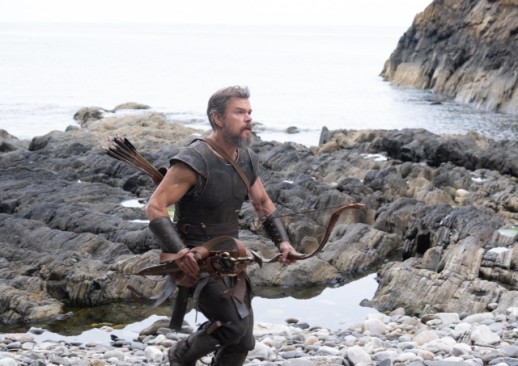 Truth-Seeker's Odyssey: From world of gods to world of man - Part 2 This is part 2 of a two-part column series by Aju Media Group's senior columnist Abe Kwak. 5. The Pale Blue Dot: Ithaca for All Humanity Let us leave, for a moment, the Mediterranean of Odysseus and turn our eyes toward space. Voyager 1, launched in 1977, photographed Earth on February 14, 1990, from a distance of roughly 6 billion kilometers. Against the immensity of space, Earth appeared smaller than a single pixel — a tiny point suspended in a shaft of sunlight. Carl Sagan transformed the image into one of humanity’s most enduring symbols of self-understanding: the Pale Blue Dot. Everything in human history happened on that dot. The Trojan War. Homer’s songs. Odysseus’s Ithaca. The land walked by Jesus. The place where the Buddha awakened. The worlds of Confucius and Laozi. The Korea in which the 20th-century religious thinker Dasuk Ryu Young-mo contemplated heaven, humanity and the meaning of existence. Every empire human beings built, every religion they founded, every revolution they fought, every war, every love, every hatred, every triumph and every failure — all occurred on that tiny point. The Pale Blue Dot reveals two apparently contradictory truths. Human beings are infinitesimally small before the universe. And yet human beings are capable of understanding that smallness. We can imagine the scale of the cosmos and ask what our existence within it means. We are not the center of the universe. Yet we can look at the universe and reflect upon ourselves. We are mortal, yet we contemplate eternity. We are imperfect, yet imagine perfection. We know we will die, and still we love, have children, build civilizations and attempt to leave something behind for generations we will never meet. Perhaps human greatness lies not in imagining ourselves to be the center of existence, but in recognizing how small we are and nevertheless choosing to live meaningfully. Then perhaps this pale blue Earth is the largest Ithaca humanity will ever share. For centuries we have fought over religion, ethnicity, borders, ideology, skin color and language. Seen from space, all those conflicts occur within a single tiny point. To love human beings, respect cultures and live together with nature is therefore more than noble rhetoric. It is among the most practical conditions for sustaining civilization on this fragile planet. And here I am reminded of the Korean thinker Dasuk Ryu Young-mo. Dasuk’s achievement did not lie in mixing religions together until their differences disappeared. Christianity and Buddhism are not the same. Confucianism and Daoism are not the same. Their understandings of the Absolute, the human being, salvation, awakening, world and life emerged from different histories and different languages. Erasing differences is not spiritual convergence. Dasuk’s distinctive form of religious dialogue began by respecting those differences while listening for the deepest questions that different scriptures direct toward human beings. At the bottom, one question returns: How will you live? Dasuk studied the Bible intensely while engaging Buddhism, Confucianism and Daoist thought. He used the Korean word jena to describe the self-centered ego — the self that grasps, possesses and insists upon itself. Against it he developed the idea of eolna, a uniquely Korean expression pointing toward the true or higher self, the human spirit awakening beyond ego toward a greater dimension of truth. Put in Dasuk’s language, jena wants to pull everything toward itself. To possess more. To win more. To rise higher. It resembles, at another philosophical level, the Buddhist diagnosis of greed, anger and delusion. The human being moving toward eolna, by contrast, learns to observe desire, discipline it and move beyond the narrow self toward a greater world of truth and life. Seen through such eyes, the voyage of Odysseus acquires another meaning. The Cyclops, Sirens, Circe and the storms are not only outside him. Greed is inside us. Pride is inside us. Anger, fear and revenge are inside us. The most formidable adversary a human being confronts over a lifetime may finally be oneself. Odysseus’s journey toward Ithaca can therefore also be read as an inner odyssey: a voyage from the ego-bound jena toward the deeper center of eolna. The Bible raises this essential question in another way. Jesus did not seek merely to abolish religious law. His conflicts arose when law, having lost its original purpose of sustaining human life, hardened into formalism or became an instrument of power. He healed on the Sabbath. He ate with tax collectors and people treated as sinners. He touched lepers. He welcomed children. Again and again the question was not merely whether a rule had been observed. The deeper question was: Whom does the rule serve? What kind of life does it protect? The parable of the Good Samaritan makes the point with breathtaking clarity. A man lies beaten beside the road. Religiously respected figures pass him by. Then a Samaritan — someone viewed with suspicion by many Jews of that period — stops. He treats the man’s wounds. Takes him to an inn. Pays for his care. The important question is not who knows the most law. It is: Who became a neighbor to the wounded man? Again and again, the Bible treats the way a society deals with widows, orphans and strangers as a test of justice and faith. Faith reveals itself not simply in how often one invokes God’s name, but in how one treats the vulnerable. The words of the Gospel of John — “the truth will set you free” — also sound newly urgent in the age of AI. Freedom does not mean merely doing whatever one wishes. There is a deeper freedom: freedom from falsehood; freedom from slavery to appetite; freedom to confront truth and accept the consequences of choosing it. AI can generate language. That does not mean it knows truth. An abundance of information is not the same as wisdom. The ability to generate millions of sentences does not itself entail moral responsibility for what those sentences do in the world. The final responsibility for judging what is true, choosing the truth and bearing the consequences remains human. Buddhism approaches the human problem from another direction. The Heart Sutra teaches: “Form is emptiness; emptiness is form.” Emptiness is not simple nihilism. It points toward the insight that no phenomenon exists as an eternally fixed, completely independent substance. Things arise through causes, conditions and relationships. Seen from the Buddhist understanding that intrinsic, independent self-nature is empty, Odysseus himself cannot be Odysseus alone. Because Penelope exists, he is a husband. Because Telemachus exists, he is a father. Because Ithaca exists, he is a king and a homecomer. Because companions sailed beside him, he was a commander. So it is with us. We become who we are through family and friends, society and nation, history and culture, nature and Earth, and even generations not yet born. Laozi’s Daodejing speaks of another kind of strength: “The highest goodness is like water.” Water nourishes all things without contending with them. It seeks the low places others avoid. And yet, over time, soft water can reshape stone. Human civilization has too often understood strength only as the capacity to dominate, conquer and prevail. Laozi points toward another strength: the strength to descend; the strength not to contend; the strength that sustains life. Odysseus, too, does not reach Ithaca through strength and cunning alone. He is a king who hides his name. A famous hero who returns to his own palace dressed as a beggar. To proclaim oneself endlessly is not maturity. Sometimes the greater power is the ability to become low like water. The Book of Changes, or I Ching, places change at the center of existence. Nothing remains fixed forever. Day becomes night. Winter becomes spring. Prosperity declines. Decline can become renewal. Individuals change. Companies change. Nations change. Civilizations change. One of the tradition’s enduring formulations reads: When things reach an impasse, they change; through change they find a way; finding a way, they endure. The age of AI is profoundly an age of yi — of change. Jobs are changing. Corporations are changing. Journalism and education are changing. The relationship between human beings and machines is changing. Yet to accept change does not mean accepting everything merely because it is new. We must decide what should change and what must be defended. Technology and institutions must evolve. Truth, justice, human dignity, freedom, responsibility and reverence for life must not simply be swept away by the velocity of technological change. The Confucian Doctrine of the Mean asks how human beings maintain moral centeredness in a world of motion. Its opening lines speak of human nature, the Way and cultivation: “What Heaven confers is called human nature; to follow that nature is called the Way; cultivating the Way is called education.” To understand the “mean” as merely splitting the difference between two sides is to miss the point. The center is not mediocrity. It is the capacity to discover what is fitting and right amid constantly changing circumstances. AI confronts us with the same demand. We must neither worship AI as a god nor fear it as a demon. We cannot simply refuse technology. Nor can we surrender humanity to technology. To use it without becoming its servant; to develop it while accepting responsibility; to increase efficiency without sacrificing human dignity — this may be a new expression of the Mean for the age of AI. These scriptures and traditions arise from different languages and histories. There is no need to force them into sameness. Yet, through the dialogical vision associated with Dasuk Ryu Young-mo, one can descend beneath their differences and encounter recurring human questions. How we live matters at least as much as what we profess to believe. What we choose matters at least as much as what we know. What we can relinquish matters at least as much as what we possess. And knowing where to return may matter at least as much as knowing how high we can climb. 6. Humanity Needs a Second Odyssey Looking back, human history has largely been an outward odyssey. We searched for more land. Built larger empires. Created faster ships, railways, automobiles and aircraft. We sent spacecraft beyond Earth. The internet connected the planet. And now we have created AI systems capable of imitating aspects of our language and thought. But perhaps the journey humanity most urgently needs is no longer only outward. We need an odyssey inward. A voyage back toward ourselves. In Dasuk’s language, from jena toward eolna. Freedom is not the realization of every desire. A deeper freedom emerges when a person can govern desire. Success is not possessing everything one wants. Sometimes success is knowing what must be surrendered. The human beings we need are not those who can know more than machines. We need human beings capable of judging what is right. Not people who calculate faster than machines, but people willing to accept responsibility for their judgments. Not simply people who produce more, but people capable of asking what is truly worth producing. As AI grows more powerful, human inner maturity may become more important than human external ability. This is not an argument for fearing technology. Nor for rejecting it. It is an argument that human ethics and responsibility must develop at a pace commensurate with technological power. Civilization becomes dangerous when the moral maturity of the human beings using a technology falls behind the power of the technology itself. The question Oppenheimer asked in the atomic age has returned in a new form in the AI age. AI can analyze every great love poem ever written. But taking the hand of someone we love and sharing that person’s suffering remains a human act. AI can explain thousands of years of philosophy concerning justice. But whether I remain silent before injustice or stand against it is a choice I must make. AI can define freedom. It cannot bear my responsibility for what I do with freedom. AI can calculate the dangers of climate change. But the decision to sacrifice some present convenience in order to protect nature for future generations belongs to humanity. AI can calculate the fastest course to Ithaca. But human beings must decide what their Ithaca is. That is our freedom. And that is our responsibility. Human beings will always need an Ithaca. And so we return to where we began: From the world of the gods to the world of man. This does not mean humanity expelled God. Still less does it mean that humanity became God. It means that as human beings awakened to themselves as creatures capable of thought and choice, they also acquired responsibility for those choices. The greater the freedom, the greater the responsibility. The stronger the technology, the stronger the ethics must become. The greater the knowledge, the deeper the humility required. Seen from space, all of us live upon a Pale Blue Dot. Kings and the poor live there. Christians and Buddhists. Easterners and Westerners. People divided by ideology. All live upon the same small planet. Our wealth, power, fame and wars cannot escape it. Perhaps, then, the greatest things human beings can do on this small world are simpler than we imagine: To defend truth. To choose justice. To love freedom while accepting responsibility. To love other human beings. To respect cultures different from our own. To live with nature rather than against it. To leave the next generation a world slightly better than the one we inherited. This, I believe, is the humanism we must rebuild in the age of AI. The goal is not to become stronger than machines. It is to become more fully human. The more machines resemble us, the more urgently we must remember what humanity is. Three thousand years ago Homer sent one man onto the sea. Odysseus crossed war and storm, gods and monsters, desire and temptation, and at last returned to the place to which he belonged. It was not the world’s greatest empire. It was a small island called Ithaca. Yet to him it mattered more than any empire. The people he loved were there. The people for whom he was responsible were there. The life that reminded him who he was was there. Three thousand years later Christopher Nolan summons that ancient man onto the screen again. And he asks those of us who have created a new presence called artificial intelligence: Where are we going? What are we racing so quickly to acquire? What are we losing along the way? And when this long voyage ends, where shall we return? Perhaps civilization’s progress cannot be measured only by its ability to go faster, higher and farther. Perhaps an even greater progress lies in remembering, however far we travel, where we began; in remembering what we set out to protect; and in knowing where, at the end, we must return. For Homer’s Odysseus, that place was Ithaca. For Dasuk Ryu Young-mo, it was the ascent from jena toward eolna. In the Bible, it is the path of truth and love. In the Heart Sutra, it is the wisdom of emptiness that releases attachment. For Laozi, it is the way of water flowing toward the low places. In the Book of Changes, it is the wisdom of changing without losing the Way. In the Doctrine of the Mean, it is maintaining moral centeredness amid the extremes of the world. And in Carl Sagan’s cosmic vision, it is the Pale Blue Dot we must protect together. The Ithaca we seek today must therefore be a world in which truth, justice and freedom remain alive — a world in which humanity, culture and nature breathe together rather than destroy one another. Homer’s Odysseus returned to Ithaca. Humanity’s odyssey is not yet over. Now that AI resembles human intelligence, robots increasingly resemble human physical agency, and machines have begun to speak in human language, we must ask the human question at a deeper level than ever before. What must remain, irreducibly, human? What must human beings continue to take responsibility for? And what is the final purpose of this immense adventure we call civilization? The answer will not belong simply to those who are stronger, richer or faster. The future may belong to human beings who are more truthful; more just; free, yet capable of responsibility; able to feel another person’s pain; able to respect cultures unlike their own; able to live with nature; and humble enough to know that they spend only a brief moment upon a Pale Blue Dot suspended in an immense universe. In the age of myth, human beings asked the gods for directions. In the age of philosophy, they asked reason. In the age of science, they asked the laws of nature. In the age of AI, human beings will ask the machines they created for an endless number of answers. But however powerful artificial intelligence becomes, there is one final question we must never hand over to a machine: How should I live? The moment we surrender that question, we become Odysseus without Ithaca. We may build the most powerful AI ever imagined. We may reach the farthest regions of space. But we will have lost home. That is why the story Homer began 3,000 years ago is not over. Nolan has placed the ancient question on the modern screen. But the person who must answer it is neither Homer nor Christopher Nolan. Nor AI. It is us. Where are we sailing now? And after all the storms and temptations of this long voyage have passed, what kind of human beings will we be when we finally return? 7. Westward With the Woman He Loves: The Final Voyage of Odysseus Nolan goes one step beyond the point at which Homer closes his story. At the end of the film, Telemachus becomes the new king of Ithaca. Odysseus and Penelope leave the island and sail once more into the open sea. This time the voyage is not toward Troy. It is not a voyage of war. Nor is it a homecoming undertaken to reclaim a stolen throne. Odysseus carries with him the memory of those who fought beside him and never returned, along with the burden of war, death, guilt and responsibility. And with Penelope beside him, he sails west. I would like to read that western sea as humanity’s final Ithaca. The West is where the sun goes down. Where the day ends. Where a life moves toward evening. Where human beings, having passed through all the years granted to them, cross toward something beyond the horizon. One may read it as the final return of a human being who was born into the world, loved and fought, succeeded and failed, endured countless desires, sufferings and relationships, and at last turns back toward the source from which life came. The throne is relinquished. Power is relinquished. The title of war hero is relinquished. What remains at the end is a man and a woman. Odysseus and Penelope. After almost 20 years of separation, war, waiting and wandering, the two who found one another again now sail together toward the setting sun. Perhaps human beings have an Ithaca to which they must return while still alive. And perhaps there is also a greater Ithaca to which, one day, life itself must return. At this scene, I am reminded of the concluding mantra of the Buddhist Prajñāpāramitā Hṛdaya Sūtra, the Heart Sutra: Gate gate pāragate pārasaṃgate bodhi svāhā. No single translation can exhaust the Sanskrit. But in the language of this essay, and beside the final voyage of Odysseus, I would like to hear it this way: Go. Go. Go beyond. Go altogether beyond the beyond. Go toward awakening. Or, rendered still more freely in the language of Odysseus: Go. Let us go again. Cross this sea of life and go beyond. Beyond desire, beyond fear, beyond attachment — until at last we return to where we belong. Three thousand years ago, a man set out from Troy for Ithaca. On the sea he lost almost everything. He lost his companions. He lost his youth. He confronted his own pride and desire. Yet he returned. And now he departs once more. This time not to win. Not to conquer. Not to become a king. But to relinquish everything and travel farther with the person he loves. Perhaps this is the final odyssey given to every human being. We are born and enter the world. We learn. We love. We struggle. We work. We dream. We succeed. We fail. We raise children. We hand our place to the next generation. And in the end we begin the journey back toward wherever it was that we came from. If so, must death be understood only as an absolute ending? If the voyage from Troy to Ithaca was a homecoming for Odysseus, might the final journey westward also be read as a homecoming of a greater kind? In Homer’s world, human beings ask the gods to show them the way. In Nolan’s world, human beings carry their memory, guilt, love and responsibility and venture onto the sea themselves. And those of us living in the age of AI must ask ourselves again: Where did I come from? What have I lived for? What will I leave to the next generation? And where, at the end, will I return? Humanity is now creating the most powerful instruments of intelligence in its history. But no matter how extraordinary the technology becomes, we cannot outsource the answer to those questions. The final course must be chosen by human beings themselves. Toward truth. Toward justice. Toward freedom. Toward a world that loves human beings, respects cultures and lives in harmony with nature. And, finally, toward the greater Ithaca to which all of us must one day return. Gate gate pāragate pārasaṃgate bodhi svāhā. Go. Let us go again. Across this sea of life, let us go beyond. The voyage of Odysseus does not simply end there. At last, it begins the greater homecoming. *The author is a senior columnist of AJP. 2026-08-20 09:54:11
 -
 Kazakhstan gives month to prepare Chinese waste plant deals SEOUL, August 19 (AJP) - Kazakhstan has given itself a month to prepare agreements for a new set of Chinese-built waste-to-energy plants, the government said Wednesday, extending a program that has yet to put a single incinerator into operation anywhere in the country. Three plants are already under construction, in Astana, Almaty and Shymkent, at a combined cost of 293.3 billion tenge ($637.4 million). Together they are designed to burn 4,500 tons of municipal waste a day and generate 134 megawatts of electricity. None is finished, and the Ministry of Ecology and Natural Resources said this month that Kazakhstan has no operating incineration plants at all. The instruction came out of a meeting between Prime Minister Olzhas Bektenov and Dai Daoguo, chairman of the board at Hunan Junxin Environmental Protection, the Chinese company building the Almaty plant. Bektenov told the ministry and other state bodies to examine all aspects of further cooperation with the company as a matter of urgency, and to prepare agreements for signing within a month covering plants in a number of major cities, according to the statement from the prime minister's press service. Work on the Almaty project began in May under an investment agreement signed with the ministry last August. The government put the investment at 145 billion tenge. Dai said the site was preparing to start construction and installation work. Once running, the plant is designed to process up to 2,000 tons of waste a day and generate up to 60 megawatts of electricity. The company expects it to cut carbon dioxide emissions by roughly 200,000 tons a year and to save around 800,000 cubic meters of landfill space annually. At least 700 jobs are planned during construction, and 120 permanent positions once the plant starts operating. Commissioning is due within two years of the May start. Waste-to-energy plants burn household rubbish and use the heat to drive turbines, cutting the volume that goes into landfill while producing power. Under Kazakhstan's Ecological Code, adopted in 2021, waste can be burned only after recyclable material has been pulled out of the stream. The ministry estimates that five to 10 percent of the original volume survives the furnace as ash and residue, which still has to be buried, leaving landfills in the system with a narrower role. Bektenov said at the meeting that President Kassym-Jomart Tokayev pays particular attention to environmental responsibility, and that the new Constitution, which took effect July 1 after a March referendum, makes environmental protection one of the founding principles of state policy and civic responsibility. It was the second such deadline in five weeks. On July 16, Bektenov instructed the same ministry to finish talks with China Tianying Inc. and submit an investment agreement within two weeks for waste plants in at least three major cities. The government has not said which cities either company would build in. Electricity from waste-to-energy plants qualifies for a feed-in tariff of up to 55 tenge per kilowatt-hour, and the projects are carried out through investment agreements with the state. Hunan Junxin has described larger ambitions in Kazakhstan than incineration. In talks with the state investment promotion company Kazakh Invest in July last year, Dai put the company's plan at $600 million across three plants and said it would extend to data centers running on the power those plants generate, training facilities and automated waste management systems. The company built Central Asia's first waste-to-energy plant, which opened at Bishkek's main landfill in December last year. It started a second phase there in June, designed to add up to 2,000 tons a day and 60 megawatts, and is building another plant in Osh, Kyrgyzstan's second largest city. The government is working on waste plants in Karaganda, Atyrau, Aktobe, Pavlodar and other cities. 2026-08-19 17:30:42
 -
 Türkiye rejects Israeli claim on troop deployment at Syrian airbase SEOUL, August 19 (AJP) - The justification Israel gave for bombing a Syrian airbase this week, that Turkish soldiers were about to deploy there, was rejected in full by Ankara on Wednesday, which called the allegations untenable and said their purpose was to make unlawful strikes appear legitimate. Eight strikes hit the runway at the Abu al-Duhur airbase in eastern Idlib province early Tuesday, damaging runways and hangars without killing anyone, according to Syria's state broadcaster Ekhbariya, citing a military source. The base lies about 70 kilometers east of the Turkish border and has not operated as a dedicated military airfield since 2013, having changed hands repeatedly during the civil war. Israel said nothing for most of the day, and its military declined to comment, leaving the Turkish foreign ministry and Damascus to condemn an attack nobody had yet claimed. Ankara called on the international community to hold Israel accountable for disregarding international law, while Damascus called the strikes an act of aggression and a violation of the United Nations Charter. Confirmation came instead from Washington, where Tom Barrack, the U.S. special envoy for Syria and Iraq who also serves as ambassador to Türkiye, said Israel had carried out the attack and called it an unnecessary escalation that did not advance regional stability. The Israeli explanation arrived roughly 20 hours after the bombs fell, in an English statement posted on X by the Prime Minister's Office, which said Israel and Syria had agreed to a status quo in security matters that Syria was on the verge of breaching by permitting Turkish troops to deploy at an airbase near Aleppo, and that Damascus had ignored repeated warnings. Turkish forces have been rebuilding Syria's army since Ahmed al-Sharaa toppled Bashar al-Assad in December 2024, ending more than five decades of family rule. The two defense ministers signed a training and consultancy memorandum in Ankara last August, Syrian cadets entered Turkish military academies that October, and Syrian troops joined multinational exercises in western Türkiye in May, all of it at the invitation of the government in Damascus. Israeli forces hold their own ground in Syria without that invitation, occupying positions inside the buffer zone patrolled by the United Nations on the Golan Heights and on Mount Hermon since December 2024, taken after Netanyahu declared the 1974 disengagement agreement void. Damascus wants them gone as a condition for any security arrangement, and Defense Minister Israel Katz has said they will stay. Türkiye's Directorate of Communications answered the following day. "The untenable allegations put forward by the Israeli Prime Minister's Office are intended to legitimise Israel's unlawful airstrikes targeting Syria's sovereignty and territorial integrity," the statement said. Ankara did not stop at denial but tied the accusations to Israeli domestic politics, saying they stem from Netanyahu's intent to pursue expansionist and destabilising policies in the region ahead of the elections in Israel, where voters go to the polls on October 27, the last date the law allows. Barrack, for his part, said the strike reflected a perception, accurate or misplaced, that Türkiye might soon expand its presence at the base, and that Washington is working to build a deconfliction channel linking Israel, Syria and Türkiye. "The sole path to this objective lies in Netanyahu's abandonment of his aggressive and coercive policies and in his respect for international law," Ankara's statement said. 2026-08-19 17:08:41
 -
 S. Korea says no one knew Trump would cut joint drills SEOUL, August 19 (AJP) - South Korea had no advance word that President Donald Trump would order this week's combined military exercises cut back, and neither did officials in his own administration, the Minister of Foreign Affairs said Wednesday. The move shortened the exercise by nearly a week, underscoring a sudden and highly unusual shift in alliance operations. Cho Hyun told the National Assembly's Foreign Affairs and Unification Committee that the government learned of the decision the same way the public did. He noted the revelation came entirely from Trump's post on Truth Social. "What President Trump wrote on Truth Social was not known in advance to our government, and it was not known to United States government officials either," Cho said. "So we received no prior notification." Trump wrote Sunday evening (local time) that he had instructed Defense Secretary Pete Hegseth to substantially reduce the exercises, saying it was too late to cancel them outright. He called the drills costly and said they sent a signal that was totally inappropriate and hostile to North Korea. He also tied the decision to Seoul's refusal to help the U.S. against Iran. The Joint Chiefs of Staff announced Wednesday that Ulchi Freedom Shield will end Friday rather than Aug. 27, cutting the exercise roughly in half at Washington's request. It is the first time a major combined exercise has been altered after it was already underway. Field training will also be scaled back, with the two militaries still working out the details. A U.S. defense official said some live events had been canceled outright and others converted to simulations, adding that essential readiness was preserved. The shortened schedule drops the second half of the exercise, which is a phase built around a counteroffensive. North Korea has for years denounced that specific segment as a rehearsal for invasion. About 18,000 South Korean troops began the exercise Monday alongside U.S. forces. The mobilization proceeded just hours after the social media post appeared. Cho declined to describe the cut as something imposed on Seoul. Defense Minister Ahn Gyu-back had been in close consultation with his U.S. counterparts since the post went up, Cho said, and that consultation was the reason he did not regard the outcome as a unilateral notification. Ahn told the National Assembly's Legislation and Judiciary Committee the same day that no official in either government had known what was coming. He added that he had been in continuous discussion with the U.S. side since. Cho also predicted the reduction would not slow the transfer of wartime operational control of South Korean forces, which reverts to Seoul from Washington under a conditions-based timetable. Because the United States asked for the cut, he said, it cannot then cite the cut as grounds for further delay. President Lee Jae Myung said Tuesday the transfer should proceed during his term without disruption. Trump said Monday at the White House that Kim Jong-un had responded to his overtures, calling the exchanges very positive. Recounting his call with Lee Jae Myung, Trump said the U.S. keeps 39,000 soldiers in South Korea guarding it from Kim Jong-un. In reality, about 28,500 U.S. troops are stationed in the country. Cho called the opening with Pyongyang a shift into a new phase. The government had made every preparation to get a channel to North Korea running again, he said, and would work closely with Washington so that the opening was not wasted. He said the ministry was consulting immediately with U.S. counterparts to keep the alliance from weakening. This was a direct response to concern that Washington might deal with Pyongyang over Seoul's head. Cho also welcomed the proposal from President Lee, made in his Liberation Day address on Aug. 15, for multilateral talks to formally end the Korean War. Cho said he believed it would prove an important breakthrough in relations with the North. Seoul has told Washington where it stands on the outreach to Kim Jong-un and has asked to be briefed on the state of U.S. contacts with Pyongyang. Cho said no reply had come. 2026-08-19 15:53:48
 -
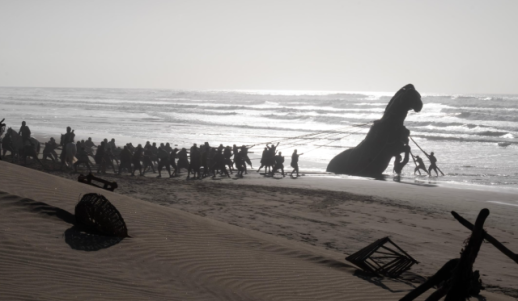 Truth-Seeker's Odyssey: From world of gods to world of man This is part 1 of a two-part column series by Aju Media Group's senior columnist Abe Kwak. A single film has summoned the world back to the seas of ancient Greece, nearly 3,000 years after Homer first sang of them. Christopher Nolan’s The Odyssey has filled theaters in major cities around the world and rekindled an extraordinary interest in Homer, Greek mythology, the Trojan War and the origins of Western philosophy. Film critics, historians, philosophers, writers and ordinary moviegoers have all entered the conversation, each finding a different meaning in the same ancient voyage. In South Korea, too, the enthusiasm has been strong enough to suggest something approaching an “Odyssey phenomenon.” A story born almost three millennia ago has returned to the center of global popular culture through the most advanced technologies of 21st-century cinema. Some groups have gone so far as to rent an entire IMAX theater to watch the film together, followed by discussions with prominent film critics. Afterward, one reads reviews and essays, each approaching the work from a different direction. Historians speak of myth and antiquity. Philosophers examine human nature and fate. Film critics analyze Nolan’s visual language and cinematic architecture. All are illuminating. Yet the more explanations one hears, and the more interpretations one reads, the clearer becomes the question that first remained after the theater went dark. Must great art yield only one answer? The moment a film leaves its director’s hands, does it not enter the life of every person who watches it? One viewer sees a family. Another remembers a war. Another thinks of youth, failure, love or waiting. Great art does not end when the screen goes black. It begins again when the audience walks out of the theater and carries it into life. The most powerful question The Odyssey left with me was, in the end, unexpectedly simple: What is a human being? How did humanity emerge from a world ruled by gods into a world in which human beings think and choose for themselves? And now, confronted by an artificial intelligence of our own making, what kind of human beings must we become? Nolan revives an ancient myth in a contemporary cinematic language. Yet the question could hardly be more modern. We send spacecraft beyond the familiar reaches of the solar system. We build machines capable of learning human language and absorbing vast stores of human knowledge. And still we stand before essentially the same questions that confronted Homer’s men and women thousands of years ago. That is why Homer’s Odyssey is great. Its greatness does not lie merely in its age. Empires have risen and vanished. Dynasties have disappeared. Religions and philosophies have been born. Humanity has passed through the Renaissance, the Scientific Revolution, the Industrial Revolution and the Information Revolution, arriving now at the threshold of artificial intelligence. Yet Odysseus is still alive. A true classic is not a relic preserved under glass. It is a work that asks a new question of every new age. That is why a classic never grows old. Homer sang of a Greek warrior crossing the Mediterranean, but within that voyage reside the permanent problems of humanity: desire and fear, love and betrayal, pride and restraint, war and peace, temptation and responsibility, death and homecoming. What Nolan ultimately finds behind the mythology is the human being. Odysseus is a hero, but never a perfect one. He is strong, yet vulnerable. Clever, yet capable of error. Brave, yet afraid. At times he becomes intoxicated by his own intelligence and success, and his pride brings new suffering upon himself and those around him. He wins a war and loses his way. The Trojan War is over, yet he cannot return home. A man who conquers the world but cannot return to himself; a civilization capable of astonishing achievement but unable to guarantee happiness; a species that accumulates immense knowledge without necessarily knowing how to live — in these respects, the Odysseus of 3,000 years ago and the humanity of the AI age are not so far apart. Nolan’s film brings this vast mythological world into modern cinematic form. Drawing upon Homer’s Odyssey, it follows the long and perilous homeward journey of Odysseus after the Trojan War. Matt Damon plays Odysseus; Tom Holland his son, Telemachus; Anne Hathaway his wife, Penelope; and Robert Pattinson Antinous, one of Penelope’s most dangerous suitors. Zendaya appears as Athena, Charlize Theron as Calypso, Samantha Morton as Circe, Jon Bernthal as Menelaus, Benny Safdie as Agamemnon, John Leguizamo as the loyal swineherd Eumaeus, Himesh Patel as Eurylochus and Elliot Page as Sinon. But behind the spectacle lies an ancient human drama. 1. The Odyssey: A Man Who Won the War but Could Not Get Home At the center stands Odysseus, played by Matt Damon. He is king of Ithaca, a small island kingdom west of mainland Greece. But Odysseus is not merely another warrior skilled with the sword. Among Homer’s heroes, what distinguishes him is not brute force but intelligence: cunning, judgment, adaptability and command of language. If Achilles represents strength, and Hector honor and duty, Odysseus represents the thinking human being. He leaves home because of the Trojan War. His wife, Penelope, and his young son, Telemachus, remain in Ithaca while he sails to battle. The war lasts 10 years. And when it ends, his suffering does not. His journey home consumes almost another decade. The simplest way to describe the architecture of The Odyssey is therefore this: a man spends 10 years fighting a war and nearly 10 more trying to return home. But those 20 years are not merely a measure of time. They are the story of a warrior slowly becoming a husband again, a father again, a human being again — after passing through temptation, terror, loss and death. For 10 years the united Greek armies cannot breach Troy. Its walls are formidable. Its defenders refuse to surrender. Then comes the stratagem that ends the war: the Trojan Horse. The Greeks construct an enormous wooden horse and hide Odysseus and other elite warriors inside it. The Greek forces then create the illusion that they have abandoned the war and sailed away. The Trojans, believing the horse to be a trophy of victory, drag it inside their city. Night falls. As Troy celebrates and sleeps, the Greek soldiers emerge from the horse, open the gates and admit the army waiting outside. The city that force could not conquer falls to deception and intelligence. Nolan’s film includes both the enormous horse and Sinon, played by Elliot Page. The figure of Sinon is elaborated less in Homer’s Odyssey than in later Greek and Roman traditions, most famously in Virgil’s Aeneid, where he helps persuade the Trojans to bring the horse within the city walls. The war ends. But that is precisely when the true Odyssey begins. Odysseus boards his ship with one destination in mind: Ithaca. There waits Penelope, who has endured years without her husband, and Telemachus, the son who scarcely remembers his father. But the sea will not release Odysseus so easily. In Homer, Poseidon, god of the sea, becomes the great divine obstacle to his return. Nolan shifts much of this divine intervention toward the realms of nature, memory, guilt and human psychology. That change makes the modern significance of the story — the movement from the world of the gods toward the world of man — all the more vivid. Polyphemus: Intelligence and Pride Among the most famous episodes is Odysseus’s encounter with Polyphemus, the Cyclops — the one-eyed giant. Odysseus and his companions enter an enormous cave stocked with sheep, goats, cheese and food. But its owner is no man. He is Polyphemus. The giant traps them inside, sealing the entrance with a massive stone, and begins devouring the sailors. No ordinary force can defeat him. Here Odysseus turns to his greatest weapon: intelligence. In Homer, he gives Polyphemus wine and tells the Cyclops that his name is “Nobody.” When the giant falls into a drunken sleep, Odysseus and his companions drive a sharpened, heated stake into his single eye. Polyphemus howls in agony. Yet when neighboring Cyclopes ask who is attacking him, he answers, in effect, “Nobody.” And so no one comes to his rescue. Odysseus survives through language and intelligence rather than strength. But what happens next is more important. Once safely away, unable to resist the temptation to boast, Odysseus reveals his true identity. He is Odysseus, king of Ithaca. It is a catastrophic act of pride. Polyphemus is the son of Poseidon. The sea god’s wrath now descends upon the hero. Odysseus’s intelligence saved him. His arrogance imperiled him again. Such is Homer’s understanding of humanity. Our greatest gift and our greatest weakness often live side by side. Circe: The Woman Who Turns Men Into Swine Odysseus and his companions eventually arrive at the island of Circe, the beautiful and dangerous enchantress. In Homer’s world, Circe possesses the power to transform human beings into animals. She casts a spell upon Odysseus’s companions and turns them into pigs. It is one of the most enduring symbols in The Odyssey. A human being who surrenders reason and self-restraint to appetite can descend into the animal within. With the aid of Hermes, Odysseus resists Circe’s magic and eventually restores his companions to human form. He nevertheless remains on her island for a significant period. And this raises a question that runs through the entire epic: Why does a man who so desperately wants to return home repeatedly stop, linger and succumb to temptation? The answer is one reason the Odyssey remains great. Homer does not portray his hero as a saint. Odysseus desires. He hesitates. He fails. And still he begins again. He is not human because he is heroic. He is a human hero because, after being shaken again and again, he keeps searching for the road that leads home. Into the Underworld: Asking the Dead for the Way Home Odysseus even descends, while still alive, into the realm of the dead. There he consults the spirit of the prophet Tiresias, asking how he can return to Ithaca. He encounters the spirit of his mother as well. He survived the battlefield, but while he fought and wandered, those he loved grew old and died. From this point on, the meaning of homecoming deepens. Home is no longer simply a place. It is the place one must reach before time itself disappears. The Sirens: Beauty Calling Human Beings Toward Destruction Then come the Sirens. Their song is irresistibly beautiful. Sailors who hear it lose reason and sail toward their deaths. Odysseus devises a solution. He orders his men to seal their ears with beeswax. But he himself wants to hear the song. So he commands them to bind him tightly to the mast — and, no matter how desperately he begs, never to release him. The song begins. Odysseus struggles violently. He commands his men to untie him. They refuse. The ship sails safely past. It is one of the most extraordinary images of desire and self-government in Western literature. Odysseus does not pretend that temptation can be abolished. He does something wiser. He acknowledges his own weakness and constructs, in advance, a mechanism that will prevent his weaker self from destroying his better judgment. Civilization itself may depend upon that insight. Scylla and Charybdis: When Every Choice Has a Cost Then comes an even crueler dilemma. On one side waits Scylla, the many-headed monster. On the other churns Charybdis, a whirlpool capable of swallowing an entire ship. There is no path without danger. This is also the tragedy of leadership. Not every decision offers a good outcome. Sometimes there is only the responsibility to choose the lesser catastrophe. Odysseus chooses the path past Scylla, sacrificing six men rather than risking the destruction of all. The hero survives. But the people beside him disappear one by one. Odysseus is therefore not a hero who marches triumphantly from victory to victory. The nearer he comes to home, the lonelier he becomes. Calypso: Choosing Mortal Love Over Immortality At last, after losing nearly everyone, Odysseus is washed ashore alone on the island of Ogygia, home of Calypso. In Homer, Calypso wishes to keep him with her. She can offer him what mortal life cannot: the possibility of escaping human finitude. Yet Odysseus does not ultimately want to become a god. He wants to return to Ithaca. He wants Penelope. He wants his son. He wants his home. Here one of the deepest themes of the Odyssey emerges: It may be better to live finitely as a human being with those one loves than to live forever without them. Another War Was Already Underway in Ithaca While Odysseus wanders, Ithaca is anything but peaceful. Its king has been gone for nearly 20 years. Many assume he is dead. Noblemen crowd into the palace and compete for Penelope’s hand, knowing that marriage to the queen could also deliver political power. Among the most dangerous is Antinous. Penelope refuses to surrender. In Homer, she uses intelligence to resist. She announces that she will choose a husband after finishing a burial shroud for her father-in-law, Laertes. By day she weaves. At night she secretly unravels what she has woven. She defeats time with patience. This is the famous weaving of Penelope. If Odysseus battles monsters across the sea, Penelope battles time within the palace. She, too, is an Odysseus. Telemachus: The Boy Who Goes in Search of His Father And another human being is growing. Telemachus. He was a child when his father sailed for Troy. Now he is a young man. Yet his palace has been occupied by suitors consuming his father’s wealth and pressuring his mother into marriage. Telemachus leaves home to discover whether Odysseus is still alive. He seeks out veterans of the Trojan War and asks what they know. Among them are Menelaus, king of Sparta, and Helen. The fact that the opening books of Homer’s Odyssey belong largely to Telemachus matters greatly. The father is trying to return home. The son must leave home in search of the father. They travel in opposite directions and finally meet. This is more than a reunion. It is the story of a boy who grows into a man in the absence of his father. Ithaca at Last: The King Returns as a Beggar After nearly 20 years, Odysseus finally reaches Ithaca. But he does not enter as a king. He disguises himself as a poor beggar and enters his own kingdom unnoticed, seeking to discover who remained loyal and who betrayed him. In Homer, one of the most heartbreaking recognitions comes not from a human being but from an animal. Argos, Odysseus’s old dog, has waited for his master through the passing years. Ancient and neglected, he recognizes Odysseus beneath the disguise. And after seeing that his master has finally returned, Argos dies. Then comes the final trial. Penelope declares that she will marry the man capable of stringing Odysseus’s bow and shooting an arrow through the aligned openings of a series of axes. One suitor after another fails. Then the ragged beggar takes the bow. He strings it. The arrow flies. The king has returned. Odysseus and Telemachus fight together against the suitors occupying the palace. For the first time, father and son stand on the same battlefield. Penelope’s Final Test: Homer’s Bed, Nolan’s Golden Pin Even then, Homer does not allow recognition to come cheaply. Penelope must know whether this man is truly her husband. Twenty years have passed. His face has changed. His body has changed. Life has changed him. So she sets one last test, referring to a secret known only to the two of them. Their marriage bed was built by Odysseus around the trunk of a living olive tree rooted in the earth. It cannot simply be moved. Only Odysseus understands what Penelope means. At that moment she knows. The man before her is her husband. Nolan does not reproduce this celebrated episode exactly. In the film, a golden Athena pin associated with Penelope becomes an important sign of recognition. The details differ. The meaning does not. The war is over. The voyage is over. The monsters have been survived. And a human being has finally returned to the person to whom he belongs. Ultimately, The Odyssey is the story of a homecoming. But homecoming does not mean merely returning to a physical house. It means the warrior becoming a husband again, the soldier becoming a father again, the figure who contended with gods becoming human again. 2. The Trojan War: The War Before the Homecoming To understand The Odyssey, one must first understand the war that precedes it. Why did Odysseus go to Troy? Why did the kings and heroes of Greece sail across the Aegean? Why did Achilles and Hector die? In mythic tradition, it begins with a wedding and a golden apple. The sea goddess Thetis is marrying the mortal Peleus. Many gods are invited. Eris, goddess of discord, is not. Enraged, she throws a golden apple into the celebration. Upon it are words meaning: “For the fairest.” Three goddesses claim it: Hera, queen of the gods; Athena, goddess of wisdom; and Aphrodite, goddess of love and beauty. Who is the most beautiful? The judgment is ultimately placed in the hands of Paris, prince of Troy. Thus comes the famous “Judgment of Paris.” Each goddess offers him a reward. Hera promises power. Athena promises wisdom and victory in war. Aphrodite promises the most beautiful woman in the world. Paris chooses Aphrodite. There is one problem. The most beautiful woman, Helen, is already married. Her husband is Menelaus, king of Sparta. Paris nevertheless brings Helen to Troy. Depending on the ancient tradition, Helen is abducted, persuaded or leaves voluntarily. But to Menelaus, the result is the same: humiliation. He appeals to his brother Agamemnon, king of Mycenae, who becomes commander of the Greek coalition. The great warriors gather. Achilles, the greatest fighter of Greece. Odysseus, king of strategy. Menelaus of Sparta. Ajax, the mighty warrior. Nestor, the veteran king. And Agamemnon, commander of them all. They cross the Aegean with a vast fleet and lay siege to Troy. On the other side stand the defenders: Priam, the aging king of Troy; Queen Hecuba; Paris; and, above all, Hector, Paris’s brother and Troy’s greatest warrior. Two names must be remembered. For Greece, Achilles. For Troy, Hector. Their collision produces the greatest tragedy of the war. Achilles: The Strongest Warrior, and Yet Entirely Human Achilles is nearly invincible. His mother is Thetis, a goddess. In a famous later tradition, Thetis immerses the infant Achilles in the River Styx, granting near invulnerability. But she holds him by the heel, leaving that one place untouched. From this story comes the expression “Achilles’ heel” — a fatal weakness. That particular version, however, is not found in Homer’s Iliad itself. It belongs to later mythological tradition. The Trojan War lasts 10 years. Yet Homer’s Iliad does not narrate all 10 years from beginning to end. It focuses primarily on a period near the war’s conclusion and on the conflict between Achilles and Agamemnon. Agamemnon takes Briseis, a woman awarded to Achilles as a prize of war. Achilles sees it as an intolerable insult. He refuses to fight. The greatest Greek warrior withdraws from battle. The war turns. Hector drives the Greeks back. Patroclus, Achilles’s closest companion, can no longer bear to watch the Greek forces suffer. He puts on Achilles’s armor and enters battle. The Trojans believe Achilles has returned and recoil in fear. But Hector kills Patroclus. When Achilles hears the news, something within him collapses. His rage is no longer directed at Agamemnon. It turns toward Hector. Achilles returns to war. Everything changes. Hector knows that he may die. He has a wife, Andromache, and a young son. Yet he cannot simply run away. He is a prince of Troy. He bears responsibility for his city. At last Achilles and Hector meet before the walls of Troy. Hector dies. But victory does not ennoble Achilles. Consumed by rage, he ties Hector’s corpse to his chariot and drags it behind him. It is the moment when triumph threatens to destroy the victor’s humanity. Then comes one of the greatest scenes in the Iliad. Priam, Hector’s elderly father, secretly enters the Greek camp at night. The king of Troy kneels before the man who killed his son. He begs for Hector’s body. Achilles looks at the old king and thinks of his own father. The two men weep. One has lost a son. The other has lost a beloved companion. For a moment they are no longer enemy king and enemy warrior. They are simply human beings joined by grief. Achilles returns Hector’s body. The Iliad moves toward this profoundly human moment. The war, however, continues. In later traditions Achilles is killed by an arrow shot by Paris, sometimes said to have been guided by Apollo. The greatest warrior in Greece is gone. Yet Troy still stands. Then the intelligence of Odysseus becomes decisive. When strength fails, thought must fight. The Greeks build the horse. Odysseus and selected warriors conceal themselves within it. Sinon helps convince the Trojans to bring it into the city. The Trojan priest Laocoön warns against trusting the Greek gift. His warning goes unheeded. The horse enters Troy. Night falls. The people celebrate what they believe to be the end of war. Then, while the city sleeps, the horse opens. Odysseus and the Greek soldiers emerge. The gates are opened. The Greek army pours in. Troy, after 10 years of resistance, falls. There is victory. But almost no one is truly happy. Troy burns. Priam is killed. The royal house collapses. Women and children are enslaved or taken captive. Hector is dead. Achilles is dead. Paris dies as well. Those who caused the war, those who tried to prevent it, and those who fought most bravely are swept away by it. Greece has won. Yet strangely, one searches in vain for the true victor. Agamemnon returns home only to be murdered in a cycle of vengeance involving his wife Clytemnestra and her lover Aegisthus. Ancient traditions and tragedies differ in detail, but the great commander’s reward is not a glorious homecoming. It is death. Menelaus and Helen endure their own difficult return. Countless soldiers never see home again. And no one pays a longer price for the journey home than Odysseus. The strategist who helped bring down Troy goes back to sea. Ahead of him wait storms, Cyclopes, Circe, Sirens, Scylla and Charybdis, Calypso, temptation and death. He no longer seeks victory. He seeks no empire. He wants no new glory. He wants one thing. Home. That is why the Iliad and the Odyssey form one continuous story while offering profoundly different visions of humanity. The Iliad is a story of war. The Odyssey is a story of return. The Iliad, through Achilles and Hector, asks how a hero dies. The Odyssey, through Odysseus, asks how a human being survives — and becomes human again. For Achilles, the central value is glory. For Hector, responsibility. For Odysseus, homecoming. For Penelope, fidelity and endurance. For Telemachus, growth. And above them all stand Zeus, Athena, Poseidon, Aphrodite and the other gods. Yet something extraordinary happens as the stories advance. At first the gods seem to determine everything. A quarrel among gods helps begin the conflict. A god raises the wind. A god blocks the sea. Gods influence victory and defeat. But what remains at the end is not the gods. It is the human being. Penelope, who waited. Telemachus, who grew to adulthood without his father. Odysseus, wounded and aged, returning after losing nearly everyone around him. Read together as a single story of civilization, Homer’s two epics reveal a remarkable movement: from the conflicts of the gods to the wars of men; from the wars of men to the homecoming of one man; and finally to the question: What is a human being? That is why humanity has remembered Odysseus for nearly 3,000 years. And it is here that Christopher Nolan’s Odyssey speaks directly to our time. Artificial intelligence can remember more than we can. It can calculate faster. It can generate human language and images. And so we must ask once again: What makes a human being human? For Odysseus, the answer was never perfection. He erred. He boasted. He succumbed to temptation. He lost almost everything. But he never completely forgot the place to which he must return. Ithaca. There was something there more important than a throne. Penelope. Telemachus. A community for which he bore responsibility. Odysseus’s greatest victory, therefore, was not the destruction of Troy. Troy was the victory of Odysseus the hero. Ithaca was the victory of Odysseus the man. And at that moment the story passes from the world of the gods into the world of humanity. From the Iliad to the Odyssey comes one of civilization’s great humanistic movements: from force to intelligence; from conquest to return; from war to ordinary life; from glory to responsibility; and, ultimately, from a world in which gods determine human destiny toward a world in which human beings begin to think, choose and bear the consequences of their choices. 3. Christopher Nolan: A Director Who Has Spent His Career Filming the Human Being Looking back across Christopher Nolan’s work, one begins to understand why he would eventually arrive at Homer. Nolan has always filmed the human being. He simply approached humanity indirectly — through memory, dreams, time, space, war and science. In Memento, he asks what happens to human identity when memory collapses. If I lose my memory, am I still myself? In Inception, he destabilizes the boundary between dream and reality and turns unconscious desire, memory and guilt into cinematic architecture. It is a world that inevitably touches the questions raised by Freudian psychoanalysis. In Interstellar, Nolan enters the worlds of relativity, black holes, time and astrophysics, yet what he refuses to abandon is the bond between a father and his daughter. In Dunkirk, he explores survival under the extremity of war. In Tenet, the direction of time itself becomes a problem of human choice. And in Oppenheimer, the triumph of human intelligence becomes the power to destroy humanity itself. What responsibility falls upon science, the scientist and civilization when knowledge becomes a weapon capable of annihilation? The forms change. The question beneath them does not. What is a human being when memory becomes unreliable? What remains of us when dream and reality collapse into one another? What does love mean when time and space themselves are distorted? What should humanity do when it acquires powers it may not be morally mature enough to wield? Now Nolan travels nearly three millennia backward and asks the same question of a man wandering among gods and monsters: Can a human being remain human to the end? In that sense, The Odyssey feels both like a new departure and like the origin point toward which Nolan’s entire career has been moving. He films time — and finds the human being. He films space — and finds the human being. He films war — and finds the human being. He films science — and finds the human being. And after filming myth, what remains is again the human being. However large Nolan’s cinema becomes, its conclusions repeatedly return to something small and intimate. Interstellar travels across the universe only to return to a father and daughter. Oppenheimer confronts the atomic bomb only to leave us with the human conscience and the burden of responsibility. And The Odyssey, after filling the screen with gods, monsters, war and oceans, leaves behind a single mortal man who wants to go home. Here one cannot help thinking of Hayao Miyazaki’s Spirited Away. Chihiro’s parents enter a strange world, encounter unattended food, surrender to appetite and are transformed into pigs. In Homer, Circe turns Odysseus’s companions into swine. There is no need to claim a direct line of influence between the works without evidence. The more fascinating truth is that, across thousands of years and across the immense geographical distance separating the Mediterranean from Japan, the same human symbol appears again: When human beings cease to govern desire and allow desire to govern them, they risk surrendering their humanity. That is the power of a classic. A classic is not copied intact. It is reborn within another culture, another era and another human life. 4. From Mythos to Logos: From the World of the Gods to the World of Man This, to me, is the most important way to read The Odyssey. In the mythic world of ancient Greece, the gods intervene directly in human life. Zeus presides over order. Poseidon shakes the sea. Athena aids mortals. Aphrodite governs love. Human beings are weaker than gods and smaller than fate. Yet as we travel through the Odyssey, the human figure becomes increasingly distinct within that divine universe. Odysseus thinks. He judges. He chooses. He makes mistakes and suffers the consequences. Then he thinks again and chooses again. Fate exists. But within fate, human beings must still act. One of the great achievements of ancient Greek civilization was not that it abolished the gods. It was that, even in a world crowded with gods, it began to discover the human right to think and the human responsibility to choose. At some point, human beings no longer looked at thunder and felt satisfied merely to call it the anger of a god. They began to ask: Why does thunder occur? What is the world made of? What is justice? What is the good life? How should human beings live? This is the movement from mythos to logos: from myth toward reason; from received explanation toward inquiry; from a world explained for us toward a world we attempt to understand for ourselves. We should not reduce history by claiming that Greek philosophy emerged directly from one literary work. But Homer’s epics, in their profound exploration of character, fate, choice and responsibility, formed part of the cultural and intellectual soil from which Greek philosophy grew. Thales and Heraclitus, Pythagoras and Socrates, Plato and Aristotle would continue the questioning. Human beings turned their gaze not only toward the cosmos but toward themselves. Who am I? Why do I exist? How should I live? Three thousand years later, those questions have not disappeared. AI has made them more urgent. Artificial intelligence learns from human language and knowledge. It writes. It draws. It composes music. It generates video. It analyzes vast quantities of data. Physical AI, joined to robotics, is moving rapidly into domains once reserved for human physical labor. The steam engine expanded human muscle. The computer expanded calculation. The internet expanded connectivity. AI now enters territories human beings long regarded as uniquely their own: language, reasoning, creativity and judgment. And so the questions change. What does it mean for a human being to write when AI can write? What is human creativity when machines make images and music? Where does responsibility lie when AI analyzes information and assists decisions? What is wisdom when a machine remembers more and calculates faster than any person? We can find part of the answer in Odysseus. AI may calculate the fastest route to Ithaca. It cannot decide why Ithaca is worth returning to. AI has no Penelope waiting. No Telemachus longing for a father. An algorithm has no homeland. To calculate a destination and to choose the purpose of a life are entirely different acts. Human beings possess that “why.” We love. We remember. We accept responsibility. We seek to make a meaningful whole from the lives we have lived. *The author is a senior columnist of AJP. 2026-08-19 14:42:46
 -
 Researchers find technique to boost water-based battery performance SEOUL, August 19 (AJP) - Developing safe and affordable batteries is essential for operating large-scale energy storage systems, but current water-based models struggle to store energy quickly and in large volumes. To resolve this, researchers have designed a new electrode material that increases both energy capacity and charging speeds by utilizing particles previously thought to degrade battery performance, the Korea Advanced Institute of Science and Technology said Wednesday. Conventional aqueous zinc-ion batteries face limitations because zinc ions are large and move slowly, restricting charging speeds. Additionally, smaller protons moving within the battery often create byproducts that hinder the zinc ions, leading engineers to traditionally suppress proton activity. The new design shifts this approach by controlling the sequence in which these particles are stored, allowing both the zinc ions and the protons to contribute to the battery's overall energy capacity instead of interfering with each other. The Korea Advanced Institute of Science and Technology (KAIST)'s announcement outlines research led by Professor Park Sun-ah from the university's chemistry department, alongside co-first authors Park Geun-chan and Lee Kyu-won from the Pohang University of Science and Technology (POSTECH). The research team used a two-dimensional conductive metal-organic framework with microscopic pores as the electrode material. They added amine functional groups inside these pores to act as designated storage spots for protons at specific voltages. This mechanism ensures the larger zinc ions enter the electrode first, followed by the smaller protons. The process is similar to filling an empty jar with large rocks first and then pouring in fine sand to fill the remaining gaps. By securing the zinc ions first, the researchers prevented the protons from reacting too early and blocking the movement of other ions inside the device. The newly developed material demonstrated a high storage capacity of 368.7 milliampere-hours per gram, meaning a small amount of the material can store a large volume of electricity. When the charging and discharging speed was increased by 16 times, the battery maintained 46.9 percent of its initial capacity, whereas standard batteries typically lose significant storage capability at high speeds. The material also showed stable performance after 500 rapid charge and discharge cycles. Water-based zinc-ion batteries use water as an electrolyte to help ions move inside the device. Because they are less prone to fire risks, cheaper to produce, and carry a lower environmental burden than standard lithium-ion batteries, they are considered a strong candidate for future energy storage infrastructure. "We have shown that protons, which were previously considered a hindrance that could degrade battery performance, can actually be utilized to store more energy," Professor Park Sun-ah said. "We expect that this principle can be applied to various electrode materials to develop batteries capable of rapidly storing larger amounts of energy." (Reference Information) Journal/Source: Chem Title: Sequential Zn2+–H+ Storage in a 2D Conductive Metal-Organic Framework for Advanced Aqueous Zinc-Ion Battery Link/DOI: 10.1016/j.chempr.2026.103129 2026-08-19 10:52:18
 -
 Kookmin University joins $1.2 mln project to develop vehicle security chip SEOUL, August 19 (AJP) - A government-funded project has picked Kookmin University to build two of the main defenses for a new chip meant to keep hackers out of cars. The project runs from July this year to December 2030, four years and six months, on a budget of 10 billion won ($7.07 million). Kookmin University gets 1.7 billion won of that. The Ministry of Science and ICT and the National Research Foundation of Korea are paying for the work. Ranix, a Seoul chip design company, leads the group. Kookmin University, Sungkyunkwan University, Ajou University, the Korea Automotive Technology Institute and Hyundai Mobis are doing the research together. Hyundai Motor is taking part as the buyer, not as a researcher. Carmakers are shifting to what the industry calls the software-defined vehicle, a car whose features are controlled by software that can be updated after it is sold. That means more of what a car does runs through software and internal networks, and every one of those is a possible way in for an attacker. Two international rules, UNECE R155 and ISO/SAE 21434, now require carmakers to guard against this. The group wants to put several defenses that are now scattered across different parts onto one chip. Among them are encryption designed to resist future quantum computers, a hardware vault for storing encryption keys, a chip fingerprint that cannot be copied, a generator of truly random numbers, and a system that watches for intruders. Kookmin University is handling three pieces. It will build the intruder detection system and test it in a real car. It will work out how to run ML-KEM and ML-DSA, two quantum-resistant encryption methods approved by the US National Institute of Standards and Technology, directly in hardware. And it will build tools to check whether a chip's random numbers are truly random, which decides whether an encryption key can be guessed. The detection work takes a different path from the usual one. Most systems watch either what happens inside the chip or what moves across the car's internal network, and look at each on its own. Kookmin University plans to link the two, so a strange event in the processor and odd traffic on the network are read as one signal. Jeon Sang-hoon, a professor in Kookmin University's Department of Automotive IT Convergence, is leading the work. Yeom Yong-jin and Kim Dong-chan, both professors in the Department of Information Security, Cryptography and Mathematics, are handling the random number checks and the quantum-resistant encryption, respectively. "This project is national recognition of Kookmin University's convergence research capability spanning vehicle network security, chip-level security and cryptographic theory," Jeon said. "By 2030 we will secure a multi-layer intrusion detection system and post-quantum cryptography implementation and verification technology proven in real vehicle environments, and contribute to raising the national competitiveness of South Korea's future mobility security technology." 2026-08-19 10:41:15
 -
 Lee keeps wartime control plan as Trump cuts drills SEOUL, August 18 (AJP) - South Korea will take back wartime control of its own troops on schedule and accelerate work on a nuclear-powered submarine, President Lee Jae Myung said Tuesday, a day after U.S. President Donald Trump ordered the allies' annual exercise scaled back. Trump said Sunday (local time) that he had instructed U.S. Defense Secretary Pete Hegseth to "substantially reduce" the drills, writing on his social media platform that it was too late to cancel them outright. He cited his relationship with North Korean leader Kim Jong-un and said South Korea had declined a request to join U.S. efforts against Iran. The exercise, Ulchi Freedom Shield, began Monday and runs through Aug. 27, involving about 18,000 South Korean troops. The Joint Chiefs of Staff said this month that 14 field training events at battalion level or larger were planned, down from 22 last year. Speaking at the Ulchi cabinet meeting at the presidential office Choeng Wa Dae, Lee gave no ground on the timetable. "The return of wartime operational control within this term must be pushed ahead without disruption, in line with the government's original plan," he said. The timing carries weight beyond the rhetoric. Wartime operational control, or OPCON, has stayed with the U.S.-led combined command since the Korean War (1950~1953), and the handover runs through a three-stage certification process. Defense Minister Ahn Gyu-back said in June that verification of the future combined command's full operational capability would be completed at the annual Security Consultative Meeting with the United States later this year. The two governments would then recommend a target year to their presidents. Large-scale exercises are where that capability is tested. Lee argued that the country has already outgrown its dependence. He said South Korea is rated the world's fifth-strongest military and a top-four defense industry power, and that its defense spending amounts to 1.4 times North Korea's gross domestic product. "In terms of weapons systems and force size, it is no exaggeration to say our capacity to defend ourselves is more than sufficient," he said. Lee then turned to the submarine program, the most concrete piece of the self-reliance agenda. He asked officials to "speed up the nuclear submarine project, which will symbolize a more constructive and solid future for the alliance." The defense ministry released its basic development plan in May. The boat is to run on low-enriched uranium fuel with a long refueling cycle, be designed and built domestically, and reach launch in the mid-2030s and service in the late 2030s. Fuel supply depends on Washington. The bilateral nuclear agreement bars South Korea from enriching uranium or reprocessing spent fuel without U.S. consent, and talks on that point have been running since the two leaders agreed last year to support a South Korean boat. He also asked that preparations for a unified armed forces academy proceed without wavering, pointing to changes in how wars are fought. "Recent warfare is evolving into a hybrid form in which conventional combat, terrorism and cyberattacks work together," he said. Before the cabinet meeting, Lee chaired a full session of the National Security Council for the exercise period and reviewed wartime transition procedures across government agencies. "Creating a peace in which there is no need to fight matters most, but we must also prepare for the worst," he said, according to a written briefing by Kang Yu-jung, the chief presidential spokesperson. Kang said Lee made clear that the exercise is defensive, aimed at protecting the lives and safety of South Koreans, and that the country has no intention of attacking North Korea or raising tension on the peninsula. Pyongyang warned Friday of unspecified stern measures, calling the drills a rehearsal for war. Lee instructed officials not to run the exercise the way it has always been run, but to rebuild it around current forms of conflict. 2026-08-18 15:34:48
 -
 Seoul expects Trump message to lead to talks with Pyongyang SEOUL, August 18 (AJP) - South Korea expects President Donald Trump's outreach to Kim Jong Un to produce meaningful talks between Washington and Pyongyang, the foreign ministry said Tuesday. The Ministry of Foreign Affairs did not disclose whether Seoul had been told in advance that the North Korean leader had replied. Foreign ministry spokesperson Park Doo-soon said the two allies had consistently declared themselves open to dialogue with North Korea and were maintaining close communication on North Korea policy, including efforts to restart talks. "The government expects President Trump's message to lead to meaningful North Korea-U.S. dialogue," Park said at a regular briefing. "We will continue the necessary diplomatic efforts under close South Korea-U.S. coordination." Trump said Monday (local time) at the White House that Kim had answered him. He said the exchanges were "very positive" and gave no further detail, then praised the relationship, saying Kim had always treated him with respect and that the two men understood each other. The remarks came a day after a Truth Social post in which Trump said he had instructed Defense Secretary Pete Hegseth to "substantially reduce" the annual combined exercises with South Korea. He wrote that the drills were costly and sent a signal that was "totally inappropriate and hostile" to a country he described as unthreatening and respectful throughout his presidency, and that it was "too late to cancel" them outright. Ulchi Freedom Shield is one of two large combined exercises the allies stage each year. This year's began Monday, hours after the post, with about 18,000 South Korean troops training alongside U.S. forces in computer-simulated command post drills, live field maneuvers and civil defense exercises. Neither government has said what a reduced exercise would look like. A Joint Chiefs of Staff official told reporters Monday that the training was proceeding as planned, and the defense ministry said the same. Park said the two countries had coordinated closely on maintaining combined defense readiness and on exercises and training, and would keep working together on the specifics. In the same post, Trump tied the decision to Seoul's refusal to join the U.S. war against Iran. He wrote that he had recently asked the South Korean president whether the country wanted to join the "Denuclearization of the Islamic Republic of Iran," and was told, "No thanks!" He described the two matters as "somewhat unrelated." Recounting the call on Monday, Trump said he had told President Lee Jae Myung that Washington did not need help in Iran but would take it, and that the United States keeps 39,000 soldiers in South Korea guarding against Kim. About 28,500 U.S. troops are stationed in the country. Park gave a different account of Seoul's role. He said the government had taken an active part from the earliest stage in international discussions aimed at securing a ceasefire in Iran and restoring free navigation through the Strait of Hormuz, and that it was in close discussion with Washington on practical military contributions, weighing Korean Peninsula readiness posture and domestic legal procedure. That position has been consistent throughout, Park said, declining to confirm details. Trump met Kim three times during his first term and has not seen him since returning to office. After the 2018 Singapore summit he suspended what he called provocative drills with Seoul, and that year's Ulchi Freedom Guardian exercise was canceled. Pyongyang has given no public sign of interest in returning to nuclear talks. Kim Yo Jong, the North Korean leader's sister, said in a statement carried by state media last July that personal relations between her brother and Trump were not bad, but that any relationship serving the purpose of North Korea's denuclearization would amount to a mockery. The exercise runs through Aug. 27. 2026-08-18 15:19:39