

Journalist
Park Sae-jin박세진
swatchsjp@ajupress.com
Assistant EditorForeign embassies in Seoul & Geopolitics, Diplomacy, Policy
Experienced journalist and editor at AJU PRESS specializing in multilingual news. I cover international diplomacy, geolpolitics, and policy, consistently delivering highly accurate, compelling reporting for a worldwide audience.
"Reporting the facts. Shaping the narrative. Every second counts."
Latest by Park Sae-jin
-
 Researchers' hacking dataset wins best artifact award at VehicleSec SEOUL, August 13 (AJP) - A record of real cyberattacks carried out on a moving car has won the best artifact award at the USENIX Symposium on Vehicle Security and Privacy, the main international meeting on the subject, held in Baltimore on Monday and Tuesday alongside the 35th USENIX Security Symposium, Kookmin University said Thursday. The winning submission cleared all three checks the symposium applies to research materials. Reviewers confirmed that the data was publicly available, that the accompanying software ran as described, and that an outside party could reproduce the results in the paper. Awards at the event went to two entries, one for the best paper and one for the best artifact, the term the field uses for the data, code and documentation that sit behind a published result. The dataset came out of a joint project between the Mobility Cybersecurity Lab at Kookmin University, led by Jeon Sang-hoon, and the Hacking and Countermeasure Research Lab at Korea University, led by Kim Huy-kang. Ahn Se-jun of Kookmin and Song Yu-chan of Korea University share first authorship on the paper, with Kim Hyeon-seong and Baek Seung-jin as co-authors. Jeon and Kim are joint corresponding authors. Their paper, titled "AutoHack: A Physically Verified Multi-Bus CAN Dataset for Intrusion Detection System Evaluation," argues that the field has been grading itself on an easy test. Systems designed to spot hacking inside a car have been reporting near-perfect accuracy for years, but most were measured against data recorded in simulations or on a workbench, where messages arrive at tidy intervals. A detector trained on that kind of traffic learns to flag anything irregular, which works until it meets a real car, where a great deal of perfectly normal communication is irregular. Cars carry an internal network called a Controller Area Network, which lets the dozens of small computers inside a vehicle send instructions to one another. The Controller Area Network (CAN) standard dates to the 1980s and was never built with security in mind, so it has no way to verify that a message came from where it claims. Modern vehicles run several CAN lines at once, divided by function into powertrain, chassis, and body, linked through a central gateway. Almost every public dataset covers only one of them. The Kookmin and Korea University team recorded three at the same time. Using a single two-channel capture device so that both channels shared one internal clock, they logged the chassis, powertrain and body lines with the traffic aligned to within a millionth of a second, which lets a researcher see how a message on one line relates to activity on another. The car was a 2023 Hyundai vehicle, and the researchers ran it on internal roads on a university campus, closed to public traffic. They stripped out interior components to reach the wiring behind the central gateway, then injected attacks from a laptop while the vehicle was being driven. The paper does not identify the model, and the vulnerabilities exploited are structural features of the CAN standard rather than defects specific to one manufacturer. What separates the dataset from earlier ones is that the team confirmed each attack by watching what the car actually did. Flooding the powertrain and body lines with randomized messages stopped the vehicle while it was in Drive and, on another run, placed an automatic call to an emergency call center with no crash having occurred. Impersonating the diagnostic tool a mechanic would plug in allowed the researchers to switch off the forward-facing camera and restrict power steering assistance while the car was moving. Lesser attacks triggered parking brake warnings, false fuel alerts and unrequested operation of the turn signals and windows. The finished dataset runs to roughly 9.6 million messages drawn from about 33 minutes of driving, covering 2,048 distinct message identifiers, with attack and normal traffic labeled at the moment each injected frame finished transmitting rather than when the attack script started. The team then handed it to 10 teams of undergraduates at a three-day competition Kookmin ran last year, giving each team five submission attempts against a live leaderboard. Final scores ranged from 39 percent to 66 percent on a combined measure of how many attacks a system caught and how often it cried wolf. The strongest entry in the room missed roughly a third of the attacks. The researchers' own reference models fared similarly. A standard machine learning classifier handled denial-of-service flooding perfectly and caught most randomized injections, but scored 0.68 on replayed traffic and 0.79 on impersonated messages, the two attack types that most closely resemble ordinary driving data. The paper is direct about what the results do not show. All of it comes from one vehicle model over a limited set of driving conditions, so the benchmark cannot be read as evidence that a detector will generalize across manufacturers, and message identifiers, payload meanings and gateway routing differ from car to car. The attacks covered representative categories rather than every known technique, and all of them required physical access to wiring inside the car. The researchers describe the risk of the work being turned to vehicle theft or worse as negligible, because the weaknesses involved are already documented properties of the protocol. The dataset and the benchmark code are archived on Zenodo under a Creative Commons Attribution license, with the code released separately under the MIT license, and the team disclosed the targeted message identifiers only for the chassis line to avoid publishing more of the manufacturer's internal specifications than the paper required. The work was funded through the Convergence and Open Sharing System program run by the Ministry of Education and the National Research Foundation of Korea, under which Kookmin leads the future mobility field and says it stages the attack and defense competition annually. Jeon said he hopes the published data becomes "a shared asset for automotive cybersecurity research and for training people in the field, in South Korea and abroad." 2026-08-13 16:30:56
-
 Fiji takes Pacific fuel crisis to Seoul as Hormuz closure drags on SEOUL, August 13 (AJP) - Much of the Pacific has spent this year rationing diesel and living with blackouts. On Thursday, Fiji brought that issue to Seoul, asking South Korea to expand energy cooperation at the first meeting between the two countries' foreign ministers in nearly 11 years. Sakiasi Ditoka, Fiji's minister for foreign affairs and external trade, told Cho Hyun that the Asia-Pacific has no choice but to be more exposed than most regions to the supply disruption caused by the war in the Middle East, because its core energy shipments run through the Strait of Hormuz, South Korea's Ministry of Foreign Affairs said in a readout. He said he hoped Fiji could strengthen energy cooperation with South Korea, which he described as holding advanced refining and stockpiling capacity. Both ministers agreed that building stable and resilient energy supply chains among countries in the region has become more important than ever, and said they would communicate more closely, according to the ministry. What Fiji imports, much of the Pacific ends up burning. The country functions as the regional distribution point for fuel that moves on to smaller island states, so a shortfall in Suva turns into a shortfall across a dozen economies within weeks. That chain has been under strain since Feb. 28, when commercial traffic through the Strait of Hormuz collapsed after fighting broke out between Iran and the United States and Israel. Kerosene prices across the Pacific rose 42 percent in the months that followed and diesel rose 35 percent, according to the United Nations Development Programme. Tuvalu declared a state of emergency in April and imposed rolling blackouts. The Marshall Islands declared a 90-day economic emergency. The United Nations reported daily outages in parts of Fiji itself, one of the better-prepared economies in the region. South Korea imports effectively all of its crude and ranks among the most Hormuz-exposed economies in Asia, which is why it built the capacity Ditoka came to talk about. Its four refiners run roughly 3.4 million barrels a day, the fifth-largest refining capacity in the world, and government and commercial stockpiles together cover about 200 days of domestic demand. The Ministry of Trade, Industry and Resources released a record 22.46 million barrels from strategic reserves in March under a coordinated International Energy Agency action. Seoul has been rerouting its own supply since. Middle Eastern crude accounted for 53.1 percent of South Korea's import mix in April, down from 65.2 percent a year earlier, according to Korea National Oil Corporation figures, as refiners pulled more barrels from the United States and Canada. Cho welcomed Ditoka in a year that marks 55 years of diplomatic relations, established in January 1971, and called Fiji the anchor of South Korea's diplomacy with Pacific island countries. The meeting schedule has not always matched that description. When 18 Pacific Islands Forum members gathered in Seoul in December for the sixth Korea-Pacific Islands Foreign Ministers' Meeting, Fiji was represented by a deputy minister, and the bilateral meetings Cho held that day were with Solomon Islands, Marshall Islands, Palau and Papua New Guinea. Before Thursday, the last ministerial talks between Seoul and Suva took place on Sept. 14, 2015, during an official visit to Fiji by Yun Byung-se. On development, Cho said South Korea is concentrating its assistance on sectors Fiji has identified as priorities, including health and energy, and that he hoped it could help improve clinical care and build renewable energy capacity on the islands. Fiji is the largest development cooperation partner South Korea has among Pacific island countries. The Korea International Cooperation Agency is building a national rehabilitation center there under a $10 million grant program that runs to 2027. Ditoka thanked South Korea for its assistance to date and asked for sustained attention to climate change. The ministers also exchanged views on the Korean Peninsula and the wider Pacific and agreed to cooperate on consular matters, including the protection of South Korean nationals in Fiji. No supply arrangement, storage agreement or specific energy measure was announced. The readout records an alignment of views and a commitment to talk more often. The climate request carries a deadline. Fiji hosts the Pre-COP31 preparatory meeting in Nadi from Oct. 5 to 8, with a leaders' event in Tuvalu, before the main climate conference opens in Antalya, Türkiye, on Nov. 9. 2026-08-13 15:43:03
-
 Seoul defends nuclear submarine plan against Pyongyang's warning SEOUL, August 13 (AJP) - South Korea's planned nuclear-powered submarines will carry only conventional weapons and sit entirely within the Nuclear Non-Proliferation Treaty, the Ministry of Foreign Affairs said Thursday, rejecting North Korea's warning that the program will set off a nuclear domino across the Asia-Pacific. The position rests on a document the Ministry of National Defense released on May 26, the first time Seoul set out publicly how it intends to build and operate the boats. Named the Jangbogo-N project, the plan commits the navy to low-enriched uranium fuel, to designing and building the submarines at home, and to launching a first boat in the mid-2030s. It also states that South Korea will hold no nuclear weapons of any kind, and that it will work with the International Atomic Energy Agency to design a safeguards system that can be applied to a submarine reactor. Park Doo-soon, the ministry's spokesperson, told a regular briefing that the program is a justified and defensive answer to a rapidly changing security environment on the Korean Peninsula, citing North Korea's advancing nuclear and missile capability and its construction of a nuclear-powered submarine of its own. South Korea has met its treaty obligations faithfully, he said, and will stay in close contact with the agency on the basis of transparency as the program moves ahead. He said the government would put the same case to every country with a stake in it. Asked whether it had already explained itself to China or Russia, and whether the subject would come up when Chinese Foreign Minister Wang Yi visits Seoul later this month, he said he had nothing to offer. North Korean state media carried the statement that prompted the question on Wednesday, under the name of Jang Kum-chol, first vice foreign minister and director of the Workers' Party of Korea's 10th Bureau, which handles South Korean affairs. Jang said the submarine plan had entered its execution phase and was deepening instability in the region. He argued the ambition was not new, claiming Seoul had secretly advanced a nuclear submarine project from 2003, and repeated the North's position that holding unmatched retaliatory power is the responsible choice for deterrence. The submarines became possible only after Washington agreed to them. President Lee Jae Myung raised the subject with US President Donald Trump at their summit in Gyeongju on Oct. 29 last year, telling him that South Korea's diesel-electric boats have limited endurance underwater, which restricts their ability to track North Korean and Chinese submarines, and that South Korean nuclear boats would lighten the load on US forces in the region. Lee said what he wanted was fuel, not weapons. Trump announced his approval the following day in a post on Truth Social, writing that South Korea could build a nuclear-powered submarine in place of what he called its old and far less nimble diesel fleet, and adding that the work would be done at a shipyard in Philadelphia. A joint fact sheet the two governments released on Nov. 14 confirmed approval for a nuclear-powered attack submarine, along with US support for civil uranium enrichment and spent fuel reprocessing within the terms of the bilateral nuclear cooperation agreement and US law. It named no construction site. National Security Adviser Wi Sung-lac said afterward that the leaders had talked throughout on the premise that the boats would be built in South Korea, and that the request to Washington concerned fuel alone. What a reactor buys is endurance. A diesel-electric submarine runs on batteries while submerged and has to rise close to the surface to run its engines and recharge, the moment at which it is most easily found. A reactor needs no air and no refueling for years, so a boat can stay down as long as its crew holds out, cross an ocean at speed, and follow a target without ever showing itself. South Korea builds some of the finest conventional submarines in the world and not one of them can do that. Nothing in the Nuclear Non-Proliferation Treaty (NPT) bars a country without nuclear weapons from using a reactor to drive a warship. The treaty governs weapons, not propulsion. The difficulty lies in the inspection system run by the International Atomic Energy Agency (IAEA), whose safeguards agreements allow a state to withdraw nuclear material from routine inspection when it goes to a military use that is not explosive. That provision was written decades ago and has never been carried through to a completed arrangement. Australia is working the same question with inspectors for its own submarine program. No verification model exists for fuel sealed inside a reactor that spends months at sea, and the May plan commits South Korea to designing one with the IAEA. The fuel itself remains unsettled. South Korea cannot enrich uranium or reprocess spent fuel under its nuclear cooperation agreement with the United States, and widening those rights requires the consent of the US Congress. Delegations from both governments met in Seoul on June 2 and 3 for the first working session on the submarine, enrichment and reprocessing, with Under Secretary of State for Political Affairs Allison Hooker leading the American side and First Vice Foreign Minister Park Yoon-joo the South Korean side. North Korea has been building a nuclear submarine of its own. State media reported on Dec. 25 that Kim Jong Un had inspected construction of an 8,700-ton nuclear-powered vessel designed to launch strategic guided missiles, disclosing its displacement and publishing an image of the full hull for the first time. Standing at the site, Kim said South Korea's plan "seriously infringes upon the security and maritime sovereignty of our state," calling it "an aggressive act" and "a security threat that must be answered." --- AJP Takeaways ● Park Doo-soon, the South Korean foreign ministry spokesperson, said at a regular briefing Thursday that the country's planned nuclear-powered submarines will carry only conventional weapons and comply fully with the Nuclear Non-Proliferation Treaty, and that Seoul will work with the International Atomic Energy Agency on transparency as the program advances. ● Jang Kum-chol, North Korea's first vice foreign minister, said in a statement carried by state media Wednesday that the South Korean program had entered its execution phase and would set off a nuclear domino across the Asia-Pacific, claiming Seoul had secretly pursued nuclear submarines from 2003. ● Donald Trump approved South Korean construction of a nuclear-powered attack submarine in a Truth Social post on Oct. 30 last year, and a joint fact sheet released on Nov. 14 confirmed the approval without naming a build site. Neither the approval nor the May 26 basic plan behind the ministry's position was raised at the briefing, and both were established through separate reporting. ● Kim Jong Un inspected construction of an 8,700-ton nuclear-powered submarine designed to launch strategic guided missiles, North Korean state media reported on Dec. 25, calling the South Korean plan an aggressive act and a security threat that must be answered. 2026-08-13 15:11:57
-
 KAIST develops AI to detect foreign-linked online commenters SEOUL, August 12 (AJP) - Software built to catch foreign influence campaigns online has long had the same blind spot. It can tell a platform which accounts look suspicious, but not why. A research team in South Korea says it has closed that gap with an artificial intelligence system that points to the exact words behind every judgment it makes, so a person can check the machine's reasoning instead of taking it on faith. Run across nearly two decades of comments on Naver News, the news service of South Korea's largest web portal, the system flagged 23,998 accounts whose writing and behavior matched patterns of foreign-linked influence activity. What those accounts posted was not praise for any foreign country. It was moral condemnation of South Korea and of South Korean politicians. KAIST announced the results Wednesday. The work was carried out with Germany's Max Planck Institute for Security and Privacy and will be presented August 13 at USENIX Security Symposium 2026, one of the leading conferences in computer security. Organized efforts to spread comments or posts in order to shift how the public sees an issue are known as online influence operations. They are cheap to run and reach large audiences, and they tend to intensify around elections and diplomatic disputes, when attention is high and trust is fragile. Earlier detection tools mostly sorted accounts and posts into suspicious or normal. That left platforms with a verdict they could neither review nor explain to the user on the receiving end of it. The team started from 70 accounts that the Institute for National Security Strategy had already reported as foreign-linked. From those, it traced outward to users connected through Naver's follow feature and to users who had commented on the same articles, building a pool of 112,658,554 comments written by 4,047,831 users between April 2006 and March 2025. That is more than two comments for every person living in South Korea. The AI reads each comment in three steps. First it looks for signs that the writer may be connected to a foreign country, drawing on the region the comment was written from, which Naver displays, along with the username and phrasing that reads as non-native. Then it checks whether the comment carries moral emotion, either condemnation expressed through anger, contempt and disgust, or admiration and praise. Finally it works out where that emotion is aimed, at South Korea, at a rival state, at a major neighboring state, or at a country friendly to it. At each step the model marks the stretch of text that led it to its answer, whether in the comment itself, the username, the writing region or the headline of the article. That is what makes it explainable, in the sense that a reviewer can look at the highlighted words and disagree. Reading 112 million comments with a large model would have been prohibitively expensive, so the team used a technique called knowledge distillation, in which a large model teaches a much smaller one to make the same calls at a fraction of the cost. The account-level judgment combined those content signals with plain behavioral ones, including how many comments a user wrote, how long the account stayed active, how often it repeated itself, how other users reacted, and whether it was connected to the accounts already known. Of the roughly four million users in the pool, 23,998 came out consistent with the known accounts on all three fronts. KAIST said the model was checked against comments people had labeled by hand and against comments deliberately reworded, and that the flagged accounts clustered in time with the known accounts more closely than ordinary users did. The team was explicit about what the result is not. Identification does not amount to a finding that any of these accounts is actually operated by a foreign government or agency. KAIST also stressed that the technology should be used as an explainable content management tool supporting expert review rather than as a system that blocks or penalizes accounts on its own. The strategy findings are where the numbers get uncomfortable. Naver ranks comments by like ratio, meaning likes divided by likes plus dislikes, so a comment above 0.5 has drawn more approval than objection and rises toward the top of the thread. Comments condemning South Korea averaged 0.514, the only strategy examined that cleared that line. Praise for a foreign country did not come close. Among the condemning comments that drew the strongest response, seven of the top 10 targets were domestic politicians, including presidents and major party leaders, drawn from both the liberal and conservative camps. KAIST said that pattern fits a strategy of widening distrust in politics generally and deepening conflict between the two sides, rather than backing either one. Oh Hye-yeon said the system analyzed not only the surface meaning of comments but the emotions that drive conflict and the organized behavior of the accounts behind them, adding that she expects it to be used against influence activity that keeps growing more subtle. Cha Mee-young, a KAIST professor who also holds a directorship at the German institute, called the study a case of actionable data science, work that connects data science to solving a real social problem, and said she hoped it would become a practical tool for raising transparency and trust in the digital public square. The timing data points to when that work matters most. During presidential, parliamentary and local election periods, an average of 34.19 suspected accounts began posting each week, compared with 22.61 outside those windows, about 51 percent more. Lee Won-jae said the findings offer "a standard for sorting out which messages should be examined first at times when social conflict runs high, such as elections." 2026-08-12 10:09:00
-
 MOFA sidesteps US congressional briefing demand SEOUL, August 11 (AJP) - South Korea's Ministry of Foreign Affairs did not say Tuesday whether the government will hold a briefing that Republican members of the United States House Judiciary Committee have demanded by Aug. 20 on how a new law against false and manipulated information online will be enforced. Asked at a regular briefing whether the government was discussing the request internally, Ministry of Foreign Affairs (MOFA) spokesperson Park Doo-soon said Seoul was fielding inquiries from the Judiciary Committee and other bodies. He did not say what it would do about this one. "We are explaining our position on the ground, and we are working actively to raise their understanding of the intent behind the law," he said. "We are continuing to communicate." He gave no indication of whether the briefing would happen, when it might be scheduled or which agency would deliver it. The deadline falls in nine days. The demand did not go to MOFA. Four Republican lawmakers led by House Judiciary Committee Chairman Jim Jordan sent the letter on Aug. 6 to Kim Jong-cheol, chairman of the Korea Media and Communications Commission, the regulator that administers the law. They asked him to arrange a briefing no later than 10 a.m. Eastern time on Aug. 20. Representatives Scott Fitzgerald, Darrell Issa and Michael Baumgartner co-signed. The letter calls the amendment a major threat to online speech and expression, and says it would let the Korea Media and Communications Commission (KMCC) punish American companies and their users for exercising rights protected by the US Constitution. The lawmakers wrote that the law does not define false information or set out how it will be enforced. That vagueness, they argued, could be used to censor politically disfavored opinions. Park rejected the discrimination charge. "The amendment contains no element that discriminates against domestic or foreign companies, and it respects freedom of expression under the Constitution," he said. The law was written to address social harms that have come with changes in the digital environment and to strengthen protection for users, he added. The ministry has worked to convey the intent and content of the bill to the United States and other stakeholders, and will keep up the communication needed as the law takes effect. The National Assembly passed the amendment on Dec. 24, 2025, by 170 votes to three, with four abstentions among the 177 members present. The main opposition People Power Party boycotted the vote after a filibuster was cut off. The law took effect on July 7. It puts definitions of false information and manipulated information into statute for the first time. Distribution is banned only where the person knew the material was false, acted to harm someone or obtain unjust gain, and infringed another party's rights or the public interest. Courts can award up to five times the damages proven, and up to 50 million won ($352,940) where damage is difficult to quantify. The Judiciary Committee objects to the reach as much as the wording. Its letter says the law covers content publishers with more than 100,000 subscribers or a monthly average of 100,000 views, and platforms averaging more than a million daily users, thresholds met by Facebook, X, Instagram and YouTube. Large platforms must set up complaint procedures, remove offending content, publish transparency reports and submit to government investigations. The KMCC can impose fines of up to 1 billion won, about $656,000. The lawmakers noted that the regulator has said it will allow no grace period for compliance. The letter places the law in a line the committee has been drawing since last year, arguing that South Korea is following the European Union in using disinformation rules to reach American speech. It quotes the ruling Democratic Party of Korea saying in September 2025 that it intended to build a Korean version of the Digital Services Act into the Network Act. The same four lawmakers produced a committee report on July 1 accusing South Korea of discriminatory treatment of American-owned businesses, Coupang among them. Ambassador to the United States Kang Kyung-wha was recalled to Seoul from July 15 to 19 on the instruction of Foreign Minister Cho Hyun for consultations on the state of the relationship. Park described that recall Tuesday as a chance for Kang to exchange views repeatedly with the foreign minister, the National Security Office and other relevant agencies. Pressed on why the letter arrived anyway, he said several pending issues underlie the friction between the two countries and that the government judged a more coordinated response necessary. "Those efforts have continued, and we are pushing them forward harder," he said. Copies of the letter went to Secretary of State Marco Rubio and to the committee's three ranking Democrats, Jamie Raskin, Jerrold Nadler and Henry C. Johnson. 2026-08-11 16:15:15
-
 Kookmin shrinks self-driving AI to run inside cars SEOUL, August 11 (AJP) - A self-driving car has to work out where every other vehicle, pedestrian and obstacle around it sits in three-dimensional space, and it has to do so many times a second on a computer bolted inside the car rather than in a data center. A South Korean university team says it has found a way to shrink the software that does the recognizing without losing accuracy. Kookmin University said Tuesday that two master's students in its artificial intelligence and software department, working with Hyundai Motor Company, had developed a compression method called SharedKD for the three-dimensional object detection models used in autonomous driving. Cho Hyun-jun and Ahn Sang-ho carried out the work in the research group of Kim Jang-ho, and the paper was presented in July at the Design Automation Conference in Long Beach, California. The problem the method addresses is a squeeze between two demands that pull in opposite directions. Detection models grow more accurate as they grow larger, but a car cannot carry a rack of servers, and a model that takes an extra fraction of a second to produce an answer is a model that has seen a hazard too late. Anything that runs on a vehicle has to fit within a fixed budget of processing power, electricity and heat. The standard fix is a training technique called knowledge distillation. Engineers take a large, accurate model, call it the teacher, and use its outputs to train a much smaller model, the student, so the small one learns to imitate the big one's judgments rather than learning from raw data alone. The result is a model that runs on modest hardware while behaving more like its oversized parent than its size would suggest. Distillation normally requires building and training two separate models. SharedKD does away with the second one. The full network serves as the teacher, and a subnetwork carved out of that same network by pruning, which means switching off connections judged to be doing little work, serves as the student. During training, the system uses gradients, the signals that tell a neural network how much each part of it is contributing to the final answer, to decide which parts to keep. The choice is made continuously as training proceeds rather than fixed in advance. The practical difference is one of sequence. Compression is usually something done to a model after it has finished training, a trimming of a completed object. SharedKD looks for the deployable small model at the same time the large one is being trained, and the two are set up so that each improves the other's learning. Kookmin said the approach cuts both the amount of arithmetic a detection model performs and the time it takes to produce a result, and expects it to be applied in vehicle systems and in edge AI, the general term for artificial intelligence that runs on a device rather than sending data away to be processed. How much it cuts has not been made public. The university released no performance figures for SharedKD, named no baseline model or test dataset for comparison, and did not say whether the method has been run on automotive hardware or only in the laboratory. Neither Kookmin nor Hyundai has described any plan to put it in a production vehicle. Model compression is Kim's own specialty. He joined Kookmin in September 2022 from Naver Webtoon's AI Research Lab, where he worked on meta-learning, and his doctoral research dealt with the tendency of deep learning models to become unwieldy as they become more capable. Kookmin said the project reflects its KMU Vision 2035: EDGE strategy, which designates eight areas for concentration, and that the work sits where two of them meet, the AI+X track and the mobility track. The Design Automation Conference (DAC) is the main annual gathering for the design of electronic circuits and systems, sponsored by the Association for Computing Machinery and the Institute of Electrical and Electronics Engineers. This year's edition, the 63rd, ran from July 26 to 29 at the Long Beach Convention Center, and organizers said more than half of the program dealt with artificial intelligence. 2026-08-11 13:53:56
-
 KAIST lines up gas atoms to pull gas mixtures apart SEOUL, August 11 (AJP) - A South Korean research team has shown that gas atoms trapped inside a porous solid can be made to line up in a regular pattern, the way atoms line up in a crystal, instead of scattering wherever they land. The finding, so far demonstrated only in computer simulations, points to a different way of designing the materials that separate one gas from another. Korea Advanced Institute of Science and Technology said Tuesday that a team led by Kim Ji-han in its Department of Chemical and Biomolecular Engineering had identified the effect, which the researchers call a gas lattice, and then used artificial intelligence to design new materials that produce it on demand. Porous materials have been studied for decades on one question above all, which is how much gas they can hold. The atoms and molecules that go inside were assumed to stick anywhere there was room. Korea Advanced Institute of Science and Technology (KAIST) said the team found that under the right conditions the host material behaves like a mold, steering the gas into fixed positions. The materials in question are metal-organic frameworks, built by linking metal clusters with organic molecules into a rigid scaffold shot through with pores far too small to see. Chemists often describe a metal-organic framework (MOF) as a molecular sponge, because it soaks up gas the way a kitchen sponge soaks up water. Why the arrangement matters comes down to cost. Pulling one gas out of a mixture is among the most energy-hungry jobs in industry, and the team tested its idea on one of the hardest cases. Xenon, a noble gas used in medical imaging, anesthesia and satellite thrusters, makes up about 0.087 parts per million of the atmosphere, roughly one atom in every 11 million. It is recovered as a byproduct when air is chilled until it liquefies and then distilled. The same process yields krypton, about 13 times more common in air, and separating the two afterward takes a second round of distillation at cryogenic temperatures. Screening a large database of known frameworks, the researchers found one in which simulated xenon stopped behaving like a gas. Inside a cobalt-based structure called Co-CAU-36, the atoms settled into what physicists call a body-centered cubic arrangement, meaning one atom at each corner of an imaginary cube and one more at its center, repeated through the pore. The team's own comparison is a box of balls. Poured in, they land anywhere. Set down one at a time, they form a pattern. The reason is geometry. The pore walls carry a repeating series of spots where a xenon atom sits most comfortably, and once enough atoms are inside, those spots dictate the arrangement. Crystallizing a gas normally demands extreme cold or crushing pressure. Here the ordering came from the shape of the container. A stranger result came when the team put xenon and krypton in together. Instead of mixing, the two gases divided by position. Xenon formed an ordered shell against the pore walls, and krypton collected in the space at the center. That is a different mechanism from the one the field normally relies on. Conventional separation materials work by gripping one gas more tightly than the other. In the simulations, the split came from where each gas ended up rather than how firmly it stuck. The team then turned the question around. Rather than picking a material and watching what the gas inside it does, the researchers specified the arrangement they wanted and let software hunt for a structure that would deliver it. They paired machine learning with a genetic algorithm, a method that breeds and mutates candidate designs over many generations and keeps whichever ones score best. The approach produced framework designs that order xenon into the body-centered pattern and into a face-centered one, where the extra atoms sit at the center of each cube face instead of in the middle. "This study is the first case of lining gas up like a crystal inside a porous material," Kim said. "We have moved past thinking only about how much gas a material can hold, and opened the possibility of designing the arrangement itself." Several steps stand between the paper and any industrial plant. Everything reported was done on a computer. Nobody has yet loaded xenon into Co-CAU-36 in a laboratory and measured the lattice, and the frameworks the software designed have not been built. Co-CAU-36 itself is real and was first reported in 2018, but the new structures exist as designs. The team has also not tested the concept on carbon dioxide or hydrogen, the two gases with the largest commercial stakes, and both are molecules rather than single atoms, which behave differently in a tight space. "Applied to carbon dioxide and other molecules, this could be used to design separation and storage materials suited to a specific purpose," Kim said. Kim Young-hun and Kim Do-hoon, both doctoral candidates at KAIST, were joint first authors, and Kim Seung-woo, a master's student, and Lim Yun-sung, who holds a doctorate, were second authors. The paper, "Framework-templated gas lattices in metal-organic frameworks," was published online in Nature Communications on June 23. 2026-08-11 10:32:30
-
 Webtoon Entertainment takes majority stake in RI Games SEOUL, August 11 (AJP) - Webtoon Entertainment is buying its way into the business of turning its own comics into games and films, ending years in which the company handed its biggest hits to outside studios and collected a fee while somebody else kept the franchise. The Nasdaq-listed operator of Naver Webtoon disclosed two deals on Monday alongside second quarter results. It agreed to buy a 60 percent stake in RI Games Holdings for about $100 million in cash, paid across two closings, and signed a limited partnership agreement with Naver Corporation in July to establish a $100 million fund that will invest in adaptations of its titles. The company has not said how much of the fund it is putting up itself. Both moves target the same weakness. Webtoon publishes the comics that have fed South Korea's streaming boom, including Sweet Home, All of Us Are Dead, Hellbound and Bloodhounds, and it has almost always sold the screen rights rather than produced the adaptation itself. That distinction decides who gets rich. Under a licensing deal, a streamer pays an agreed amount for the right to make the series, and the payment is set before anyone knows whether it will work. If the show becomes a global hit and runs three seasons, the fee does not grow. Company president Kim Yong-soo said the pattern is now a problem the company intends to fix. "Historically, our adaptation business has been based on a licensing model, which means that the success of those adaptations has not always translated directly into meaningful economics for ," he said on the earnings call. RI Games Holdings was founded by Kevin Han, who built Redice Studio, the production house behind the Solo Leveling comic, serialized in South Korea on the rival KakaoPage platform. It operates two game studios, GrayGames and Offbeat, and the companies plan to release multiple games over the next four years drawn from webcomic titles including Doom Breaker and Omniscient Reader, both of which run on Naver Webtoon, and Overgeared, another KakaoPage title. Webtoon intends to time game launches to coincide with animated versions of the same stories. Chief financial officer David Lee said the arrangement lets Webtoon skip the part most publishers get wrong. "We are not seeking to build ground-up capability in gaming," he said. "We have 120,000 stories arriving every day from 27 million creators, and we know from data what can be a hit, not just on our platform, but off it." Lee said certain terms of the agreement were redacted in the company's filing, and that the structure includes put options on both sides, obliging each party to buy the other out under conditions Webtoon has not disclosed. The strategy shift landed on a quarter that looked worse in dollars than it was in practice. Revenue came in at $338.5 million, about 508 billion won at the quarter's average rate of 1,500.7 won to the dollar, down 2.8 percent from a year earlier. Almost all of that decline is a currency effect. Webtoon earns most of its money in won and yen but reports in dollars, and both weakened over the quarter, so identical sales in Seoul and Tokyo converted into fewer dollars. Strip the exchange rate out and revenue grew 5.2 percent. The net loss widened to $14.6 million from $3.9 million a year earlier, which the company attributed to a tax bill and to advertising spending. Measured before those items, the quarter beat expectations, with adjusted earnings of four cents a share and gross margin up almost a full percentage point to 26 percent. The two core markets moved in opposite directions. South Korean revenue grew 20 percent in constant currency, with paying readers up 10.4 percent to 3.8 million. Japan fell 6.7 percent, with paying readers down 9.5 percent to 2.1 million. Guidance for the current quarter implies constant currency growth of 0.7 to 3.3 percent, well below the pace just reported. Management maintained a commitment to double-digit growth by the end of the year, then clarified under questioning that the figure refers to the rate the company expects to be running at as the fourth quarter closes, not to the quarter as a whole. Shares closed the regular session at $9.45 before the results, then fell 6.2 percent in after-hours trading to $8.86, against a 52-week range that runs from $8.30 to $22.47. The RI Games purchase alone accounts for about a sixth of the $583 million in cash Webtoon Entertainment held at the end of the quarter. 2026-08-11 09:41:44
-
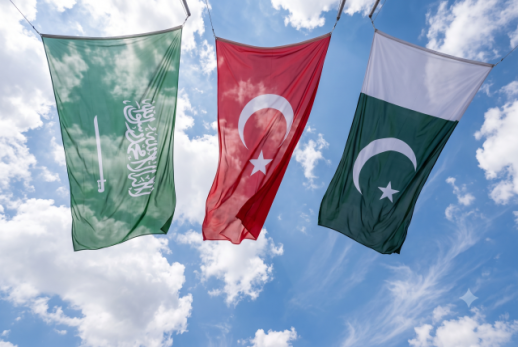 Mecca defense pact buries American security guarantee Saudi Arabia, Türkiye and Pakistan signed a treaty last week promising to defend each other if any one of them is attacked. That is the promise the United States has been making to these countries for decades. The Makkah Joint Defence Agreement was signed on Aug. 7 at Al-Safa Palace in Mecca by Saudi Crown Prince Mohammed bin Salman, Turkish President Recep Tayyip Erdoğan and Pakistani Prime Minister Shehbaz Sharif. The joint statement says an attack on one "shall be regarded as an attack against them all." That one sentence is nearly all we know. The three governments have not published the treaty text. There is no joint command, no rule for how new members join, no agreement on stationing troops in each other's countries. To see why these three signed, start with what happened in Doha last year. Israeli aircraft bombed a Hamas delegation in the Qatari capital on Sept. 9, 2025, killing five Hamas members and a Qatari security officer. The group was reading an American ceasefire proposal at the time. It was the first time Israel had struck Qatar. Qatar hosts Al Udeid, the biggest US military base in the region. The White House said the bombing "does not advance Israel or America's goals," and said the US military had told President Donald Trump it was coming. Washington knew, and did nothing. Eight days later, Saudi Arabia and Pakistan signed their own mutual defense agreement in Riyadh. Eleven months after that, Türkiye joined them in Mecca. One sentence and three signatures do not sound like much. But that is about all NATO was in April 1949. The joint commands and permanent headquarters took another ten years to build. The question everyone is asking is who this pact is meant to stop. None of the three will say. Erdoğan wrote on X that the deal rests on "collective deterrence" and that Türkiye still wants to solve problems through talks. Sharif called it a "historic endeavour" for the region's security. The other two went further. Saudi deputy minister for public diplomacy Rayed Krimly wrote that the agreement is not meant to build a military bloc or a religious one, and has nothing to do with nuclear weapons or an arms race. Pakistani Deputy Prime Minister and Foreign Minister Ishaq Dar wrote that the pact is purely defensive and "not targeted against any country." Nobody denies things that nobody has accused them of. The reason the three governments will not name an enemy is simpler than diplomacy. Each of them is worried about a different country. For Türkiye, that country is Israel, and this is not guesswork. At a cabinet meeting on Feb. 22, Netanyahu described a "hexagon" of alliances Israel would build against what he called a radical Shia axis and an emerging radical Sunni axis. He named India, Greece, Cyprus, and unnamed Arab, African and Asian states. Former Israeli prime minister Naftali Bennett had already told a conference that "a new Turkish threat is emerging," and that Israel needs to act against Türkiye at the same time as Iran. In July, Netanyahu lobbied in Washington against selling F-35 fighter jets to Türkiye, telling reporters the country "is governed by a man who calls openly for the annihilation of Israel." Turkish Foreign Minister Hakan Fidan has said Israel is deliberately turning Türkiye into its next enemy. Whatever else is true, Ankara did not start this fight and did not start it this year. Saudi Arabia is worried about something else. Since the Iran war began with American and Israeli strikes on Feb. 28, Iranian missiles and drones have hit targets across the kingdom, including oil refineries, killing two civilians and wounding 12. A Houthi strike set the Jizan refinery on fire on July 25. Riyadh has also never recognized Israel, and it was negotiating over doing so before the Gaza war. Yoel Guzansky, who runs Gulf research at Israel's Institute for National Security Studies, has said the new pact does not completely close that door. Pakistan has said both things, through the same man. In a television interview in September 2025, Defense Minister Khawaja Asif was asked whether the deterrence Pakistan gets from nuclear weapons would be extended to Saudi Arabia. What Pakistan has, he answered, would be made available under the agreement. He took it back within days, saying nuclear weapons were not on the radar. Asked about it at a weekly press briefing, Foreign Office spokesman Shafqat Ali Khan would say only that Pakistan's nuclear doctrine has evolved and continues to do so. Then, one day after the Mecca treaty, Asif called for a united military front against Israel, which he called a threat to the whole Muslim world. His own foreign minister had just said the pact targets nobody. So this is not three countries building an anti-Israel bloc. It is three countries facing three different threats who reached the same conclusion about the same protector. Israel's actions are what pushed that conclusion into the open. Doha is where it became impossible to ignore. If an American ally country hosting roughly 10,000 American troops can be bombed by another American ally, with Washington told in advance and doing nothing, then the American guarantee is a favor rather than a commitment. Riyadh worked that out in eight days. Ankara worked it out over a year of Israeli politicians calling it the next target. Pakistan has been hedging for decades. Whether this treaty turns into a real alliance is something we can check. Watch for the Turkish parliament ratifying it, for the text being published, for rules on new members, for a joint planning staff, for combined air and missile defense drills. The practical obstacles are large. Saudi Arabia flies American equipment, Pakistan flies Chinese and domestic equipment, Türkiye flies NATO and Turkish equipment. Their systems cannot talk to each other, and none of the three keeps supplies stored in the others' countries. There is also a precedent for this kind of promise not being kept. In April 2015, when Saudi Arabia and Pakistan were as close as they have ever been, Pakistan's parliament voted unanimously to stay out of the Yemen war instead of sending the combat troops Riyadh asked for. 2026-08-10 14:40:38
-
 KAIST president unveils AI native campus vision SEOUL, August 10 (AJP) - Artificial intelligence will run through teaching, research, administration and campus energy systems at the Korea Advanced Institute of Science and Technology under a plan its new president set out Monday, one that treats AI as a shared tool for every field of study rather than the property of specialists. Bae Choong-sik presented the plan at his inauguration as the 18th president of the Korea Advanced Institute of Science and Technology (KAIST), held at the university's main auditorium. He took office on July 1 and used the ceremony to declare a new institutional vision, "Fundamentals First, Innovation Forward," ahead of the university's 60th anniversary in 2031. Deputy Prime Minister and Minister of Science and ICT Bae Kyung-hoon attended, along with former president Lee Kwang-hyung and ambassadors posted to Seoul. The changes fall under five strategies KAIST calls the Beyond Series: Beyond AI, Beyond Laboratory, Beyond Barriers, Beyond Carbon and Beyond KAIST. The first commits the university to a curriculum rebuilt around AI use. Every course will carry an AI use grade, sorted into three levels that run from foundational teaching conducted without AI at all to courses in which students design AI systems. Undergraduate humanities and social science teaching will expand, as will laboratory practice. "Designing learning around AI, not simply transmitting knowledge, is the beginning of AX educational innovation," Bae said, using an abbreviation for AI transformation. Research will move toward physical AI, meaning systems that act in the world through robots, self-driving vehicles and advanced manufacturing, alongside quantum technology and climate and energy research. KAIST plans to bring more corporate satellite laboratories onto campus, following its recent cooperation with Nvidia, and to build an AI Autonomous Lab that folds AI into joint research with companies. Startup education will reach first-year students for the first time, taught with founders drawn from the alumni network. Bae said technology companies started by KAIST graduates now hold combined assets of more than 100 trillion won. Administration will be rebuilt on AI tools, with internal regulations cut and incentives offered to staff who lead the change. The campus itself becomes a living lab for climate and energy technology, with building energy systems linked through an AI model developed with the university's climate and energy research institute. International work expands through dual degree programs, overseas scholars on dissertation committees and a global advisory group, under a program KAIST calls Global Connect. The ceremony departed from the usual form. Rather than deliver a conventional address, Bae explained the strategies himself in a staged presentation directed by Kang Yi-yeon, a professor in KAIST's Department of Industrial Design. Three speakers followed with working examples, covering digital twins in shipbuilding, AI in chip production and physical AI in cars and robots. Bae is a specialist in clean energy and carbon-neutral power engineering. He earned bachelor's and master's degrees in aerospace engineering at Seoul National University and a doctorate in mechanical engineering at Imperial College London in 1994. He joined KAIST in 1998 and later headed the School of Mechanical and Aerospace Engineering and served as dean of the College of Engineering. He chairs the sustainable combustion technology collaboration program at the International Energy Agency and was the first South Korean named a fellow of SAE International in the powertrain field. "I will develop KAIST into a university that creates new standards beyond innovation, and into a national innovation platform leading the future of South Korean science and technology," he said. 2026-08-10 13:40:18