

Journalist
Park Sae-jin박세진
swatchsjp@ajupress.com
Assistant EditorForeign embassies in Seoul & Geopolitics, Diplomacy, Policy
Experienced journalist and editor at AJU PRESS specializing in multilingual news. I cover international diplomacy, geolpolitics, and policy, consistently delivering highly accurate, compelling reporting for a worldwide audience.
"Reporting the facts. Shaping the narrative. Every second counts."
Latest by Park Sae-jin
-
 Seoul expands draft evader data disclosure to mirror sex offender registries SEOUL, June 16 (AJP) - South Korea's Military Manpower Administration expanded the public disclosure of personal information for military draft evaders, applying measures similar to the country's sex offender registries to enforce conscription compliance. According to South Korean conscription laws, all able-bodied men must serve in the armed forces. Because of this universal mandate, draft evasion remains a highly sensitive social issue where those who dodge the draft face severe public backlash for betraying a shared civic duty. The public pressure surrounding conscription is so intense that all seven members of the K-pop group BTS enlisted for military duty. The members initiated their mandatory service to rid themselves of ongoing national controversies and political debates regarding whether global pop stars should receive draft exemptions. Focusing heavily on public accountability, the administration's expanded disclosure policy now includes specific building numbers for the residential addresses of draft evaders. For individuals who violate overseas travel regulations to avoid military service, their destination countries will also be published. The government previously limited the public release to six basic categories, including names, ages, and general addresses. The level of detail in the updated policy closely aligns with the strict information release protocols used for serious crimes. Court-ordered public registries for convicted sex offenders mandate the release of eight specific categories, including names, ages, exact building numbers, physical dimensions, photographs, and criminal summaries. To further deter draft evasion before it occurs, the administration deployed a kiosk-based electronic facial recognition system for all conscription physical examinations. The new biometric technology replaces the previous administrative method of visually matching individuals to their identification card photographs. The Military Manpower Administration framed the enforcement upgrades as a major achievement in restoring fairness and reliability to the mandatory draft system. The agency noted these policy shifts mark a key milestone during the first year of the Lee Jae-myung administration. 2026-06-16 14:27:15
-
 Kookmin University partners with FISU to launch sports master's program SEOUL, June 16 (AJP) - Kookmin University has signed an agreement with the International University Sports Federation (FISU) to operate a new graduate-level master's degree program focused on global sports education. The partnership aims to cultivate professionals in the international sports sector, Kookmin University said Tuesday. The agreement was signed Monday, June 15, 2026, at the university campus in Seoul, South Korea. Officials from both organizations attended the ceremony, including Kookmin University Foundation Chairman Kim Ji-yong, Kookmin University President Chung Seung-ryul, FISU Secretary General Matthias Remund, and FISU representative Delise O'Meally. Following the signing, the university's physical education college led a working-level meeting to discuss the implementation of the FISU Master's program. FISU is the governing body for international university sports and organizes major global events such as the World University Games, the World University Championships, and the World University Cups. The biennial World University Games draw about 10,000 participants from more than 160 countries during the summer, and approximately 2,500 participants from over 60 countries for the winter edition. Kookmin University, which operates the only independent physical education college among universities in Seoul, plans to use this partnership to expand its international sports education network. The new program is designed to provide students with global learning opportunities by combining academic theory with practical experience in international sports administration. "This business agreement is a meaningful starting point that expands the intersection of international university sports and higher education, beyond simple cooperation between institutions," Kookmin University President Chung Seung-ryul said. "We expect that the educational capabilities of Kookmin University and the global platform of FISU will meet to create synergy in nurturing talent who will lead the future sports field." 2026-06-16 14:21:45
-
 Korea household debt ratio falls to 6-year low on high nominal GDP SEOUL, June 16 (AJP) - South Korea's household debt-to-gross domestic product ratio dropped to its lowest level in over six years at the end of last year, according to the Bank for International Settlements on Tuesday. While the financial industry attributes the decline to tighter lending rules, the shift was driven more by a surge in nominal economic growth than by a pure reduction in borrowing. Data by the Bank for International Settlements (BIS) showed that the ratio reached 88.6 percent in the fourth quarter, dropping 0.8 percentage points from the previous three months. It is the lowest figure recorded since the third quarter of 2019. The household debt metric hit a high of 99.1 percent in late 2021 and hovered just below 90 percent for most of last year. Financial regulators have worked to limit new loans, but the sudden drop in the percentage is largely a statistical result of an expanding economic denominator. Because the ratio measures total household debt against the size of the broader economy, a higher gross domestic product naturally shrinks the headline debt figure. South Korea's nominal output has been expanding rapidly, hitting a 17.1 percent year-on-year increase in the first quarter. It marks the sharpest growth since 1995, leading analysts to expect further mathematical declines in the debt ratio even if the actual volume of debt remains high. Government debt metrics showed a similar trend due to the expanding economy. The sovereign debt-to-gross domestic product ratio declined by an unprecedented 2.0 percentage points in the fourth quarter to 45.7 percent, although it remains above the 43.6 percent logged at the end of 2024. The central bank and financial authorities have set a long-term goal to bring the household debt ratio below 80 percent. Bank of Korea Governor Shin Hyun-song discussed the changing metrics at an international conference earlier this month. "The nominal gross domestic product growth rate seems to be very high, which will have a quite beneficial effect on the household and public debt-to-gross domestic product ratios," Shin said. 2026-06-16 13:36:36
-
 New liquid cooling system cuts AI data center power use by 90 percent SEOUL, June 16 (AJP) - Researchers in South Korea have developed a method to carve tiny water channels directly into computer chips, creating a liquid cooling system that reduces the power needed to cool artificial intelligence data centers by 90 percent, the Korea Advanced Institute of Science and Technology said Tuesday. As artificial intelligence programs become more advanced, the computer chips that run them generate massive amounts of heat. Traditional air-cooling methods using fans and air conditioners are no longer enough to keep these systems from overheating. To solve this, a joint research team, led by the Korea Advanced Institute of Science and Technology (KAIST)'s Professor Kim Sung-jin and Professor Lee Ik-jin, designed a highly efficient technique to flow water directly inside the chips to absorb heat. The new technology involves etching microscopic pathways, which are thinner than a human hair, into the silicon of the semiconductor. By dividing the water into multiple short paths rather than pumping it through one long channel, the system works like a local delivery network. This setup significantly reduces the distance the water has to travel, which drastically lowers the energy required to pump it through the chip. During testing, the team achieved an efficiency level that was more than 10 times higher than the previous world record set in 2020. The system removes heat using ordinary, room-temperature water and does not require expensive materials or complex cooling chemicals. Because the channels can be carved using standard manufacturing processes, the technology can be adopted by chip makers without requiring massive investments in new equipment. While the initial tests were conducted on a small test chip, the researchers noted the same design could be scaled up for the large, high-performance chips used in modern data centers. The technology has already demonstrated a 30 percent improvement in cooling performance when applied to standard data center cooling plates. "In the AI era, how effectively heat is controlled is more of a competitive edge than semiconductor performance," Professor Kim said, adding: "We expect this technology to be utilized as a core technology to reduce power consumption in AI data centers." (Reference Information) Journal/Source: Energy Conversion and Management Title: Highly energy-efficient manifold microchannel for cooling electronics with a coefficient of performance over 100,000 Link/DOI: https://doi.org/10.1016/j.enconman.2026.121422 2026-06-16 11:13:59
-
 South Korea's national museum forges partnership with Italy's Uffizi Gallery SEOUL, June 15 (AJP) - To spread the value of their cultural heritage and increase mutual understanding, the National Museum of Korea and Italy's Uffizi Gallery have signed an agreement to exchange exhibitions and staff, Korea's iconic museum said Sunday. According to the National Museum of Korea's statement, its Director Yoo Hong-jun and Uffizi Gallery's Director Simone Verde signed the agreement in Florence, Italy, on Saturday. The two museums will work together on sharing art, educational programs, and restoring historical pieces. This partnership follows South Korean President Lee Jae Myung's state visit to Italy. The Uffizi Gallery is famous for its Renaissance art, holding masterpieces by Leonardo da Vinci and Sandro Botticelli. The iconic South Korean museum plans to use this new partnership to bring some of these famous works to Seoul for local audiences. The agreement comes at a time when the main state-operated museum is seeing record-breaking popularity. The museum welcomed 3,255,160 visitors between January and May of this year, which is a 45.2 percent increase from the same period last year. Foreign visitor numbers also jumped 57.8 percent during this time, reaching 122,024 people. Experts believe the museum could reach 7 million total visitors this year, easily passing last year's record of 6.5 million. This steady growth is driven by popular special exhibitions and new programs that draw larger crowds, including families and international tourists. Before signing the agreement, the two directors met on June 12 to discuss bringing Italian masterpieces to Seoul. "Our museum has been holding special exhibitions every year to introduce collections from world-class museums," Yoo said, adding: "We hope to be able to introduce masterpieces from the Uffizi Gallery, such as Botticelli, in South Korea." In response, Verde noted the growing global influence of South Korean culture. "I want to introduce the Uffizi Gallery's collection in South Korea," Verde said. "This agreement is very meaningful because the National Museum of Korea and the Uffizi Gallery have taken their first step towards cooperation," Yoo said. "I look forward to continuing substantive exchange in various fields, such as exhibition, research, and education, based on the academic capabilities and collections that both institutions have accumulated." 2026-06-15 15:58:27
-
 South Korean researchers technique to transfer nano circuits using water SEOUL, June 15 (AJP) - Researchers in South Korea have developed a technique to transfer microscopic electronic circuits onto delicate surfaces by floating metal components on water. This opens new possibilities for wearable devices and biological sensors, the Korea Advanced Institute of Science and Technology said Monday. The technique, called water-floated nanotransfer printing, removes the need for heat, pressure, toxic chemical solvents, or adhesives. This allows the circuits to be applied to biological tissues or complex shapes that would normally be damaged by traditional methods. The research was led by the Korea Advanced Institute of Science and Technology (KAIST)'s Professor Park In-kyu, in collaboration with Dr. Jung Jun-ho from the Korea Institute of Machinery and Materials (KIMM) and Professor Ahn Jun-sung from Korea University. To create the floating circuits, the research team places an extremely thin layer of metal, such as gold or platinum, onto a polymer template. They use an ionized gas plasma to remove specific parts of the template. When placed in water, the liquid moves into small gaps, allowing a 20-nanometer-thick metal film to separate and float on the surface while keeping its shape. The circuits are transferred by dipping an object under the floating metal film and slowly scooping it up. As the water dries, the physical force of the liquid pulls the circuit tightly against the object, and natural molecular attraction keeps it attached without glue. The team also used the method on water-repellent surfaces, such as lotus leaves, by adding a small amount of ethanol to lower the surface tension of the water. The researchers tested the technology by creating sensors directly on lemons and oranges to detect small amounts of a pesticide. They also moved a metal mesh onto stretchable fibers to create a wearable gas sensor. The study, with KAIST doctoral candidate Kang Byung-ho as the lead author, was published in the journal Nature Communications on March 30, 2026. "This technology is significant because it overcomes the substrate limitations of existing nanotransfer printing, allowing nano patterns to be transferred to sensitive surfaces like living plant leaves or skin without adhesives or heat," Professor Park In-kyu said. "It can be utilized in various fields, from smart agriculture that measures pesticides without damaging crops to wearable health monitoring devices, bioelectronics, and next-generation robotic electronic skin, and is expected to develop into a core platform technology for wearable sensors and bioelectronics in the future." (Reference Information) Journal/Source: Nature Communications Title: Versatile water-floated nanostructures for three-dimensional nanotransfer printing Link/DOI: https://bit.ly/4e9s0h5 2026-06-15 15:31:53
-
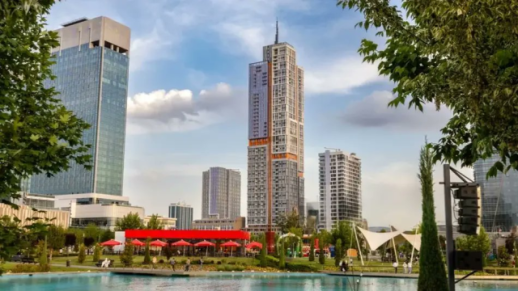 Uzbekistan hosts Tashkent International Investment Forum SEOUL, June 12 (AJP) - Uzbekistan will host the fifth Tashkent International Investment Forum from June 16 to 19 as the country establishes itself as the primary economic and investment hub for Central Asia, the Embassy of Uzbekistan in the Republic of Korea said Friday. The four-day event serves as a sustainable mechanism to transition high-level political dialogue into concrete commercial solutions and cross-border cooperation. The upcoming gathering aims to expand upon the framework of the previous session, which drew more than 8,000 delegates from 97 countries. That event concluded with signed business agreements totaling 30.5 billion US dollars, representing one of the largest outcomes among regional investment platforms. The program features a plenary session with heads of state alongside panel sessions, thematic pitch presentations, and an expanded exhibition showcasing national industrial potential. Organizers have structured dedicated business-to-business and business-to-government meetings to facilitate direct interaction between global financiers and local decision-makers. A unique concentration of political and corporate capital will assemble at the venue, including government leaders from Central Asian and European nations. Major institutional participants include the European Bank for Reconstruction and Development, the European Investment Bank, the Asian Development Bank, and the International Finance Corporation. International financial leaders noted that ongoing domestic regulatory adjustments have significantly strengthened corporate confidence in the local market. Nobumitsu Hayashi, the governor of the Japan Bank for International Cooperation, stated that the economic reforms are creating a predictable and attractive environment for long-term investments. The economic diversification efforts coincide with the strategic integration of the country into international capital markets. Wang Bo, the chairman of the Chinese company CAMCE, stated that the developing economy represents a unique opportunity for foreign investors, particularly in light of the World Trade Organization accession process. 2026-06-12 22:52:00
-
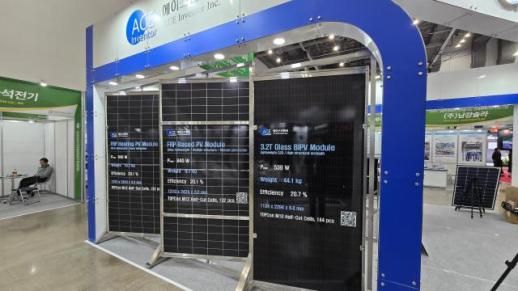 Sookmyung Women's University startup develops ultra-lightweight, snow-melting solar panels SEOUL, June 11 (AJP) - A technology startup founded by a mechanical engineering professor at Sookmyung Women's University has developed and commercialized a new line of lightweight solar modules designed to melt snow and integrate seamlessly into electric vehicles. The prominent university in Seoul said Thursday. ACE Inventor, founded by Joung Young-soo, a professor at Sookmyung Women's University's School of Mechanical Systems Engineering, has been receiving research and development support from the university since 2017. The startup is currently building a mass-production system capable of combining multiple cells into large-area modules measuring up to 3.75 (2.5m x 1.5m) square meters. Once operational, the facility is expected to produce up to 50 megawatts of the lightweight solar modules annually. The company has also secured funding from several South Korean government initiatives, including the Ministry of SMEs and Startups. Traditional solar panels rely on thick glass covers to protect the internal solar cells, making them heavy, rigid, and prone to shattering. The heaviness of the panels limits where they can be installed, often making the solar panel structure difficult to be put on older buildings, large logistics warehouses, or curved architectural structures that cannot support heavy loads. ACE Inventor replaced the standard glass with a specialized fiber-reinforced plastic (FRP). This material reduces the total weight of the solar panel by up to 70 percent while providing the flexibility to bend around curved surfaces. One of the company's primary products is an FRP solar module equipped with an internal heating film. In regions that experience heavy snowfall, winter weather poses two major problems for solar energy generation. First, accumulated snow physically blocks sunlight, halting electricity production entirely. Second, the sheer weight of heavy snow combined with heavy glass solar panels frequently causes the roofs of agricultural greenhouses, barns, and older factories to collapse. The heating module can be operated in freezing or snow-accumulation conditions to raise the panel's surface temperature. This melts the snow before it can accumulate into a dangerous, light-blocking hazard. Because the system clears the panels efficiently using minimal power, it restores power generation quickly during winter months and prevents costly structural damage to vulnerable agricultural and industrial buildings. The company also introduced a vehicle-integrated photovoltaic (VIPV) sunroof module aimed at the electric vehicle market. Range anxiety remains a significant hurdle for electric vehicle adoption, and adding solar panels to a car's roof, hood, or trunk can provide auxiliary power to extend driving range. However, traditional glass panels add significant weight to the vehicle, which paradoxically drains the battery faster. "In the electric vehicle era, vehicle weight and energy efficiency are directly linked to driving range, making lightweight and safe automotive modules a core technology for the future mobility market," ACE Inventor's chief executive Professor Joung Young-soo said. The new FRP automotive module weighs approximately 2.8 kilograms, which is more than 70 percent lighter than traditional double-sided glass modules. Its flexible nature allows it to mold seamlessly to the aerodynamic curves of modern car roofs. Because it contains no glass, it also eliminates the risk of dangerous glass shards scattering in the event of a traffic collision. "The modules released this time are a meaningful case where original technologies from the laboratory met the university's startup support system and led to actual product launches," Joung said, adding: "Moving forward, we will lead the market for domestic aging industrial facilities and zero-energy buildings, and expand into the global mobility market and heavy snowfall regions to write a success story as a university-originated deep tech company." 2026-06-11 16:44:20
-
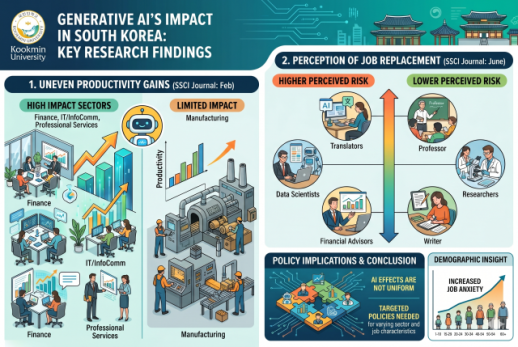 Studies reveal uneven productivity gains and job anxiety from generative AI in S. Korea SEOUL, June 11 (AJP) - Kookmin University International Business School (KIBS)'s Professor Oh Eun-young has published two research papers analyzing the varying impacts of generative artificial intelligence (AI) on industrial productivity and occupational replacement in South Korea, Kookmin University said Wednesday. The studies, published in international academic journals in February and June, examine how the adoption of AI technologies affects different sectors and how the public perceives the threat of job displacement. The research indicates that the effects of generative AI are determined by industrial structures and job characteristics rather than applying uniformly across the economy. The first paper analyzed productivity changes following the spread of generative AI. The research found that early productivity gains were concentrated in finance, information and communications, and professional services. In contrast, the manufacturing sector experienced limited changes, suggesting that the initial economic benefits of AI are more prominent in specific service-oriented industries. The second paper assessed public perceptions of job replacement by AI tools like ChatGPT. The survey indicated that South Koreans believe translators, data scientists, and financial advisors face a high likelihood of replacement. Meanwhile, professions such as professors, researchers, and writers were viewed as less vulnerable to AI substitution. The study also noted that older individuals experience greater overall job anxiety related to the technology. "Generative AI is an important technology that can increase productivity across the economy, but its effects do not appear equally in all industries and professions," Oh said. "In order to spread the benefits of AI technology more widely and respond to changes in the labor market, policy discussions that consider the characteristics of each industry and profession are necessary." 2026-06-11 06:56:44
-
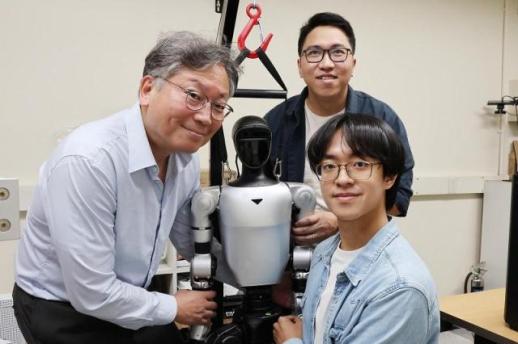 KAIST researchers teach robots human judgment using short videos SEOUL, June 10 (AJP) - Researchers in South Korea have built an artificial intelligence system that allows robots and self-driving cars to figure out human intentions just by watching a handful of videos. The new method heavily cuts down the amount of data needed to train these machines, the Korea Advanced Institute of Science and Technology said Wednesday. A research team led by Professor Yoo Chang-dong at the Korea Advanced Institute of Science and Technology (KAIST)'s electrical engineering department designed the framework, called Video-based Optimal TransPort Preference (VOTP). The technology lets smart machines learn how to make the right choices without needing a person to manually grade thousands of different actions. Instead of relying on massive datasets, the method only requires someone to provide about 10 short video clips showing both good and bad ways to complete a task. The system then uses a mathematical method called optimal transport to track tiny differences in movement. From there, it automatically guesses what humans would prefer in thousands of other situations, setting up virtual rewards to steer the machine. This setup mimics how people learn to do new things by simply watching a few examples. Physical AI systems, like factory robots, self-driving cars, and medical equipment, need strict guidelines to choose the safest actions in complicated environments. Until now, creating those guidelines meant having workers spend countless hours evaluating robot behaviors one by one. Some developers previously tried using text-based language models to speed up this grading process, but trying to describe highly specific mechanical movements with words often failed. The research team noted that their video-based approach works well for robotic arms, humanoid robots, drones, and software that controls computer screens. The study was picked for an oral presentation at the International Conference on Machine Learning (ICML) 2026, which will take place in Seoul in July 2026. The paper, authored by Tung Minh Luu, Kim Hwan-hee, Lee Young-hwan, and Chang D. Yoo (Yoo Chang-dong), ranked in the top 0.7 percent of the 23,918 submissions the conference received. "The core of physical AI is making machines understand human intent and select the correct actions," Yoo said. "VOTP can learn human judgment criteria from a small number of videos, and it is a core technology that will advance the era of robots making human-like judgments." 2026-06-10 10:54:44