

Journalist

Ryu Yuna류윤아
Julia37@ajupress.com
ReporterFinancial Supervisory Service (FSS) & finance, capital markets, Southeast Asian affairs
Yuna Ryu covers finance, capital markets and Southeast Asian affairs.
She is drawn to the questions that numbers raise and the stories that data alone cannot answer.
Prior to journalism, she worked at Hyundai Motor Company and the Singapore Chamber of Commerce, focusing on business strategy and international affairs. She has also hosted diplomatic receptions and international conferences as an MC.
Ryu holds a master's degree in Media and Communication from Korea University, where her research focused on neuroscience-based studies of media effects. "Beyond every statistic is a human story waiting to be heard."
She is drawn to the questions that numbers raise and the stories that data alone cannot answer.
Prior to journalism, she worked at Hyundai Motor Company and the Singapore Chamber of Commerce, focusing on business strategy and international affairs. She has also hosted diplomatic receptions and international conferences as an MC.
Ryu holds a master's degree in Media and Communication from Korea University, where her research focused on neuroscience-based studies of media effects. "Beyond every statistic is a human story waiting to be heard."
Latest by Ryu Yuna
-
 PARU extends rally after share consolidation SEOUL, August 28 (AJP) - South Korean renewable energy company PARU surged for a second straight session Friday after trading resumed following a two-for-one share consolidation. Shares of PARU closed 10.82 percent higher at 1,475 won ($1.08) on the KOSDAQ on Friday, after rising as high as 1,630 won in early trading. The gains followed a 29.98 percent surge Thursday, when the stock hit its daily upper limit on the first session after trading resumed. According to a regulatory filing on DART, trading resumed Thursday after the company completed the listing procedures related to the consolidation. PARU consolidated every two common shares into one, raising the face value of each share to 1,000 won from 500 won and reducing the number of issued shares to 20.90 million from 41.80 million. The company said the move was aimed at stabilizing its share price and enhancing shareholder value. Trading had been suspended since Aug. 4 while the consolidation process was completed. PARU, founded in 1993, develops renewable energy equipment and printed electronics technologies. Its solar business includes tracking systems that adjust the position of solar panels to follow the sun and improve power generation efficiency. The company has spent more than three decades developing technologies in renewable energy and related fields. It has expanded its business both at home and overseas, drawing on experience in clean energy projects and advanced manufacturing technologies. PARU said it aims to strengthen its renewable energy business while pursuing new technologies focused on cleaner energy and improved efficiency. The company has also emphasized responsible management and environmental, social and governance practices as part of its long-term growth strategy. AJP Takeaways • PARU closed 10.82 percent higher Friday, extending its rally to a second session after trading resumed following a share consolidation. • The company combined every two common shares into one, halving the number of issued shares to 20.90 million while raising the face value per share to 1,000 won. • Founded in 1993, PARU develops renewable energy and printed electronics technologies, including solar tracking systems designed to improve power generation efficiency. 2026-08-28 17:37:51
 -
 Is KOSPI party over, or moving to Wall Street? SEOUL, August 28 (AJP) — South Korea's stock-market party is thinning fast. Average daily trading across the country's two equity platforms has nearly halved from June's 99.39 trillion won ($72.2 billion), cash parked in brokerage accounts has retreated sharply from its peak and the KOSPI's share turnover has sunk to the lowest level this year. Yet the missing activity does not look like a wholesale flight from Korean equities. Foreign investors still own nearly 40 percent of the KOSPI by market value, only modestly below their share near the June peak. Korean investors, meanwhile, were already deeply invested abroad before the latest slowdown and now hold more than $185 billion in U.S. stocks alone. An analyst at a South Korean brokerage said the recent increase in overseas investment does not necessarily indicate a structural shift away from the domestic market. “We have continued to see money move back and forth between Korean and overseas stocks,” he said. “At this point, it looks more like rotation within the market. Retail investors are very sensitive to returns, and recent volatility in the Korean market has also played a role.” The emerging picture, then, is less one of a party abruptly ending than of the KOSPI moving from a speculative frenzy into a plateau around 7,000, while Korean investors spread more of their money between Seoul and Wall Street. The change in market velocity is unmistakable. With investors able to trade Korean stocks on both the Korea Exchange (KRX) and alternative trading platform Nextrade (NXT), combined average daily trading value fell from 99.39 trillion won in June to 66.25 trillion won in July and 50.74 trillion won from Aug. 3 through Thursday. That represents a 48.9 percent decline from red-hot June. The fall cannot be explained by investors simply shifting trades from the KRX to NXT. Average daily turnover on the KRX dropped 46.5 percent to 32.28 trillion won this month from 60.36 trillion won in June, while NXT turnover fell 52.7 percent to 18.46 trillion won from 39.03 trillion won. The contrast becomes even starker against individual days near the height of the rally. The KOSPI closed at 9,052.42 on June 19 after touching an intraday record of 9,385.59. Trading value reached about 67.26 trillion won that day. By Thursday, when the index closed at 6,912.37, KOSPI turnover was just 22.5 trillion won — roughly one-third of the June 19 level. Market participation indicators tell much the same story. The average daily turnover ratio of KOSPI-listed shares fell to 0.54 percent from Aug. 1 through Aug. 26, the lowest this year. The ratio had risen from 0.86 percent in January to 1.74 percent in March before retreating to 1.13 percent in May, 0.81 percent in June and 0.72 percent in July. Retail trading has cooled almost as quickly. Average daily trading value by individual investors on KRX markets fell to 24.05 trillion won through Thursday from 46.77 trillion won in June, a 48.6 percent drop. Cash waiting for the next trade is also disappearing. Investor deposits at brokerage firms, a widely followed gauge of money available to buy stocks, approached 140 trillion won on June 4 as the KOSPI raced through successive milestones. The balance had fallen to 98.92 trillion won as of Aug. 26, nearly 30 percent below the June peak. Comparable data put the balance at about 102.5 trillion won on Aug. 25, after dipping into the 97 trillion won range earlier in August. The shrinking pool of trading cash is important because it suggests the slowdown is broader than investors merely waiting for a better entry point while keeping their money inside securities accounts. Still, Wall Street cannot account for all the missing money. Korean investors' U.S. stock holdings reached $185.6 billion as of Aug. 24, up 8.3 percent from $163.6 billion a month earlier, according to Korea Securities Depository (KSD) data. Net buying has also revived. Korean investors returned to net purchases of U.S. equities worth about $633 million in June after selling in April and May, before purchases surged to $4.64 billion in July. Recent buying has remained aggressive, particularly in technology and semiconductor-related assets. Leveraged semiconductor exchange-traded funds, memory-chip investments and major U.S. technology companies have ranked among the most heavily purchased securities. The analyst also pointed to the exchange rate as another factor supporting overseas investment. “Investors who had been concerned about the exchange rate are feeling less burdened about investing overseas as the won has strengthened,” he said. The currency has appreciated into the 1,370-per-dollar range from above 1,400 earlier this month, reducing the amount of won Korean investors need to acquire the dollars required for U.S. investments. The scale of Korea's overseas portfolio is already far larger than the latest monthly flows suggest. Bank of Korea data show Korean residents held a record $3.08 trillion in external financial assets at the end of June. Securities investments alone amounted to $1.38 trillion, up $142.7 billion during the second quarter as overseas equity markets rallied. The BOK's June balance-of-payments financial account also captured the two-way movement of capital. Net financial assets increased by a record $46.71 billion during the month. Korean residents increased overseas portfolio assets by $3.56 billion overall, with overseas equity investment rising $7.53 billion. Foreign portfolio investment in Korea, by contrast, decreased by $26.32 billion, including a record $31.61 billion decline in foreign investment in Korean stocks. Large foreign selling flows, however, have not translated into anything resembling foreign abandonment of the Korean market. Foreign investors' share of KOSPI market capitalization stood at about 39.49 percent in the latest reading, compared with a peak of 41.58 percent in late June. Foreigners therefore remain enormous owners of Korean stocks even after months of net selling. Earlier in August, their market-cap share was still around 39 percent despite cumulative selling that had exceeded 160 trillion won during the year. The distinction between flow and stock helps explain what is happening. Foreign investors have taken profits and reduced positions, but they have not deserted the KOSPI. Korean retail investors are trading far less at home and buying more U.S. stocks, but the increase in Wall Street purchases is nowhere near large enough to explain the entire collapse in Seoul turnover or brokerage deposits. The investor who appears to be leaving fastest is therefore the marginal trader — the investor who chased momentum, traded frequently or kept large sums immediately available during the extraordinary climb toward 9,000. The underlying pool of capital remains much larger and more patient. The KOSPI itself reflects the transition. Thursday's 6,912.37 close was 23.6 percent below its June 19 close and more than 26 percent below the record intraday high, but it was also about 22 percent above the July 29 close of 5,663.24. Instead of continuing either the June melt-up or July collapse, the index has increasingly gravitated toward the high-6,000 range, repeatedly approaching 7,000 without decisively breaking through it. The next test may therefore be less about whether Korean investors have fallen out of love with stocks than whether the KOSPI can attract enough fresh money to escape its new plateau. A sustained move above 7,000 accompanied by recovering turnover, rising investor deposits and broader foreign buying would suggest the party has merely taken an intermission. Another run at 7,000 on thin volume would tell a different story. The music may still be playing in Seoul, but many of the partygoers are no longer dancing — and a growing number are keeping Wall Street within walking distance. AJP Takeaways • KOSPI trading activity has nearly halved from June, with combined average daily turnover on the KRX and Nextrade falling 48.9 percent as South Korea's stock-market frenzy cools. • Korean investors are increasing U.S. equity exposure, with U.S. stock holdings reaching $185.6 billion in August and July net purchases surging to $4.64 billion. • Foreign investors have sold heavily but have not abandoned South Korea, retaining about 39.5 percent of KOSPI market capitalization compared with roughly 41.6 percent near the June peak. • The KOSPI increasingly looks to be forming a plateau around 7,000, leaving trading volume, brokerage deposits and foreign inflows as key signals for whether Seoul's rally can restart. 2026-08-28 17:04:46
 -
 Genians, SANDS Lab jump on AI cyberattack warning SEOUL, August 28 (AJP) - South Korean cybersecurity stocks surged Friday after more than 100 global technology and security companies warned that AI-powered cyberattacks could become far more widespread and sophisticated in the coming months. Shares of Genians, which provides security software for corporate networks and individual devices, jumped 26.76 percent to 18,330 won as of 10:55 a.m. on the KOSDAQ, after rising as much as 28.56 percent to an intraday high of 18,590 won. SANDS Lab, which specializes in analyzing cyber threats using AI and big data, climbed 12.38 percent to 4,585 won, after surging as much as 26.72 percent to 5,170 won. The rally followed an open letter published Thursday on the website of OpenAI, the U.S. artificial intelligence company behind ChatGPT, and signed by more than 100 companies and organizations, including Anthropic, Google, Microsoft, Amazon Web Services and Oracle. Cybersecurity firms including CrowdStrike and Palo Alto Networks also joined the initiative. The letter called for companies to strengthen existing security tools with AI, continuously test their defenses against emerging threats and share information on cyberattacks. It also urged governments to give hospitals, water utilities and other critical services greater access to AI-powered security tools and support. The push for stronger AI-based defenses put a spotlight on domestic cybersecurity companies with technologies used to protect networks, devices and systems from attacks. Genians is a cybersecurity software company that helps businesses control access to corporate networks and protect devices connected to them. Its products include network access control, zero-trust network access, which requires users and devices to be verified before they can access a network, and endpoint detection and response systems. The company serves more than 5,000 customers across sectors including government, finance and manufacturing. The firm has also examined how hackers are adopting AI. Earlier this month, it reported that North Korean hacking group Kimsuky was using AI tools and exploring ways to use them to develop malware, analyze data and automate parts of cyberattacks. SANDS Lab focuses on cyber threat intelligence, using AI and big data to collect and analyze information on malware and hacking attempts. Its technology is designed to help identify new malware and previously unknown attack methods. It is also a member of the Cyber Threat Alliance, an international cybersecurity group whose members share threat information to help detect and respond to attacks. AJP Takeaways • Genians shares jumped 26.76 percent to 18,330 won as of 10:55 a.m. Friday, while SANDS Lab rose 12.38 percent to 4,585 won. • More than 100 companies and organizations, including OpenAI, Google, Microsoft and major cybersecurity firms, warned that AI-powered cyberattacks could become more widespread and sophisticated in the coming months. • Genians provides network and device security software, while SANDS Lab uses AI and big data to analyze cyber threats and identify new malware and attack methods. 2026-08-28 13:18:02
 -
 KOSPI slips on chip losses despite Nvidia rally SEOUL, August 28 (AJP) — South Korean shares retreated Friday as investors digested the Bank of Korea's back-to-back rate hikes, with losses in major chip and biotech stocks overwhelming the positive spillover from Nvidia's overnight surge. The KOSPI traded at 6,818.87, down 1.29 percent, as of 10:30 a.m. amid broad selling and thin turnover. Losers outnumbered gainers 575 to 294. Foreign investors led the outflows, selling a net 233.5 billion won ($169.1 million). Institutions unloaded 10.4 billion won, while retail investors also turned net sellers with 34.7 billion won in net sales. The retreat followed Thursday's decision by the Bank of Korea (BOK) to raise its benchmark rate by 25 basis points to 3.00 percent, delivering its first back-to-back hikes since January 2023. Higher U.S. Treasury yields and lingering geopolitical uncertainty added to the pressure. U.S.-Iran tensions remained elevated, with Washington keeping its options open and Tehran warning of retaliation. The U.S. 10-year Treasury yield rose 3.0 basis points to 4.6762 percent, while the 30-year yield climbed 2.6 basis points to 5.1931 percent. The weakness in Seoul contrasted with a strong overnight rally on Wall Street, where Nvidia's earnings and sales outlook reinforced expectations for continued artificial intelligence investment. The Dow Jones Industrial Average rose 0.20 percent, the S&P 500 gained 0.72 percent and the Nasdaq Composite jumped 1.57 percent. The Philadelphia Semiconductor Index climbed 2.33 percent, while Nvidia surged 8.74 percent. The enthusiasm failed to carry over into Korean chip shares. About 40 minutes after the opening bell, SK hynix was down 0.75 percent at 1,717,000 won, while Samsung Electronics fell 0.85 percent to 263,750 won. Samsung Electronics preferred shares lost 2.42 percent to 189,600 won, while SK Square declined 1.83 percent to 1,048,500 won. The declines erased part of Thursday's gains, when Korean chipmakers rallied after Nvidia's strong results and outlook strengthened expectations for sustained demand for advanced memory used in AI infrastructure. Elsewhere in technology, Samsung Electro-Mechanics bucked the weakness, rising 2.24 percent to 1,416,000 won. LG Energy Solution fell 1.48 percent to 365,000 won, while Samsung SDI gained 0.53 percent to 572,000 won. Biotechnology shares were among the sharpest decliners. Samsung Biologics plunged 6.15 percent to 1,496,000 won after announcing plans to raise about 3 trillion won through a new share issue. The company said most of the proceeds will be used to acquire PolyPeptide Group, a Swiss drug-ingredient manufacturer, with the remainder going toward expansion of its second biocampus in Songdo. The new shares would increase Samsung Biologics' share count by about 4.9 percent, diluting existing shareholders and weighing on the stock. Automakers proved relatively resilient. Hyundai Motor rose 0.38 percent to 399,500 won and Kia gained 0.16 percent to 126,300 won, while Hyundai Mobis slipped 0.22 percent to 450,000 won. Among industrial and defense shares, Hanwha Aerospace fell 2.43 percent to 1,122,000 won, while Doosan Enerbility rose 0.70 percent to 86,500 won. HD Hyundai Heavy Industries was unchanged at 470,000 won. Financial shares also weakened, with KB Financial down 0.65 percent at 167,000 won and Shinhan Financial falling 0.64 percent to 108,100 won. Samsung Life declined 1.47 percent to 302,500 won. Samsung C&T fell 1.60 percent to 369,500 won, while SK dropped 2.70 percent to 541,000 won. One notable exception was SK Telecom. The stock climbed 2.22 percent to 101,300 won at the open after unveiling a plan to bring in 3.08 trillion won of outside investment to expand its AI data center business. The investment will help finance the expansion while SK Telecom retains a 51 percent stake in the new unit. The stock later pared most of its gains and was up about 0.4 percent. The junior KOSDAQ followed a similar pattern, surrendering an early gain and turning lower. About an hour into trading, the index stood at 833.78, down 0.46 percent, after falling as low as 829.79. Retail investors bought a net 126.5 billion won, while foreign investors sold 103.1 billion won and institutions unloaded 23.5 billion won. Biotech and battery-material stocks were mostly lower. Alteogen slipped 0.16 percent to 311,000 won. Battery-material maker EcoPro BM dropped 2.29 percent to 115,300 won, while parent EcoPro fell 3.04 percent to 89,200 won. Robot maker Rainbow Robotics lost 2.76 percent to 458,000 won. Among semiconductor-equipment shares, Jusung Engineering rose 1.62 percent to 182,000 won. Wonik IPS gained 0.44 percent to 113,200 won and LEENO Industrial climbed 0.60 percent to 67,100 won, while EO Technics fell 1.11 percent to 402,000 won. The Korean won strengthened slightly to 1,379 per dollar as of 10:03 a.m., compared with 1,380.9 in the previous session. Japan's Nikkei 225 added 0.6 percent to 66,524.88. AJP Takeaways • The KOSPI fell 1.29 percent to 6,818.87 as of 10:30 a.m., as investors digested the BOK's back-to-back rate hikes while higher U.S. Treasury yields and geopolitical uncertainty weighed on sentiment. • Samsung Electronics and SK hynix gave back part of Thursday's Nvidia-driven gains despite an 8.74 percent surge in Nvidia and a strong overnight rally in U.S. chip stocks. • Samsung Biologics plunged more than 6 percent after announcing a roughly 3 trillion won share issue, while SK Telecom briefly rallied on a 3.08 trillion won outside investment plan for its AI data center business. 2026-08-28 10:48:35
 -
 Korea's card debt surges on increased borrowing before higher rates SEOUL, August 27 (AJP) - South Korean card and insurance companies earned more in the first half as personal borrowings sought to secondary lenders due to stricter bank regulations, boding badly for household finances with lending rates set to go higher after the central bank's faster-than-expected rate hikes, government data showed Thursday. Credit and debit card purchases totaled 635.3 trillion won in the first half, up from 595.7 trillion won a year earlier, according to the Financial Supervisory Service. The figures cover eight standalone card companies and 11 banks that also issue cards. Borrowing rose much faster. Total card lending increased 9 percent to 56.1 trillion won. Long-term card loans, commonly known in Korea as card loans, surged to 28 trillion won from 23.2 trillion won a year earlier. Short-term card loans, or cash advances, moved in the opposite direction, falling 0.8 percent to 28.1 trillion won. That means almost all of the increase in card borrowing came from longer-term card loans as individuals moved to secure loans before the rates went higher. Borrowing has already has become more expensive. The average card-loan rate at the eight standalone issuers rose to 14.15 percent in July from 13.87 percent in June, crossing 14 percent for the first time in nine months, according to the Credit Finance Association (CREFIA). Thursday's interest-rate hike could add to borrowing-cost pressures over time. The Bank of Korea raised its benchmark rate to 3 percent, with card loans already up 20.9 percent from a year earlier and the average card-loan rate at 14.15 percent in July. Higher funding costs have contributed to the increase. Unlike banks, card companies do not take deposits and rely heavily on bonds to raise money for lending. Higher market rates can therefore increase their funding costs and eventually put upward pressure on card-loan rates. Rising delinquencies have also increased the need for issuers to manage credit risk. Signs of repayment difficulty also increased slightly. The share of card loans overdue by at least one month rose to 3.35 percent at the end of June from 3.21 percent at the end of last year. The delinquency rate for card purchases and card loans combined rose to 1.61 percent from 1.54 percent. That does not mean card issuers themselves are becoming financially unstable. The share of their receivables classified as being at higher risk of loss fell to 1.13 percent from 1.15 percent at the end of 2025. The FSS said overall asset quality remained stable and card companies had generally adequate capacity to absorb losses. Card companies also remained profitable. The eight standalone issuers posted a combined net profit of 1.2934 trillion won in the first half, up 5.6 percent from 1.2251 trillion won a year earlier. The higher profit was not driven by card lending. Card-loan revenue fell by 50.5 billion won, while fees from card purchases at merchants increased by 196.3 billion won and installment-payment fee revenue rose by 100.2 billion won. The FSS said increased credit-card purchases were among the factors lifting profits. Insurance companies also posted higher profits, although life and non-life insurers showed different trends in their insurance businesses. The country's 52 insurers, including 22 life insurers and 30 non-life insurers, earned a combined 9.0138 trillion won in the first half, up 13 percent from a year earlier. Life insurers' net profit rose 17.7 percent to 3.9254 trillion won, while non-life insurers' profit increased 9.6 percent to 5.0884 trillion won. Life insurers, however, earned less from insurance operations. Insurance profit fell 26.2 percent to 1.9297 trillion won from 2.6147 trillion won a year earlier. The regulator said the decline reflected higher costs from loss-making contracts and larger losses when actual insurance results differed from previous estimates. Investment earnings more than offset the decline. Life insurers' investment profit jumped 51.6 percent to 2.6803 trillion won, helped by higher interest and dividend income and gains on financial assets. Insurers make up the bulk of institutional players in the equity and bond market. Life insurers collected 65.2045 trillion won in premiums in the first half, up 8.4 percent from a year earlier. Premium income from protection products rose 10.8 percent, while variable insurance premiums increased 3.9 percent and retirement pension-related premiums climbed 18.4 percent, reflecting high wage-earners seeking safe non-bank haven to park their income. Savings-type insurance was the only major category to decline, falling 1.3 percent to 14.1928 trillion won. Non-life insurers performed better in their core insurance business. Insurance profit rose 14 percent to 4.3261 trillion won, while investment profit increased 10.2 percent to 2.7601 trillion won. Premiums also increased across all major business lines, including long-term and automobile insurance. Key Takeaways • South Korean card borrowing grew far faster than spending in the first half of 2026. Long-term card loans jumped 20.9 percent on year to 28 trillion won, while credit and debit card purchases rose 6.7 percent to 635.3 trillion won, according to the Financial Supervisory Service. • The average card-loan rate at South Korea's eight standalone card issuers reached 14.15 percent in July 2026, while the card-loan delinquency rate rose to 3.35 percent at the end of June from 3.21 percent at the end of 2025. • South Korean financial companies remained profitable despite signs of pressure among some card borrowers. Eight standalone card issuers posted a 5.6 percent increase in first-half net profit, while 52 life and non-life insurers earned a combined 9.0138 trillion won, up 13 percent on year. Life insurers' insurance profit fell 26.2 percent, but stronger investment earnings lifted their overall profit. 2026-08-27 13:12:27
 -
 KOSPI pares Nvidia rally after BOK hikes to 3% SEOUL, August 27 (AJP) — South Korea's KOSPI gave up more than half of its Nvidia-fueled early gains Thursday after the Bank of Korea (BOK) delivered a surprising back-to-back rate hike to 3 percent, tempering a rally in Korean chipmakers that had pushed the benchmark close to 7,000. The KOSPI traded at 6,864.75 as of 10:20 a.m., up 0.84 percent, after jumping more than 2 percent earlier in the session on Nvidia's bullish outlook for artificial intelligence demand and warnings of increasingly scarce and expensive memory supply. The BOK raised its benchmark rate by 25 basis points for a second straight month, bringing it to 3 percent for the first time since November 2024 despite a stronger won and the Federal Reserve's pause in tightening. The decision caught much of the domestic bond market off guard. A Korea Financial Investment Association survey released ahead of the meeting showed 79 percent of bond-market professionals expected a hold, while 20 percent forecast an increase. The central bank also sharply raised its growth forecast for this year to 3.3 percent from 2.6 percent and its 2027 estimate to 2.9 percent from 2.1 percent, reflecting confidence that the semiconductor boom will continue supporting exports and investment. Retail investors turned heavy sellers as higher rates threatened to raise financing costs for leveraged stock bets. Foreign investors remained net buyers of 63.2 billion won ($45.9 million), while institutions purchased a net 276.5 billion won. Retail investors sold a net 582.6 billion won. Market breadth also weakened, with 330 stocks advancing against 518 decliners and 57 unchanged. Chip shares nevertheless held onto sizable gains after Nvidia delivered another record quarter and signaled that the global AI infrastructure boom still has considerable room to run. The U.S. chipmaker reported second-quarter revenue of $96.22 billion for fiscal 2027 and adjusted earnings per share of $2.22, beating Wall Street expectations. Nvidia projected third-quarter revenue of about $108 billion, above analysts' estimate of around $104.2 billion, and gave a preliminary forecast for revenue to grow roughly 70 percent in fiscal 2028. Samsung Electronics opened at 270,000 won and rose as high as 271,000 won before easing to 268,500 won as of 9:27 a.m., still up 2.68 percent. SK hynix opened at 1,776,000 won and climbed as high as 1,788,000 won before trimming its gain to 4.32 percent at 1,761,000 won. The gains reflected expectations that continued AI investment will sustain demand for advanced memory chips, including high-bandwidth memory (HBM), a key business for SK hynix and an increasingly important market for Samsung Electronics. Nvidia on Wednesday admitted that even the AI chip giant cannot escape the cost squeeze from the boom it helped ignite, as soaring memory prices lift its production costs while benefiting Samsung Electronics and SK hynix from the supply crunch. Nvidia's second-quarter revenue more than doubled from a year earlier, while data center revenue jumped 117 percent to $89 billion. Yet the rapid expansion of AI infrastructure is increasingly straining the memory supply chain. "We are experiencing extreme pricing conditions in memory," Nvidia Chief Financial Officer Colette Kress said during an earnings call Wednesday. "The magnitude of the price increase has exceeded our prior expectations and are headed even higher into next year." Other technology and electronics shares also advanced. SK Square climbed 4.54 percent to 1,106,000 won and Samsung Electro-Mechanics gained 4.89 percent to 1,395,000 won. LG Energy Solution rose 0.71 percent to 353,500 won. Hyundai Motor edged down 0.12 percent to 407,500 won despite announcing a stronger shareholder-return plan a day earlier. The automaker said it will cancel 2.51 million treasury shares worth about 789.1 billion won on Aug. 31, excluding shares set aside for employee compensation. The cancellation will permanently reduce shares outstanding. Hyundai Motor also reaffirmed plans to maintain a total payout ratio of at least 35 percent and an annual dividend of at least 10,000 won per share. Among industrial and defense shares, Hanwha Aerospace rose 1.84 percent to 1,107,000 won and Kia gained 0.53 percent to 132,100 won. Doosan Enerbility fell 2.56 percent to 83,600 won. Financial shares were mostly higher. KB Financial rose 0.42 percent to 167,300 won and Shinhan Financial gained 1.12 percent to 108,600 won, while Samsung Life was unchanged at 309,500 won. Samsung C&T gained 0.90 percent to 391,000 won, while Samsung Biologics slipped 0.19 percent to 1,596,000 won. The junior KOSDAQ opened 0.58 percent higher at 831.64, with gains across biotech, battery-material and semiconductor-equipment shares. Alteogen rose 0.32 percent to 312,500 won. EcoPro gained 2.76 percent to 89,400 won and cathode-material maker EcoPro BM advanced 2.33 percent to 114,100 won. Robot maker Rainbow Robotics climbed 1.44 percent to 457,000 won. Semiconductor-equipment shares were also higher. Jusung Engineering rose 0.98 percent to 175,100 won, Wonik IPS gained 0.91 percent to 110,300 won and LEENO Industrial added 0.60 percent to 66,800 won. EO Technics climbed 1.62 percent to 407,000 won. Investor attention now turns to Federal Reserve Chairman Kevin Warsh's first keynote address at the Jackson Hole Economic Policy Symposium on Friday for clues on whether the U.S. central bank could resume tightening after keeping its policy rate at 3.50 percent to 3.75 percent since December. Meanwhile, Japan's Nikkei 225 fell 0.65 percent to 65,833.96. The Korean won strengthened to 1,378.90 per dollar as of 10:23 a.m., up about 0.5 percent from the previous session's reference rate of 1,386.00. AJP Takeaways • The KOSPI pared an early gain of more than 2 percent to 0.84 percent after the BOK delivered a second straight rate hike to 3 percent. • Samsung Electronics and SK hynix remained sharply higher after Nvidia signaled continued AI demand and extreme memory pricing conditions. • The BOK raised its 2026 growth forecast to 3.3 percent and its 2027 outlook to 2.9 percent, strengthening expectations that Korea's chip-driven expansion has further to run. • Attention shifts to Fed Chairman Kevin Warsh at Jackson Hole on Friday for clues on the next move in U.S. monetary policy. 2026-08-27 10:34:20
 -
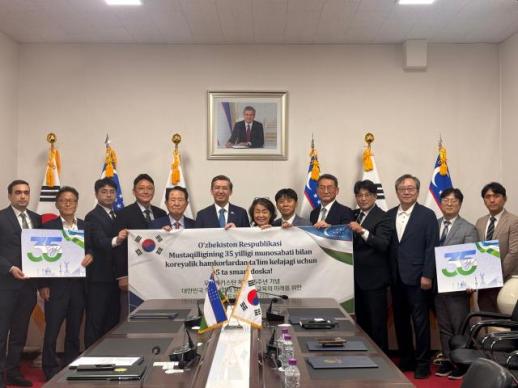 South Korean firms support Uzbek schools with 35 smartboards SEOUL, August 26 (AJP) - Eleven South Korean companies have funded 35 smartboards for schools and vocational institutions across Uzbekistan, as part of an initiative marking the 35th anniversary of the country’s independence. The Embassy of the Republic of Uzbekistan in the Republic of Korea held an appreciation ceremony Wednesday afternoon for 11 Korean companies that helped finance the project, organized ahead of the 35th anniversary of Uzbekistan's independence on Sept. 1. Alisher Abdusalomov, Uzbekistan's ambassador to South Korea, said the interactive smartboards, manufactured by South Korean education technology company AHA, will be distributed to schools and vocational education institutions throughout Uzbekistan. "The advanced interactive smartboards manufactured by AHA will make a significant practical contribution to the digital transformation of education in Uzbekistan," he said. "This equipment will be delivered to schools and vocational education institutions across all regions of the country, giving thousands of young people access to modern technology and new opportunities for learning,” Abdusalomov said. The ambassador said supporting younger generations has long been a top priority for the country. “Education provides a strong foundation for the future, and investment in young people yields the most valuable and lasting results,” he said. The ambassador also pointed to broader changes in Uzbekistan over the past decade, including economic modernization, greater openness to the world and broader social development. The 35 smartboards were funded by 11 Korean companies, including BOMI Engineering & Construction, Shindong Resources, Hansae Mobility, Youngone Corporation, Hyundai Rotem, Edulink Global, DK Consultants, Shield Consulting, Sungshin L&P, Hana Global and UzAuto Korea. AHA, which manufactured the smartboards, supported the project separately by offering the equipment at a 50 percent discount and assisting with logistics and delivery to Uzbekistan. Abdusalomov expressed special appreciation to the company for helping reduce the cost of the equipment and supporting its delivery. He described the support as "a remarkable example of strong corporate social responsibility and genuine partnership." The ambassador said the project also carried broader significance for relations between the two countries. "Your contribution is more than a noble gesture marking the anniversary of Uzbekistan's independence," Abdusalomov told participating companies. "It represents meaningful and practical support for the country's younger generation and makes a valuable contribution to strengthening the bonds of friendship and strategic cooperation between Uzbekistan and the Republic of Korea." The project also reflects the expanding role of Korean companies in Uzbekistan in education and social projects alongside broader economic cooperation between the two countries. AJP Takeaways • Eleven South Korean companies funded 35 smartboards for schools and vocational education institutions across Uzbekistan as part of an education project marking the 35th anniversary of Uzbekistan’s independence on Sept. 1, 2026. • South Korean education technology company AHA manufactured the 35 smartboards and separately supported the project by providing a 50 percent discount and assisting with logistics and delivery to Uzbekistan. • Uzbekistan’s Ambassador to South Korea Alisher Abdusalomov said the smartboard project will support the digital transformation of education, expand learning opportunities for young people and strengthen strategic cooperation between Uzbekistan and South Korea. 2026-08-26 17:22:37
 -
 South Korean matchmaker Duo fined $250,000 over false claims SEOUL, August 26 (AJP) - South Korean regulator has fined matchmaking company Duo 345 million won ($250,000) for misleading claims that it had the industry’s largest pools of professionals and graduates from prestigious universities. The Fair Trade Commission (FTC) said Wednesday the company had used the claims across its website, blog and outdoor advertisements since April 2022. The regulator also ordered the company to correct the practices. Among the slogans were statements that it had “the industry’s largest 5,135 professional members” and “16,479 members from prestigious universities, the most in the industry.” However, the regulator found that the firm created its own definitions of what qualified as a professional occupation or prestigious university and calculated the figures using those standards. It did not compare its membership data with competitors or provide objective evidence. The company also advertised itself as “the industry’s only corporation subject to an external audit” and “the only matchmaking company in Korea disclosed through the Financial Supervisory Service (FSS).” The FTC determined those claims were false because Baroyeon, another matchmaking company, also had external audit reports available on DART, the FSS’s electronic disclosure system. The company also overstated the size of its matchmaking staff. It advertised having as many as 230 professional matchmakers, but only 188 employees were dedicated to arranging matches between members as of October 2023. The advertised total included other employees who were not directly involved in matchmaking. The watchdog said such claims could mislead consumers because information about membership and matchmakers can influence their choices. It therefore classified the statements as false or exaggerated advertising under the country’s advertising law. The FTC said it would continue monitoring advertising in the matchmaking industry to ensure that information affecting consumer decisions is presented accurately. AJP Takeaways • South Korea’s Fair Trade Commission fined matchmaking company Duo 345 million won ($250,000) on August 26, 2026, for misleading advertisements claiming it had the industry’s largest number of professional members and graduates from prestigious universities without objective evidence. • The Fair Trade Commission found that Duo used its own definitions to count professional and elite-university members, while also falsely claiming to be the only matchmaking company subject to an external audit. • Duo also advertised having as many as 230 professional matchmakers, but the Fair Trade Commission found that only 188 employees were dedicated to arranging matches as of October 2023. 2026-08-26 13:52:21
 -
 Afinit eyes KOSDAQ listing on India growth SEOUL, August 26 (AJP) - South Korean fintech company Afinit has begun the process of listing on the KOSDAQ, seeking to build on rapid growth in India and expand its financial services into other emerging markets. The company said Wednesday that it submitted a preliminary listing application to the Korea Exchange (KRX), formally kicking off its initial public offering (IPO) process. Mirae Asset Securities is the lead underwriter, with Hana Securities serving as a co-underwriter. Founded in 2014, Afinit operates True Balance, an AI-powered financial platform targeting people in India who have limited access to traditional banking and credit services. A key part of the business is its in-house alternative credit scoring system. Rather than relying only on conventional credit records, the system analyzes more than 90,000 types of alternative data to assess customers, including those with little or no traditional credit history. It reported revenue of 112.3 billion won ($81 million) in the first half of this year, up 45.8 percent from a year earlier. Operating profit jumped 79.4 percent to 29.6 billion won. Annual revenue increased from 24.2 billion won in 2021 to 161.9 billion won in 2025, a roughly 6.7-fold increase over four years. Building on that growth, the company aims to use the planned listing to broaden True Balance beyond small loans and other basic financial products into a wider financial platform. Beyond India, it is also looking to expand into other emerging markets. Earlier this month, it signed memorandums of understanding with Shinhan Vietnam Finance and Lotte Finance Vietnam as part of its planned entry into Vietnam. The company plans to expand from Vietnam into other emerging markets, including Indonesia, where demand for broader access to financial services remains high. AJP Takeaways • Afinit submitted a preliminary application for a KOSDAQ listing on Aug. 26, 2026, with Mirae Asset Securities as lead underwriter. • The company operates True Balance, an AI-powered financial platform in India that uses alternative data to assess customers with limited credit histories. • First-half revenue rose 45.8 percent to 112.3 billion won, while operating profit increased 79.4 percent to 29.6 billion won. • Afinit is broadening its services into insurance and credit cards while preparing to expand into Vietnam and other emerging markets. 2026-08-26 13:46:24
 -
 Asian stocks tread water ahead of Nvidia results SEOUL, August 26 (AJP) — Asian stocks were mostly sidelined Wednesday as investors waited for a cluster of market-moving U.S. events, with South Korea's KOSPI and regional chip shares looking to Nvidia's earnings for their next direction. Markets are bracing for three major catalysts - the U.S. personal consumption expenditures price index, Nvidia's earnings after the bell on Wednesday and Federal Reserve Chairman Kevin Warsh's remarks at the Jackson Hole symposium Friday. Nvidia rose 2.2 percent overnight, snapping its longest losing streak since 2022 ahead of the closely watched results. South Korean stocks swung between gains and losses Wednesday morning as the rebound in U.S. chip shares and falling Treasury yields supported sentiment, while continued foreign selling capped the upside. The benchmark KOSPI traded at 6,798.08, up 0.82 percent, as of 11:25 a.m. The index climbed as high as 6,829.88 shortly after the open before falling to 6,704.10 and recovering. Foreign investors sold a net 416.7 billion won ($301 million) of KOSPI shares. Retail investors bought a net 104.5 billion won, while institutions sold 58.4 billion won. A total of 401 stocks advanced, 445 declined and 58 were unchanged. Chip heavyweights edged higher following the overnight rebound in U.S. semiconductor shares. Samsung Electronics rose 0.39 percent to 258,000 won, while SK hynix gained 0.60 percent to 1,688,000 won. Other large-cap moves were mixed. Samsung C&T climbed 3.00 percent and Samsung Life jumped 5.61 percent. Doosan Enerbility rose 4.21 percent and Shinhan Financial gained 1.41 percent. Hanwha Aerospace dropped 3.90 percent, Samsung Electro-Mechanics fell 3.16 percent and SK Square lost 1.70 percent. Hyundai Motor declined 0.95 percent, LG Energy Solution fell 1.00 percent and Kia slipped 1.48 percent. The junior KOSDAQ fell 0.96 percent to 819.18 as foreign and institutional selling outweighed retail buying. Battery-material and semiconductor-equipment shares were among the weaker performers, with EcoPro BM down 2.93 percent, Jusung Engineering off 3.52 percent and Wonik IPS falling 4.01 percent. The KOSPI's early support followed a broad rebound on Wall Street overnight. The S&P 500 gained 0.32 percent to 7,677.28, the Nasdaq Composite climbed 0.66 percent to 26,151.30 and the Dow Jones Industrial Average added 0.30 percent to 53,577.40. Chipmakers led the recovery after several sessions of heavy selling. Nvidia rose 2.19 percent, snapping a seven-session losing streak. AMD jumped 4.91 percent and Micron Technology gained 2.48 percent, while the Philadelphia Semiconductor Index advanced 1.44 percent. The MSCI Korea ETF gained 3.75 percent and the MSCI Emerging Markets ETF rose 1.72 percent. Falling bond yields and oil prices provided additional support. The U.S. 10-year Treasury yield fell 6.5 basis points to 4.638 percent, while the 30-year yield declined 5.6 basis points to 5.174 percent. Both fell to their lowest levels since early August. Weaker U.S. consumer confidence contributed to the decline in yields. The Conference Board said its consumer confidence index fell 0.8 point from July to 89.4 in August. Oil prices also retreated sharply, with West Texas Intermediate crude down 3.12 percent and Brent crude falling 3.89 percent. The Korean won strengthened slightly to 1,385.20 per dollar from 1,386.10 won in the previous session. Attention is now turning to Nvidia's second-quarter earnings for another signal on the durability of artificial intelligence chip demand. The results carry particular weight for South Korea, where Samsung Electronics and SK hynix have become increasingly sensitive to shifts in expectations for global AI spending and memory demand. Caution was visible elsewhere in Asia. Japan's Nikkei 225 fell 0.41 percent to 65,586.26, with chip shares among the main drags, while China's Shanghai Composite slipped 0.20 percent to 3,881.74. The muted trading reflected a market reluctant to make large bets before the next round of U.S. inflation, chip and monetary-policy signals. AJP Takeaways • Asian stocks were mostly subdued Aug. 26 as investors waited for U.S. inflation data, Nvidia's earnings and Federal Reserve Chairman Kevin Warsh's Jackson Hole remarks. • South Korea's KOSPI rose 0.82 percent as Samsung Electronics and SK hynix gained after a rebound in U.S. chip shares, although foreign investors remained net sellers. • Nvidia's results are expected to provide the next major signal for Asian semiconductor stocks and South Korean chipmakers after recent volatility in AI-related shares. 2026-08-26 11:36:22