
Journalist

Abraham Kwak
ellenshs@ajunews.com
-
 Korea's Jan exports up 34% on doubled chip shipments, trade surplus streak for 1-year SEOUL, February 01 (AJP) -South Korea’s exports jumped more than 30 percent in January from a year earlier, extending their on-year growth streak to eight consecutive months, driven by steamy semiconductor shipments. Exports totaled $65.85 billion, up 33.9 percent from a year earlier, marking the highest January figure on record, according to data released Sunday by the Ministry of Trade, Industry and Energy. Semiconductor exports, the country’s top export item, more than doubled from a year earlier to $20.54 billion, surpassing the $20 billion mark for a second straight month. The 102.7 percent on-year jump reflected surging demand for AI server chips and sustained gains in memory prices. January chip exports ranked as the second-highest monthly total on record, following December’s $20.8 billion, and extended a streak of 10 consecutive monthly record highs for the period. Average daily exports rose 14.0 percent to $2.8 billion, also the highest ever for January. The ministry attributed the strong performance to robust semiconductor demand and an increase in working days, as the Lunar New Year holiday fell in February this year, compared with January a year earlier. Monthly exports have remained on an upward trajectory since June last year. In January, exports increased across 13 of the country’s 15 major product categories. Automobile exports climbed 21.7 percent on year to $6.07 billion, the second-highest January figure on record, supported by strong sales of hybrid and electric vehicles and the longer factory schedule. Other sectors posting solid gains included wireless communication devices ($2.03 billion, up 66.9 percent), displays ($1.38 billion, up 26.1 percent), petroleum products ($3.74 billion, up 8.5 percent) and bio-health products ($1.35 billion, up 18.3 percent). By contrast, exports of petrochemicals ($3.52 billion, down 1.5 percent) and ships ($2.47 billion, down 0.4 percent) edged lower. By destination, shipments to the United States rose 29.5 percent on year to $12.02 billion, setting a new January record despite ongoing tariff concerns. Exports to China also rebounded sharply, jumping 46.7 percent to $13.5 billion. Imports increased 11.7 percent from a year earlier to $57.11 billion, resulting in a trade surplus of $8.74 billion for the month. South Korea has now posted a monthly trade surplus for 12 consecutive months, starting in February last year. 2026-02-01 11:01:03
 -
 Seoul confident but cautious as Canada submarine bid turns into Korea–Germany contest SEOUL, February 01 (AJP) -South Korea has mounted a full-court, government-led push to win Canada’s next-generation submarine program, but Germany’s entrenched role within NATO and its long-standing engineering ties with Ottawa remain formidable obstacles, said a senior presidential official. Presidential chief of staff Kang Hoon-sik said Saturday that Seoul remains confident in its technological edge, even as it competes against Germany for what is widely regarded as one of the world’s largest defense procurement projects. “Our submarine technology is significantly better, and we believe any remaining issues can be addressed through long-term industrial cooperation with Canada,” Kang told reporters at Incheon International Airport upon returning from back-to-back visits to Canada and Norway, where he led a senior “Team Korea” delegation. The delegation included officials and executives from a South Korean consortium led by Hanwha Ocean and HD Hyundai Heavy Industries, alongside representatives from Hyundai Motor and Korean Air. Seoul is pitching the bid as a broad industrial package rather than a stand-alone weapons sale. Canada’s Canadian Patrol Submarine Project (CPSP) is estimated at up to 60 trillion won ($41.4 billion), including decades of maintenance, repair and overhaul. The Korean consortium was recently shortlisted as one of two final contenders, alongside Germany’s ThyssenKrupp Marine Systems. While South Korea has emphasized its shipbuilding capacity, missile integration and faster delivery timelines, Kang acknowledged that Germany enjoys structural advantages. Canada and Germany maintain close security cooperation under the North Atlantic Treaty Organization, and German technology underpins parts of South Korea’s own submarine development. Competing against Germany — which provided original technology for Korea’s submarine capabilities and shares NATO membership with Canada — "will not be easy to crack,” Kang said. The stakes are high because Canada has made clear that submarine performance alone will not decide the winner. According to bidding instructions issued late last year, only 20 percent of the evaluation is based on platform capability. Half of the score is tied to long-term sustainment, with the remainder split between financial capacity and economic benefits to Canada. That weighting has transformed the competition into what officials describe as a de facto industrial partnership contest. Seoul has positioned the submarine bid as a national strategic export project, promising investment across defense manufacturing, shipbuilding, automotive supply chains, energy and critical minerals — sectors that could generate tens of thousands of Canadian jobs over several decades. Kang said Canadian Prime Minister Mark Carney expressed strong interest in South Korea during meetings that included corporate leaders, though he cautioned against reading too much into diplomatic signals at this stage. Asked about the timeline, Kang said a final decision could come “as soon as six months” or take “up to a year,” adding that Canadian officials are expected to visit South Korea as part of the evaluation process. Kang’s trip yielded more tangible results in Norway, where South Korea signed a 1.3 trillion won contract to export its Chunmoo multiple rocket launcher system. He said Norway’s decision could encourage neighboring countries such as Sweden and Denmark to consider South Korean defense systems, potentially expanding Seoul’s footprint in Northern Europe. 2026-02-01 09:11:43
 -
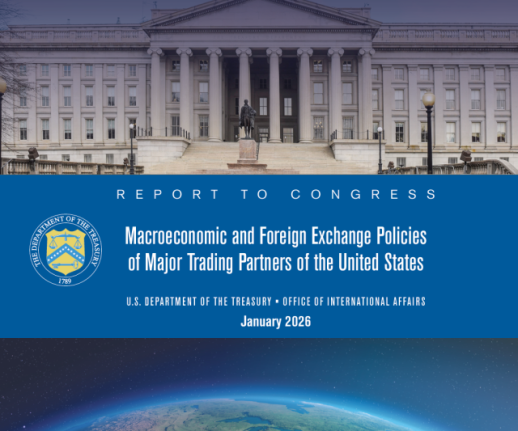 Seoul stays on U.S. currency monitoring list, FX intervention "broadly symmetrical" SEOUL, January 30 (AJP) -South Korea remained on the U.S. Treasury Department’s currency Monitoring List in its latest semiannual report, on widened external surpluses and sizeable bilateral trade imbalance with the United States, while finding the Korean won's weakness "not in line with" the country's "strong fundamentals. In its January 2026 Report to Congress on the Macroeconomic and Foreign Exchange Policies of Major Trading Partners of the United States released on Thursday, the U.S. Department of the Treasury said no major trading partner met all three statutory criteria for designation as a currency manipulator during the review period, covering the four quarters through June 2025. “Treasury concludes that no major trading partner of the United States engaged in conduct of the kind described in Section 3004 of the 1988 Act,” the report said, referring to the law governing findings of currency manipulation for competitive advantage. Still, South Korea was kept on the Monitoring List because it met two of the three thresholds set out under the 2015 Trade Facilitation and Trade Enforcement Act: a material current account surplus and a significant bilateral trade surplus with the United States. Countries meeting two criteria are subject to enhanced scrutiny for at least two consecutive reports to ensure improvements are durable rather than temporary. Along with South Korea, the Monitoring List includes China, Japan, Taiwan, Thailand, Singapore, Vietnam, Germany, Ireland and Switzerland. South Korea returned to the list in November 2024 after a brief leave in 2023 for the first time in seven years. According to the report, Korea’s current account surplus rose to 5.9 percent of GDP over the review period, up from 4.3 percent a year earlier, driven almost entirely by goods trade — particularly semiconductors and other technology exports. Korea’s goods and services surplus with the United States also expanded sharply, reaching $52 billion, more than double its pre-pandemic high of $18 billion in 2016. Despite these strong external positions, the Korean won came under sustained depreciation pressure in late 2024 and 2025. Treasury noted that the won’s weakness was “not in line with Korea’s strong economic fundamentals,” attributing much of the pressure to private-sector capital outflows rather than policy actions. Retail investors and institutional funds accelerated overseas equity purchases, while the National Pension Service (NPS) continued large-scale foreign investment as part of its diversification strategy. Treasury described these outflows as a key factor behind won depreciation. The report said Korean authorities sold $7.3 billion in foreign exchange reserves on a net basis during the review period — about 0.4 percent of GDP — primarily to smooth excess volatility rather than to push the currency in a particular direction. Treasury assessed Korea’s foreign-exchange intervention since 2016 as “broadly symmetrical,” marking a departure from earlier practices aimed at resisting appreciation. The Bank of Korea has reported net sales in most quarters since it began regular disclosure in 2019, largely during periods of dollar strength. The report also highlighted expanded transparency commitments made in a September 2025 joint statement between Seoul and Washington, including monthly disclosure of intervention data and more detailed reporting of foreign-exchange reserves and forward positions in line with International Monetary Fund standards. Treasury pointed to demographics and savings behavior as structural drivers of Korea’s persistent surplus. Rapid population aging has raised precautionary savings, while households and institutions channel funds overseas in search of higher returns, reflecting limited dividend payouts and low valuations in domestic equity markets. In its most recent assessment, the IMF judged Korea’s external position to be broadly in line with medium-term fundamentals, estimating the won to be undervalued by about 2.4 percent on a real effective basis in 2024. An updated IMF assessment for 2025 has yet to be released. While Korea avoided any escalation toward enhanced enforcement, Treasury said it would continue to closely monitor the country’s exchange-rate practices and macroeconomic policies, particularly as large trade surpluses persist alongside currency weakness. 2026-01-30 07:36:15
 -
 Samsung defends record results for 2025, but falls behind local rival in chip profitability *Updated with additional earnings details and stock quote SEOUL, January 29 (AJP)-Samsung Electronics, South Korea's No. 1 tech behemoth, raked in strong operating income and record sales in the final quarter and full year of 2025, but fell short of expectations and in the memory race versus local rival SK hynix, which shifted faster toward an AI-centric architecture and client base. According to its finalized results disclosed Thursday, for the quarter ended December the company reported 16.4 trillion won ($1.14 billion) in chip (DS) operating profit, up as much as 9.4 trillion won from the previous quarter and 13.5 trillion won from the same period a year ago. Its staggering performance however has been paled by its rival. On the previous day, rival local pure-play memory maker SK hynix delivered 19.17 trillion won in operating profit on sales of 80.8 trillion won during the same period, flashing an operating margin of 58 percent — the industry's highest — due to the company’s fab concentration on high-bandwidth memory (HBM) that powers multi-functional AI accelerators and hyperscale data centers. Chip sales reached 44 trillion won in the fourth quarter, up 33 percent on year and 46 percent on quarter, and 130 trillion won for full-year 2025, up 17 percent. Of that, memory sales totaled 37 trillion won for the fourth quarter and 104.1 trillion won for full-year 2025. Mindful of its lateness in the HBM race, Samsung Electronics said in its earnings statement that it will address “customers' demand by timely shipment of competitive HBM4” and continue expanding AI-related product sales while “proactively addressing AI-related NAND demand.” For full-year 2025, the company generated 24.9 trillion won in chip operating profit, up 9.8 percent on year. SK hynix reported operating profit of 47.2 trillion won on sales of 97.15 trillion won for full-year 2025, underscoring the gap in profitability driven by its focus on AI-related and other high-margin chips. Beyond chip sector, Samsung’s smartphone operation - Device eXperience (DX) division - posted an operating profit of 1.3 trillion won ($963 million) for the fourth quarter, nearly halved from 3.5 trillion won recorded in the previous quarter as new model launch effects fizzed out. The figure also fell significantly from the 2.3 trillion won earned in the same period of 2024, highlighting a year-on-year drop of over 40 percent. The display panel business maintained its earnings stability, reporting an operating profit of 2.0 trillion won. This remained flat compared to the 2.0 trillion won posted a year earlier, as robust demand for high-end smartphone panels and automotive applications offset broader market volatility. Samsung’s audio-and-automotive unit Harman recorded 0.3 trillion won in operating profit, due to increased in-vehicle product supply in Europe and seasonal strength in audio products. Looking ahead, Samsung said global tariff risks and geopolitical uncertainty are expected to persist in 2026. It said the DS division plans to leverage its strength as an integrated “one-stop solution” provider spanning logic, memory, foundry and packaging to secure leadership in AI semiconductors, while DX will respond by diversifying its supply chain and optimizing operations, expanding AI-enabled products and delivering more seamlessly integrated AI experiences. Net cash amounted to 100.61 trillion won at the end of December, compared with 93.32 trillion won a year-ago period. Shares were down 0.7 percent at 161,300 won as of 10:30 a.m. 2026-01-29 08:47:17
 -
 Trump says Washington will "work something out" with Korea over tariff issue SEOUL, January 28 (AJP) -U.S. President Donald Trump, who has threatened to reinstate “reciprocal tariffs” on South Korean exports, hinted at a possible compromise on Tuesday before departing for Iowa on a campaign-style trip focused on the economy. “We’ll work something out with South Korea,” Trump said when asked about his earlier remarks suggesting tariffs on Korean products — including automobiles — could be raised to 25 percent from 15 percent. He had cited delays in South Korea’s legislative procedures to approve a trade framework tied to $350 billion in investment pledges from Korean companies. An anonymous White House official told The Wall Street Journal that Trump was frustrated by what he views as Seoul’s failure to deliver on its commitments. “While the president lowered tariffs on Korea, the Koreans have made no progress on fulfilling their end of the bargain,” the official said. “Other alleged issues in the U.S.-Korea relationship are not pertinent to the president’s decision here.” The report however said the Trump administration has warned Seoul against targeting U.S. technology companies through what it views as discriminatory regulations or investigations. Concerns over South Korea’s broad probe into Coupang — which brands itself as a U.S. tech company while providing platform services primarily to Korean consumers — were raised during a meeting last week between U.S. Vice President JD Vance and visiting South Korean Prime Minister Kim Min-seok. The latter had explained that the ongoing investigation probes a massive data breach, regardless of where it is based. 2026-01-28 09:27:30
 -
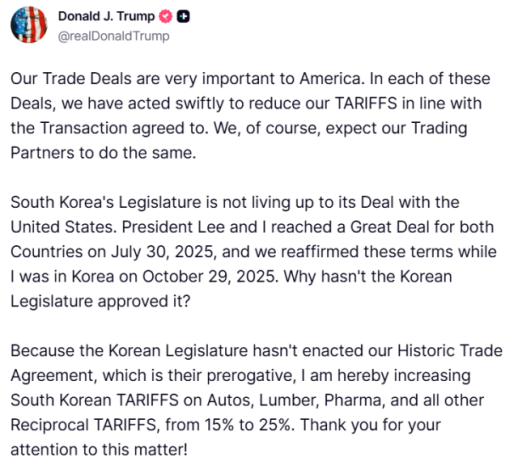 Trump threatens to raise tariffs back to 25%, blaming Seoul for delaying tariff deal SEOUL, January 27 (AJP) -U.S. President Donald Trump said Monday he is raising tariffs on a wide range of South Korean goods from 15 percent to 25 percent, citing delays in South Korea’s National Assembly approving a bilateral trade agreement reached last year. “Because the Korean Legislature hasn’t enacted our Historic Trade Agreement, which is their prerogative, I am hereby increasing South Korean TARIFFS on Autos, Lumber, Pharma, and all other Reciprocal TARIFFS, from 15% to 25%,” Trump wrote in a post on Truth Social. It was not immediately clear when the higher tariffs would take effect. Trump said the decision followed South Korea’s failure to ratify a trade package he described as a “Great Deal” reached with President Lee Jae Myung on July 30, 2025, and reaffirmed during his visit to Korea late October. The White House has yet to confirm Trump's remark. Seoul also has not responded. The October understanding was billed by the White House at the time as a sweeping $350 billion trade and investment framework, aimed at expanding U.S. exports and investment flows while easing tariff and non-tariff barriers between the two allies. The package reportedly covered market access in autos, pharmaceuticals and industrial materials, alongside commitments related to supply chains, energy cooperation and long-term Korean investment in the United States. “South Korea’s Legislature is not living up to its Deal with the United States,” Trump wrote, questioning why the agreement had yet to be enacted despite what he called repeated reaffirmations at the leadership level. The tariff hike directly affects key Korean export sectors. Autos are expected to be among the hardest hit, with Hyundai Motor Group the largest importer of South Korean-made vehicles into the U.S. market. Pharmaceuticals and industrial materials such as lumber were also singled out in Trump’s post. A senior-level U.S. delegation is expected to visit Seoul to negotiate the details to the factsheet released in November that differs in some areas with Seoul's separate announcement on the deal. 2026-01-27 07:34:29
 -
 U.S. investors asks Washington to probe Seoul's treatment of Coupang SEOUL, January 22 (AJP) -Two major U.S. investors in Coupang Inc. have asked the U.S. government to investigate its Korean counterpart over what they describe as discriminatory treatment of the U.S.-based e-commerce platform commanding dominant market in Korea, raising the prospect that a corporate dispute could spill into a bilateral trade issue. Technology investment firms Greenoaks and Altimeter said Thursday that they have petitioned the U.S. Trade Representative (USTR) to examine South Korea’s actions under U.S. trade law and consider remedies, including tariffs or other measures. Separately, the investors notified the South Korean government of their intent to file arbitration claims under the U.S.–Korea Free Trade Agreement (KORUS). The moves follow a consumer data breach disclosed by Coupang in November, after which a number of Korean authorities launched sweeping investigations and lawmakers called for tougher penalties. The investors argue that the government response went far beyond normal regulatory enforcement and has inflicted heavy losses on shareholders. Coupang reported that personal data of about 33 million users in South Korea had been compromised, triggering public backlash, regulatory scrutiny and a wave of lawsuits from consumers and investors. Since the disclosure on Nov. 30, Coupang’s New York–listed shares have fallen about 27 percent, according to market data. Greenoaks and Altimeter allege that South Korean authorities mounted a “whole-of-government” response against Coupang, involving labor, tax, financial and customs probes that they say are unrelated to the data incident. They claim the actions amount to discriminatory treatment of a U.S.-based company operating in Korea. “Our main concern is the scale and speed of the government’s response, which has led to significant damages and threatens the value of our investment,” said Marney Chee, a partner at law firm Covington, which represents Greenoaks. The investors said their notice under KORUS triggers a 90-day consultation period before full arbitration proceedings can begin. Separately, the USTR has up to 45 days to decide whether to launch a formal investigation under Section 301 of the U.S. Trade Act of 1974, a step that could lead to hearings and potential U.S. countermeasures. Seoul has stood firm on its stance and rejected claims of discrimination. President Lee Jae Myung, who previously called for tougher penalties following the data breach, said at a news conference Wednesday that South Korea would address the issue “fairly according to the law and principles,” emphasizing the country’s sovereignty. Trade Minister Yeo Han-koo said earlier this month that the government was not singling out Coupang and that U.S. officials had “misunderstandings.” Speaking after meetings in Washington with USTR Jamieson Greer and members of Congress, Yeo said the data breach — which he described as unprecedented — and Coupang’s response should be treated separately from trade and diplomatic issues. Greenoaks was founded by Neil Mehta, a Coupang board member. Greenoaks and related entities hold more than $1.4 billion worth of Coupang shares, according to filings. In 2023, Coupang partnered with Greenoaks to acquire luxury fashion platform Farfetch in a $500 million deal. Altimeter is a technology-focused investment firm investing across public and private markets. 2026-01-22 21:11:22
 -
 Washington makes a rare Korean won-supporting remark SEOUL, January 15 (AJP) - In a rare departure from Washington’s long-held opposition to currency intervention, the U.S. Treasury secretary echoed Seoul’s concerns over the weak Korean won, lending verbal support to efforts to stabilize the currency. U.S. Treasury Secretary Scott Bessent met with South Korea’s Deputy Prime Minister and Finance Minister Koo Yun-cheol on Monday (local time) to discuss market developments and preparations for the upcoming critical minerals ministerial meeting, according to a Treasury Department readout released Wednesday. During the meeting, the two officials exchanged views on economic conditions in both countries and ways to deepen bilateral economic ties. Bessent specifically addressed the recent depreciation of the Korean won, noting that the currency’s weakness does not align with South Korea’s underlying economic fundamentals. He emphasized that excessive volatility in foreign-exchange markets is undesirable, while underscoring South Korea’s role as a critical U.S. partner in Asia — particularly given the strength of its key industries that support the American economy, the readout said. The remarks mark an unusual shift in tone for Washington, which has traditionally cautioned Seoul against interventionist moves seen as supporting exports at the expense of the U.S. dollar and trade balance. Bessent and Koo also discussed the full and faithful implementation of President Donald Trump’s Korea Strategic Trade and Investment Deal. Bessent said he expects the rollout to proceed smoothly and stressed that the agreement would further deepen bilateral economic cooperation and contribute to the revitalization of U.S. industrial competitiveness. The comments appeared to have an immediate market impact. The dollar weakened sharply against the won overnight, sending the U.S. dollar down 13.50 won to 1,465.00 won. 2026-01-15 06:15:19
 -
 OPINION: Musk may be wrong on doctors — Seoul still needs to listen Elon Musk has a habit of compressing time. What most people describe as decades, he calls years. What institutions treat as distant futures, he presents as near inevitabilities. The result is often exaggeration. Occasionally, it is also illumination. Musk lately suggested that humanoid robots could surpass the world’s best human surgeons within three years. The remark, made on the Moonshots podcast hosted by physician and engineer Peter Diamandis, was quickly dismissed by medical experts. Arthur Caplan, a bioethicist at New York University, called the timeline “not credible,” pointing to the complexity and variability of human surgery. Three years is almost certainly wrong. But focusing on the timeline misses the significance of the question Musk was really posing: what happens to healthcare when expertise itself becomes scalable? Musk’s argument rests on a simple observation. Training a great surgeon takes more than a decade. Even then, human doctors are constrained by fatigue, limited hours and the inevitability of error. Medical knowledge evolves faster than any individual can fully absorb. Machines, by contrast, do not tire, do not forget and can replicate best practices endlessly once trained. This is not a claim that robots will replace surgeons tomorrow. It is a claim that the bottleneck in healthcare may soon shift from human availability to system design. That idea feels distant — until it suddenly does not. At CES this year, the most consequential advances were not flashy consumer devices but what the industry now calls “physical AI”: systems that can perceive, reason and act in the real world. Humanoid robots are moving beyond scripted demonstrations into logistics, manufacturing and service roles. Robotics firms are no longer asking whether machines can move reliably, but where they should be deployed first. Healthcare is already on that list. Robotic-assisted surgery has been standard in certain procedures for years. AI systems now read radiology images with accuracy rivaling specialists. What is changing is integration: software, sensors, chips and mechanical precision are improving together, not in isolation. This matters particularly in Korea, where the debate over doctor shortages has returned with familiar intensity. Government projections suggest that if current trends hold, Korea could face a shortfall of up to 4,923 doctors by 2035 and more than 11,000 by 2040. The policy response has been predictably narrow: how many medical school seats to add, and how to manage resistance from the medical profession. The debate is framed almost entirely as a numerical problem. Musk’s provocation exposes the limitation of that framing. It assumes that the future of medicine will resemble the past — only with more people working harder. That assumption is increasingly fragile. Korea is not a country lacking in medical or industrial capacity. It is one of the few nations capable of producing the full robotics value chain domestically, from semiconductors to precision manufacturing. Its clinical outcomes in cancer treatment, organ transplantation and cerebrovascular surgery already rank among the world’s best. Korean hospitals routinely train foreign doctors who return home carrying Korean techniques. The global spread of SMILE LASIK surgery is a revealing example. Initially, the procedure was limited by the skill threshold required of surgeons. Its global expansion accelerated only after Korean clinicians refined surgical planning and execution methods, effectively turning individual expertise into a reproducible system. Today, SMILE LASIK is performed in more than 60 countries. This is what scalable medical knowledge looks like. The same pattern appears in medical tourism. The global market is growing at more than 20 percent annually. A routine appendectomy that can cost around $14,000 in the United States is available in Korea for a fraction of that price. Even after travel and accommodation, the cost advantage remains decisive. More importantly, foreign patients are increasingly seeking comprehensive internal medicine and complex care, not just cosmetic procedures. This suggests trust not only in individual doctors, but in the system itself. The industrial foundations are already shifting. Hyundai Motor Group and Kia have unveiled on-device AI chips designed for robotics. Boston Dynamics’ humanoid robot Atlas is approaching near-commercial readiness. These technologies will not replace doctors first. They will augment them — extending reach, standardizing precision tasks and reducing burnout. In such a world, the key constraint may no longer be how many doctors Korea trains, but how effectively medical knowledge is captured, encoded and deployed. Musk’s three-year prediction may be far-fetched. But his exaggeration is useful precisely because it destabilizes comfortable assumptions. Korea’s healthcare debate remains anchored in a 20th-century logic: supply versus demand, quotas versus resistance. The harder question — how medicine itself is being reorganized by AI and robotics — remains largely unasked. That is the question Korea is unusually well positioned to answer. Few countries combine world-class medical outcomes with advanced manufacturing and robotics capabilities. Fewer still have an urgent demographic and workforce challenge forcing the issue. The future of healthcare will not be decided by how loudly professions defend their boundaries, but by how intelligently societies redesign their systems. Musk’s provocation is flawed, premature and overstated. But it points, uncomfortably, toward a future that will arrive whether the debate is ready or not. And that, more than the timeline, is what Korea can no longer afford to ignore. *The author is the managing editor of AJP 2026-01-11 12:00:26
 -
 Despite equally chip-strong, South Korea overtaken by Taiwan in per capita GDP SEOUL, January 11 (AJP) Stronger economic growth and a stable currency allowed Taiwan to overtake South Korea in per capita gross domestic product last year, with the gap expected to persist this year, according to government data and economic forecasts released Sunday. South Korea’s per capita GDP in 2025 is estimated at $36,107, down 0.3 percent from the previous year, marking its first decline in three years. The drop reflects weak growth and a sharp depreciation of the won, government and central bank data showed. South Korea’s dollar-denominated nominal GDP fell 0.5 percent to $1.87 trillion, the first contraction since 2022, while real GDP growth slowed to an estimated 1.0 percent, its weakest pace since the pandemic-era contraction in 2020. The average won-dollar exchange rate rose to 1,422.16 last year, the weakest annual level on record. Taiwan, by contrast, recorded robust growth led by semiconductor exports, particularly those linked to artificial intelligence demand. Taiwan’s statistics agency estimates the island’s per capita GDP reached $38,748 in 2025, surpassing South Korea for the first time in 22 years. Taiwan’s real GDP growth estimate for 2025 was revised up sharply to 7.37 percent, while the New Taiwan dollar remained relatively stable, strengthening slightly against the U.S. dollar over the past year. According to Taiwan’s official outlook, per capita GDP is expected to exceed $40,000 this year, extending a four-year upward trend. Major global investment banks project Taiwan’s real GDP growth at around 4.0 percent in 2026 on continued strength in AI-related exports. South Korea’s per capita GDP is expected to recover modestly this year if economic growth improves to government-target of around 2 percent. Based on government projections, per capita GDP could rise to about $37,900 if exchange rates remain near last year’s levels, or to roughly $38,500 if the won strengthens to around 1,400 per dollar. South Korea first surpassed Taiwan in per capita GDP in 2003 and maintained a lead for more than two decades. The reversal highlights diverging economic trajectories, with Taiwan benefiting from its central role in the global semiconductor supply chain, led by Taiwan Semiconductor Manufacturing Co. (TSMC). The International Monetary Fund in October projected South Korea’s global ranking in per capita GDP will slip to 37th in 2025 from 34th in 2024, while Taiwan's goes up to 35th from 38th. 2026-01-11 10:19:24