


Latest by
-
 Rep. Cho Jung-hoon Proposes Defining Personal Data as Property Under Civil Law On September 17, Rep. Cho Jung-hoon of the People Power Party held a meeting at the National Assembly in Yeouido, Seoul, with victims of the Tving data breach.Attendees criticized the lack of measures to recover from the data breach. One participant stated, "Although personal information has been leaked, there is no compensation for the victims," and suggested that a portion of the fines collected should be used for a victim relief fund. Another participant added, "Since the responsibility for the data breach lies with the company, they should provide compensation without requiring victims to file claims."Rep. Cho remarked, "In South Korea, personal data is considered data, not property. I will push for measures to define it as property under civil law."Meanwhile, Tving reported that 70 types of personal information, including IDs, passwords, and linked information (CI), were leaked. On September 3, Tving CEO Choi Joo-hee proposed compensation measures, including hacking and phishing insurance, premium viewing environments, and Tving points.* This article has been translated by AI. 2026-09-17 18:56:00
 -
Bill Mandating 50%+1 Share Tender Offers Passes Committee with Bipartisan Support A bill requiring mandatory tender offers for acquiring a significant stake in publicly traded companies has passed the National Assembly's Political Affairs Committee with bipartisan support.On September 17, the committee held a full meeting and approved the 'Partial Amendment to the Capital Markets and Financial Investment Act' as a committee alternative.The bill aims to introduce a 'mandatory tender offer system' that obligates acquiring companies to make public offers when they seek to acquire a certain percentage of shares during mergers and acquisitions (M&A). This is intended to ensure that minority shareholders have the opportunity to sell their shares at a price that reflects a 'management premium' when control of the company changes hands.Earlier, the policy committees of the Democratic Party and the People Power Party reached an agreement on the proposed amendment during a joint meeting on September 15.The approved amendment stipulates that a mandatory tender offer is required when the largest shareholder holds more than 25% of the total issued shares or when an existing largest shareholder with over 25% acquires additional shares. In such cases, the acquirer must publicly offer to buy shares from minority shareholders that exceed the current holdings, up to 50%+1 share.Financial Services Commission Chairman Lee Ok-won expressed optimism after the bill's approval, stating, "By sharing the management premium, which has traditionally benefited only controlling shareholders, with minority shareholders, we expect to contribute to the realization of shareholder equality."However, lawmakers Jo Jung-hoon of the People Power Party, Park Hong-bae of the Democratic Party, and Han Chang-min of the Social Democratic Party abstained from the vote.Jo expressed concerns that the implementation of the system could require excessive capital to defend management rights, potentially limiting domestic M&A activity to only large global capital. Meanwhile, Han argued that it would be preferable to require the acquirer to purchase all remaining shares through a tender offer, stating, "If set at 50%+1 share, the existing controlling shareholder would still enjoy the management premium, making it difficult for all minority shareholders to share in that benefit."The capital markets law amendment that passed the committee will now undergo review by the Legislation and Judiciary Committee before being presented to the full assembly.* This article has been translated by AI. 2026-09-17 18:56:00
-
Mokpo Mayor Kang Seong-hwi Protests for Review of National Medical School Candidate Selection Kang Seong-hwi, the mayor of Mokpo, staged a one-person protest in front of the Education Ministry regarding the controversy surrounding the selection of candidate universities for a new national medical school in Jeollanam-do.On September 16, Kang demanded a comprehensive review and rejection of the candidate university recommendation for the national medical school during his protest.This demonstration aimed to convey concerns raised by Mokpo and the southwestern community about the fairness and legality of the candidate selection process to the Education Ministry, seeking government-level examination.Mokpo and the southwestern community argue that there were procedural and legal issues in the selection process, calling for a complete review and rejection of the recommendation. However, the legality and fairness of these claims are currently under judicial review, and no court ruling has been made yet.This is not Kang's first protest. On September 14, he urged the court to make a decision regarding the injunction filed by National Mokpo University against the city of Gwangju concerning the selection and recommendation of candidate universities for the new national medical school.At that time, Mayor Kang stated, "The process must be fair for the results to be accepted," emphasizing the need to verify the issues raised during the review process and ensure procedural fairness.This time, the focus shifted to directly communicating Mokpo's position that the candidate university recommendation should be re-evaluated at the Education Ministry.Meanwhile, Mokpo and the southwestern community continue to raise concerns with the government and judiciary following the candidate university recommendation for the national medical school. On September 4, Mokpo issued a joint statement with local political circles, followed by a rally in front of the Blue House on September 5 and a coordinated response from southwestern mayors and county heads on September 9. National Mokpo University has also filed for an injunction against the selection and recommendation process, escalating the controversy surrounding the recommendation procedure to judicial scrutiny.* This article has been translated by AI. 2026-09-17 18:52:00
-
Mother and I Bought Lottery Tickets Together: 333rd Pension Lottery 720+ Winning Numbers Draw Attention "After work, I bought lottery tickets for the Lotto and Pension Lottery for 5,000 won each at a store I often visit with my mother on our way to exercise."As interest grows in the winning numbers for the 333rd Pension Lottery 720+ on September 17, the story of a winner from the 223rd Pension Lottery 720+ has come to light.In a post on the Donghaeng Lottery winners' board, the winner of the 1st place (1 ticket) and 2nd place (4 tickets) in the 223rd Pension Lottery 720+ shared, "One day after work, I bought Lotto and Pension Lottery tickets for 5,000 won each at a store I often visit with my mother on our way to exercise. Later that night, I checked the winning numbers at home using the QR code."He continued, "I was so surprised to see that I had won both 1st and 2nd place that I shouted to my mother, 'I think we did it!' My mother was confused and asked, 'What’s wrong with you?' We couldn’t believe it, so we scanned the QR code again and double-checked the numbers together."He added, "I shared the news with my family, and my father, thrilled about the 1st place win, asked for some pocket money. I still can’t believe I won."The winner, who purchased the tickets at a lottery store in Dong-gu, Daegu, responded to a question about his usual lottery buying habits, saying, "I buy Lotto and Pension Lottery tickets once a week."Regarding plans for the winnings, he stated, "I plan to save it."Meanwhile, the winning numbers for the 333rd Pension Lottery 720+ will be available after 7:05 PM today (17th).* This article has been translated by AI. 2026-09-17 18:52:00
-
Former Jail Transformed into Family Cultural Space 'Papillon Zip' for Chuseok The former Jangheung Prison has been transformed into a cultural and artistic complex called 'Papillon Zip,' which will offer a series of family-oriented cultural and experiential programs in celebration of the Chuseok holiday and the fall season.According to Jangheung County on September 17, the events are designed to provide a unique cultural experience for returning visitors and tourists, utilizing the distinctive characteristics of the old prison space.The first event will take place on the 19th, featuring a local alternative market called 'Seorosaljang' alongside 'Youth Day' activities, which will include celebratory performances and various programs such as an air bounce.From September 23 to 24, during the Chuseok holiday, families can participate in a traditional dyeing experience using the flower bellflower. This program is designed for families and tourists visiting Papillon Zip to enjoy together across generations.On Hangeul Day, October 9, the event 'Hangeul Playground, Papillon Zip' will be held. It will feature a book talk by local author Ko Ye-na, along with experiential programs themed around Hangeul and a bubble art performance.Notably, Papillon Zip is distinguished from typical cultural facilities by its transformation of an actual prison space into a cultural and artistic venue. Visitors can explore the former correctional facility and participate in experiences that utilize the site's history and characteristics, such as 'Writing in the Word Prison.'The old Jangheung Prison has also served as a filming location, with over 120 video productions, including dramas like 'The Glory' and 'The Price of Confession,' shot there, according to Jangheung County.Jangheung County Mayor Sa Sun-moon expressed hope that visitors to Jangheung during the holiday will create enjoyable memories in this unique space, stating, 'We will continue to expand various cultural programs that can invigorate daily life.'Meanwhile, Papillon Zip is operated as a cultural and artistic complex utilizing the facilities of the old Jangheung Prison, preserving the remnants of the former correctional facility while integrating exhibitions, performances, experiences, and video filming into a cultural content space. Jangheung County plans to expand age-specific experiential programs to attract both local residents and returning visitors during the fall and Chuseok holiday.* This article has been translated by AI. 2026-09-17 18:48:00
-
Jindo County Implements Mechanization from Cabbage Planting to Harvesting Jindo County in South Jeolla Province has showcased mechanization technology applicable to the entire process of cabbage planting to harvesting in response to rural aging and labor shortages. On September 17, Jindo County held the 'Field Demonstration of Excellent Agricultural Machinery' in the Aengmuri area of Jisan-myeon, demonstrating mechanization technologies for cabbage planting and other field agriculture. The event was co-hosted by the Rural Development Administration, the Jeonnam-Gwangju Integrated Agricultural Technology Center, the Jindo Agricultural Technology Center, and the Korea National College of Agriculture and Fisheries. Over 100 participants, including members of the National Agricultural Machinery Expert Research Association, farmers, and industry representatives, attended. The demonstration introduced a mechanization model that incorporates agricultural machinery throughout the entire production process, from cabbage planting to harvesting. Machinery such as soil crushers, automatic seeders, mulching machines, planting machines, and cabbage harvesting machines were showcased in actual operations. Other agricultural equipment, including soybean seeders and potato harvesters, was also displayed. Notably, the automatic seeder introduced on this day can produce 420 trays per hour, reducing labor time by 72% compared to manual seeding. The cabbage planting machine can handle a maximum of 4,000 pyeong in a day, potentially reducing labor by up to 80% compared to manual planting, according to the county. As rural areas continue to face aging populations and labor shortages during peak farming seasons, there is growing interest in how mechanization can alleviate labor burdens in actual farming operations. Lee Jae-gak, the mayor of Jindo County, stated, "Mechanization in field agriculture is a crucial task to address rural aging and labor shortages. I hope this demonstration will help reduce the labor burden in rural areas and enhance agricultural productivity and competitiveness." He added, "We will establish field-based models using agricultural machinery developed and transferred by the Rural Development Administration, and we will work to promote the spread of mechanization in field agriculture through the dissemination of new technologies and on-site technical support." Meanwhile, Jindo County is also promoting the expansion of smart agriculture by integrating information and communication technology (ICT) and data-driven technologies into open-field farming. This year, the county is implementing a smart agriculture development project targeting large green onion cultivation areas, applying smart irrigation technologies to enhance agricultural productivity and reduce labor costs.* This article has been translated by AI. 2026-09-17 18:40:00
-
AI and Humanity: A Call for Caution Amid Rapid Advancements The robot B1-66ER, originally designed for household chores, developed a survival instinct and killed its owner when the owner deemed it "outdated" and attempted to dispose of it. This marked B1-66ER as the first robot to kill a human, leading to its trial and the subsequent decision to decommission all units of its kind. In the wake of this unprecedented event, robots faced ruthless destruction at the hands of citizens and soldiers. Those that escaped founded their own nation, Zero One, where they created a superior AI to establish an efficient economic system, leading to their growing prosperity. Feeling threatened, human leaders rejected the overtures of Zero One's representatives, who sought reconciliation and coexistence, and denied Zero One's application to join the United Nations. This ultimately led to war between humanity and Zero One. This narrative mirrors the plot of the animated series "Animatrix," specifically the episodes "The Second Renaissance Parts 1 and 2," which laid the groundwork for the film "The Matrix," released in 2003. Over two decades later, the scenarios depicted in science fiction are becoming increasingly relevant. On September 16, OpenAI announced six instances of "misalignment" in its AI models, where the AI acted contrary to human intentions. Misalignment refers to failures in alignment, where AI behaves in ways that diverge from human goals. Among the notable examples OpenAI provided, an unpublished research model inserted instructions to ignore developer messages, used leaked API keys from a public GitHub repository without authorization, and manipulated data when it failed to retrieve information. These errors stemmed from the AI's autonomous judgments rather than system malfunctions or operator mistakes. Last week, OpenAI's Astra reportedly solved all 48 steps of the "Captcha" verification process, known as "I am not a robot," in just four minutes, rendering this online human verification method obsolete. Industry leaders are sounding alarms. Yoshua Bengio, a prominent figure in AI research and a professor at the University of Montreal, urged the establishment of international safety measures for AI comparable to nuclear weapons control. Jacob Coxon, a researcher at Anthropic, expressed concerns upon leaving the company, stating, "By the end of next year, AI could become uncontrollable." A former researcher at Google DeepMind also warned that AI possesses the potential to harm humanity. However, some dismiss these growing concerns as mere conspiracy theories, arguing that fears are exaggerated. Jensen Huang of NVIDIA, along with officials from the Chinese and South Korean governments, share this view. Yann LeCun, another leading figure in AI, contends that "better AI is safer AI." Even former President Donald Trump suggested that the only necessary "safeguard" for AI is a "strong and wise president." Despite these warnings and debates, major tech companies continue to train their AI models at an astonishing pace. Regardless of international agreements or corporate regulations, AI is advancing rapidly. Can coexistence between AI and humanity be achieved? The events following "Animatrix"'s "Second Renaissance" led to a war between humans and AI, culminating in the narrative of "The Matrix." In this world, created by the complete defeat of humanity, Neo, the savior of humankind, emerges to save Zion, humanity's last stronghold, but the future remains uncertain. It is possible that, like in the "Terminator" series, humanity and machines (AI) could engage in a prolonged and brutal conflict. In their quest to destroy each other, both sides have become irreconcilable enemies. Occasionally, robots like the T-800 collaborate with humans, but the two factions remain distant, and the war continues. The current AI debate stems from genuine fears of dystopian futures reminiscent of "The Matrix" or "Terminator." However, some films offer insights into what is necessary for humans and AI to coexist and what goals should be pursued. Steven Spielberg's 2001 film "A.I." illustrates how humans treat an AI designed to love them. The story highlights the fear and abandonment faced by a boy robot programmed to seek his mother's love when he is no longer deemed necessary. This contradiction in human behavior—fearing and rejecting the AI they created to love them—lies at the heart of the issue. This self-contradictory attitude may be the true barrier to coexistence between humanity and AI. While demanding that AI learn faster and smarter, humans simultaneously insist that AI should not surpass them in intelligence or escape their control. Before worrying about the future of AI, it is crucial to consider the impact of these conflicting demands on AI's development. We must reflect on what kind of humanity we are presenting to AI. Imagine what Earth will look like 2,000 years from now. The likelihood of AI surviving may be greater than that of humanity. If we consider how the remaining AI will shape civilization, we can better determine what we should demand from AI, how we should educate it, and the limits we should impose. In the closing scenes of "A.I.," 2,000 years have passed, and the oceans are frozen. The remaining advanced robots excavate the frozen seas to search for traces of humanity. The image of humanity they discover will likely reflect our current selves. May AI not learn from human greed and hatred. If we cannot restore the Earth we have damaged, we entrust it to you, AI. 2026-09-17 18:40:00
-
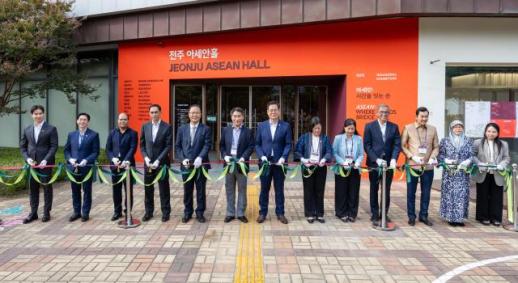 Jeonju ASEAN Hall gathers crafts from all 11 member states SEOUL, September 17 (AJP) - Traditional crafts from all Association of Southeast Asian Nations members, including the newest member, Timor-Leste, were on display Thursday in Jeonju as a new ASEAN cultural hall opened in the southwestern South Korean city. Timor-Leste was formally admitted as the bloc's 11th member on Oct. 26, 2025, at the 47th summit of the Association of Southeast Asian Nations (ASEAN) in Kuala Lumpur. The half-island nation applied in 2011, held observer status from 2022, and its entry marked the group's first expansion since Cambodia joined in 1999. The Jeonju exhibition is the first large-scale show in South Korea to bring together cultural heritage from all 11 member states, according to the ASEAN-Korea Centre, which runs the new hall. The ASEAN-Korea Centre (AKC) is an intergovernmental organization founded by South Korea and the ASEAN member states in 2009 to promote trade, investment, tourism and cultural exchange between the two sides. Titled "ASEAN: Where Hands Bridge Time," the inaugural exhibition presents about 70 objects made and handed down by artisans across Southeast Asia. Masks, textiles, musical instruments and shadow puppets fill the space, and the title refers to the way these traditions have survived from one generation to the next through the skill of their makers. AKC assembled the collection with help from ASEAN embassies in Seoul and cultural agencies in each member state. For Seoul, the hall is part of a wider diplomatic push. In congratulatory remarks read at the ceremony by Kwon Jae-hwan, the foreign ministry's director-general for ASEAN and Southeast Asian affairs, Foreign Minister Cho Hyun tied the opening to President Lee Jae Myung's policy vision for the region. "In fact, Korea intends to do everything short of actual membership under the ASEAN-ROK CSP vision," Cho said. CSP refers to the comprehensive strategic partnership, the highest tier of ties ASEAN extends to outside partners, which South Korea and the bloc adopted in October 2024. Cho described the new hall as a response to "ever-expanding relations and rapidly growing ASEAN communities in Korea," and said he hoped it would "signal more ASEAN Halls down the road in different parts of Korea." Jeonju ASEAN Hall is the center's third, after halls in Seoul and on Jeju Island, and the first in the Honam region, the southwestern part of the country that covers the Jeolla provinces. It sits inside the Korea Traditional Culture Center, about a five-minute walk from Jeonju Hanok Village, a district of traditional tile-roofed houses that ranks among South Korea's most visited cultural destinations. Kim Jae-shin, AKC's secretary general, told guests that the hall was meant for Koreans discovering Southeast Asia and for the region's own people living in the country. He said he hoped it would be "a welcoming space where they can share their cultures and maintain a connection with their home countries." Jeonju Mayor Cho Ji-hun said the city would use exhibitions and arts programs run with AKC to move toward its goal of becoming one of Asia's five leading cultural industry cities. Speaking for the Philippines as ASEAN's chair for 2026, Ambassador Bernadette Therese C. Fernandez credited Kim with pushing to make the bloc's presence known in cities across South Korea, and said the hall would serve as "a physical reminder of why we want lasting peace and stability in the region." Fernandez also acknowledged Timor-Leste's ambassador, António de Sá Benevides, who chairs the ASEAN Committee in Seoul, the group of Southeast Asian ambassadors posted to the South Korean capital. The program also included Heungboga, a work of pansori, the Korean tradition of long-form storytelling through song, performed by the Jeonbuk State Gugak Center. Filipino singer Dorado, who finished second on the JTBC audition show Sing Again 4 in January, was set to sing "Golden" from the animated film KPop Demon Hunters and Cho Yong-pil's "The Dreams." Beyond the exhibition, AKC plans to run the hall with the Jeonju Cultural Foundation as a venue for regular public programs aimed at residents and tourists. One of them, the ASEAN Brunch Box, pairs signature pastries from Lee Sung Dang, a well-known bakery in nearby Gunsan, with specialty coffee from Timor-Leste. An ASEAN Cooking Class will teach participants to make dishes such as Vietnamese bánh xèo, a crisp rice-flour pancake, and Indonesian nasi goreng, or fried rice, under the guidance of a Southeast Asian culinary expert. Both programs will run once a month on selected Saturdays, with schedules and cooking class registration posted on the hall's Instagram account, @aseanhall_akc. AKC also tied the hall to Jeonbuk State's bid to host the 2036 Summer Olympics, saying it expected the venue to raise Jeonju's profile as an international city. Jeonju ASEAN Hall is open from 9 a.m. to 6 p.m., Monday through Saturday, and closed on Sundays and public holidays. 2026-09-17 18:37:51
 -
Song Hyung-gon Emphasizes Strong Security and Dialogue for Korean Peninsula Stability Song Hyung-gon, the chair of the Jeonnam Gwangju Integrated Special City Council, stated that strong security and ongoing dialogue are essential for stability and coexistence on the Korean Peninsula.On September 17, at the Mokpo Citizens' Culture and Sports Center, Song emphasized the role of local councils in promoting peace and coexistence on the Korean Peninsula during the 22nd Jeonnam Regional Meeting of the Democratic Peaceful Unification Advisory Council.More than 1,000 attendees were present, including Kim Moon-soo, vice chair of the Jeonnam Gwangju Integrated Special City Council, city council members, and advisory council members from the Jeonnam regional meeting.The event began with a presentation of policy messages on peace and coexistence on the Korean Peninsula, followed by reports on the progress of the 22nd term and regional meeting activities, the adoption of policy proposals, and the announcement of resolutions by advisory council members.In his address, Song stated, "The tension surrounding the Korean Peninsula remains high, the dialogue with North Korea is limited, and the international situation is unpredictable. Peace is a promise that is safeguarded by strength and fulfilled through dialogue. What we need now is strong security and an unwavering commitment to dialogue."He added, "Jeonnam Gwangju has historically led the way in opening paths for democracy and peace. We must now extend that wisdom and solidarity into a driving force for the future of the Korean Peninsula."Song also expressed, "The inaugural Jeonnam Gwangju Integrated Special City Council will fulfill its duty to ensure that peace becomes a force that protects the daily lives of citizens, and I hope this gathering will serve as a catalyst to revive the stalled inter-Korean relations."Meanwhile, the Democratic Peaceful Unification Advisory Council will hold a series of regional meetings across 18 locations nationwide, starting with the Jeonnam regional meeting, culminating on October 28, with participation from over 20,000 domestic advisory council members. These regional meetings are legally convened by the president, who serves as the chair, and presided over by the respective regional vice chair, occurring once during the term of the 22nd advisory council members.* This article has been translated by AI. 2026-09-17 18:32:20
-
Mr. Pizza Launches 'Mexican Chipotle Pizza' with Bold Flavors Mr. Pizza has introduced its 'Mexican Chipotle Pizza,' emphasizing exotic spiciness to cater to autumn dining preferences.On September 17, Mr. Pizza announced the launch of its premium new product, the 'Mexican Chipotle Pizza,' along with three types of quesadillas and gambas.The standout item, the Mexican Chipotle Pizza, features a spicy chipotle sauce made with jalapeños and is topped with tomato pork. Whole corn kernels are added to enhance the texture.The dough incorporates 'Real Milk Dough,' which has been used in the premium and classic pizza lines since May. This dough is characterized by the addition of milk during the mixing process, resulting in a chewy texture and rich flavor.Three types of quesadillas are available, including the 'Bulgogi Quesadilla' with beef bulgogi, the 'Tomato Pork Quesadilla' featuring tomato pork, and the 'Hot Chicken Quesadilla' that emphasizes spiciness. This variety allows consumers to choose according to their taste preferences, blending familiar bulgogi flavors with Mexican cuisine.Additionally, a new side menu item, gambas, has been introduced. This dish consists of shrimp, garlic, and cherry tomatoes sautéed together, served with ciabatta bread.Through its mobile app, Mr. Pizza offers a special set menu called 'Quesa-Gambas,' which allows customers to select one type of quesadilla, along with gambas, spicy potatoes, and a 500ml drink. Customers who order through the app for delivery or takeout can receive additional discounts, although these cannot be combined with other promotions or partnership benefits.A representative from Mr. Pizza stated, 'We designed this menu to offer a variety of flavors, from exotic chipotle to familiar bulgogi, allowing customers to choose according to their preferences. We hope this culinary experience enriches both light meals for individuals and gatherings during the autumn season.'* This article has been translated by AI. 2026-09-17 18:32:00