


Latest by
-
 Korea and Uzbekistan Discuss Strengthening Economic Cooperation The Export-Import Bank of Korea discussed expanding economic cooperation with Uzbekistan, focusing on key minerals, energy development, and infrastructure.The bank announced that its President, Hwang Gi-yeon, met with Uzbekistan's President Shavkat Mirziyoyev on September 15 during his visit to South Korea. They engaged in in-depth discussions on enhancing economic cooperation between the two countries.This meeting took place immediately after a business roundtable held in conjunction with the first Korea-Central Asia Summit.Both sides agreed on the need to link Uzbekistan's national development policies with South Korea's industrial competitiveness to achieve tangible cooperation outcomes.Uzbekistan is currently pursuing initiatives in key minerals and energy development, industrial diversification, and infrastructure expansion. The Export-Import Bank explained that these projects could serve as strategic cooperation areas between South Korea and Uzbekistan, aimed at stabilizing global supply chains, diversifying export markets, and securing future growth drivers.In conjunction with the summit, the bank also exchanged memorandums of understanding on key cooperative projects and established a system for identifying strategic projects between the two countries.* This article has been translated by AI. 2026-09-16 10:28:00
 -
Court Rules North Korea Must Compensate South Korea for Liaison Office Explosion 북한이 남북공동연락사무소를 폭파한 것에 대해 우리 정부에 손해액을 지급해야 한다는 법원 판단이 나왔다. 서울중앙지법 민사합의46부(김형철 부장판사)는 16일 정부가 북한을 상대로 낸 손해배상 청구 소송에서 원고 일부 승소로 판결했다. 이번 사건의 1심판결은 지난 2023년 6월 소송을 낸 지 3년 3개월 만에 나왔다. 재판부는 정부가 청구한 446억2641만722원을 사실상 그대로 인용했다. 구체적인 판결 이유는 밝히지 않았다.다만 북한을 상대로 진행된 이전 민사 소송과 마찬가지로 판결 내용에 따르지 않을 것으로 예상된다. 현재는 북한에 손해배상 이행을 강제할 수단이 없는 상황이다. 연락사무소 청사는 2007년 12월 준공돼 개성공단 내 납북교류협력협의사무소, 남북회담 장소 등으로 활용됐다.하지만 2010년 5·24 조치에 대한 북한의 반발로 폐쇄됐고, 북한은 2019년 하노이 북미 정상회담이 '노딜'로 끝난 이듬해인 2020년 6월 일부 탈북민 단체의 대북 전단 살포를 문제 삼아 연락사무소 건물을 폭파했다. 통일부는 윤석열 정부 시절인 2023년 6월 연락사무소 폭파의 손해배상청구권 소멸시효(3년)를 중단하고, 국가채권을 보전하기 위해 북한을 상대로 소송을 제기했다. 이는 개인이 아닌 정부가 북한 당국을 상대로 낸 첫 소송으로 소장에 원고는 '대한민국', 피고는 '조선민주주의인민공화국'으로 각각 기재됐다. 이와 관련해 통일부는 연락사무소 청사 102억5000만원, 인접한 종합지원센터 344억5000만원 등 총 447억원을 당시 연락사무소 폭파로 발생한 국유재산 손해액으로 산정했다. 애초 이번 선고는 지난달 12일 이뤄질 예정이었으나, 재판부는 통일부 요청에 따라 이날로 연기했다. 통일부 관계자는 지난달 11일 "북한 당국에 대한 소송이 처음 있는 사례이고, 판결 이후 조치 등에 대해 검토할 필요가 있어 선고 연기를 요청했다"고 말했다.* This article has been translated by AI. 2026-09-16 10:28:00
-
Trump Administration Officials Meet with Anthropic Executives Amid AI Safety Debate Senior officials from the Trump administration met with executives from the U.S. artificial intelligence (AI) company Anthropic. The meeting comes amid tensions after Anthropic CEO Dario Amodei recently advocated for slowing the pace of advanced AI development and introducing government regulations.On September 15, Bloomberg reported that Emil Michael, the Chief Technology Officer (CTO) of the U.S. Department of Defense, and Howard Lutnick, the Secretary of Commerce, held a video conference with Tom Brown, the Chief Computing Officer (CCO) of Anthropic. Brown, one of Anthropic's co-founders, has recently focused on the company's public affairs.Both Anthropic and the White House declined to comment on the meeting, and specific details of the discussions were not disclosed. The meeting drew attention given Anthropic's differing stance on AI safety regulations compared to President Trump, who has expressed skepticism.The video conference followed a lengthy blog post by Amodei on September 12, in which he called for the Trump administration to implement AI regulations. He argued for slowing the advancement of AI technology, suggesting that leading AI companies should establish safety standards voluntarily, while those that do not comply should face regulation.This position garnered support from Sam Altman, CEO of OpenAI, and Elon Musk, CEO of xAI, but faced criticism from President Trump, who labeled it a "terrible hoax" and remarked that only China would welcome such measures. Trump also criticized Anthropic, suggesting they were pretending to be "perfect little angels." Historically, Anthropic has had conflicts with the Trump administration over national security and AI safety issues. Tensions escalated earlier this year when the Department of Defense demanded that Anthropic expand the military use of its AI model, Claude, which the company refused. This led to the Department of Defense designating Anthropic as a "supply chain threat," resulting in legal disputes between the two parties. Anthropic has also faced conflicts with the Department of Commerce over national security issues, leading to temporary export controls on its advanced AI models, which were later lifted.Amid these tensions, Brown has emerged as a key figure in mediating the relationship between Anthropic and the Trump administration. He was involved in negotiations with U.S. authorities to lift export controls on Anthropic's advanced AI models. Last month, he appeared alongside Secretary Lutnick at a public event during a G20 meeting, where he praised the Trump administration's data center support policies. Business Insider referred to Brown as "Anthropic's political secret weapon" in early July.* This article has been translated by AI. 2026-09-16 10:28:00
-
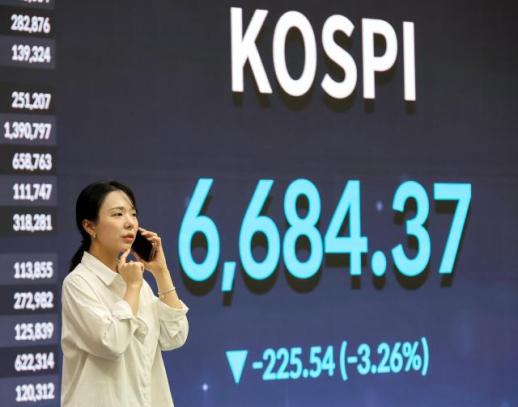 KOSPI rises on chip gains ahead of Fed's rate decision SEOUL, September 16 (AJP) - South Korean stocks rose Wednesday morning as gains in major chip stocks helped offset concerns over high oil prices, rising U.S. Treasury yields and uncertainty ahead of the Federal Reserve's rate decision. The benchmark KOSPI stood at 6,659.29 points at around 10 a.m., up 0.48 percent from the previous session. The index fell 0.06 percent shortly after the market opened to 6,623.33 points before turning higher. Retail investors bought a net 125.0 billion won (US$92 million) of KOSPI shares. Foreign investors sold a net 365.6 billion won ($269 million), while institutions bought a net 50.4 billion won ($37 million). Despite the rebound, sentiment remained cautious after four straight sessions of losses left the index at 6,627.26 the previous day. Investors were weighing bargain hunting against persistent pressure from oil prices, bond yields and the prospect of another U.S. rate increase. Those concerns were reinforced by another weak session on Wall Street. The Dow Jones Industrial Average lost 0.63 percent, while the S&P 500 fell 0.45 percent and the Nasdaq Composite dropped 0.78 percent. Oil prices remained high on concerns about Middle East supply. Saudi Arabia suspended crude shipments from Yanbu, a major oil-export port on the Red Sea, after a pipeline disruption, while Libya stopped production at three oil fields. November Brent crude rose 2.90 percent to $108.75 a barrel, while October West Texas Intermediate advanced 4.38 percent to $105.83. The rise in crude added pressure to the bond market. The benchmark U.S. 10-year Treasury yield climbed as high as 5.041 percent, its highest level since July 2007. Investors remained cautious ahead of the Federal Open Market Committee's decision due early Thursday in Seoul. Futures markets priced in about a 95 percent chance that the Fed would raise rates by 0.25 percentage point, with markets also watching for signs of further tightening. Still, some technology shares in New York showed signs of stabilization after recent losses. Nvidia gained 0.57 percent, Micron Technology rose 0.39 percent and Advanced Micro Devices advanced 2.19 percent, helping cushion concerns over a recent pullback in artificial intelligence-related stocks. That strength carried into Seoul's semiconductor sector. SK hynix gained 2.31 percent to 1,729,000 won. Samsung Electronics rose 1.11 percent to 251,250 won, while its preferred shares climbed 4.60 percent to 195,700 won. Other technology-related shares also advanced. Samsung Electro-Mechanics rose 1.90 percent to 1,342,000 won, while SK Square gained 0.90 percent to 1,009,000 won. Among other large-cap stocks, battery maker LG Energy Solution climbed 1.64 percent to 371,500 won, while Hyundai Motor fell 1.23 percent to 362,500 won. Samsung Biologics slipped 0.35 percent to 1,407,000 won. Financial shares edged higher. KB Financial rose 0.34 percent to 176,400 won, while Samsung Life Insurance added 0.18 percent to 286,000 won. Investors were also digesting the early performance of the Korea Exchange (KRX)'s new after-market session, which began on Monday and runs from 4 p.m. to 8 p.m. According to the KRX, combined KOSPI and KOSDAQ after-market turnover totaled 1.01 trillion won on Tuesday, down 44.6 percent from 1.82 trillion won on the launch day. Trading volume fell 15.4 percent to 61.1 million shares. Broader market sentiment remained weak, with the junior KOSDAQ down 1.03 percent at 804.05 as of 9:51 a.m. The index opened at 808.37 and moved between 801.90 and 808.53 in early trading. Despite the index decline, some of the most actively traded stocks posted gains. Lightron Fiber-Optic Devices, an optical communications equipment maker, jumped 8.37 percent to 4,465 won, while Taihan Fiberoptics rose 4.81 percent to 14,820 won. VISSEM Electronics, an electronic-components maker, surged 20.93 percent to 12,940 won. Korea Advanced Materials, which makes telecommunications equipment, gained 2.98 percent to 3,460 won. Security and software shares were also stronger. AXGATE, a system-software company, climbed 2.39 percent to 17,970 won, while Hancom WITH, a digital security company, rose 5.74 percent to 5,530 won. Elsewhere, semiconductor equipment maker Jusung Engineering slipped 0.47 percent to 191,900 won. Sky Labs, a maker of wearable medical devices, gained 2.16 percent to 21,250 won. Sungho Electronics, an electronic-components maker, advanced 5.77 percent to 17,780 won, while robotics company ROBOTIS fell 5.08 percent to 308,000 won. The Korean won weakened to 1,371.6 per dollar from 1,359.4 a day earlier. AJP Takeaways - South Korea's KOSPI rose 0.48 percent to 6,659.29 as of 10:01 a.m. on September 16, 2026, as gains in Samsung Electronics and SK hynix offset pressure from high oil prices and U.S. Treasury yields. - Foreign investors sold a net 365.6 billion won ($269 million) of KOSPI shares, while retail investors bought 125.0 billion won ($92 million) and institutions bought 50.4 billion won ($37 million). - The Korean won weakened to 1,371.60 per dollar from 1,359.40 a day earlier as higher U.S. yields and rate concerns pressured the currency. 2026-09-16 10:27:01
 -
 SK hynix workers approve revised wage deal SEOUL, September 16 (AJP) -SK hynix workers approved a revised wage and collective bargaining agreement Wednesday after the company and its production union adjusted the mix of cash and stock in profit-sharing bonuses, ending a dispute that forced the two sides back to the bargaining table after an initial deal was narrowly rejected. The revised agreement won support from 57.08 percent of union members who voted, or 8,731 workers, in a two-day ballot held Monday and Tuesday, SK hynix said Wednesday. The vote clears the way for the chipmaker and the union to complete this year's wage negotiations about three weeks after workers rejected the first tentative agreement on Aug. 25 by just 25 votes. SK hynix said the two sides held about two weeks of intensive negotiations after the rejection and reached the revised agreement on Sept. 9. The central change was the treatment of the company's profit-sharing bonus, known as PS. The revised agreement raises the cash portion of PS to 50 percent from 40 percent and lowers the stock portion to 50 percent from 60 percent. It also gives employees greater choice over how they receive the bonus. Workers can convert part or all of the cash portion into SK hynix shares in increments of 10 percentage points, allowing those who choose to receive as much as 100 percent of their PS in stock. The arrangement represents a compromise between employees seeking greater cash payments and management's effort to increase stock-based compensation. Profit-sharing has become an increasingly important part of compensation at SK hynix as booming demand for high-bandwidth memory, or HBM, used in artificial intelligence accelerators has sharply increased the chipmaker's earnings. Under a framework agreed last year, SK hynix removed the previous ceiling on PS and set aside 10 percent of annual operating profit for the bonus pool for 10 years. The revised labor agreement also formally introduces a provision allowing wages to be deferred when the company posts a loss. SK hynix described the provision as a commitment by workers and management to share responsibility not only when profits are strong but also when the company faces financial difficulties. The company said it held about 60 employee briefing sessions during the renewed voting process to explain the purpose and expected effects of the revised compensation system. SK hynix said those sessions helped employees better understand the changes, although that assessment came from the company. The agreement comes as labor organization at SK hynix is also changing. A newly established integrated union spanning production, technical and office workers has been seeking to expand its membership and has made preservation of cash-based PS payments one of its priorities. SK hynix has at the same time been stepping up returns to shareholders alongside sharply higher earnings from the AI memory boom. The company last month announced a record 40 trillion won ($28.6 billion) share buyback and cancellation program and said it would return more than 50 percent of cumulative free cash flow generated from 2025 through 2027 through dividends, buybacks and share cancellations. “We thank the labor union and our employees for working through a difficult process,” SK hynix said. “We will continue to address future challenges together through cooperation between the company and its employees.” Shares of SK hynix were 1.66 percent higher at 1,717,500 won, outperforming its peer Samsung Electronics and the main KOSPI that mostly stayed flat during early Wednesday session. The company plans to hold a signing ceremony before the Chuseok autumn harvest holiday to formally conclude this year's wage and collective bargaining process. AJP Takeaways - SK hynix workers approved a revised 2026 wage deal with 57.08 percent support, three weeks after the first agreement was rejected by just 25 votes. - The compromise raises the cash portion of profit-sharing bonuses to 50 percent from 40 percent, while allowing workers to voluntarily convert cash into shares and receive as much as 100 percent in stock. - The deal ends a closely watched dispute over sharing SK hynix’s AI-driven earnings, as the chipmaker balances employee compensation with record shareholder returns and heavy HBM investment. 2026-09-16 10:24:10
 -
 Korean robots may lag, but stocks are flying SEOUL, September 16 (AJP) -South Korean humanoid robots may still be grounded and stand awkwardly compared with their Chinese peers, but stocks of their makers are flying, helping sustain the junior KOSDAQ market against broadly bearish sentiment in Seoul. A correction took hold Wednesday, but robotics stocks have stood out throughout the month and remained strong through Tuesday despite renewed anxiety over artificial intelligence investment in the United States. Shares of Robotis fell 5.24 percent in early Wednesday trading after a steep run that pushed the robot maker into the KOSDAQ's top 10 by market capitalization. The stock had gained 50.6 percent since Aug. 3 through Tuesday, lifting Robotis to 10th place on the KOSDAQ from 19th about a month earlier. Other robotics-related shares surged Tuesday before giving up some of their gains to profit-taking Wednesday. Samhyun jumped 29.8 percent Tuesday, near the daily limit, while HigenRNM soared 24.69 percent. Wonik Holdings rose 14.38 percent, SPG gained 13.34 percent and CP System advanced 11.52 percent. Rainbow Robotics added 3.09 percent. The rally has put two robotics companies among the KOSDAQ's 10 largest stocks. Rainbow Robotics ranked fifth with a market capitalization of 8.41 trillion won as of Tuesday, while Robotis ranked 10th at 4.76 trillion won. Investor enthusiasm is being fueled by expectations that the next phase of AI investment will spread from chips and data centers into physical AI, where artificial intelligence is embedded in robots and other machines operating in the real world. Government spending is adding to those expectations. South Korea plans to more than triple spending on physical AI to 3.1 trillion won next year from 900 billion won this year under its proposed 2027 budget. The government plans field trials across eight areas including manufacturing, smart factories, construction, agriculture, defense, care services, logistics and ports, while deploying about 2,000 domestically produced AI robots. Eugene Investment & Securities said government support is expected to expand beyond research and development into purchases, field trials and mass production, potentially helping robotics companies move closer to commercialization. Support is also being directed at components critical to humanoid robots. The 2027 budget proposal includes 62 billion won for sensors, actuators and secondary batteries for humanoids, up about 50.4 billion won from this year. Second Vice Finance Minister Huh Chang underscored the policy push during a Sept. 10 visit to Robotis headquarters in Seoul, where he inspected humanoid robots and actuator technology. “We will actively support the private sector through the 2027 budget for future industry core components,” Huh said. The government has said it plans to expand support from technology development to field testing as it tries to build a domestic supply chain for key humanoid components. AJP Takeaways - South Korean robot stocks rallied on Sept. 15, 2026, as Samhyun rose 29.8 percent and Hyzen R&M gained 24.7 percent on the KOSDAQ, according to Korea Exchange data. - Rainbow Robotics and Robotis ranked fifth and 10th by market value on the KOSDAQ as of Sept. 15, 2026, with five of the top 10 companies in chips and electronic parts. - South Korea's 2027 budget proposal would raise physical AI spending to 3.1 trillion won from 900 billion won, pending approval by the National Assembly. 2026-09-16 10:22:10
 -
KG Mobility Expands Collaboration with Paraguay, Supplies 20 Musso EVs KG Mobility (KGM) welcomed a delegation from Paraguay's Ministry of Industry to its Pyeongtaek factory. On September 15, KGM held a meeting at its headquarters with Javier Viveros, Paraguay's Deputy Minister of Industry, and other officials. The discussions focused on KGM's latest technological advancements and potential collaboration opportunities. The delegation visited South Korea as part of a training program organized by the Ministry of Trade, Industry and Energy. This initiative is part of the Official Development Assistance (ODA) project aimed at establishing an 'Automotive Parts TASK Center' in Paraguay. The Korea Automotive Technology Institute will support the center's establishment and operation, along with the pilot distribution of electric vehicles. KGM plans to supply 20 Musso EVs for this pilot program. After the meeting, the delegation toured the production line and visited the design center, where they observed the development process of the upcoming 'SE-10' model, concept cars, and clay models at full scale. They also test drove the Musso and Actyon Hybrid (HEV) at the test track. A KGM representative stated, "KGM products are recognized for their excellence not only among general consumers but also in the public sector in overseas markets. We aim to secure sales channels through government ODA projects and diversify our supply chain to increase export volumes." Meanwhile, KGM is accelerating its efforts to diversify its overseas sales network, having recently launched its brand in Myanmar and expanding local assembly (KD) operations in Saudi Arabia and Vietnam.* This article has been translated by AI. 2026-09-16 10:20:10
-
MG Saemaul Geumgo Foundation Allocates 400 Million Won to Improve Community Facilities MG Saemaul Geumgo Hope Sharing Foundation is taking steps to improve the usage environment of community facilities. On September 16, the foundation announced the launch of the 'MG Local Community Activation Support Project.' This initiative aims to assist community facilities that are experiencing discomfort due to aging infrastructure and insufficient supplies. The targeted facilities include senior centers, social welfare centers, local children's centers, and youth facilities that residents use regularly. Starting this year, the support method has been changed to allow facilities to directly select the types of supplies they need. This adjustment reflects the varying operational conditions and user characteristics of each facility, moving away from a one-size-fits-all approach to support tailored to on-site demand. The scale of support has also increased to 400 million won, with the number of facilities receiving assistance rising from 80 last year to 99 this year. Among these, senior welfare facilities account for the largest share at 49, followed by 15 for disability welfare, 11 for community welfare, 9 for early childhood and child welfare, 6 for women's welfare, 4 for youth welfare, 2 for family welfare, and 3 for others. Since launching the project in 2022, the Saemaul Geumgo Foundation has provided approximately 830 million won to a total of 303 facilities as of last year. Including this year's support, the cumulative total will reach 402 facilities and about 1.23 billion won. A foundation official stated, "We have improved the support method to allow facilities to choose the supplies they need directly, and we will continue to provide practical support that residents can feel in their communities."* This article has been translated by AI. 2026-09-16 10:16:10
-
Syngenta Launches IPO Process in Hong Kong, Valued at $50 Billion Syngenta, the world's largest agricultural technology company, has officially initiated its initial public offering (IPO) process on the Hong Kong Stock Exchange. According to Reuters, the company submitted a confidential IPO application on September 16. The offering is expected to raise at least $5 billion, with the potential to increase to $10 billion depending on investor demand. If successful, Syngenta could debut on the Hong Kong market by the end of this year or early next year.Headquartered in Basel, Switzerland, Syngenta is a global company primarily controlled by Chinese state capital. In 2017, China National Chemical Corporation acquired Syngenta for approximately $43 billion, and it was later integrated under Sinochem following a merger with China National Chemical.Currently, Syngenta operates as a private company and is the largest agricultural technology firm by revenue. It ranks first in the crop protection sector, first in the biopesticide field, and third in the seed industry. The company employs over 50,000 people across more than 90 countries.The funds raised from this IPO will be used to pay down debt and expand investments in core businesses such as crop protection and seeds. Notably, Syngenta is increasing its investments in next-generation agricultural technologies, including artificial intelligence (AI), digital agriculture, and biological crop protection methods.Syngenta's anticipated market capitalization is between $50 billion and $100 billion. The final valuation will be determined after the number of shares and the offering price are finalized.In 2021, Syngenta attempted to list on the Shanghai Stock Exchange but withdrew its application due to market conditions in 2024. The recovery of the Hong Kong IPO market is also supporting Syngenta's listing efforts. So far this year, Hong Kong has raised $45.8 billion through IPOs, and Syngenta's listing is expected to be one of the largest in the recent Hong Kong market.* This article has been translated by AI. 2026-09-16 10:16:10
-
Hanwha Life Insurance Conducts Consumer Protection Checks Nationwide 한화생명이 전국 영업현장을 직접 찾아 금융소비자보호 교육과 현장 점검에 나선다.한화생명은 15일부터 다음 달 말까지 최고고객책임자(CCO) 주관으로 ‘영업현장 고객신뢰 PLUS 데이’를 운영한다고 16일 밝혔다. 소비자보호 정책과 금융당국의 감독 방향을 공유하고 완전판매 문화를 정착해 민원을 예방하기 위한 취지다.이번 프로그램은 한화생명금융서비스와 라이프랩 지역단을 비롯해 콜센터, 손해사정 조직, 제휴 GA 사업부 등 29개 기관을 대상으로 진행된다. 각 자회사 GA의 CCO와도 협업해 소비자보호 문화를 확산할 계획이다.교육에서는 금융소비자보호 정책과 최근 민원 처리 동향을 공유하고 6대 판매원칙과 설명의무 등 완전판매 준수를 강조한다. 금융감독원 민원 사례를 통해 주요 민원 발생 원인과 예방 방안도 안내한다.현장 의견을 듣는 자리도 마련한다. 한화생명은 민원 대응 과정에서 발생하는 애로사항과 개선 의견을 청취하고 이를 소비자보호 제도와 업무 프로세스 개선에 반영할 예정이다.외부 전문가와 고객의 의견을 소비자보호 체계에 반영하는 작업도 이어가고 있다. 지난 4월 출범한 ‘고객신뢰 PLUS 자문위원회’를 통해 소비자 권익 보호와 관련한 주요 사안을 검토하고 개선 과제를 도출하고 있다.지난 7월부터는 320명 규모의 고객패널을 운영하며 상품과 서비스에 대한 의견을 수렴하고 있다. 영업현장에서는 교육과 안내를 병행하면서 완전판매 준수 여부도 지속적으로 점검한다.최재덕 한화생명 소비자보호실장은 “소비자보호는 고객과 가장 가까운 영업현장에서 실천될 때 의미가 있다”며 “이번 프로그램을 통해 현장의 소비자보호 문화를 강화하고 고객이 신뢰할 수 있는 금융서비스 환경을 만들겠다”고 말했다.* This article has been translated by AI. 2026-09-16 10:16:00