

Japanese health officials said Thursday that three young people have contracted dengue fever, the first such infections in the country in nearly 70 years.
The three are suspected of having contracted the disease when they were bitten by mosquitoes in Yoyogi Park in central Tokyo, officials said.The patients - a man in his 20s in Tokyo as well as a teen and woman in her 20s in Saitama Prefecture north of the capital - go to the same educational institution in Tokyo.
None of them is in a life-threatening condition, officials said.
The last domestic infection of dengue fever was in 1945, although there are around 200 cases annually among those who have traveled abroad, mainly in Southeast Asia.
Dengue fever is not transmitted directly from person-to-person and symptoms range from mild fever to incapacitating high temperatures, according to the World Health Organization.
There is no vaccine or any specific medicine to treat dengue and patients should rest, drink plenty of fluids and reduce the fever using paracetamol or see a doctor, it says.
By Ruchi Singh
Copyright ⓒ Aju Press All rights reserved.
Related News
-
 Jeju steps up measures against African swine fever
SEOUL, November 18 (AJP) - Jeju Island is tightening quarantine measures through February 2027 to prevent the spread of African swine fever (ASF), the provincial government said Wednesday. South Korea has recorded 24 outbreaks at pig farms this year, while Jeju has never reported a case. The province has banned most animal feed containing pig blood and restricted pork shipments from affected regions. Livestock vehicles entering Jeju through its ports must undergo disinfection, while people who have visited farms in other regions are barred from entering local farms for five days. Tags: South Korea, Jeju Island, African Swine Fever, ASF, Animal Disease, Pig Farming, Pork, Livestock, Agriculture, Quarantine, Biosecurity, Disease Prevention, Animal Feed
-
 Busan fever sweeps Asia as Taiwanese lead new tourism boom
Asian tourists have jumped to Busan over the last two years, led by Taiwanese visitors. The phot shows a family enjoying the seaside at Haeundae, Busan. July 17, 2026. AJP Seo Hye Seung SEOUL, July 22 (AJP) - Busan has emerged as one of Asia’s hottest urban escapes, drawing travelers with its beaches, seafood, cinematic coastal scenery and the hometown appeal of BTS members Jimin and Jungkook. Chinese can now be heard across the southern port city, but increasingly it is not the Mandarin typically associated with mainland visitors. Taiwanese travelers have become one of Busan’s largest and fastest-growing visitor groups, helping transform the city from a secondary stop after Seoul into a destination in its own right. A new expression circulating on social media in Taiwan, mainland China and Japan captures the mood: “Busan sickness.” The phrase describes the lingering longing travelers feel after leaving the city. Once commonly associated with “Seoul sickness,” the post-trip nostalgia appears to have shifted southward as Busan gains a stronger identity among young Asian travelers. The boom is visible in the numbers. Busan welcomed 1.94 million foreign visitors in the first five months of 2026, up 40 percent from a year earlier and 78.4 percent from the same period in 2019, according to the Busan Tourism Organization’s latest data. The figure represented 22.2 percent of South Korea's 8.72 million inbound visitors during the period, meaning more than one in five foreign tourists visiting Korea traveled to Busan. While nationwide inbound tourism grew about 21 percent, Busan expanded at nearly twice that pace, cementing its status as one of Asia's fastest-rising urban tourism destinations. In May alone, the city received 460,683 international visitors, a 42.9 percent increase from a year earlier and 83.7 percent above the pre-pandemic level recorded in May 2019. Asian tourists crowd BTS pop up store at Shinsegae Department Store in Busan ahead of Arirang concert on June 12-13. June 11, 2026. AJP Seo Hye Seung The most striking change has come from Taiwan. Some 84,502 Taiwanese visitors traveled to Busan in May, up 46.3 percent from a year earlier and more than four times the May 2019 level. They accounted for 18.3 percent of all foreign visitors that month, nearly matching mainland Chinese travelers, who made up 19.4 percent. Over the January-May period, Taiwan was Busan’s largest single visitor market, with 375,322 arrivals and a 19.4 percent share. Mainland China followed with 359,981 visitors, or 18.6 percent, while Japan accounted for 233,685, or 12.1 percent. Mainland Chinese tourism is also recovering rapidly. Their arrivals nearly doubled from a year earlier to 89,275 in May and were almost three times the corresponding 2019 level. But the strong Taiwanese presence has changed the linguistic and cultural complexion of Busan’s tourism districts, particularly around Haeundae, Gwangalli and popular shopping areas. The city’s broader tourism surge has also translated into heavier spending. Foreign visitors spent 132.2 billion won ($95 million) in Busan in May, more than 2.5 times January’s 51.2 billion won, according to city data. Busan retained its position as South Korea’s second-largest destination for foreign tourist spending after Seoul for a third consecutive month. The appeal is also reflected in online sentiment. An analysis by Yanolja Research of 11,270 Chinese-language travel posts on Xiaohongshu and 18,694 reviews on Ctrip ranked Busan first in overall satisfaction among eight Asian cities, ahead of Tokyo and Singapore, with an average score of 4.723 out of five. Nature accounted for 38.2 percent of Busan-related mentions, followed by food at 23.8 percent. The finding suggests that the city’s appeal comes less from the sheer number of attractions than from the concentration and intensity of the experiences it offers. Haeundae beach signature red lighthouse seen at a misty beach in monsoon season in July 2026. AJP Seo Hye Seung Busan’s first advantage is its highly photogenic landscape. Unlike the dense and relentlessly paced capital, Busan is increasingly perceived as a place that feels distinctly Korean but is less exhausting. Its geography places expansive coastlines beside urban neighborhoods, giving travelers beaches, cafés, markets and nightlife within a relatively compact area. Haeundae, Gwangalli and Gamcheon Culture Village have long appealed to social media users. More recently, attractions that let visitors experience the sea rather than merely view it have widened the city’s draw. The Haeundae Blueline Park beach train, promoted on Xiaohongshu as a “train running by the sea,” has become one of the city’s most recognizable images. Yacht tours, Skyline Luge and the X the Sky observatory have similarly helped turn Busan’s coastline into an activity-driven tourism product. Affordability is another strength. Local dishes such as pork-and-rice soup and milmyeon wheat noodles offer inexpensive alternatives to the increasingly costly dining scene in Seoul. That value has proved especially attractive to Taiwanese visitors, who can reach Busan on direct flights to Gimhae International Airport in about two hours. Travelers from parts of Japan enjoy similarly easy access, allowing Busan to function as a convenient weekend destination rather than an extension of a longer trip to Seoul. Yanolja Research said Busan was moving beyond its traditional image as a city of beaches and scenery by combining marine resources with transportation, observation decks, leisure activities and entertainment. The result, it said, was a new model of an “Asian experiential tourism city” built around the sea. The latest tourism figures suggest the model is working. Busan is no longer merely South Korea’s second city or a seaside add-on to Seoul. For a growing number of Asian travelers, it has become the Korean city they miss once they leave.
-
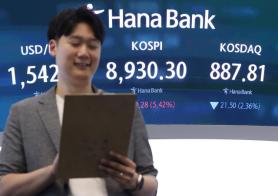 KOSPI, Nikkei 225 refueled by revived chip fever
Electronic boards display the KOSPI and KOSDAQ indexes at Hana Bank's dealing room in central Seoul on June 25, 2026.Yonhap SEOUL, June 25 (AJP) — The KOSPI moved to the brink of reclaiming the 9,000-point milestone amid a tense market rivalry between the country's two chip heavyweights, while the junior KOSDAQ sank further as bets narrowed on chip infrastructure. The benchmark KOSPI closed up 5.42 percent at 8,930.30 after briefly climbing above the 9,000-point threshold during afternoon trading. Trading was volatile throughout the session. A buy-side sidecar was triggered shortly after the open amid a rush into chip stocks after overnight results from Micron Technology reinforced expectations that the AI boom would last well through next year. Samsung Electronics climbed 5.29 percent to close at 358,500 won, while SK hynix surged 13.06 percent to 2,917,000 won to reclaim the No. 1 market capitalization title after losing it for just one day. Shares tied to the two chipmakers also rallied sharply, with SK Square rising 5.56 percent to 1,899,000 won, Samsung C&T gaining 7.79 percent to 519,000 won, Samsung Life Insurance adding 3.23 percent to 447,000 won and Samsung Electronics preferred shares surging 10.07 percent to 235,000 won. Samsung Electro-Mechanics also gained 1.68 percent to 1,997,000 won. Samsung Biologics ended little changed, edging up 0.07 percent to 1,386,000 won, while Kia rose 0.43 percent to 139,500 won. Much of the non-semiconductor blue chips remained subdued. Hyundai Motor fell 1.18 percent to 503,000 won, LG Energy Solution dropped 3.69 percent to 352,000 won, HD Hyundai Heavy Industries slipped 0.85 percent to 582,000 won and Hanwha Aerospace declined 2.29 percent to 1,069,000 won. Institutional investors remained the dominant buyers, purchasing a net 4.24 trillion won ($2.75 billion) worth of KOSPI shares. Retail investors sold a net 3.45 trillion won, while foreign investors offloaded a net 773.6 billion won. The semiconductor-led surge came at the expense of the secondary market, where the tech-heavy KOSDAQ fell 2.46 percent to 887.81, slipping back below the 900-point mark. Among KOSDAQ heavyweights, Alteogen edged up 0.94 percent to close at 375,000 won, while battery materials makers EcoPro BM and EcoPro tumbled 5.57 percent to 144,000 won and 5.29 percent to 102,000 won, respectively. Among semiconductor equipment makers, Jusung Engineering plunged 8.50 percent to 166,900 won, although Wonik IPS and Reno Industrial gained 2.72 percent to 154,700 won and 4.11 percent to 88,700 won, respectively. The Korean won weakened slightly against the U.S. dollar, trading at 1,544.7 won per dollar, down 2 won from the previous session. The session underscored the market's growing divide, with semiconductor winners continuing to outpace the broader market. Japan's Nikkei 225 jumped 4.61 percent to 72,366.34, extending gains alongside the global chip rally. China's Shanghai Composite rose 0.23 percent to 4,120.28, while Hong Kong's Hang Seng Index declined 1.61 percent to 23,035.63.