

Copyright ⓒ Aju Press All rights reserved.
Related News
-
 Korea gets a double shot of sobriety as AI saga adds romance-spy drama
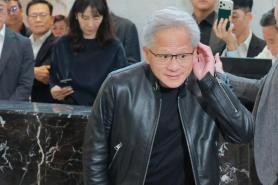
Nvidia CEO Jensen Huang listens to a question from reporters during a briefing with SK Group Chairman Chey Tae-won at the SK Seorin Building in Jongno, central Seoul, June 8, 2026. AJP Yoo Dae-gil SEOUL, November 11 (AJP) - The AI saga has suddenly taken a romance-and-espionage turn, with its poster child Nvidia's Jensen Huang at the center and his Asian chipmaking buddies unwillingly drawn into the drama. In Taiwan, disbelief has greeted the controversy surrounding one of its most celebrated emigrants. Beijing has rejected the espionage allegations as a romantic affair becomes a national security issue ahead of an expected Trump-Xi meeting on the sidelines of APEC in Shenzhen next week. South Korea, the primary supplier of memory chips powering Nvidia's AI empire, is absorbing a double blow — the U.S. midterm results and the eruption of the scandal. Huang's confession compounded the pressure on Seoul's chip-heavy KOSPI, which has lost more than 12 percent since the Democratic election victories raised concerns about tighter curbs on data center construction in Republican strongholds such as Texas and Georgia. "I owe my family and all of you an apology," Nvidia's founder and chief executive wrote to employees on Nov. 8, admitting he had been unfaithful to his wife. Nvidia's board opened an independent investigation the same day into reports that he had been the target of a foreign intelligence effort. The reports center on Alice Huang, no relation, a former executive at Megaspeed, a Singapore-based buyer of Nvidia chips. U.S. officials believe she was recruited by China's Ministry of State Security, the New York Times and the Financial Times reported. No criminal charges against either have been reported, and Nvidia's board said it had "no reason to believe" that company secrets or U.S. national security had been compromised. The fallout reached Seoul before Nvidia's latest gathering here. Madison Huang, his daughter and a senior director at the company, canceled her trip to Nvidia AI Day Seoul a day before she was due to arrive. A planned meeting with Deputy Prime Minister and Science Minister Bae Kyung-hoon was also called off. For Korea, the stakes extend well beyond a canceled visit. With its chips, data centers, cars and robots increasingly wired into one foreign company, the question is how much of that relationship runs through one man. The business-as-usual facade was maintained. Launching AI Day at Seoul's COEX on Monday sans the Huangs, Nvidia screened a film that moved through Korea's chips, cars and ships before cutting to a StarCraft match under the caption: "This is the beginning of our friendship with Korea." Edited and compiled by AJP. Graphics AI Assisted In 1996, three years after Huang co-founded Nvidia, a letter arrived from someone he had never met: Samsung Chairman Lee Kun-hee. Lee wanted to connect Korean homes to broadband, build an industry around video games and stage a gaming Olympics. "In 1996, I received a letter from Korea," Huang recalled at a GeForce Gamer Festival in Seoul on Oct. 30, 2025, explaining what brought him to the country for the first time. Beside him stood Lee's son, Samsung Electronics Chairman Lee Jae-yong. Huang arrived in a country about to fall for StarCraft. Released in 1998, the game helped fuel the proliferation of internet cafes known as PC bangs, which numbered about 20,000 by the early 2000s. Many of their computers were assembled in Seoul's Yongsan Electronics Market, where Huang walked the aisles handing out business cards and pitching graphics cards. The processors built to render games later became engines of the AI boom. The salesman from Yongsan now leads the company at the center of it. Nvidia designs its chips but owns no fabrication plants. Samsung Electronics and SK hynix supply the high-bandwidth memory that sits alongside its AI processors, making Korea essential to the hardware behind its computing power. The relationship also runs in the other direction. A day after Huang shared fried chicken and beer with Lee Jae-yong and Hyundai Motor Group Executive Chair Chung Euisun in Seoul last year, Nvidia announced plans to supply more than 260,000 graphics processing units to the Korean government, Samsung, SK, Hyundai and Naver. He returned in June for grilled pork belly with SK Group Chairman Chey Tae-won, LG Group Chairman Koo Kwang-mo and Naver founder Lee Hae-jin. "Korea is in a very unique position in the world of physical AI," he told reporters in Seoul on June 8, describing a country equipped to support all five layers of the AI industry. The ambitions grew after he left. In July, SK Group and Nvidia signed letters of intent for an initiative they valued at more than $500 billion, spanning AI infrastructure and next-generation memory. Naver also unveiled plans for a $10 billion AI factory with Nvidia and Brookfield. On Nov. 6, Nvidia completed a $1 billion investment for a 4.13 percent stake in Naver. These ties now extend through equity ownership, procurement and engineering programs. Some projects remain statements of intent, but the relationship has acquired a structure beyond Huang's personal diplomacy. The government buys its Nvidia GPUs through server vendors rather than directly from Nvidia, Ryu Je-myung, second vice minister of science and ICT, told a National Assembly budget committee on Nov. 9. He said he expected contracted deliveries to remain on schedule. Nvidia CEO Jensen Huang throws the ceremonial first pitch before a KBO League game between the Doosan Bears and the Kiwoom Heroes at Jamsil Baseball Stadium in Seoul, June 7, 2026. AJP Yoo Dae-gil With SK Telecom and chip startup Rebellions, Nvidia announced plans to integrate Korean-designed AI processors into Nvidia's computing infrastructure. It also signed an agreement with Kakao Mobility on self-driving technology for Kia vehicles. Nvidia Korea, led by Jeong So-young, ran the two-day event as planned. Jeong told a physical AI forum in Seoul last month that Korea could assume a role in the supply chain for robots and other physical AI systems comparable to Taiwan's position in data centers. That prospect rests on Korea's manufacturing base and Nvidia's technology. Realizing it will require years of cooperation across companies. For now, Huang remains at the helm. Nvidia said he would continue as chief executive during the investigation, while its board expressed confidence in "Jensen and his leadership team." The independent directors on Tuesday retained Joon H. Kim, a former acting U.S. attorney in Manhattan, and his firm, Wachtell, Lipton, Rosen & Katz, to conduct the inquiry. The scrutiny is widening. President Donald Trump said the FBI was also examining the matter, and a shareholder has filed a proposed class action in federal court in San Jose, California. House Foreign Affairs Committee Chairman Brian Mast said he was prepared to subpoena Huang if he did not respond by Wednesday to a request for a closed-door briefing. For Korea, the uncertainty centers on the man who has made a complex industrial partnership feel personal. Huang, 63, has led Nvidia since its founding in 1993, and the board has not publicly named a successor. His appearances in Korea have carried a familiarity rarely associated with the head of a foreign technology supplier: handing out fried chicken outside a Gangnam restaurant and snacks labeled "HBM Chips" in Hongdae. Such gestures helped turn commercial interdependence into a public narrative of friendship. They also made Huang unusually difficult to separate from the company he represents. "Even if a personal risk arises for Jensen, Nvidia's technology, its chip ecosystem and its market dominance do not disappear overnight," said Kim Dae-jong, a business professor at Sejong University. Edited and compiled by AJP. Graphics AI Assisted "But at a founder-centered company, decision-making and outside trust are concentrated in one person, so growing leadership uncertainty can affect investment, contracts and technology cooperation, not just the share price," he said. Kim said Samsung Electronics and SK hynix, both of which count Nvidia as a key customer, should reduce their reliance on a single company and a single person. "Companies should do business by trusting systems and contracts, not people," he said. Thirty years after a letter from Seoul brought Huang to Korea, the deals he helped seal bear company names. The photographs still carry his face. AJP Takeaways - Nvidia CEO Jensen Huang admitted to being unfaithful to his wife in a message to employees on Nov. 8, 2026, and Nvidia’s board opened an independent investigation the same day into reports that he had been the target of a foreign intelligence effort involving Alice Huang, a former executive at Singapore-based Megaspeed. - Madison Huang, his daughter and a senior director at Nvidia, canceled her trip to Nvidia AI Day Seoul a day before she was due to arrive, and a planned meeting with Deputy Prime Minister and Science Minister Bae Kyung-hoon was called off. - In October 2025, Nvidia announced plans to supply more than 260,000 graphics processing units to South Korea. SK Group and Nvidia signed letters of intent in July 2026 for an initiative valued at more than $500 billion, and on Nov. 6, 2026, Nvidia completed a $1 billion investment for a 4.13 percent stake in Naver. - Nvidia said Huang, who has led the company since its founding in 1993, would remain CEO during the investigation. Its independent directors hired Joon H. Kim of Wachtell, Lipton, Rosen & Katz on Nov. 10, 2026 to lead the inquiry.
-
 Hit Korean Romance Fantasy 'The Remarried Empress' Transitions to Live-Action Drama
Global views for the Korean romance fantasy 'The Remarried Empress' have reached 2.97 billion, and it is now being adapted into a live-action drama to captivate audiences worldwide. The series, featuring a grand scale, will premiere on Disney+, showcasing the cool remarriage declaration of the perfect empress and the deadly romance surrounding the royal family.On November 3, a production presentation for the Disney+ original series 'The Remarried Empress' was held at the Conrad Seoul in Yeouido. The event featured director Jo Soo-won and lead actors Shin Min-a, Ju Ji-hoon, Lee Jong-suk, and Lee Se-young, who shared in-depth discussions about the project.'The Remarried Empress' follows the story of 'Nabihye' (played by Shin Min-a), the empress of the Dongdae Empire, who is informed of her divorce by Emperor 'Sobieshu' (played by Ju Ji-hoon), who has fallen for runaway slave 'Rasta' (played by Lee Se-young). Nabihye demands approval for her remarriage to Prince 'Heinri' (played by Lee Jong-suk) of the Western Kingdom. The series is based on a popular web novel that began in 2018 and expanded into a webtoon, achieving global mega-hit status.Director Jo Soo-won expressed both excitement and pressure in adapting the extensive source material for live-action. He stated, "The response during the pre-release at the Busan International Film Festival was positive, which raises expectations, but I am nervous about how global audiences will receive it during the simultaneous worldwide release. The biggest challenge was determining the tone of the piece, and I aimed to find a balance between the seriousness of the novel and the bright, whimsical feel of the webtoon while staying true to the original work."Shin Min-a, portraying the perfect empress Nabihye, delicately portrays the complex inner life hidden behind her glamorous exterior. She expressed her deep affection and sense of responsibility for the role, stating, "I believe that bringing familiar content to life will create a fresh and new form of drama, which is why I participated with anticipation. Although my character is heavy and does not show much emotional change, I aimed to portray a human side facing new love and choices as a woman while maintaining my boundaries in acting."She added, "Wearing a dress to externally showcase the empress's grace was somewhat uncomfortable, but the fun and anticipation of acting in such a world that I may never experience again outweighed that discomfort."Ju Ji-hoon plays Emperor Sobieshu, who becomes infatuated with runaway slave Rasta, causing a significant rift in the royal family. He interprets the multifaceted character as a capable ruler who acts foolishly in love. Ju Ji-hoon described his character, saying, "He is good at diplomacy and politics but causes a rift when he opens his heart to love, acting purely on his feelings like a child. While Sobieshu has his own justification for wanting an heir, the story centers on Nabihye, so I focused on the process of causing someone pain and adjusted the details accordingly."Regarding the anticipated backlash from viewers, he humorously remarked, "Having been in the entertainment industry for 20 years, I am fully prepared for criticism. If viewers feel their hearts racing and express their anger, I will gladly accept any backlash."Lee Jong-suk plays Prince Heinri, Nabihye's most reliable ally with a secret identity. He faced deep contemplation to bring the character, known for his perfect appearance and gentle charm, to life. Lee Jong-suk shared, "As a passionate fan of the original work, I was confident it would be a strange yet attractive piece. The external descriptions like 'falling when making eye contact' and 'having a beautiful voice' were so elaborate that I had to pay a lot of attention to my appearance, which was the most burdensome aspect of this project." He also discussed the new CG settings, stating, "Although I didn't perform them directly, I engaged in extensive discussions with the production team to reflect my characteristic gestures in the new work."Reflecting on reuniting with director Jo Soo-won after ten years since 'I Can Hear Your Voice' and 'Pinocchio,' he expressed deep trust, saying, "The director, who shared my most beautiful days in my 20s, proposed this project, and I took courage without hesitation."Lee Se-young portrays Rasta, the runaway slave who disrupts the royal family and captures Sobieshu's heart, delivering her most daring villainous performance to date. She joined the project with anticipation for collaboration with director Jo Soo-won and senior actors, sharing her firm acting philosophy toward the original work's top villain. Lee Se-young stated, "Rasta is a character who fiercely desires to survive. I aimed to reveal her unique purity and showcase 'pure evil.' Since the character received significant criticism in the original work, I pondered how to portray her charm that makes her hard to hate. I believe that if she weren't beautiful and pure, she would be truly despised, so I put in extra effort into my appearance management. I hope viewers can understand her as someone they dislike but also feel sympathy for."Finally, Ju Ji-hoon emphasized the appeal of the series being released on a global platform, encouraging viewers to watch. He said, "Our work fits well with Disney. Disney invites you to a world of dreams, hope, and fantasy. Beyond realistic plausibility, we have created a piece that fulfills fantasy, and I hope everyone enjoys their fantasy to the fullest with our drama."Meanwhile, 'The Remarried Empress' will be released globally on Disney+ today. The first four episodes will be available, followed by two episodes every Wednesday, totaling ten episodes.* This article has been translated by AI.
-
Chinese Stock Market Rises on Stimulus Hopes; Short Drama Stocks Surge
On November 2, the Chinese stock market closed higher across the board, driven by expectations surrounding government stimulus measures. The Shanghai Composite Index rose 1.08% to close at 3,638.03, while the Shenzhen Component Index increased by 1.63% to finish at 11,010.68. The ChiNext Index saw a 1.87% gain, closing at 2,458.70.According to the Shanghai Securities News, the People's Bank of China, the China Securities Regulatory Commission, and the National Financial Regulatory Administration convened major securities firms and fund management companies to discuss ways to utilize capital market support policies. On the same day, these three institutions also gathered major banks to discuss improvements to re-lending policies that support share buybacks and additional stock purchases by listed companies.Re-lending is a liquidity supply measure introduced by Chinese authorities in 2024 to invigorate the capital market. It encourages financial institutions to provide loans to listed companies and major shareholders that meet certain criteria, thereby supporting share buybacks and additional stock purchases. According to China Business Network, a large state-owned bank plans to increase loan limits by 100 billion yuan each for two central state-owned asset management companies, China State-Owned Assets Supervision and Administration Commission (CSAM) and China Chengtong Holdings Group (CCHGTG), totaling 200 billion yuan (approximately $40.4 billion) for share buybacks and stock purchases.Sheng Meng, a representative from Xiangsun Capital, told Bloomberg, "This meeting will have a positive short-term impact on the market, but such policy signals alone cannot change fundamental economic trends. To continuously improve the medium- to long-term outlook, structural reforms along with fiscal and industrial support policies are necessary."Stocks related to short dramas saw significant gains on this day. Companies like Haikan Co. and Huashi Technology hit their upper price limits. According to state-run CCTV, around ten Chinese companies have established overseas short drama platforms. Additionally, over ten short drama applications have launched dedicated channels abroad, with Chinese firms accounting for nine of the top ten paid short drama applications.The baijiu sector also performed strongly, with Huangtai Jiuye reaching its upper price limit and Shuijingfang recording substantial gains. The positive market impact is attributed to the strong performance of Kweichow Moutai, China's largest baijiu producer, which reported a third-quarter net profit of 19.951 billion yuan, marking a 3.78% increase year-on-year and a 15% increase from the previous quarter.Meanwhile, the People's Bank of China set the yuan's central parity rate against the dollar at 6.7146 yuan, an increase of 0.0008 yuan from the previous trading day, reflecting a 0.01% decline in the yuan's value.* This article has been translated by AI.