

[Courtesy of Volkswagen]
The head of Volkswagen AG and Audi AG's local unit faces a criminal probe by South Korean prosecutors Tuesday for balking at recalling diesel vehicles equipped with emissions-cheating devices, environment ministry officials said.
The German auto giant has been under a flurry of legal actions in South Korea and other countries after it admitted in September to falsifying U.S. emissions tests on some of its diesel cars.
In November, South Korea's environment ministry ordered Audi Volkswagen Korea to recall more than 125,000 diesel-powered cars and fined it 14.1 billion won ($12.3 million).
The German car maker was ordered to submit detailed recall plans by January 6, but its proposal presented so far did not include concrete plans about how to improve emissions results and maintain fuel efficiency, the ministry said.
So the ministry took action, calling on prosecutors to investigate Volkswagen Korea head Johannes Thammer.
Violators of South Korea's environmental law could receive a prison sentence of up to five years and a fine of up to 30 million won.
German cars have been popular in South Korea with Volkswagen and Audi topping the list of imported cars.
Charles Lim
아주경제 임장원 기자 = cwlim34@ajunews.com
Copyright ⓒ Aju Press All rights reserved.
Related News
-
 Foreign Car Brands Expand Consumer Engagement in South Korea
Foreign car brands have organized participatory events to enhance their recognition in South Korea. They are expanding consumer engagement through various methods, from popup stores in shopping malls to experiential test drive events.According to the automotive industry on the 27th, Chinese premium electric vehicle brand Zeeker will operate a popup store at Starfield Suwon from today until the 29th. The event will showcase the top trim of the Zeeker 7X, the Ultra, and the long-range model, the Max.Considering the characteristics of the shopping mall, which attracts many family visitors, the focus is on demonstrating the space utilization and convenience of the mid-sized electric SUV, the Zeeker 7X.German tire company Continental Tire is also operating a popup store at Starfield Suwon in collaboration with sports brand Dynafit from today until December 2. This is the second event following last month’s popup store at Lotte Premium Outlet in Giheung.The two companies will present 11 types of clothing inspired by motorsports, including padded jackets, and three types of accessories. They have also set up experiential programs such as a 'VR Driving Simulator' for virtual driving and a 'Speed Challenge' to compete reaction times within a limited time.Customer participation test drive events are also ongoing to showcase vehicle technology competitiveness. BYD Korea conducted a test drive event from the 6th to the 22nd of this month in major cities nationwide, where participants competed for fuel efficiency with the plug-in hybrid vehicle, the Sea Lion 6 DM-i.A total of 142 teams participated in this event, with the average fuel efficiency of all teams recorded at 23.62 km per liter. The participant with the highest fuel efficiency of 32.26 km per liter received a one-year test drive voucher for the Sea Lion 6 DM-i.There are also movements to enhance brand image through social contribution activities. The BMW Korea Future Foundation is hosting the 'Young Innovator Dream Project 2026' pop-up exhibition from today until the 29th at Cafe Marley in Seongsu-dong, Seongdong-gu, Seoul.An industry official stated, 'To respond to the interest of domestic consumers confirmed at the popup store, we will continuously increase engagement events.'* This article has been translated by AI.
-
 AI bust exposes Korea's car troubles
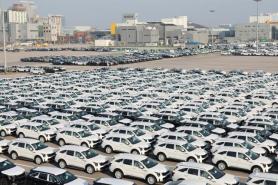
Cars stacked for export at Pyeongtaek Port. AJP Han Jun-gu SEOUL, November 23 (AJP) - South Korea's car troubles were easy to miss beneath the extraordinary export headlines fueled by memory chips. With the AI froth fizzling out, the weaknesses of another traditional export pillar are coming into sharper view. The country crossed $1 trillion in annual exports on Nov. 19, becoming only the fourth nation to do so after the United States, Germany and China. Semiconductors brought in $396.8 billion in the first 10 months, accounting for about 43 percent of the total. Cars kept a low profile at the party. Auto exports fell 1.7 percent to $58.61 billion over the same period, reducing their contribution to about 6.3 percent of export earnings. Passenger car exports fell another 5.6 percent in the first 20 days of November. While chipmakers and chip stocks stayed in the limelight throughout the year, carmakers struggled against multiple whammies: U.S. tariffs, higher production costs, sluggish demand, gaps in their model lineups and Chinese competitors offering more car for the money. Korea shipped 3.2 percent more vehicles through October but earned fewer dollars, implying a roughly 4.7 percent decline in average export value per vehicle. Hyundai Motor is struggling more than its smaller sister Kia Corp. According to their November quarterly filings, Hyundai's revenue edged up just 0.6 percent to 140.26 trillion won in the first nine months, while operating profit fell 17.7 percent to 8.04 trillion won. Kia's revenue grew 9.4 percent to 94.14 trillion won, with operating profit down a milder 8.1 percent at 6.65 trillion won. Kia retained a 7.1 percent operating margin against Hyundai's 5.7 percent, although Hyundai's consolidated business also includes substantial financial operations. Hyundai's global sales volume fell 7.0 percent to about 2.89 million vehicles through September. Kia's rose 4.4 percent to about 2.48 million. Strikes and production disruptions helped drive Hyundai's third-quarter domestic sales down 27.2 percent. Overseas wholesale sales fell 8.0 percent. The company subsequently cut its annual sales target to 4 million vehicles and lowered its operating-margin forecast to 5.5 to 6.5 percent. Edited and compiled by AJP. Graphics AI assisted Its filing shows nine vehicle production operations running at about 86.1 percent of stated capacity through September, against Kia's 95.1 percent. Hyundai's Georgia Metaplant stood at 41.4 percent, although new-factory ramp-ups and production interruptions affect those comparisons. Kia's strength has been its grip on the family-car market. Its filing credits the Sorento, Sportage and Carnival, together with new models including the Seltos, with lifting domestic sales 5.4 percent through September. Hyundai's domestic sales fell 16.3 percent over the same period, leaving its lead over Kia at barely 12,000 vehicles. The smaller sister has kept its SUV and minivan lineup supplied with powertrains buyers want, expanding hybrids alongside smaller, more affordable EVs. In the United States, Kia's hybrid sales more than doubled to about 175,000 vehicles through September, according to its filing. Overall retail sales rose 4.9 percent. Hyundai's U.S. retail sales also increased, by 3.0 percent. Europe offers a sharper contrast. Hyundai reported a 9.2 percent sales decline in its European market, citing Chinese EV competition and weakness in established volume models. Kia reported 10.0 percent growth in Western Europe, supported by its expanding EV lineup, although the companies use different regional definitions. Kia's third-quarter EV retail sales jumped 75.4 percent to 123,000 vehicles, with roughly half sold in Western Europe. For Hyundai, moving upmarket has offered less shelter than expected. Genesis, its premium brand, saw Korean sales fall 29.4 percent to 68,683 vehicles through October. Its mainstay G80 sedan and GV70 SUV date to 2020, while its first hybrid arrived only this autumn. "It is impossible to beat Chinese EVs in a price war," said Esther Yim, a Samsung Securities analyst, pinning Hyundai and Kia's slowdown on Chinese competition rather than one-off production disruptions. She expects Hyundai's global sales to fall short of 4 million units this year for the first time since 2010, excluding 2020. Investors have bought a different story. Hyundai's market value topped 100 trillion won for the first time in January after Boston Dynamics unveiled its latest Atlas humanoid at CES 2026. Cars stacked for export at Pyeongtaek Port. AJP Han Jun-gu Yet Atlas is still in training at Hyundai's Georgia plant. It is slated to start sorting parts there in 2028 and move into assembly by 2030, with roughly 25,000 units eventually headed to Hyundai and Kia plants worldwide. Hyundai's union has warned that "not a single robot" can enter its factories without a labor-management agreement. Analyst estimates put Atlas at about $130,000 per unit, with a targeted payback period of roughly two years. Vice Chairman Chang Jae-hoon has said human workers will remain essential for maintaining and training robots, while the group says the machines will take on dangerous and repetitive tasks. Autonomous driving is a sorer point. Hyundai plans to introduce Nvidia-based Level 2+ driving assistance in the first half of 2028, followed by more advanced functions later that year. Its in-house Atria AI is scheduled for production vehicles in the second half of 2029. These systems still require driver supervision. "Our partnership with Nvidia is not about leaving our destiny entirely in their hands," Park Min-woo, who heads the group's autonomous driving unit, told a media briefing. On the showroom floor, price speaks loudest. BYD's Dolphin starts at 24.5 million won, about 15 million won below the sticker price of Kia's EV3 compact SUV, though the gap narrows after subsidies for eligible Korean models. BYD lost access to government purchase subsidies in July. Hyundai's new Avante launched in August at 23.98 million won—3.64 million won above the previous entry price of 20.34 million won cited in subsequent pricing reports. The driver's instrument display was a 350,000-won option on the base trim, although Hyundai is now offering it free under a promotion running through December. Chinese production is making its presence felt well beyond Chinese badges. Tesla’s Shanghai-built Model Y sold 78,631 units in Korea through October, approaching the Sorento’s 81,717. BYD registered 21,731 vehicles, more than triple its 2025 total. Edited and compiled by AJP. Graphics AI assisted Across the market, domestic-brand sales fell 7.2 percent while imports rose 23.3 percent. Hyundai and Kia's service advantage at home is also facing a challenge. BYD has nearly doubled its Korean service network from 11 centers at launch to 21 and plans 26 by year-end. That remains far short of the more than 1,200 domestic service centers available to Hyundai and Kia customers. "Right now, everyone is focused purely on the sticker price," said Brian Lee of CLSA Securities Korea. He cautioned that resale values, service access and maintenance costs could temper Chinese brands' appeal as the market matures. Defending the sticker price is already expensive for Kia. Incentives and price reductions shaved 727 billion won from its third-quarter operating profit compared with a year earlier. Raw-material increases and the prolonged Middle East conflict added roughly 577 billion won in pressure. U.S. tariffs remained a burden even after the rate fell from 25 percent to 15 percent. Exchange rates provided some relief: both companies reported favorable currency effects in the quarter. But neither escaped a decline in nine-month operating profit. Abroad, Hyundai and Kia have all but vanished from China, where their combined retail share fell to 0.6 percent in the first nine months, from more than 10 percent at their mid-2010s peak. Their combined retail sales there fell 22 percent to about 115,000 vehicles. "Automakers exposed to price competition with Chinese EVs will see their profitability come under pressure unless they secure a competitive cost structure and differentiation," Hana Securities analyst Song Sun-jae said. Korea’s trade barriers offer less protection than those in other major markets. It charges an 8 percent tariff on Chinese passenger cars, against triple-digit U.S. duties on Chinese EVs. Lawmakers are debating whether to extend a new domestic production tax credit to EVs, which were left out of the government's August tax plan. Building more vehicles overseas can reduce tariff exposure, although those sales do not count toward Korea's vehicle exports. October brought some respite, with auto export earnings rising 18.1 percent, but the recovery has yet to erase the year’s decline. The pressure is mounting just as Seoul and Beijing warm to each other. President Lee Jae Myung and Xi Jinping agreed at the APEC summit in Shenzhen on Nov. 18 to expand cultural and content exchanges in stages. Automakers see little room for goodwill on the road. The Korea Automobile and Mobility Association has warned that Chinese EVs "could trigger the collapse of not just domestic EV makers, but the entire auto industry." For now, the trillion-dollar headline belongs to chips. Whether cars get a bigger share of the next one may be decided as much in Korea’s own showrooms as in overseas ports.
-
 BMW 5 Series maintains lead in South Korea's premium imported car market
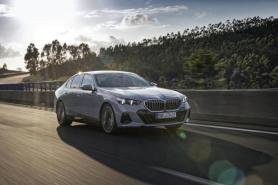
Courtesy of BMW SEOUL, November 12 (AJP) - German automaker BMW sold more than 20,000 units of its 5 Series here during the first 10 months of this year, maintaining its lead in the premium imported car market, it said on Thursday. Sales of the sedan reached 21,552 units through October, slightly up from 21,364 units in the same period last year, making it the best-selling import in its segment in South Korea. The automaker attributed the strong performance to the sedan's wide range of options including gasoline, plug-in hybrid and fully electric models, as well as convenience features available across the lineup, even in entry-level versions. The 520i was the best-selling model in the 5 Series lineup, accounting for 12,112 units or about 56 percent of total sales. It also topped sales among all individual premium imported cars available in South Korea, retaining the position for a second consecutive year. The fully electric i5 also drew strong demand, with sales reaching 2,635 units through October, up 91.6 percent from 1,375 units a year earlier.