
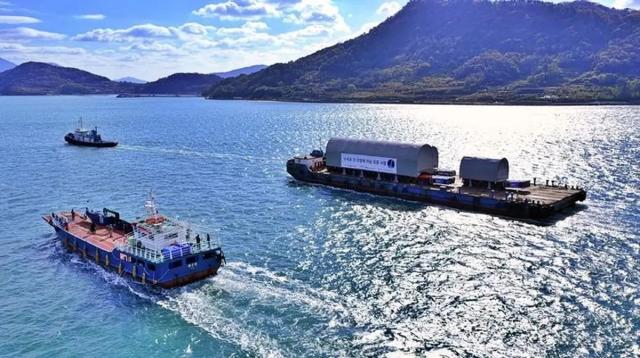
The Korea AeroSpace Administration (KASA) and the Korea Aerospace Research Institute (KARI) said Thursday they had completed a three-day trial of the rocket's land and sea transportation procedures in cooperation with Hanwha Aerospace.
Until the rocket's fifth launch this year, its first, second and third stages had been assembled and joined together at the Naro Space Center in Goheung, South Jeolla Province.
Starting with the sixth launch, Hanwha Aerospace will assemble each rocket stage separately at its Suncheon facility before transporting them by road and sea to Naro for final assembly.
The new arrangement marks a shift in South Korea's rocket production process, giving the private aerospace company a greater role in manufacturing and preparing the country's flagship launch vehicle.
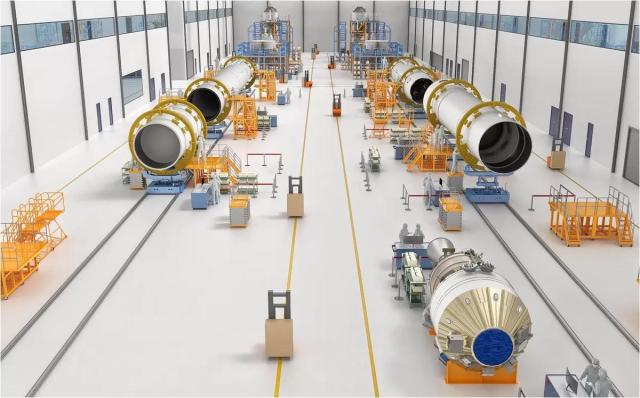
Earlier this month, Hanwha Aerospace completed construction of a roughly 60,000-square-meter space launch vehicle manufacturing center at the Yulchon Industrial Complex in Suncheon.
The facility, described as South Korea's largest privately operated rocket manufacturing plant, will handle assembly and performance testing of rocket components, including the 75-ton-class engines used in Nuri.
KARI provided technical guidance based on its experience transporting components of the earlier Naro rocket, whose first stage was manufactured in Russia and shipped to South Korea.
"Safely transporting rocket components also requires technology built on years of development and operational experience," said Lee Sang-cheol, president of KARI.
"We will carefully manage the entire transportation process to ensure the stages are moved safely and preparations for next year's sixth launch proceed without disruption," said KASA Administrator Oh Tae-seok.
The agencies said they would use the trial results to finalize preparations for transporting the rocket's actual components in 2027.

Kim Hee-su
Kim Hee-su is a bilingual reporter at AJU Press, covering defense and foreign affairs. Before joining AJP in 2025, she worked at The Korea Times, where she wrote interview stories, including a profile of North Korean defector Kim Gum-hyok, and produced digital content. She also previously worked as a researcher for KBS News 9’s International News Department, supporting correspondents in 10 countries around the world. She graduated from the University of Toronto in Canada with a double major in Book and Media Studies and East Asian Studies.
Copyright ⓒ Aju Press All rights reserved.
Related News
-
 Nuri Rocket's Fifth Launch Successful, But Concerns Raised Over Space Agency's Industrial Transition
About a week after the successful fifth launch of the Nuri rocket, lawmakers raised concerns during an audit of the Korea Space Agency (KSA) regarding the lack of a robust framework to support its industrial transition. Both ruling and opposition party members questioned the agency's opaque contracts and the ineffective operation of the interagency committee for the low Earth orbit satellite communication network.On October 13, the Science, Technology, Information, Broadcasting and Communications Committee held an audit focused on the KSA at the National Assembly in Yeouido, Seoul.KSA Administrator Oh Tae-seok announced plans to shift the agency's focus from research and development to industrial growth. He stated, "We will develop the space industry as a future national industry," emphasizing efforts to reduce launch costs through next-generation rocket development and to establish a Korean low Earth orbit satellite communication network by 2035.He added, "We will accelerate the launch of a lunar orbit communication satellite in 2029 and a small lunar lander in 2030, and we aim to secure independent lunar landing technology by 2032."Oh also expressed a commitment to fostering the relatively neglected aviation industry, stating, "We will pursue joint development of next-generation commercial aircraft alongside global players and work to enter the global supply chain. We will also actively promote the development of hybrid vertical takeoff and landing aircraft."During the questioning, topics included the status of the AI space data center, reusable rocket development, and the progress of the low Earth orbit satellite network. Concerns were raised about the KSA's internal oversight of its affiliated organizations.Democratic Party lawmaker Lee Joo-hee pointed out that the launch of a verification satellite for the AI data center is scheduled for 2030, urging for an expedited timeline. Oh responded, "The market for AI data centers in space is growing rapidly, so prompt verification is necessary. Please consider the budget for the verification satellite during the budget review process."The timeline for reusable rocket development was also disclosed. Democratic Party lawmaker Lee Jeong-heon noted that progress is being made on the next-generation rocket development project. Oh stated, "We will demonstrate basic reusable technology by 2028 and complete the hardware for the next-generation reusable rocket by 2032, after which we plan to enhance related technologies through actual operations."The Korean low Earth orbit satellite communication network, targeted for completion by 2035, faces challenges due to a lack of domestic launch vehicles. Lawmaker Lee Yeon-hee questioned whether the domestic industry could handle the plan to deploy a total of 512 satellites.Oh acknowledged, "It is difficult to launch all the satellites with just the Nuri and next-generation rockets. We will utilize foreign launch vehicles during the initial construction phase."Democratic Party lawmaker Kim Nam-guk criticized the interagency cooperation framework for the establishment of the low Earth orbit satellite communication network, stating, "The interagency task force involving the Ministry of Science and ICT, KSA, Ministry of National Defense, and Defense Acquisition Program Administration was launched in March, but there has not been a single full meeting chaired by the Prime Minister."In response, Oh noted, "While the working committee has met several times, there has not been a meeting chaired by the Prime Minister. The Ministry of Science and ICT is leading the documentation of meeting minutes, so we need to verify that."Concerns over opaque contracting practices among affiliated organizations were also raised. Lawmaker Lee Yeon-hee revealed that contracts worth a total of 49.8 billion won were awarded to companies established or acquired by former and current employees of the KSA, including one company that secured a contract for satellite ground system operation and maintenance services for six consecutive years, totaling 28.6 billion won. She also highlighted suspicions that contract information was provided to companies established by employees' relatives and friends, resulting in a 2.4 billion won contract being awarded.Oh stated, "We need to examine the situation where contracts are concentrated on specific companies due to direct contracts or the absence of competitors, and we will establish preventive measures with the Korea Aerospace Research Institute and the Korea Astronomy and Space Science Institute."The interagency coordination function of the National Space Commission was also scrutinized. Lawmaker Lee Joo-hee pointed out that the total support staff consists of only three members, which is insufficient to support interagency coordination, noting that 11 out of 12 agenda items were processed without the attendance of government members.In response, Oh emphasized the need for a permanent secretariat for the National Space Commission, similar to other committees, stating, "We have begun discussions with relevant ministries, including the Ministry of the Interior and Safety." He also mentioned that there are plans to appoint the Vice Minister of Science and Technology as a co-chair in place of the current civilian co-chair.Other topics discussed included the repeated launches of the Nuri rocket, securing independent space surveillance capabilities, selecting a site for the second space center, and improving the treatment of researchers at the Korea Aerospace Research Institute and the Korea Astronomy and Space Science Institute.* This article has been translated by AI.
-
All Nine Cube Satellites Launched by Nuri Rocket Successfully Communicate
Nine cube satellites launched into space aboard the Nuri rocket have successfully established communication.On October 13, the Korea Aerospace Administration (KASA) and the Korea Aerospace Research Institute (KARI) announced that all nine auxiliary satellites carried by the Nuri rocket have successfully communicated.SpaceLink's B-1012 achieved two-way communication during its first attempt around 2 p.m. on October 7. The Ulysses satellite from the unmanned exploration research institute, Space & Bean's SD1 satellite, and Chosun University's space optical communication orbit verification also succeeded in two-way communication around the same time.KARI's domestically developed component and part space verification platform No. 2 completed its satellite body check with two-way communication around 2:30 p.m. on the same day.Daejeon City's DaejeonSat-1 successfully communicated around 11 p.m. on October 8, confirming the satellite's normal status.CosmoWorks' Jack-007 achieved data reception around 2 p.m. on October 7, while KAIST's G-Bisat received data around 11 p.m. on the same day. O&V Space's Sledge confirmed successful data reception on October 9, verifying that solar panels and antennas were deployed normally.O Tae-seok, head of KASA, stated, "In this fifth launch of the Nuri rocket, we successfully communicated with the cube satellites in a much shorter time compared to the fourth launch. We will continue to enhance our capabilities for space transport missions in the future."Meanwhile, the Nuri rocket, carrying a total of 15 satellites, was launched into space on October 7. Among them, the auxiliary satellite 'Persat,' developed by Quaternion, was not deployed.* This article has been translated by AI.
-
Nuri Rocket Successfully Launches for the Fifth Time, One Cube Satellite Fails to Deploy
On October 7, 2026, at 12:25 PM, South Korea's Nuri rocket successfully completed its fifth flight. The weather was favorable, and preparations were flawless. Although this marked the fourth consecutive successful launch, it was the first time the rocket launched exactly on schedule without any delays. Oh Tae-seok, head of the Korea Aerospace Research Institute, held a briefing at the Naro Space Center in Goheung, Jeollanam-do, stating, "The fifth launch of the Nuri rocket was successful," and added, "The primary payload, Small Cluster Satellite 6, successfully established its first communication with the Antarctic Sejong Station at 1:08 PM." Oh praised the launch for not being delayed even by a minute, noting that this reflects an advancement in launch operation capabilities. The Nuri rocket lifted off from the second launch pad at the Naro Space Center at 12:25 PM. It successfully executed all flight procedures, including stage separations and ignition of the third stage. The automatic flight sequence lasted 22 minutes and 17 seconds. The rocket reached a sun-synchronous orbit at an altitude of 575.4 kilometers. Park Jong-chan, head of the Korean Launch Vehicle Advancement Project at the Korea Aerospace Research Institute, explained that the rocket met the target altitude of 570 kilometers within an allowable range of ±15 kilometers. However, one of the ten Cube Satellites did not deploy, leaving some disappointment. Park noted, "The non-deployed satellite was developed by Quaternion. The Nuri rocket sent the separation command normally, but we did not receive the final separation signal from the Cube Satellite." The Cube Satellites are housed in a deployment tube, and when the separation command is issued, the cover of the tube opens, allowing the satellite to be pushed out. Park indicated that the cover did not open this time, and video from the payload confirmed that the satellite did not deploy. Oh added that further analysis is needed to determine the exact cause of the failure.* This article has been translated by AI.