
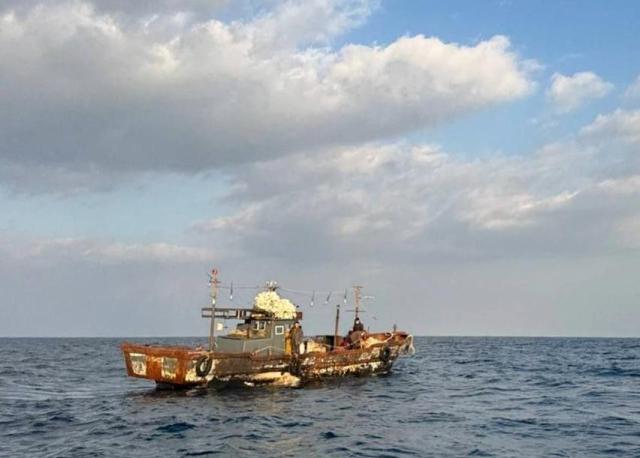
SEOUL, November 27 (AJP) - South Korea sent six North Korean fishermen home Friday, 24 days after their boat was found adrift near Ulleung Island. A seventh crew member chose to stay in the South, the Ministry of Unification said.
South Korean military and coast guard personnel found the boat in international waters north of the island on Nov. 3 and towed it to safety. Authorities interviewed the crew to establish where each person wanted to go. The six who asked to return were repatriated on humanitarian grounds, while the man who chose to stay will receive protection and resettlement support under South Korean law.
The South Korean coast guard towed the boat to near the Northern Limit Line, the de facto maritime border in the East Sea. The six men then boarded their boat and crossed the line under their own power at 8:33 a.m., meeting a waiting North Korean vessel around 9 a.m. With direct inter-Korean communication channels cut off, Seoul relayed the repatriation plan through the United Nations Command.
Lee Jung-woo
I studied philosophy in college, and sociology and journalism in graduate school. I cover North Korea, South Korean politics, foreign affairs and films. I enjoy Nordic cinema, Indian cuisine and Japanese detective novels. I have a cat and like bright, acidic coffee.
Copyright ⓒ Aju Press All rights reserved.
Related News
-
 North Korea temporarily freezes military aid to Russia, Ukraine claims
SEOUL, November 27 (AJP) - North Korea had temporarily halted military aid to Russia over Moscow's recent remarks on easing tensions on the Korean Peninsula, Ukraine's military intelligence agency claimed on Thursday. The alleged suspension includes shipments of ballistic missiles and ammunition, access to North Korean airspace for Russian military aircraft, and plans to increase North Korean troop deployments in Russia from 8,500 to 50,000. However, the claims remain unverified and contradict recent signs of closer military ties between the two countries. Just over a week ago, Russian President Vladimir Putin praised North Korean troops fighting alongside Russian forces, highlighting the close military ties between Moscow and Pyongyang. Tags: North Korea, Russia, Ukraine, Vladimir Putin, military aid, arms supplies
-
 North Korea orders Swiss mission to leave Pyongyang
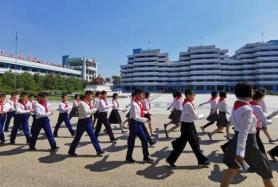
Children take part in a camp at Songdowon in North Korea, in this undated file photo from Koryo Tours, a travel agency in Beijing specializing in North Korea. SEOUL, November 25 (AJP) - North Korea ordered Switzerland to close its newly opened diplomatic office in Pyongyang and demanded that its officials leave the country within 48 hours, state media reported on Wednesday. According to the state-run Korean Central News Agency (KCNA), Pak Hyon-su, a senior North Korean Foreign Ministry official responsible for European affairs, summoned Swiss diplomat Sylvain Astier and ordered the closure of the office. Referring to him as an "unwelcome person," the ministry also demanded that he leave the country within 48 hours. The abrupt move came just a day after Kim Yo-jong, the powerful sister of North Korean leader Kim Jong-un, threatened to expel Switzerland's diplomatic mission from Pyongyang in response to Bern's sanctions on an international children's camp over its alleged involvement in the forced transfer of Ukrainian children to North Korea. She accused Bern of interfering in North Korea's internal affairs, describing the sanctions as an "open hostile act" and an infringement on North Korea's sovereignty. The Songdowon camp, established in 1960 on North Korea's east coast, has hosted children from countries friendly to Pyongyang including China and Russia. However, the European Union accused the camp of participating in programs that brought Ukrainian children from Russian-occupied territories to North Korea, where they were allegedly exposed to pro-Russian propaganda. Switzerland soon followed suit by imposing sanctions on the camp. The development comes just weeks after Switzerland opened its first diplomatic office in Pyongyang since establishing diplomatic relations with North Korea in 1974. Swiss Foreign Minister Ignazio Cassis visited North Korea late last month to attend the office's opening ceremony and hold talks with senior officials including Workers' Party secretary Jo Yong-won and Foreign Minister Choe Son-hui.
-
Hong Ik-pyo: North Korea Policy to Start with Realistic Approaches
Hong Ik-pyo, the nominee for Minister of Unification, stated that he aims to inherit the overarching framework of peace coexistence on the Korean Peninsula established by former Minister Jeong Dong-young, while pursuing low and realistic tasks in a manner akin to 'moving mountains with a mouse.' He emphasized the importance of public participation, social consensus, international cooperation, and coordination among foreign affairs and security ministries. Rather than completely overhauling policy direction, he intends to adjust the pace and methods of implementation to align with reality.During his first door-stepping event on November 26 at the North-South Dialogue Headquarters in Jongno, Seoul, Hong said, "We will not rush toward the goal of peace coexistence on the Korean Peninsula, but we will not stand still either." He introduced the idioms 'moving mountains with a mouse' and 'maintaining vigilance' and added, "We will make every effort to realize our aspirations under a consistent and sustained goal."His remarks are interpreted as a policy proposal to restore trust by accumulating small achievements rather than attempting to transform the long-disrupted inter-Korean relations all at once.If given the opportunity to serve as minister, Hong emphasized that he would focus on easing and resolving hostilities between the North and South, stating, "I will build trust between the two Koreas through small actions." He further stated, "I will secure public support based on concrete and realistic outcomes."When asked by reporters about specific plans to break the deadlock in inter-Korean relations, he responded, "I will make every effort to identify realistic and feasible tasks, and I believe it is preferable to present low and realistic solutions to address issues, considering the current state of inter-Korean relations and the situation on the Korean Peninsula."Hong also proposed expanding public participation in the formation and implementation of North Korea policy. He remarked, "The Lee Jae-myung government is a government of popular sovereignty," and pledged to work on expanding public involvement in the formation and implementation of North Korea policy that aligns with this principle, as well as broadening the foundation for social consensus.He identified cooperation with relevant countries and the international community as a key task. Hong stated, "Cooperation with relevant countries and the international community has become very important in the context of the Korean Peninsula situation," and expressed his commitment to strengthening diplomatic capabilities for peaceful unification and stability on the Korean Peninsula. He emphasized that "peace on the Korean Peninsula is the most important task for realizing the national interests of South Korea."Regarding differences between foreign affairs and security ministries, he acknowledged that it is natural for different perspectives to exist. Hong stated, "The Ministry of Foreign Affairs has its perspective, the Ministry of National Defense has its perspective, and the Ministry of Unification has its perspective," and he does not view these as disharmony or conflict.However, he noted, "What is important is that we are on the same boat under the Lee Jae-myung government," and he expressed his intention to create a consensus on the government's foreign affairs and North Korea policies while coordinating various positions and realistic alternatives. He added, "I will do my utmost to create a foundation for implementing consistent policies without wavering based on this."Regarding the policies promoted by former Minister Jeong, he stated, "I plan to go along with the larger framework." However, he mentioned that for issues such as the renaming of North Korean defectors, which are currently under public consultation, he plans to make realistic adjustments based on the results of the Ministry of Unification's consultations and through public consensus if necessary.He clarified that the concept of 'peaceful two-state relations aimed at unification' is not yet the official position of the government. Hong explained, "This is one of the options being considered by the Ministry of Unification, taking into account the realistic inter-Korean relations," and noted that the simultaneous admission of North and South Korea to the United Nations in 1991 has effectively established the two states in international law.He also pointed out that under domestic law, inter-Korean relations are considered a special relationship aimed at unification, stating, "We must gather wisdom with the public to determine what is the most desirable approach to open the future of the Korean Peninsula, considering relevant laws and the simultaneous UN membership, among other factors." He distanced himself from claims that some domestic factions have aligned with North Korean leader Kim Jong-un's declaration of 'hostile two states.'Regarding allegations of self-plagiarism in his doctoral thesis, Hong acknowledged, "It is true that there are aspects that do not fully comply with current research ethics regulations," but explained, "At the time of writing the thesis, there were no precise standards for the relevant regulations, and both studies were written almost simultaneously." He added, "I do not believe I have seriously violated research ethics."* This article has been translated by AI.