

[Courtesy of Sony]
Sony's much anticipated 'PlayStation VR' release schedule and its price is revealed. The virtual reality (VR) headset will cost US$ 399, and will be available in October.
Andrew House, Sony's President announced the cost and release schedule of the PlayStation VR during a press event held at San Francisco on Tuesday. The headset costs $200 less than the Oculus Rift, and $400 less than the HTC's Vive headset. With the PlayStation VR's release, Schedules and prices of all four major VR headsets to be released this year had been revealed.
According to Sony officials, around 160 game titles are under development phase, and 50 game titles are to be released this year.
The PlayStation VR will need a PlayStation 4 and PlayStation Camera to run, which is available for prices around $349. It would cost $749 to have the full VR system ready to play. Although it may seem a bit pricey to enjoy the world-popular VR at home, but considering Oculus Rift and HTC Vive need a computer with the latest hardware to run, it is relatively cheaper.
To run Oculus Rift and HTC Vive smoothly, the companies expect a PC which costs around $800.
아주경제 박세진 기자 = swatchsjp@ajunews.com
Copyright ⓒ Aju Press All rights reserved.
Related News
-
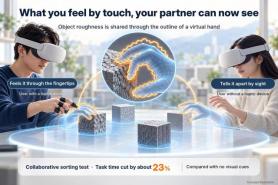 KAIST VR tool shows surface roughness to users without haptic gear
Courtesy of KAIST SEOUL, November 03 (AJP) - People working together in virtual reality can now tell how rough an object feels to a partner even without touch-feedback equipment of their own, using a KAIST technique that turns roughness into the shape and motion of a virtual hand's outline. In a joint sorting task, pairs finished about 23 percent faster when the roughness cues appeared on both partners' virtual hands than when no cues were shown, and they kept sorting accuracy high, the university said Tuesday. The research came from Professor Woo Woon-tack's Ubiquitous Virtual Reality Lab at KAIST's Graduate School of Metaverse. It won the Best Paper Award at the IEEE International Symposium on Mixed and Augmented Reality (ISMAR) 2026, an international conference on virtual and mixed reality, giving the team the award for the third year running. When several people work in a shared virtual space, what each of them can perceive depends on the equipment they use. One person may wear a haptic device, which recreates the sense of touch by sending vibrations to the fingertips. A partner without one has to judge an object by sight alone. Because only one side receives touch information while examining the same object, the two can struggle with tasks such as choosing or sorting items together. The researchers call this gap sensory asymmetry. Instead of trying to recreate the same sensation on the second user's skin, the team made roughness visible. When a user touches a virtual object, the outline drawn around the virtual hand changes its shape and movement to signal one of three levels, low, medium or high. Two preliminary experiments checked whether people could tell the visual signals apart and whether each signal matched the roughness felt through the haptic device. The team then split 48 participants into 24 pairs, each made up of one person with a haptic device and one without, and had them sort objects together in virtual reality. The pairs worked under different conditions, with no cues, cues on one partner's hand, or cues on both. Showing the cues on both hands produced the 23 percent time saving. When the cues appeared on their own virtual hand, participants without haptic devices also rated their confidence in their judgments and their sense of contributing to the task higher. The team said the results show that people do not need identical touch equipment to share the information they need to make decisions together. The experiment also found that collaboration depends not only on how roughness is displayed but on whose hand displays it. KAIST said the technology could be used in remote collaboration, virtual product evaluation, and VR education and training, where only some participants may own haptic devices. Sharing surface information visually would let others take part in assessing materials. The work remains at the user-experiment stage. KAIST said the study has verified the interface's effect and design direction through user experiments, and that applying it in real settings will require further testing across a wider range of users, tasks, devices and work environments. The lab's earlier wins came in 2024, for research on remote collaboration in mixed reality, and in 2025, when two of its papers on space sharing and visual-tactile experience were selected at the same time. "Winning three years in a row is a meaningful result achieved through the government's support for training and research in virtual convergence, KAIST's research base and the convergence research of young researchers," Woo said. He said the lab would keep combining extended reality, a term covering virtual, augmented and mixed reality, with artificial intelligence to share knowledge and experience "beyond the limits of time and space." Baeck Min-ju, a doctoral student in KAIST's Graduate School of Culture Technology, was the paper's first author. Shin Yoon-seok, Lee Hyun-jin, Yoon Bo-ram, Yoon Sang-ho and Woo were co-authors. The paper was accepted for publication in IEEE Transactions on Visualization and Computer Graphics, presented at ISMAR 2026 and named a best paper on Oct. 6. The research was supported by the virtual convergence graduate school program of the Ministry of Science and ICT and the Institute of Information and Communications Technology Planning and Evaluation. Journal/Source: IEEE Transactions on Visualization and Computer Graphics Title: Sharing Roughness with Hand-Outline Visualization to Reduce Sensory Asymmetry in VR Collaboration Link/DOI: https://arxiv.org/abs/2608.29040
-
 GIST Develops VR Technology to Reduce Motion Sickness in Vehicles
GIST AI Convergence Department doctoral students Kang Yu-min, Kang Sung-jun, Kim Kwang-bin, Professor Kim Seung-jun, and postdoctoral researcher Ahmed Elsharkawy, along with doctoral student Yeo Do-hyun and master's student Kim Bo-cheon. Researchers in South Korea have developed a virtual reality (VR) technology that converts physical sensations experienced during vehicle acceleration and turns into visual effects, aiming to reduce motion sickness and enhance immersion. On May 18, the Gwangju Institute of Science and Technology (GIST) announced that a research team led by Professor Kim Seung-jun from the AI Convergence Department has created 'Force Mapping' technology, which transforms the actual movements of vehicles into visual and spatial changes in a VR environment. The findings were presented at the prestigious ACM CHI 2026 conference in April, focusing on human-computer interaction. Force Mapping utilizes an Inertial Measurement Unit (IMU) device and GPS module to detect real-time vehicle movements, including acceleration, deceleration, rotation, and road vibrations. These movements are then represented in the VR environment through effects such as falling objects, spatial shaking, waves, and ripples. Previous VR research for vehicles primarily focused on aligning the vehicle's travel path with virtual scenes to mitigate motion sickness. However, this approach failed to bridge the gap between the physical sensations of acceleration and rotation felt by the body and the virtual space displayed on the screen, resulting in a passive content experience. The research team conducted comparative experiments between the traditional method of simply reflecting vehicle movements on the screen and the Force Mapping approach. The results showed that the Force Mapping condition significantly improved immersion and situational awareness while statistically reducing motion sickness. Notably, emphasizing directionality and intensity rather than merely replicating physical forces led to a greater sense of alignment with bodily sensations. The effects of ground tilt and spatial shaking were particularly pronounced in enhancing immersion during acceleration and deceleration scenarios. This research highlights the potential for VR technology in vehicles to go beyond merely alleviating motion sickness, suggesting that it could transform travel time into an opportunity for gaming, entertainment, education, and remote collaboration through various extended reality (XR) content experiences. As the era of autonomous driving becomes more tangible, the commercial value of this technology is expected to grow significantly. Professor Kim Seung-jun stated, "We plan to further develop sophisticated and diverse environmental feedback technologies to expand vehicle movement itself into an immersive interface, considering future autonomous driving environments."* This article has been translated by AI.
-
 TWS VR Concert Film 'Rush Road' Tops 40,000 Viewers in Korea
TWS VR concert film “Rush Road” (Amaze) K-pop group TWS has wrapped up its first VR concert film, “TWS VR CONCERT : RUSH ROAD,” after a successful run in South Korea. The film surpassed 40,000 cumulative viewers and posted an average seat occupancy rate of 81%. The results came despite a limited release in a single theater, outperforming previous VR concert titles and setting a notable mark in the K-pop VR concert market. “Rush Road” sold out repeatedly from its opening week, prompting extended screenings and multiple repeat viewings that sustained demand. After tickets went on sale, individual showings quickly sold out, and the title rose to No. 1 on the Megabox box office. It maintained steady occupancy through the end of its run. The company credited the performance in part to the members’ hands-on involvement. From early production, the group contributed ideas on performance structure and camera direction to improve the final product. They also met audiences in person at stage greetings held shortly after release and continued fan engagement through the Weverse community. Audience feedback was also strong, with favorable reviews posted on Megabox and on social media. The film drew not only the group’s fan base, known as “42,” but also a sizable share of general moviegoers and fans of other artists, suggesting VR concerts can serve as an entry point beyond core fandom. The film opens at a rock festival setting and moves through locations including a rooftop and an aurora-themed space, aiming to heighten immersion. It also features close-range performances designed for VR viewing. After ending its domestic run, “TWS VR CONCERT : RUSH ROAD” is continuing with sequential screenings in major cities overseas.* This article has been translated by AI.