

[Courtesy of Samsung Heavy Industries]
SEOUL -- Harmful air pollutants emitted from shipyards come mostly from volatile organic compounds used in solvent-based paints. As an alternative, solvent-free paints have been recommended, but it's been difficult to use them for commercial ships because of high viscosity.
Samsung Heavy Industries, one of South Korea's three leading shipbuilders, said Wednesday that its research team has teamed up with Jotun, a Norwegian chemicals company dealing in decorative paints and performance coatings, to overcome the technical limitations of solvent-free paints.
Solvent Free Coating (SFC), a technology developed jointly by Samsung Heavy and Jotun, contains almost no solvents. There is no danger of fire or explosion and it is eco-friendly, the shipbuilder said, adding that at the same time, surface protection is excellent.
Samsung Heavy said that SFC was used for a liquefied natural gas (LNG) carrier for the first time in the world, opening the way for the development of automation equipment such as paint robots. It has been difficult for shipyards to introduce automation technology in coating work due to the explosion risk of solvent-based paints.
Since the viscosity of new paints is low, it is easy to work and realize the coating of the desired thickness so that the construction period can be remarkably shortened, the shipbuilder said.
Copyright ⓒ Aju Press All rights reserved.
Related News
-
 South Korea makes good weapons. Is it ready for war?
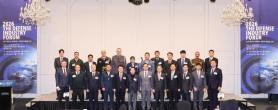
Panelists discuss the competitiveness of South Korea's defense industry and the modernization of its military in the AI era at the 2026 Defense Industry Forum at Nine Tree Premier ROKAUS Hotel in Yongsan, Seoul, on Nov. 20, 2026. From left: Choi Ki-il, professor at Sangji University; Chang Won-jun, professor at Jeonbuk National University; Kim Yoon-tae, former president of the Korea Institute for Defense Analyses (KIDA); Yang Uk, research fellow at the Asan Institute for Policy Studies; and Eom Hyo-sik, director of defense industry and security at the Korea Defense and Security Forum. AJP Yoo Na-hyun SEOUL, November 20 (AJP) - South Korea’s weapons are selling well abroad, but its military’s readiness for future warfare is less assured, experts warned Friday, pointing to outdated procurement practices, limited investment in military AI and an emphasis on hardware over battlefield effectiveness. “Our companies are developing weapons for the future, but we have to ask if our government and military are postured for the wars of the past,” said Yang Uk, a research fellow at the Asan Institute for Policy Studies. Speaking at the 2026 Defense Industry Forum in Seoul, Yang drew a distinction between the country’s success as an arms manufacturer and its ability to put those weapons to effective use. “The ability to manufacture good weapons and the ability to win wars are two entirely different things,” he said. The forum brought together government officials, lawmakers, defense executives and military experts, along with military attachés from nine countries, to discuss how artificial intelligence is changing warfare. Jointly organized by Aju Business Daily, the Korea Defense Industry Association and Jeonbuk National University, the event featured a keynote address by former Vice Defense Minister Shin Beom-chul, presentations by Hanwha Aerospace and HD Korea Shipbuilding & Offshore Engineering, and a panel on industrial competitiveness and military modernization. Yang pointed to Ukraine, where relatively inexpensive drones have destroyed tanks and other equipment worth millions of dollars, as evidence that conventional measures of military strength are becoming less reliable. South Korea, he argued, remains too focused on how many tanks, fighter jets and warships it can acquire, with insufficient attention to how effectively they can operate together. He also questioned the government’s plan to train 500,000 military personnel in drone operations, arguing that developing even 100 highly skilled operators could matter more than expanding the headcount. For defense companies, the obstacles begin long before their technology reaches the battlefield. Choi Ki-il, a professor of military studies at Sangji University, identified three barriers to developing military AI: unclear requirements, restricted access to military data and insufficient funding. Domestic companies are increasing their AI investment, he said, but the military has yet to clearly explain what it needs. Companies also struggle to obtain the operational data necessary to develop and train their systems. According to Choi, only about 340 billion won of this year’s roughly 66 trillion won defense budget was allocated to military AI and systems enabling soldiers and unmanned equipment to operate together. That amounts to about 0.5 percent of the budget — roughly the cost of three KF-21 fighter jets, he said. Choi also warned of South Korea’s heavy reliance on Chinese-made drone components. He called for greater investment in domestic production and stronger protection against cyberattacks on unmanned systems. Chang Won-jun, a professor at Jeonbuk National University, said manufacturing prowess alone would no longer be enough to sustain South Korea’s position in the global arms market. Participants pose for a group photo at the 2026 Defense Industry Forum at Nine Tree Premier ROKAUS Hotel in Yongsan, Seoul, on Nov. 20, 2026. Clockwise from top left: Meinardo Cabral, head of the Science, Technology and Innovation Section at the Brazilian Embassy; Rafael Jose Vieira Barreto, Brazil's defense, army, navy and air force attaché; Aldrin Gacusan, Philippine naval attaché; Ahmed Elhadidi, Egyptian military attaché; Pawel Janik, Polish military attaché; Pamela T. Stein, U.S. Air Force attaché; Yang Uk, research fellow at the Asan Institute for Policy Studies; Boldkhuu Batkhuyag, Mongolian military attaché; Eom Hyo-sik, director of defense industry and security at the Korea Defense and Security Forum; Park Mae-hoon, head of the Fourth Business Division at Hanwha Aerospace's Land Systems Business Group; Aqeel Ibrahim Mohammed Al-Karawi, Iraqi defense attaché; Yeo Sang-jae, team leader of unmanned and autonomous vessel research at HD Korea Shipbuilding & Offshore Engineering; Choi Ki-il, professor of military studies at Sangji University; Antonio P. Villareal, Jr., second secretary at the Philippine Embassy; Chang Won-jun, professor of advanced defense industry studies at Jeonbuk National University; Shin Beom-chul, senior research fellow at the Sejong Institute; Lee Nam-woo, executive vice chairman of the Korea Defense Industry Association; Kim Il-dong, acting head of the Defense Acquisition Program Administration; Rep. Yoo Yong-won, member of the National Assembly's National Defense Committee; Kwak Young-kil, chairman of Aju News Corporation; Kim Ki-young, director general for force policy at the Ministry of National Defense; Yang O-bong, president of Jeonbuk National University; Gino Chretien, Canadian defense attaché; and Tanel Sepp, Estonian ambassador to South Korea. AJP Yoo Na-hyun Despite years of efforts to promote military AI, he said, AI-based weapons remain difficult to find among the approximately 200 weapons development projects overseen by the Defense Acquisition Program Administration (DAPA). He advocated pursuing domestic AI development alongside partnerships with foreign companies that already have expertise. HD Hyundai’s partnership with U.S. defense technology company Anduril Industries to develop unmanned vessels offers one example of how Korean manufacturers can combine their industrial capabilities with foreign technology. But partnerships will have limited value if procurement cannot keep pace. Conventional weapons programs can take years to move from development to deployment. AI and drone technologies evolve much faster, raising the risk that equipment will be outdated before it reaches troops, Chang said. He called for procurement procedures that would allow new equipment to be introduced within 60 to 90 days and prototypes to be developed within a year. Companies could then improve their products continuously using feedback from soldiers. Eom Hyo-sik of the Korea Defense and Security Forum questioned whether the military still treated future warfare as a distant concern. “In the past, when we talked about the future, we usually meant 20 or 30 years from now. Today, the future could be as soon as next week,” Eom said. North Korean drones were first discovered in South Korea in 2014, he noted. More than a decade later, the country is still debating how to counter the threat. A panel discussion on the competitiveness of South Korea's defense industry and the modernization of its military in the age of AI warfare takes place at the 2026 Defense Industry Forum at Nine Tree Premier ROKAUS Hotel in Yongsan, Seoul, on Nov. 20, 2026. From left: Choi Ki-il, professor at Sangji University; Chang Won-jun, professor at Jeonbuk National University; Kim Yoon-tae, former president of the Korea Institute for Defense Analyses and moderator of the discussion; Yang Uk, research fellow at the Asan Institute for Policy Studies; and Eom Hyo-sik, director of defense industry and security at the Korea Defense and Security Forum. AJP Yoo Na-hyun With many modernization projects scheduled for completion in the 2030s, Eom questioned how the military would address its vulnerabilities in the intervening years. He also urged South Korea to nurture domestic AI startups alongside partnerships with global companies, noting that Palantir Technologies and Anduril had themselves begun as small businesses. The urgency extends to the heavily guarded border with North Korea, where a shrinking pool of recruits is accelerating plans to replace some personnel with unmanned surveillance systems. Yang said the military plans to reduce the number of troops guarding front-line positions from approximately 22,000 to 6,000. Greater reliance on technology is inevitable, he acknowledged, but troop reductions should follow proof that unmanned alternatives can do the job. “The true advancement of K-defense is not achieved by selling more weapons, but by building a military capable of winning future wars,” Yang said.
-
 2026 Defense Industry forum held in Seoul
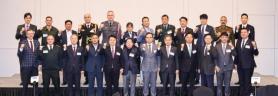
AJP Yoo Na-hyun Participants pose for a group photo at the 2026 Defense Industry Forum held at Nine Tree Premier ROKAUS Hotel Seoul Yongsan in Yongsan-gu, Seoul, on November 20, 2026. Clockwise from the top left are Rafael Jose Vieira Barreto, Brazilian defense, army, navy and air attaché; Gino Chretien, Canadian defense attaché to South Korea; Navy Capt. Aldrin Gacusan, naval attaché at the Philippine Embassy in Seoul; Ahmed Elhadidi, attaché at the Egyptian Embassy in Seoul; Pawel Janik, attaché at the Polish Embassy in Seoul; Pamela T. Stein, air attaché at the U.S. Embassy in Seoul; Yang Wook, research fellow at the Center for Foreign Policy and National Security of the Asan Institute for Policy Studies; Boldkhuu Batkhuyag, attaché at the Mongolian Embassy in Seoul; Eom Hyo-sik, head of the Defense Industry and Security Division at the Korea Defense Security Forum; Park Mae-hoon, head of the 4th Business Group at Hanwha Aerospace's LS Business Division; Aqeel Ibrahim Mohammed Al-Karawi, Iraqi defense attaché to South Korea; Yeo Sang-jae, team leader at HD Korea Shipbuilding & Offshore Engineering's Autonomous Unmanned Naval Vessel Research Laboratory; Choi Ki-il, professor of military studies at Sangji University; Antonio P. Villareal, Jr., second secretary at the Philippine Embassy in Seoul; Jang Won-jun, professor of advanced defense industry at Jeonbuk National University; Shin Beom-chul, senior research fellow at the Sejong Institute; Lee Nam-woo, executive vice chairman of the Korea Defense Industry Association; Kim Il-dong, acting administrator of the Defense Acquisition Program Administration; Yoo Yong-won, member of the National Assembly's National Defense Committee; Kwak Young-gil, chairman of Aju News Corporation; Kim Ki-young, director general for force policy at the Ministry of National Defense; Yang Oh-bong, president of Jeonbuk National University; Gino Chretien, Canadian defense attaché to South Korea; and Tanel Sepp, Estonian ambassador to South Korea. AJP Yoo Na-hyun
-
 US maritime officials visit HD Hyundai's shipyard in Ulsan
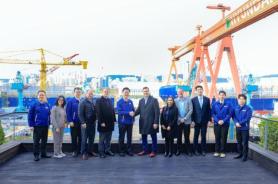
HD Hyundai Heavy Industries' president Joo Won-ho (6th from left) and U.S. Maritime Administration (MARAD) deputy administrator Mark D. Johnson (7th from left) pose for a group photo at a shipyard in Ulsan on Nov. 19, 2026, in this photo provided by the shipbuilder. SEOUL, November 20 (AJP) - Officials from the U.S. Maritime Administration (MARAD) visited HD Hyundai Heavy Industries' shipyard in Ulsan, the shipbuilder said on Friday. The delegation, led by Mark D. Johnson, deputy administrator of the U.S. federal agency, visited the shipyard the previous day to discuss cooperation in the construction of military support vessels and port infrastructure. They also discussed HD Hyundai's joint venture with Nebraska-based engineering firm Kiewit to build a new shipyard in the U.S. Construction is targeted to begin in 2027, with operations expected to start in 2029. The facility is expected to produce military logistics vessels and ship modules. The discussions come as Washington seeks to revitalize its shipbuilding industry through its "Bridge Strategy," which leverages the technology and production capabilities of overseas shipbuilders by allowing the initial vessels under multi-ship contracts to be built at allied foreign shipyards, while foreign partners invest capital and transfer technology. "We plan to work closely with MARAD to produce vessels and port equipment needed by the U.S., drawing on more than 50 years of shipbuilding experience and contribute to the modernization of its ports," said the shipbuilder's president Joo Won-ho. The latest visit follows an earlier trip to the shipyard on Nov. 4 by senior U.S. military officials including Brendan Rogers, assistant secretary of the Navy for Energy, Installations and Environment, and Andrew Niebel, director of facilities and logistics for the U.S. Marine Corps.