

[Photograph by Yoo Dae-gil = dbeorlf123@ajunews.com]
The KF-X project aimed at manufacturing 120 fighter jets that would replace South Korea's aged fleet of US-made F-4 and F-5 fighters began in January 2016, led by a consortium of KAI and US aerospace giant Lockheed Martin.
KAI showcased its actual model Monday at Seoul ADEX 2019, an aerospace and defense exhibition held at a military airport in Seongnam, south of Seoul. Specifications outlined by KAI showed that the fighter's maximum speed is Mach 1.81 with its range put at 2,900 kilometers (1,798 miles). With a maximum payload of 7,700 kilograms, 10 "pods" for missiles and fuel barrels are installed on the bottom of the fuselage and wings.
KAI said The KF-X fighter can carry German-made IRIS-T air-to-air missiles, advanced medium-range air-to-air missiles (AMRAAMs), and BLU-109 laser-guided bombs (LJDAMs) as well as long-range air-to-ground guided weapons. In particular, four AMRAAMs can be mounted inside the fuselage to strengthen steal function.
The exterior is similar to F-35A, but KAI said it costs about half less to operate and has better mobility.
As Washington has been reluctant to allow Lockheed to transfer technologies related to the active electronically scanned array (ASEA) radar and other core components, South Korea sought to receive technical support from an Israeli firm for the development of the AESA, a more advanced and sophisticated system which can radiate multiple beams of radio waves at multiple frequencies simultaneously.

Copyright ⓒ Aju Press All rights reserved.
Related News
-
 Korea unveils first domestically built KF-21 fighter jet
The first production KF-21 Boramae fighter jet is unveiled at Korea Aerospace Industries (KAI) in Sacheon, South Gyeongsang Province, March 25, 2026. Yonhap SEOUL, March 25 (AJP) - South Korea rolled out the first mass-produced KF-21 Boramae fighter jet on Wednesday, marking a major milestone in the country’s decades-long push to develop the domestically built 4.5-generation supersonic fighter. President Lee Jae Myung, who attended the ceremony at Korea Aerospace Industries (KAI) in Sacheon, described the rollout as a historic step toward strengthening self-reliant defense capabilities. “South Korea has finally secured weapons developed with our own technology and determination to protect peace not only on land and sea, but also in the skies,” Lee said. “This marks a proud achievement for self-reliant national defense,” Lee said, calling the moment a “historic milestone” for the nation. About 500 attendees joined the ceremony, including test pilots of the KF-21, defense industry officials, air force cadets, students from the aviation science high school and diplomatic representatives from 14 countries. The KF-21 Boramae is a 4.5-generation supersonic fighter jet developed by KAI in cooperation with the Republic of Korea Air Force and the Agency for Defense Development under the KF-X (Korea Fighter eXperimental) program. Lee emphasized that the KF-21 represents decades of national ambition. “This fighter, designed with our own technology and built by our own hands, embodies our long-standing aspiration for self-reliant defense,” he said. He also highlighted the long development process, noting that the project dates back to 2001 when then-President Kim Dae-jung first announced plans to develop a domestically produced fighter jet. “This historic achievement did not come easily,” Lee said. “For 25 years, our researchers and military personnel overcame countless challenges and turned what once seemed impossible into reality.” He added that the KF-21’s success goes beyond strengthening national defense saying that the jet has already drawn strong interest from overseas even before its rollout. Lee also noted that South Korea has already demonstrated its defense capabilities through exports such as the K9 self-propelled howitzer and the Cheongung air defense missile system. The KF-21 is expected to be deployed to the South Korean Air Force later this year. According to government and industry officials, the fighter jet is drawing interest from several countries, including the United Arab Emirates, Saudi Arabia, the Philippines and Poland, in addition to Indonesia, which has already signed on as a development partner. With the KF-21 rollout, South Korea has become the eighth country or region to successfully develop a 4.5-generation or higher supersonic fighter jet, joining the United States, China, Russia, Japan, France, Sweden and a European consortium.
-
 President Moon hails rollout of home-made fighter jet as 'historic milestone'
SEOUL -- After nearly two decades of strenuous work to shake off doubtful or sometimes depreciatory eyes from top-class foreign aircraft makers, South Korea finally rolled out the first prototype of its home-made fighter jet which was hailed by President Moon Jae-in as a "historic milestone" in independent aircraft development. The jet fighter was christened "KF-21 Boramae (Young Hawk)" in a ceremony chaired by Moon at the base of Korea Aerospace Industries (KAI), the sole aircraft maker in South Korea, in the southern city of Sacheon. "A new era of self-defense has opened," Moon said, adding the advantages of homemade fighter jets are "indescribable." The KF-X project is aimed at manufacturing 120 fighter jets that would replace South Korea's aging fleet of US-made F-4 and F-5 fighters. Specifications outlined by KAI showed that the fighter's maximum speed is Mach 1.81 with its range put at 2,900 kilometers (1,798 miles). With a maximum payload of 7.7 tons, 10 "pods" for missiles and fuel barrels are installed on the bottom of the fuselage and wings. Research began 20 years ago. However, South Korea had to officially launch the project led by a consortium of KAI and US aerospace giant Lockheed Martin in January 2016 due to technical reasons. Washington has been reluctant to transfer sensitive technologies for stealth fighters and an advanced radar system, prompting South Korea to acquire related technologies independently or through cooperation with other foreign companies. "The success of developing high-tech Korean fighter jets not only strengthens our national defense but also has a tremendous economic impact," Moon said. "It is installed with state-of-the-art (radar) equipment developed by our own technology," he said, referring to the Active Electronically Scanned Array (AESA) system. AESA is a computer-controlled array antenna system that can electronically steer the beam of radio waves to point in different directions, allowing aircraft to radiate powerful radar signals while still remaining stealthy. South Korea has developed AESA technology with the help of an Israeli firm. South Korea has yet to overcome challenges such as the development of a long-range missile and Indonesia's lackluster attitude. Initially, Indonesia agreed to invest some 1.7 trillion won ($1.5 billion), or 20 percent of total expenses, in return for gaining access to some technical data and information and producing 50 planes on its home soil. Indonesia has paid only 227.2 billion won out of 831.6 billion won due in February. The ceremony in Sacheon was attended by an Indonesian delegation led by Defense Minister Prabowo Subianto. "We will be together until the development is completed and the two countries jointly enter the third country market with a mass production system," Moon said, urging Indonesia to honor its commitment. Along with the development of seekers for missiles to track ground and air targets, South Korea should acquire independent technologies related to a long-range air-to-ground missile system. Germany's IRIS-T and MBDA's Meteor have been selected for air-to-air short- and mid-range missiles. As for the long-range air-to-ground weapon, South Korea has pushed for the development of its air-launched cruise missile (ALCM) by 2028.
-
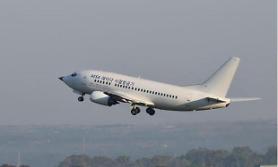 Date set for flight test to verify performance of AESA radar for KF-21 fighter jet
SEOUL -- A flight test to verify the performance of a computer-controlled array antenna system for South Korea's homemade KF-21 fighter jet will begin in domestic airspace in mid-March, using a Boeing 737-500 plane modified into a flying testbed in South Africa. The system is an essential device that determines the survival of fighter jets in aerial warfare and is used to detect, track and form images of aerial and ground targets. Active electronically scanned array (AESA) radars can electronically steer the beam of radio waves to point in different directions, allowing aircraft to radiate powerful radar signals while still remaining stealthy. AESA radars can spread signal emissions across a wider range of frequencies, allowing aircraft to radiate powerful radar signals while still remaining stealthy. Radar function and performance tests have been completed abroad through 10 sorties in November and December 2021. The domestic test will run until April next year before a KF-21 jet fighter installed with the system conducts the final stage of evaluation until the first half of 2026, according to the Defense Acquisition Program Administration (DAPA), a state arms procurement agency controlled by the Defense Ministry. About 62 items will be tested through a total of 50 flights, along with the test of a detection and tracking function in an air-to-air mode and the design verification of acquiring synthetic property radar (SAR) images. SAR is a form of radar that is used to create two-dimensional images or three-dimensional reconstructions of objects, such as landscapes. "The KF-21 AESA radar's performance will be more stabilized through domestic flight tests," Roh Ji-man, a DAPA official in charge of the KF-21 project, said in a statement on March 4. US companies such as Lockheed Martin were involved in the KF-X project, but Washington has been reluctant to transfer key technologies for stealth fighters and an advanced radar system, prompting South Korea to acquire related technologies independently or through cooperation with other foreign companies. The state-run Agency for Defense Development (ADD) and Hanwha Systems, a provider of defense products and technologies, have been involved in the development of AESA and automatic terrain-following and terrain avoidance technologies that allow high-tech aircraft to make detection by enemy radar more difficult by flying low and safe along the terrain. Additional flights will be conducted in South Africa and South Korea to test topographic tracking and avoidance functions. The first AESA prototype was unveiled in 2020 and sent to ELTA Systems, an Israeli provider of defense products, for ground and flight tests. In 2021, South Korea rolled out the first KF-21 prototype installed with an AESA system, after nearly two decades of strenuous work to shake off doubtful or sometimes depreciatory eyes from top-class foreign aircraft makers. With AESA radars, it is possible to detect a large area, perform multiple missions, and engage multiple targets simultaneously, Hanwha Systems said, adding that fast beam steering is possible by electronically controlling a thousand small transmission and reception integration modules fixed to the front of the radar. "We will challenge the global market as well as contribute to the successful development of homemade fighter jets by optimizing the performance of AESA radar's demands through the remaining domestic and international flight tests," said Hanwha Systems CEO Eoh Sung-chul, showing confidence over the development of a reliable system that can be sold abroad and dispel concerns about independent technology development caused by Washington's refusal to transfer technology. The KF-21 project is aimed at manufacturing 120 fighter jets that would replace South Korea's aging fleet of US-made F-4 and F-5 fighters. Specifications outlined by Korea Aerospace Industries (KAI), the sole aircraft maker in South Korea, showed that the fighter's maximum speed is Mach 1.81 with its range put at 2,900 kilometers (1,798 miles). With a maximum payload of 7.7 tons, 10 "pods" for missiles and fuel barrels are installed on the bottom of the fuselage and wings. South Korea has yet to overcome challenges such as the development of a long-range missile system and seekers for missiles to track ground and air targets. Germany's IRIS-T and MBDA's Meteor have been selected for air-to-air short- and mid-range missiles. As for the long-range air-to-ground weapon, South Korea has pushed for the development of its air-launched cruise missile (ALCM) by 2028. AESA technology can be applied to other military equipment. South Korea has embarked on the development of a homemade close-in weapon system (CIWS) that would be used for the defense of next-generation destroyers and other warships against incoming threats such as small speed boats, surface torpedoes, missiles and helicopters penetrating outer defenses. CIWS has two types. A gun-based system usually consists of a combination of radars, computers, and rapid-firing multiple-barrel rotary cannons placed on a rotating turret. A missile-based system uses either infra-red, passive radar, or semi-active radar terminal guidance to guide missiles. Through cooperation with unspecified foreign companies, DAPA aims to acquire core technologies for a close-in weapon system that can neutralize supersonic or sea-skimming missiles and incoming high-speed ships within its mission area. South Korean warships have used foreign systems such as Goalkeeper, a Dutch system developed by Thales, and Phalanx, a U.S. system developed by Raytheon.