
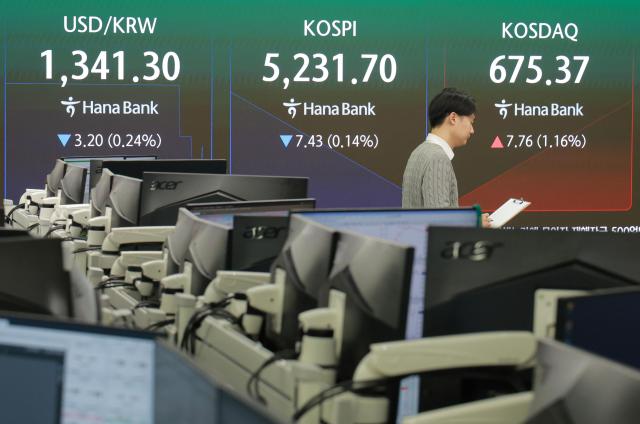
SEOUL, November 13 (AJP) - South Korean stocks reversed sharp early gains Friday as foreign investors returned to selling and semiconductor shares declined amid uncertainty following Nvidia chief Jensen Huang's resignation.
The benchmark KOSPI fell 0.98 percent, or 52.20 points, to close at 5,290.53, after trading between 5,259.09 and 5,504.44.
Foreign investors sold 555 billion won ($415 million) worth of shares, ending three consecutive sessions of buying. Retail investors purchased a net 20.9 billion won, as institutions bought 1.9 billion won.
The index opened 2.05 percent higher at 5,452.41 and briefly climbed above 5,500 before surrendering its gains as foreign investors shifted to net selling.
The reversal came as investors assessed the implications of Nvidia's unexpected leadership change for the global artificial intelligence industry.
Nvidia announced Thursday that Huang had stepped down as president and chief executive officer, with Chief Financial Officer Colette Kress appointed interim CEO.
The chipmaker's shares plunged more than 14 percent during Thursday's trading session on Wall Street before recovering to close 4.34 percent lower at $166.19.
The Philadelphia Semiconductor Index also slipped 0.54 percent, reflecting continued uncertainty surrounding the technology sector.
The leadership change added to concerns over AI investment profitability and the sustainability of large-scale data center spending, which have already contributed to substantial volatility in South Korean semiconductor stocks.
SK hynix fell 2.47 percent to 1,223,000 won, while Samsung Electronics edged down 0.48 percent to 207,000 won.
Both stocks had advanced in early trading before reversing course as the broader market weakened.
Samsung Electro-Mechanics dropped 2.93 percent to 860,000 won, while SK Square declined 3.16 percent to 766,000 won.
Naver fell 4.57 percent to 173,500 won, adding to losses among major technology-related shares.
Hanwha Ocean plunged 15.41 percent to 112,000 won, making it one of the sharpest decliners among actively traded KOSPI stocks.
Despite the broader weakness, several stocks advanced.
Samsung SDI gained 1.37 percent to 479,500 won, while Samsung E&A rose 4.55 percent to 69,000 won.
Samsung Electronics' preferred shares climbed 1.49 percent to 170,800 won, while Isu Petasys jumped 7.37 percent to 90,300 won.
Banking and telecommunications shares also outperformed.
BNK Financial Group rose 6.3 percent to 13,600 won, while Shinhan Financial Group gained 5.5 percent to 89,700 won and KB Financial advanced 4.4 percent to 158,500 won.
SK Telecom climbed 3.6 percent to 84,400 won, while LG Uplus gained 2.99 percent to 15,520 won.
The financial sector's strength contrasted with the retreat in semiconductor shares as investors continued to reassess their exposure to technology stocks.
The volatile session coincided with President Lee's visit to the Korea Exchange in Seoul, where he chaired a policy meeting on strengthening South Korea's capital markets.
Lee reaffirmed his administration's commitment to correcting the undervaluation of Korean stocks, emphasizing market transparency, fair trading and investor confidence.
He said restoring trust was central to normalizing the market and called for stronger efforts to address unfair trading practices and improve corporate governance.
The meeting also addressed reforms aimed at strengthening the KOSDAQ market and encouraging long-term investment.
However, the president's remarks failed to sustain the morning rally as foreign selling continued through the afternoon.
The tech-heavy KOSDAQ edged up 0.5 percent to close at 699.66, after trading between 697.69 and 725.81.
Institutions bought 126.3 billion won worth of shares, while foreign investors sold 76.7 billion won and retail investors unloaded 55.3 billion won.
The index climbed above 720 during the session but gave up most of its gains, narrowly failing to reclaim the 700-point mark.
Semiconductor equipment shares were among the stronger performers.
Jusung Engineering rose 1.05 percent to 173,800 won, while Simtech gained 1.45 percent to 125,700 won.
Wonik Holdings advanced 4.44 percent to 31,750 won, while Jeju Semiconductor edged up 0.33 percent to 60,700 won.
Genians jumped 10.53 percent to 34,650 won, while KBI Metal surged 24.11 percent to 4,530 won.
Exicon climbed 7.75 percent to 62,600 won, and SFA Semiconductor gained 5.03 percent to 9,190 won.
By contrast, Alteogen slipped 0.11 percent to 177,200 won, while Wonik IPS fell 1.52 percent to 78,000 won.
Venture capital-related shares also attracted buying interest, with DSC Investment jumping 29.9 percent to 8,120 won and TS Investment surging 22.8 percent to 1,909 won.
Throughout Asia, Japan's Nikkei 225 rose 0.5 percent to 61,142.35, while China's Shanghai Composite fell 0.6 percent to 3,634.35. Hong Kong's Hang Seng Index declined 1.5 percent to 23,644.6.
The Korean won weakened 0.1 percent against the dollar, with the exchange rate quoted at 1,337.8 won per dollar.
Oil prices moved in opposite directions as investors weighed renewed tensions between the United States and Iran against signs of recovering Middle Eastern crude exports.
West Texas Intermediate crude slipped 0.1 percent to $88.68 a barrel, while Brent crude gained 0.4 percent to $95.26.
The divergence followed remarks by U.S. President Donald Trump that Washington no longer needed an agreement with Tehran, dampening expectations for a diplomatic settlement.
Iran has maintained that U.S. sanctions and the maritime blockade must be lifted before direct peace negotiations can proceed.
Despite renewed diplomatic uncertainty, crude shipments from the Middle East have continued to recover, keeping oil prices on track for a second consecutive weekly decline.

Joonha Yoo
Joonha Yoo is a bilingual journalist at AJU Press (AJP), covering music, culture, entertainment and Korea’s automotive industry.
Raised in Fort Collins, Colorado, he often writes from the scene, bringing firsthand detail to stories ranging
from BTS comeback concerts to unique cultural events that catch the world's eye.
Copyright ⓒ Aju Press All rights reserved.
Related News
-
 Despite Calls for a '3000 KOSDAQ,' Index Struggles Below 700 as Most Stocks Decline
The government's push to invigorate the KOSDAQ market contrasts sharply with the ongoing struggles of individual stocks. Since the beginning of the year, approximately 80% of KOSDAQ-listed companies have reported negative returns, with some stocks plummeting by over 80%. Experts argue that fundamental reforms, including the exit of underperforming companies and the restoration of market confidence, must precede any index support measures.According to the Korea Exchange, the KOSDAQ index closed at 699.66, up 0.45% from the previous session. The number of declining stocks decreased significantly from 1,097 to 685, easing overall market pressure. This improvement in sentiment was likely bolstered by President Lee Jae-myung's proposals during a policy meeting, which included measures for the exit of failing companies and increased transparency.However, the cumulative performance since the start of the year reveals persistent market weakness. As of the latest closing price, 1,391 out of 1,766 KOSDAQ stocks have fallen compared to the last trading day of the previous year, representing 78.8% of the total. This indicates that nearly eight out of ten KOSDAQ-listed companies have experienced stock price declines this year.The extent of these declines is significant, with 226 stocks falling between 30% and 40%, and 24 stocks experiencing drops of over 80%. As the momentum for market recovery weakens, some investors are facing even greater losses.Trading volume has also contracted. KOSDAQ trading volume decreased from 818.9 million shares at the end of last year to 416.8 million shares recently. Similarly, trading value fell from 10.55 trillion won to 5.42 trillion won during the same period, indicating a decline in overall market activity.The poor performance of individual stocks has contributed to the index's decline. The KOSDAQ index, which stood at 925.47 at the end of last year, has continued to drop, falling below the 700 mark. Despite the government's goal of achieving a '3000 KOSDAQ' through capital market revitalization and enhancing KOSDAQ competitiveness, there has been little sign of a rebound in the index or recovery among individual stocks.Challenges to market recovery include the slow progress of structural reforms, such as the exit of underperforming companies. The government initiated measures to tighten delisting criteria in July, but some companies have responded with legal challenges, delaying the process. The introduction of a KOSDAQ segment system aimed at fostering qualitative growth is also expected to be postponed until the second half of next year.Market analysts caution that simply raising the index level will not restore KOSDAQ's competitiveness. They emphasize the need to address structural issues, such as increasing institutional investor participation and reducing the short-term investment tendencies of individual investors.During the meeting, Hwang Hyun-young, a researcher at the Capital Market Research Institute, stated, "To achieve long-term results, a blueprint addressing structural issues must be developed. If we can outline a long-term vision and tackle specific tasks one by one, the impact will be significantly greater."* This article has been translated by AI.
-
Chinese Stocks Decline Amid Rising U.S. Interest Rate Concerns, Semiconductor Shares Surge
Chinese stocks reversed course on Tuesday after a previous day of gains, as concerns over rising U.S. interest rates weakened investor sentiment. The Shanghai Composite Index closed down 0.67% at 3,655.83, the Shenzhen Component Index fell 1.68% to 11,197.98, and the ChiNext Index dropped 2.44% to 2,509.43.The U.S. Consumer Price Index (CPI) for October rose 0.4% from the previous month, exceeding market expectations of 0.3%. The market now assesses a 90.8% probability of a 0.25 percentage point rate hike by the Federal Reserve in December. Rising interest rates diminish the relative attractiveness of stocks, particularly growth stocks with high valuations.The controversy surrounding NVIDIA CEO Jensen Huang also impacted global tech investment sentiment. Doubts lingered regarding the scale of investments in AI data centers and the potential for realizing investment returns.In a report, Xinyi Securities stated, "As global tech companies significantly increase their AI investments, skepticism about investment returns is growing, and concerns about an investment bubble in the AI sector are emerging due to declining free cash flow for some companies. Geopolitical tensions, fluctuations in international energy prices, and the potential for interest rate hikes in developed countries are dampening risk asset investment sentiment." The firm also noted that profit-taking demand is emerging from previously high-flying tech growth stocks.On the day, the AI semiconductor sector showed strength. Tianpu Guofen hit its upper limit, while Suiyuan Technology surged over 12%, reaching a record high since its listing. Analysts predict that Chinese semiconductor companies will benefit from increased U.S. restrictions on semiconductor exports to China due to the Jensen Huang scandal. Additionally, Alibaba's AI semiconductor subsidiary, T-Head, announced plans for an independent listing. Alibaba disclosed on the evening of November 10 that it had submitted application documents for the spin-off listing of T-Head. As of April 2026, T-Head's dedicated AI semiconductor series, the Zhenwu series, had accumulated shipments of 560,000 units, with over 650 customers.Shares related to specialty gases for semiconductors also rose, with Zhongchuan Special Gas and Feiwotai recording significant gains. Expectations for an improvement in the semiconductor industry are believed to have stimulated investor sentiment. According to a report from the Semiconductor Equipment and Materials International (SEMI), global silicon wafer shipments increased by 13.4% year-on-year in the third quarter of 2026. The ongoing expansion of semiconductor production facilities continues to drive demand for specialty gases.Meanwhile, the People's Bank of China set the yuan's central parity rate against the dollar at 6.7174 yuan, a decrease of 0.0017 yuan from the previous day, reflecting a 0.02% increase in the yuan's value.* This article has been translated by AI.
-
Entertainment Stocks Rise Amid Historical Undervaluation and AI Boom Exclusion
Major entertainment stocks, including HYBE, SM Entertainment, and JYP Entertainment, are showing strong performance.According to the Korea Exchange, as of 9:05 a.m. on November 12, HYBE was trading at 150,700 won, up 1.96% from the previous trading day. SM Entertainment rose 3.43% to 75,400 won, while JYP Entertainment surged 16.67% to 45,000 won.At the same time, other companies such as YG Entertainment (up 2.92%), Artist Studio (up 4.95%), iOKAY Entertainment (up 1.32%), Studio Dragon (up 4.04%), CJ ENM (up 3.65%), and Dear U (up 1.14%) are also experiencing upward trends.The rise in entertainment stocks is attributed to an analysis from the securities industry, which indicates that the sector has reached a historical low due to market exclusion rather than a deterioration of fundamentals. Analysts believe that the recent poor performance of entertainment stocks is largely due to being overlooked in market supply and demand.In this context, a report titled 'Entertainment: The Game is Changing, Three Key Changes' published by Shin Young Securities has garnered attention. Researcher Kim Ji-hyun noted in the report that 'the competitive landscape of the K-pop industry is changing due to generational shifts, changes in competition among agencies, and global B2C transformations.'As resources for content production and distribution channels diversify, the premium that large agencies enjoyed in talent discovery is diminishing. It is now believed that the ability to repeatedly produce and monetize intellectual property (IP) will determine corporate value.Shin Young Securities has set a target price of 300,000 won for HYBE, 61,000 won for JYP Entertainment, and 130,000 won and 35,000 won for SM Entertainment and Dear U, respectively. The target price for YG Entertainment is set at 62,000 won, indicating a potential upside of approximately 37% to 100%.* This article has been translated by AI.