
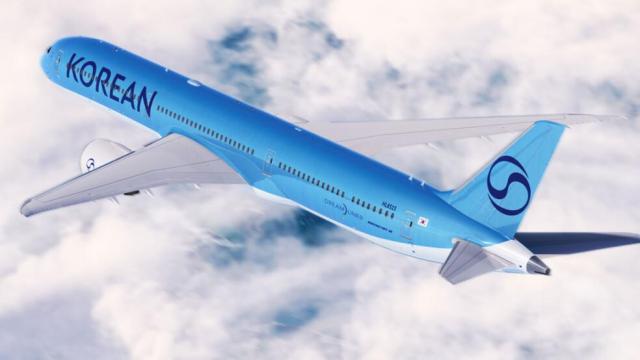
The airline said its standalone operating profit reached 421.2 billion won ($315.1 million) in the July-September period, up from 376.3 billion won a year earlier.
Revenue rose 25.8 percent to 5.04 trillion won from 4.01 trillion won, while net profit surged to 929.7 billion won from 91.8 billion won, helped by foreign exchange-related gains.
The stronger revenue came as Korean Air expanded capacity on high-demand routes to the United States and Japan during the summer travel season.
The airline also increased efforts to attract inbound passengers and travelers connecting through Incheon International Airport, offsetting weaker outbound demand from South Korea.
Its cargo business benefited from growing global investment in artificial intelligence, which boosted demand for high-value shipments such as server racks and semiconductor manufacturing equipment.
Higher fuel surcharges, introduced in response to rising oil prices, also contributed to revenue growth.
However, operating costs increased sharply amid prolonged geopolitical tensions in the Middle East and elevated fuel prices.
Korean Air's fuel expenses jumped 67 percent to 1.70 trillion won during the quarter from 1.02 trillion won a year earlier.
Despite the increase in operating profit, its operating profit margin narrowed to 8.3 percent from 9.4 percent, reflecting faster growth in expenses than revenue.
Revenue from the airline's air transportation business rose 25 percent to 4.79 trillion won, while its aerospace division recorded a 44.1 percent increase to 250.8 billion won.
The aerospace division handles military aircraft maintenance and upgrades, aircraft component manufacturing and unmanned aircraft development.
On a consolidated basis, including subsidiaries such as Asiana Airlines, Korean Air posted third-quarter revenue of 7.32 trillion won, up 21.4 percent from a year earlier.
Consolidated operating profit more than doubled to 349.2 billion won from 157.5 billion won, while net profit swung to 1.26 trillion won from a loss of 278.1 billion won.
For the first nine months of 2026, however, consolidated operating profit declined 31.2 percent to 659.4 billion won, despite a 13.2 percent increase in revenue to 21.21 trillion won.
The airline warned that geopolitical instability in the Middle East and growing protectionist trade policies could continue to increase uncertainty in global air cargo demand.

Kim Hee-su
Kim Hee-su is a bilingual reporter at AJU Press, covering defense and foreign affairs. Before joining AJP in 2025, she worked at The Korea Times, where she wrote interview stories, including a profile of North Korean defector Kim Gum-hyok, and produced digital content. She also previously worked as a researcher for KBS News 9’s International News Department, supporting correspondents in 10 countries around the world. She graduated from the University of Toronto in Canada with a double major in Book and Media Studies and East Asian Studies.
Copyright ⓒ Aju Press All rights reserved.
Related News
-
 Korean Air Expands Routes Amid Concerns of Increased Competition and Monopoly
Korean Air is set to expand its international routes as it prepares for the launch of its merger with Asiana Airlines on December 17. The airline plans to increase flight frequencies on four existing international routes, raising concerns about its growing market dominance, particularly on routes where monopoly fears have been raised.According to data submitted to the Ministry of Land, Infrastructure and Transport, obtained by Aju Economy through Rep. Jeong Hee-yong's office, Korean Air will increase the number of flights on these routes to coincide with the merger's launch.The Incheon-Seattle route, which absorbed Asiana's operations last month and was expanded to 12 flights per week, will increase to 14 flights per week in line with the merger. The Incheon-Brisbane route will rise from four to five flights per week, while the Incheon-Miyazaki route will increase from three to seven flights, and the Incheon-Sendai route will grow from five to seven flights per week.Notably, the Seattle route has been flagged by the Fair Trade Commission as a route with potential competition restrictions. As of 2019, the combined market share of Korean Air (34.96%), Asiana (34.69%), and Delta Air Lines (26.47%) on this route reached 96.12%.In response, the Fair Trade Commission selected Alaska Airlines as an alternative carrier for the Seattle route to alleviate competition concerns, but slot transfers have yet to occur. Alaska Airlines has been operating the Incheon-Seattle route five times a week since September 13 of last year, which is only 35.7% of the planned 14 flights by the merged Korean Air.A Fair Trade Commission official stated, "When an alternative airline is selected for a route with competition restrictions, it is generally considered that structural corrective measures have been implemented once the airline actually enters the market. However, if there is no change in market share within ten years after the corrective measures, it could become an issue."Korean Air cited resource optimization as the reason for the increased flight frequencies. The airline aims to diversify flight schedules and departure times according to seasonal factors to enhance passenger choice and convenience. However, there are concerns in the market that this route expansion could further strengthen the market dominance of the merged airline, particularly on major international routes.The new and expanded routes to Australia and Japan announced by the merged Korean Air are markets where domestic low-cost carriers (LCCs) have focused on capturing niche demand. Jeju Air currently operates the Incheon-Hiroshima route 14 times a week and plans to launch a new route to Sendai three times a week in January. The Incheon-Brisbane route is also operated three times a week by the Australian LCC Jetstar. If Korean Air increases its flight frequencies on these routes, competition for passenger acquisition among existing airlines is expected to intensify.An airline industry official remarked, "From a consumer perspective, the increase in available seats is positive, but for airlines that previously operated these routes alone, sharing passengers could pose management challenges."* This article has been translated by AI.
-
 Korean Air to launch daily flights to Newark next spring
Courtesy of Korean Air SEOUL, November 12 (AJP) - Korean Air will offer a new daily flight between Incheon and Newark, New Jersey, starting in May next year, the country's flagship carrier said on Thursday. The new route, operated by a Boeing 777-300ER, is slated to launch on May 22, with seven flights per week. Located in the New York metropolitan area, Newark Liberty International Airport is a convenient gateway to both New York and New Jersey. It also provides an alternative to John F. Kennedy International Airport for travelers heading to Manhattan and the wider New York metropolitan area. Korean Air said the new route aims to meet growing demand for business and leisure travel along the U.S. East Coast while giving passengers more options for traveling to the New York area.
-
Korean Air Faces Dispute Over Headquarters Location for Integrated Jin Air
The integrated Jin Air, set to launch in the first quarter of next year, is facing turbulence over its headquarters location. The parent company, Korean Air, and local stakeholders in Busan are at odds, raising concerns about the potential disappearance of regional airlines. Amid political disputes over the headquarters relocation, discussions on securing the integrated low-cost carrier's (LCC) competitiveness have taken a backseat.According to the aviation industry on the 28th, Korean Air submitted an additional response to lawmaker Kim Mi-ae of the ruling People Power Party regarding the headquarters location of the integrated LCC, following a request from the National Assembly.In its response, Korean Air proposed a functional division between Seoul and Busan but did not clarify its stance on the headquarters location, stating it is a matter under comprehensive review. While it specified that the final decision-making authority lies with Korean Air and Jin Air, it reportedly avoided providing a timeline for the headquarters decision. In response, Kim criticized Korean Air's reply as disrespectful to Busan citizens and urged the company to disclose the results of its review and the decision schedule by November.The push for the integrated LCC's headquarters in Busan stems from concerns that the integration process could weaken the local aviation industry. With the construction of the new Gadeokdo Airport underway, advocates argue that a regional airline must take a central role and expand its operations. Busan is citing past commitments from the government and the Korea Development Bank to establish a second hub as a basis for its demand.Conversely, Korean Air maintains its position for a headquarters in Seoul. The merger agreement signed in August specifies that the headquarters of the surviving entity, Jin Air, will be located in Gangseo-gu, Seoul. Korean Air argues that plans to develop Busan as a second hub are separate from relocating the integrated airline's headquarters.Previously, on October 16, Korean Air submitted a proposal to the National Assembly outlining plans for the integrated LCC's second hub in Busan, stating it would expand international routes from Gimhae Airport from 28 routes and 281 weekly flights before integration to 33 routes and 339 weekly flights afterward. This plan includes adding four routes to Japan and one to Southeast Asia to support the revitalization of Busan's aviation industry.Some argue that the autonomy of private enterprises must be respected. According to airport statistics, Incheon and Gimpo airports accounted for 67.4% of all domestic flights from January to September this year, while Gimhae Airport's share was only 12%. This situation is reflected in the operations of Trinity Air and Jeju Air, which have their legal headquarters in Daegu and Jeju, respectively, but maintain their main operational bases near Gimpo Airport.Korean Air plans to gather opinions from Busan city officials and employees of the three integrated companies by the end of next month. Choi Jeong-ho, Korean Air's vice president, stated during a National Assembly audit on the 7th that it is the company's responsibility to develop Busan as a second hub airport, while also noting that the main operational airports for the integrated Jin Air will be Incheon, Busan, and Gimpo. A shareholders' meeting to approve the merger of the three companies is scheduled for December, which is expected to be a turning point in discussions regarding the headquarters location.Kim Kwang-ok, a professor at Korea Aerospace University, emphasized that as airlines are private enterprises, the decision on headquarters location should prioritize operational efficiency and future competitiveness over regional interests. He noted that with the integration of three airlines, it is essential to enhance efficiency in route operations, aircraft management, and workforce management, while maximizing economies of scale and scope.* This article has been translated by AI.