

[Courtesy of SK Chemicals]
SK Chemicals said Wednesday in a regulatory filing that the decision to sell its business division which produces bio-diesel and bio-heavy oil was made to focus "our capabilities on core projects and finance our future investments in new growth projects." "We want to increase the value of our existing businesses and secure funding for new projects, including mergers and acquisitions."
SK Chemicals has produced composites, high-performance materials, energy-saving materials, and other products. The company also offers total healthcare solutions services. In recent years, the company has reorganized its business structure. In 2018, it divided its vaccine business to establish SK Bioscience and is in the process of expanding eco-friendly copolyesters.
Copolyesters form when modifications are made to polyesters. Manufacturers use them in the design of high-volume, low-cost parts as well as critical, more expensive component parts. They are also frequently used in the manufacture and packaging of consumer goods and materials.
Hahn & Co., established in 2010, has seen rapid growth through a differentiated investment strategy to become one of South Korea's largest and most active private equity investors.

Copyright ⓒ Aju Press All rights reserved.
Related News
-
 Korean stocks reverse early gains as foreigners shift to selling
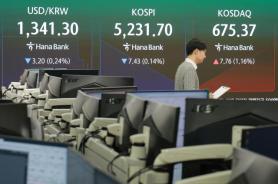
A display board shows the won-dollar exchange rate and the KOSPI and KOSDAQ indices at the dealing room of Hana Bank's headquarters in Jung-gu, central Seoul, on the morning of Nov. 11, 2026. AJU Business Daily Ha Sung-min SEOUL, November 13 (AJP) - South Korean stocks reversed sharp early gains Friday as foreign investors returned to selling and semiconductor shares declined amid uncertainty following Nvidia chief Jensen Huang's resignation. The benchmark KOSPI fell 0.98 percent, or 52.20 points, to close at 5,290.53, after trading between 5,259.09 and 5,504.44. Foreign investors sold 555 billion won ($415 million) worth of shares, ending three consecutive sessions of buying. Retail investors purchased a net 20.9 billion won, as institutions bought 1.9 billion won. The index opened 2.05 percent higher at 5,452.41 and briefly climbed above 5,500 before surrendering its gains as foreign investors shifted to net selling. The reversal came as investors assessed the implications of Nvidia's unexpected leadership change for the global artificial intelligence industry. Nvidia announced Thursday that Huang had stepped down as president and chief executive officer, with Chief Financial Officer Colette Kress appointed interim CEO. The chipmaker's shares plunged more than 14 percent during Thursday's trading session on Wall Street before recovering to close 4.34 percent lower at $166.19. The Philadelphia Semiconductor Index also slipped 0.54 percent, reflecting continued uncertainty surrounding the technology sector. The leadership change added to concerns over AI investment profitability and the sustainability of large-scale data center spending, which have already contributed to substantial volatility in South Korean semiconductor stocks. SK hynix fell 2.47 percent to 1,223,000 won, while Samsung Electronics edged down 0.48 percent to 207,000 won. Both stocks had advanced in early trading before reversing course as the broader market weakened. Samsung Electro-Mechanics dropped 2.93 percent to 860,000 won, while SK Square declined 3.16 percent to 766,000 won. Naver fell 4.57 percent to 173,500 won, adding to losses among major technology-related shares. Hanwha Ocean plunged 15.41 percent to 112,000 won, making it one of the sharpest decliners among actively traded KOSPI stocks. Despite the broader weakness, several stocks advanced. Samsung SDI gained 1.37 percent to 479,500 won, while Samsung E&A rose 4.55 percent to 69,000 won. Samsung Electronics' preferred shares climbed 1.49 percent to 170,800 won, while Isu Petasys jumped 7.37 percent to 90,300 won. Banking and telecommunications shares also outperformed. BNK Financial Group rose 6.3 percent to 13,600 won, while Shinhan Financial Group gained 5.5 percent to 89,700 won and KB Financial advanced 4.4 percent to 158,500 won. SK Telecom climbed 3.6 percent to 84,400 won, while LG Uplus gained 2.99 percent to 15,520 won. The financial sector's strength contrasted with the retreat in semiconductor shares as investors continued to reassess their exposure to technology stocks. The volatile session coincided with President Lee's visit to the Korea Exchange in Seoul, where he chaired a policy meeting on strengthening South Korea's capital markets. Lee reaffirmed his administration's commitment to correcting the undervaluation of Korean stocks, emphasizing market transparency, fair trading and investor confidence. He said restoring trust was central to normalizing the market and called for stronger efforts to address unfair trading practices and improve corporate governance. The meeting also addressed reforms aimed at strengthening the KOSDAQ market and encouraging long-term investment. However, the president's remarks failed to sustain the morning rally as foreign selling continued through the afternoon. The tech-heavy KOSDAQ edged up 0.5 percent to close at 699.66, after trading between 697.69 and 725.81. Institutions bought 126.3 billion won worth of shares, while foreign investors sold 76.7 billion won and retail investors unloaded 55.3 billion won. The index climbed above 720 during the session but gave up most of its gains, narrowly failing to reclaim the 700-point mark. Semiconductor equipment shares were among the stronger performers. Jusung Engineering rose 1.05 percent to 173,800 won, while Simtech gained 1.45 percent to 125,700 won. Wonik Holdings advanced 4.44 percent to 31,750 won, while Jeju Semiconductor edged up 0.33 percent to 60,700 won. Genians jumped 10.53 percent to 34,650 won, while KBI Metal surged 24.11 percent to 4,530 won. Exicon climbed 7.75 percent to 62,600 won, and SFA Semiconductor gained 5.03 percent to 9,190 won. By contrast, Alteogen slipped 0.11 percent to 177,200 won, while Wonik IPS fell 1.52 percent to 78,000 won. Venture capital-related shares also attracted buying interest, with DSC Investment jumping 29.9 percent to 8,120 won and TS Investment surging 22.8 percent to 1,909 won. Throughout Asia, Japan's Nikkei 225 rose 0.5 percent to 61,142.35, while China's Shanghai Composite fell 0.6 percent to 3,634.35. Hong Kong's Hang Seng Index declined 1.5 percent to 23,644.6. The Korean won weakened 0.1 percent against the dollar, with the exchange rate quoted at 1,337.8 won per dollar. Oil prices moved in opposite directions as investors weighed renewed tensions between the United States and Iran against signs of recovering Middle Eastern crude exports. West Texas Intermediate crude slipped 0.1 percent to $88.68 a barrel, while Brent crude gained 0.4 percent to $95.26. The divergence followed remarks by U.S. President Donald Trump that Washington no longer needed an agreement with Tehran, dampening expectations for a diplomatic settlement. Iran has maintained that U.S. sanctions and the maritime blockade must be lifted before direct peace negotiations can proceed. Despite renewed diplomatic uncertainty, crude shipments from the Middle East have continued to recover, keeping oil prices on track for a second consecutive weekly decline.
-
 Winter is coming for Korea's flush refiners
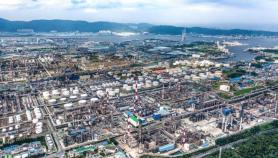
SK Innovation Ulsan Complex. Courtesy of SK Innovation SEOUL, November 13 (AJP) - Contrary to earlier fears, a year marked by war has been kind to South Korea's refiners. But as winter approaches, recovering crude supplies and falling oil prices threaten to erode their bumper profits. The easing supply squeeze marks a reversal for an industry that only weeks ago feared a shortage in November as the Middle East war dragged into its ninth month. Now recovering shipments and hopes for an end to the conflict threaten to unwind some of the windfall. Crude shipments secured for November and December each equal more than 90 percent of last year's monthly average, the Ministry of Trade, Industry and Resources said at its Middle East war response briefing on Tuesday. November's figure stood at about 70 percent in mid-September, when disruptions to Saudi crude exports fueled talk of a "November crisis." "Flows out of the Strait of Hormuz are running at about 75 percent of prewar levels, and supply itself has stabilized somewhat," said Chang Tae-hun, an associate research fellow at the Korea Energy Economics Institute. "With more than 90 percent secured for November, the numbers do not suggest supply is something to worry about, unless there is an unusual shift in demand," Chang said. Brent crude closed at $91.49 a barrel on Nov. 10, its lowest since late August, after U.S. President Donald Trump said further strikes on Iran were unlikely. It rose 3.3 percent on Thursday to $95.82 but remained down about 20 percent for the month. Democratic control of both chambers of Congress following the Nov. 3 midterm elections has added to expectations of pressure for a negotiated settlement. "Democrats are likely to use war funding and congressional oversight to press for negotiations to normalize the Strait of Hormuz," said Yoon Jae-sung, an analyst at Hana Securities. "Along with the recovery in Middle East crude exports, stronger expectations for an end to the war will lower geopolitical risk around oil and gas markets in the short term and weigh on prices," Yoon said. The shift follows an exceptional quarter. Combined operating profit from refining and lubricants at SK Innovation, S-Oil, GS Caltex and HD Hyundai Oilbank reached 5.9 trillion won ($4.4 billion) in the third quarter, 4.8 times the level a year earlier but 7.4 percent below the second quarter. Edited and compiled by AJP. Graphics AI Assisted Lubricants supplied about 42 percent of that profit as disruptions in the Middle East drove base oil prices sharply higher. For refiners, cheaper crude offers lower future purchasing costs but can bring an immediate accounting sting. Oil bought weeks earlier at higher prices may have to be processed into fuel sold into a falling market, exposing companies to inventory losses. GS Caltex and HD Hyundai Oilbank both reported third-quarter operating profit down more than half from the previous quarter. Brokerages disagree on how deep the fourth-quarter dent will be. Hana Securities expects S-Oil to earn 1.29 trillion won in operating profit, down 9 percent from the third quarter, while Mirae Asset Securities forecasts 911 billion won. The companies still see reasons for margins to hold up. SK Innovation cited maintenance shutdowns and winter demand, while S-Oil pointed to low global inventories. Both identified a recovery in Middle East supply as the main risk. The U.S. Energy Information Administration on Nov. 10 forecast Brent at around $100 a barrel for November and December and $86 in 2027. At home, another unsettled bill awaits. Refiners continue to sell fuel under a government price cap introduced on March 13. The ministry plans to calculate the first round of compensation, covering March 13 to June 30, by the end of this month. The industry estimated its losses at about 5 trillion won as early as June. The government set aside a 4.2 trillion won reserve fund in March and has proposed another 1.45 trillion won in next year's budget to cover the fourth quarter. The dispute centers on how those losses should be measured. The ministry plans to base compensation on production costs. Refiners argue that it should reflect Singapore product prices, a benchmark that would yield a substantially larger payout. "It is now time to consider an exit strategy for the price cap," Chang said, adding that one should ideally be in place from the first quarter of next year. Edited and compiled by AJP. Graphics AI Assisted The industry's bumper earnings complicate its case for compensation. So do pending price-fixing charges. Prosecutors indicted all four refiners on July 6 on charges of coordinating price increases immediately after the war broke out. They put sales associated with the alleged collusion at about 14.2 trillion won. The companies denied the charges at their first hearing on Aug. 20. Korea's refiners look better supplied for winter than they did two months ago. Whether they remain as profitable will depend on how quickly Middle Eastern barrels return — and how much of their domestic price-cap bill the government agrees to pay.
-
 AI bust? Asia's bigger test is making AI pay
Harvard Business School professor Willy Shih, left, and World Bank Chief Economist for Asia Franziska Ohnsorge in this composite image. Courtesy of Harvard Business School; screenshot from the World Bank YouTube channel Editor’s note: In the final installment of AJP’s four-part series on the durability of the AI boom, Harvard Business School professor Willy Shih and World Bank Chief Economist for Asia Franziska Ohnsorge examine the risks facing Asia’s technology suppliers and the challenge of turning an investment windfall into lasting economic gains. SEOUL, November 13 (AJP) - Asia’s AI boom has made its chipmakers richer. It may also be helping their next competitors get stronger — while leaving much of the region’s economy waiting for the promised productivity gains. Those are two of the more unsettling conclusions from AJP’s video interviews with Harvard Business School professor Willy Shih and World Bank Chief Economist for Asia Franziska Ohnsorge, as questions mount over the returns on AI infrastructure spending. For Shih, the danger for Korean memory makers is already taking shape inside the shortage that has made them so profitable. Customers unable or unwilling to pay premium prices are looking elsewhere, giving China’s ChangXin Memory Technologies (CXMT) an opening to win business and improve its manufacturing. For Ohnsorge, Asia’s success in supplying the AI buildout leaves a larger question unanswered: how widely businesses across the region are using the technology themselves. “That whole AI supply chain is really just producing AI. It is not using AI,” she said. Their arguments extend the debate beyond whether an investment bubble will burst. Even if spending continues, today’s suppliers may lose pricing power, while the broader productivity gains remain concentrated among firms already equipped to capture them. Shih expects investment to continue at a more measured pace as providers face pressure to demonstrate returns. Ohnsorge warns that a sharp reversal would expose East Asia through two channels at once: weaker demand for its exports and turbulence spreading from U.S. financial markets. Excerpts from the interviews follow. The outlook — slower spending and a double shock Q: Major American technology companies are committing enormous sums to AI infrastructure. Is this the beginning of a durable industrial transformation, or could the industry be approaching a capital investment bubble? Willy Shih: Will the big AI suppliers, such as OpenAI and Anthropic, earn sufficient returns to justify their level of investment? My view is that this will become more tempered over time as pressure to demonstrate a return on investment increases. I think investment will continue, perhaps at a less frenetic pace, which could be better for the long run. But we might experience some indigestion in the meantime. People have not fully thought through the implications of Nvidia chips being replaced by later generations, meaning the installed base becomes less valuable over time. Will AI deliver benefits? Yes. Will those benefits be proportional to the investments being made? That is the big question. Q: If AI-related capital expenditure slows sharply or reverses, how would the shock spread through Asian economies? Which countries would be most vulnerable? Franziska Ohnsorge: There would be two effects. First, if investment slows, demand for the goods that investment purchases will fall. Those are precisely the goods supplied through the East Asian supply chain. That would be a major hit to Southeast Asian exports. Second, U.S. financial markets would be affected, with equity markets exposed because AI-related companies now account for a large part of the S&P 500. On the real-economy side, slower investment would mean weaker demand for exports from the region. On the financial side, you would see tightening financial conditions and an equity market correction. East Asia differs from other regions because it is so deeply embedded in that supply chain. It would be hit through both channels. We conducted an event study looking at what happens when the S&P 500 corrects. We examined episodes involving large corrections and asked what happens to equity markets in emerging markets and developing economies. They decline in a statistically significant way. It is very difficult for emerging markets, including those in East Asia, to escape an equity market correction when the S&P 500 corrects. East Asia would therefore be hit harder than other regions because it is exposed through both channels. Korea’s memory boom — the shortage opens China’s door Q: South Korea’s memory manufacturers are enjoying extraordinary demand and profits. What happens when additional production capacity comes online? Shih: Right now, SK hynix, Samsung and Micron are capturing enormous value. One reason is that capacity is very expensive, and additions to capacity are lagging demand, as they historically have in the memory business. All the memory makers were relatively conservative about adding manufacturing capacity two years ago, but it takes a year or two to add capacity. Because memory is now in such short supply, all of them are capturing a lot of value. The real question will arise when new capacity comes onstream and supply meets, and then exceeds, demand. At that point, the picture will be very different. When supply exceeds demand, pricing collapses. That has historically been the case in the memory business because additions to supply take time. When there is too much capacity, prices collapse, and everybody keeps selling because they want to keep their plants running and absorb their manufacturing overhead. It is cheaper to keep the plants running, but financial performance then becomes terrible. That will be the real test. Q: Korea supplies critical high-bandwidth memory, while Taiwan dominates advanced contract chip manufacturing. Which part of the supply chain has the more durable pricing power? Shih: One company that really has pricing power—and you can see it in its quarterly earnings reports—is TSMC. It is manufacturing chips for Nvidia and for Nvidia’s competitors, including Amazon’s Trainium. Here, you have a situation in which capacity is constrained and there is really only one provider . So TSMC has a lot of pricing power and captures a lot of value. It is hard to say who is capturing the majority of the value because these companies do not disclose their margins. The memory business is a little different from the chip foundry business. The products are not exactly substitutable commodities because each supplier has to be qualified. Nvidia and other customers buying these memory chips want that kind of competition. That is why the picture could be very different when memory supply catches up with demand. Q: Does the shortage of memory chips create an opportunity for China’s ChangXin Memory Technologies, or CXMT, even though its advanced memory production yields reportedly remain far below those of Korean competitors? Shih: For South Korean memory firms, as well as Micron, this is a very dangerous time because they are unable to meet demand for memory chips of all kinds. They have allocated much of their production capacity to high-bandwidth memory because it offers better margins. Meanwhile, prices for conventional DRAM and NAND flash have risen sharply, which is unusual in the history of the memory industry. The bigger problem is that shortages have caused companies to start looking for other sources. It is in their interest to keep memory a commodity. They do not like paying premium prices for memory because much of their profit comes from selling higher-memory configurations of their phones, tablets and computers. The way I see the current situation, this is a golden opportunity for CXMT to exploit market shortages. Under these circumstances, even though its yields are relatively low, it can still make a lot of money. The key to improving yields is to work with the customers who need to qualify its products. As you gain more experience and manufacture more, you have opportunities to refine and tune your processes. So CXMT will get better. The most dangerous thing for Korean manufacturers right now is that this capacity shortage is opening the door to CXMT. That is a near-term problem for which there is no easy fix. The real test will come when new supply enters the market and prices fall. That will inevitably happen; the only question is when. Taiwan and Japan — strengths that are hard to replace Q: If a disruption in the Taiwan Strait temporarily disabled advanced chipmaking or packaging capacity in Taiwan, could production elsewhere compensate for the loss? Shih: If there were disruptions to the supply of chips and materials from Taiwan, that would be a major problem for everybody globally because we have a global supply chain feeding all this computing hardware. It would take time to make the necessary adjustments. I think the interdependence and connectivity are somewhat underestimated. People forget how much dependence on Taiwan remains, even though there has been substantial investment in the United States. U.S. capacity would not even meet all of Nvidia’s needs, let alone those of Apple, Qualcomm, Broadcom, AMD or any of the others. If that kind of disruption occurred, I think it would be much worse than people realize. Q: Japan occupies critical positions in semiconductor equipment and specialty materials. Could its technological advantages prove more durable than those of chip manufacturers? Shih: To the extent that the industry goes through upcycles and downcycles—whether they are booms and busts or something less severe—it is difficult to separate the rest of the supply network from those cycles. Suppliers go through ups and downs as well. Companies such as Tokyo Electron, Advantest and some of the materials companies will experience those fluctuations. Some of the things that are really hard to replace are materials: the fine ceramics used inside many tools, for example, along with certain exotic metals and other materials. Across the supply chain, you have Japanese toolmakers such as Tokyo Electron and Advantest, as well as other companies that make specialized tools and are dominant suppliers in their fields. They have been working on these things for decades, so they have a lot of experience and are not easy to replace. The wider economy — producing AI is not using it Q: Export earnings and higher semiconductor profits do not automatically translate into greater productivity or higher wages. What would convince you that AI is producing sustainable benefits across Asia’s wider economies? Ohnsorge: The most important factor is likely to be how quickly they adopt AI themselves. That whole AI supply chain is really just producing AI. It is not using AI. Using AI productively is where the difficulty lies for emerging markets, including those in Asia. Thailand, for example, has a strong position in the AI supply chain. But we asked firms—not just AI firms, but firms generally—how many actually use AI. The answer was 12 percent. How many pay for it? Four percent. They are very good at production and deeply embedded in the production chain, but use is the missing part, at least in Thailand, where we have clear data. That is probably a pattern affecting other countries as well. Q: What would it take for productivity gains to reach smaller companies and ordinary workers rather than remain concentrated among large technology businesses? Ohnsorge: That really is the main question: how do you achieve broad-based gains from AI? One of our exercises asked firms to estimate the productivity gains they expected from AI over the next three years. The vast majority of firms in those surveys in East Asia and South Asia expected no productivity gains, while others expected very large gains. Our next exercise examined which firms expected larger productivity gains. It came down to precisely the traditional conditions that enable development. The firms expecting the largest productivity gains were larger firms, but they were firms with more skilled workforces and greater existing digital capabilities as well. Before generative AI, there was predictive AI. We now have a dataset that allows us to track 10 years of predictive AI adoption across many firms, mostly in OECD countries but in some emerging markets as well. We see very clearly that adoption spread rapidly among multinational corporations over roughly five years before plateauing. Among other firms—those that are not multinationals—there was a slight uptick, but not much. By the end of those five years, or even 10 years later, fewer than 20 percent had adopted predictive AI. To achieve broad-based productivity gains from AI across firms, one of the best things governments can do is pursue basic development policies that get the conditions right: a skilled workforce, digital connectivity and competitive pressure to adopt productivity-enhancing tools. Basic development policy can be one of the best interventions for ensuring that productivity gains spread. Q: Could AI make the traditional path to prosperity more difficult for emerging Asian economies by weakening demand for entry-level jobs? Ohnsorge: In many countries, research has now shown that hiring has slowed steeply, by double-digit rates, since the introduction of AI, but very narrowly in occupations exposed to AI in a substitutable way. These are concentrated hiring slowdowns, not necessarily job losses. They are slowdowns in hiring identified through job-posting data. The interesting thing is that we did not find it in the Philippines, the country in our sample here. It is remarkable that we did not see the same statistically significant slowdown in the Philippine data. But even where we do not see these hiring slowdowns, AI is already reshaping labor markets. Returning to your question, the narrowly concentrated losses in occupations where AI can substitute for workers tend to affect entry-level workers. But that does not mean there are no other entry-level jobs. New entry-level jobs may be those in which AI augments workers’ capabilities. What it means is that these particular entry-level pathways have become more difficult, while others are opening up that we have not yet fully identified. The experience of previous general-purpose technological revolutions matters: the Industrial Revolution, the internet revolution and the computer and information and communications technology revolution. The biggest productivity gains came not simply from replacing a worker, but from changing entire production processes. In that sense, AI can have a major effect on development once it diffuses throughout the production process. I do not think AI closes development pathways. It opens an entirely new set of pathways that we cannot even imagine today. That is the most likely outcome, based on previous episodes involving general-purpose technologies. Government policy — measurable goals and affordable AI Q: What should governments do to ensure that AI investment generates lasting economic benefits, and when should they abandon industrial policies that fail to deliver? Ohnsorge: Governments adopt industrial policies for many reasons, some of which go beyond economics. There may be political or security reasons, and that is fine. What is almost more important is establishing mechanisms to check whether the policy is delivering results. Governments should define their objectives in advance: “This is what we want to achieve with the policy, and these are the milestones we will monitor to determine whether we are achieving it. If we are not, we will unwind the policy.” That is the critical part of implementing industrial policy, which can be undertaken for any number of reasons. Small AI is really important because it is a readily accessible opportunity for many countries and firms that cannot afford large AI models. Small AI is the solution. It does not have to cost as much, and cost is one of the biggest obstacles to AI adoption.