
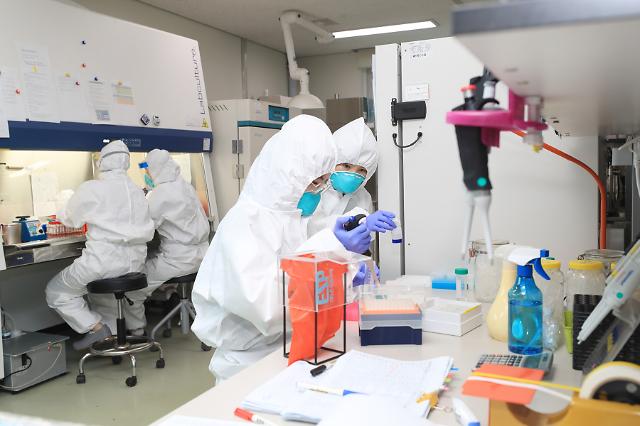
[Yonhap Photo]
In clinical trials, 90 patients with mild or secondary symptoms will be given drugs for up to 14 days to determine the effectiveness of Foistar tablets, which are used to treat to treat chronic pancreatitis and postoperative reflux esophagitis. Daewoong plans to carry out Phase III clinical trials within this year.
In research abroad, Camostat mesilate was found to be effective in blocking the spread and pathogenesis of COVID-19 in animal testing. To find COVID-19 treatment, the company is also testing the effectiveness of mesenchymal stem cells (MSCs), which are multipotent stromal cells that can differentiate into a variety of cell types.
Daewoong claimed to have achieved progress in the initial animal testing of niclosamide (DWRX2003), a tapeworm treatment medicine selected as a candidate for COVID-19 antibody treatment. Institut Pasteur Korea, an infectious disease-focused research institute, works with a subsidiary of Daewoong to test the efficacy of niclosamide, which basically starves tapeworms to death.

Copyright ⓒ Aju Press All rights reserved.
Related News
-
 Korean Obesity Drug 'Epe' Set to Launch as Competitors Target Niche Markets
As the launch of South Korea's first obesity drug, Hanmi Pharmaceutical's 'Epe' (epiglenatide), approaches, attention is turning to the strategies of domestic competitors. If Epe competes with the established weekly injections of Wegovy and Manjaro, other local companies are opting for differentiated dosing schedules, formulations, and mechanisms of action to carve out niche markets.According to industry sources, the Ministry of Food and Drug Safety approved Hanmi Pharmaceutical's GLP-1 (glucagon-like peptide-1) obesity treatment 'Epe' as the 45th new drug developed in South Korea on October 7. Hanmi plans to launch the product as early as the end of this month. The emergence of the first domestic GLP-1 obesity treatment is expected to accelerate the development competition among latecomers.The most advanced competitor is HK inno.N. Its 'Eknoglutide,' introduced from China's Saiwind Biosciences in 2024, is notable for being the world's first cAMP (cyclic adenosine monophosphate) biased GLP-1 receptor agonist, enhancing signaling selectivity. In China, it received approval for obesity indications in March this year, following its approval as a diabetes treatment. Clinical trials for obesity and diabetes treatments are currently underway in South Korea.Competition is also heating up for long-acting injectable formulations with extended dosing intervals. JW Pharmaceutical secured exclusive development and commercialization rights in South Korea for 'Bofanglutide' from China's Gan & Lee in April. This GLP-1 receptor agonist is administered every two weeks. In a Chinese phase 3 trial, participants receiving 48 mg showed an 18.54% weight reduction after 52 weeks.In August, JW Pharmaceutical submitted plans for domestic phase 3 clinical trials for obesity and type 2 diabetes indications to the Ministry of Food and Drug Safety. The obesity trial is set to begin in December. By extending the dosing interval from weekly to biweekly, the annual injection frequency would decrease from 52 to 26.Dongkook Pharmaceutical is developing a long-acting obesity treatment candidate, 'DKF-MB501,' which is designed to maintain efficacy for over three months with a single dose. Currently in the formulation and preclinical research stage, it aims to enter phase 1 clinical trials next year.The competition is also intensifying for non-injection formulations. Daewoong Pharmaceutical and Daewoong Therapeutics are developing 'DWRX5003,' a patch that delivers semaglutide via microneedles applied to the skin. They have received approval for phase 1 clinical trials, with the first participant registration completed in May.Il Dong Pharmaceutical continues to work on an oral obesity treatment. 'ID110521156,' taken once daily, showed an average weight loss of 9.9% and a maximum of 13.8% after four weeks in a phase 1 trial involving 36 healthy adults.Market analysts note that pricing and insurance coverage will be critical factors for commercialization. According to a study published in the journal 'Obesity' by the American Obesity Society, 47.6% of 288 patients who discontinued treatment with semaglutide and tirzepatide cited cost and insurance issues as reasons for stopping.Jung Jae-won, a researcher at iM Securities, stated, "Given that economic burden is a major reason for discontinuing obesity treatment, demonstrating competitive pricing could trigger an increase in market share. If Epe can also highlight its price advantages compared to existing obesity treatments, it is expected to secure a significant market share."Meanwhile, the domestic obesity treatment market is rapidly expanding. The market, valued at 242.6 billion won in 2024, grew to 819.5 billion won last year, more than tripling in just one year. Currently, Wegovy and Manjaro dominate the market with approximately 86% share. With the anticipated entry of 'Epe' this year, the competitive landscape is likely to shift from a two-player to a three-player dynamic.* This article has been translated by AI.
-
K-Bio Companies Focus on Clinical Results Ahead of Year-End
As the year draws to a close, attention is turning to the clinical results of Hanol Biopharma's autoimmune disease treatment 'Imeroprobat,' SK Biopharm's epilepsy drug 'Opacalim,' and Olix's hair loss treatment 'OLX104C.' Market analysts predict that these clinical events could revive the previously stagnant investment sentiment in the pharmaceutical and biotech sectors.Hanol Biopharma, a subsidiary of Daewoong Pharmaceutical, announced on November 10 that its global partner Immunovant met the primary endpoint in a Phase 2b trial of Imeroprobat (IMVT-1402) for patients with refractory rheumatoid arthritis (D2T RA).The trial targeted patients who had not responded to at least two different targeted therapies. After administering 600 mg for 16 weeks, patients who showed a response were divided into groups receiving 600 mg, 300 mg, or a placebo for an additional 12 weeks.In the 28-week evaluation, the ACR20 response rate (percentage of patients with over 20% improvement in symptoms) for the 600 mg group was 92.5%, significantly higher than the placebo group (75.6%) by 16.9 percentage points, with statistical significance achieved. The ACR50 and ACR70 response rates were 80% and 52.5%, respectively. Among patients who had used both JAK and TNF inhibitors, the ACR20 response rate was 92%. No serious adverse events were reported. However, the secondary endpoints measuring disease activity (CDAI and SDAI) did not show significant differences compared to the placebo group, and the 300 mg group also did not differ from the placebo.Immunovant plans to discuss further development plans with the U.S. Food and Drug Administration (FDA) by the end of the year. Key results for trials on Graves' disease and myasthenia gravis are expected in 2027, while results for chronic inflammatory demyelinating polyneuropathy (CIDP) are anticipated in 2028. SK Biopharm's epilepsy drug candidate 'Opacalim' has emerged as a variable following a deal with U.S. company Biohaven worth up to $795 million (approximately 1.1 trillion won) announced in August. In September, the FDA notified SK Biopharm of a partial clinical hold on the Phase 2/3 trials 'RISE2' and 'RISE3' due to nonclinical toxicity findings in rodents. Consequently, new patient enrollment for RISE2 has been halted. The technology transfer agreement is still under review by the U.S. antitrust authorities (HSR), and no upfront payment has been made yet.Both companies believe that the toxicity findings are limited to rodents and are unlikely to affect humans. The RISE3 trial, which has completed patient enrollment, is proceeding normally with the goal of announcing top-line results by the end of the year.Yoo Chang-ho, head of strategy at SK Biopharm, stated during a conference call in September, "Discussions are ongoing between the two companies to proceed with the closing of the licensing agreement once the clinical hold issue is sufficiently resolved."Olix is preparing to release data from its Phase 1b trial of the male pattern hair loss treatment 'OLX104C' in Australia. OLX104C is an RNA interference (RNAi) therapy that reduces the expression of androgen receptors (AR), a major cause of hair loss, administered via injection to the scalp every four weeks. The company has completed the last patient dosing and follow-up for the Phase 1b trial. A Phase 2a trial, which will increase the number of patients by adding New Zealand, is planned to begin dosing the first patient by the end of the year. However, the market anticipates that the data from the Phase 1b trial may focus on safety and tolerability.An industry insider noted, "The year-end clinical results will not only gauge the value of individual companies' pipelines but also serve as a litmus test for the recovery of investment sentiment in the domestic biotech sector."* This article has been translated by AI.
-
Dongkuk Pharmaceutical Changes Name to DK Centellian, Expands into Health and Beauty
Dongkuk Pharmaceutical has announced a name change to 'DK Centellian' as it seeks to expand its business into the health and beauty sectors. On October 12, the company held a board meeting where it resolved to pursue the name change to target the global market. The company plans to broaden its focus from its existing domestic pharmaceutical business to include treatment and prevention, as well as health and beauty. The new name reflects its vision of 'Science based health and beauty.' To facilitate the name change, Dongkuk Pharmaceutical will present an amendment to its articles of incorporation at an extraordinary shareholders' meeting scheduled for November 27. A company representative stated, "We are pursuing the name change to engage with global customers in a broader business area that encompasses health and beauty, beyond just prevention and treatment." Meanwhile, Dongkuk Pharmaceutical is expected to join the '1 trillion won club' this year, buoyed by strong performance in its healthcare business. Last year, eight pharmaceutical companies, including Yuhan Corporation, GC Green Cross, Chong Kun Dang, Kwangdong Pharmaceutical, Daewoong Pharmaceutical, Hanmi Pharmaceutical, HK inno.N, and Boryung, surpassed 1 trillion won in annual revenue. According to the Financial Supervisory Service's electronic disclosure system, Dongkuk Pharmaceutical reported sales of 509.9 billion won and an operating profit of 53.4 billion won in the first half of this year, marking increases of 11.5% and 12.6%, respectively, compared to the previous year. Notably, sales from its healthcare business, including cosmetics, reached 202.9 billion won, a 28.7% increase from 157.7 billion won in the same period last year, driving overall performance growth.* This article has been translated by AI.